I want to say the biggest, most heartfelt THANK YOU and to give an update on Mitchell.
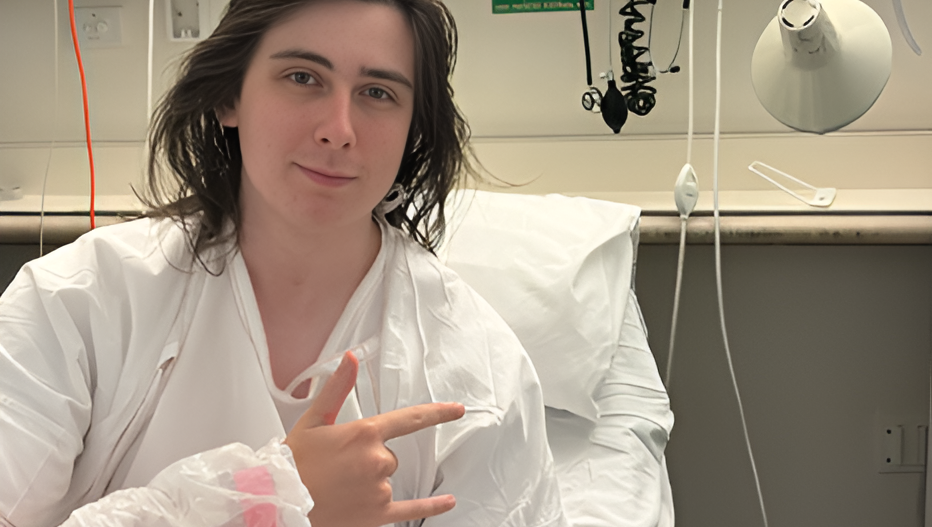
Mitchell was flown by RFDS to the RPH State Trauma Unit with bleeding on the brain, air in the skull, multiple skull and jaw fractures, complex base of skull fractures, multiple ear fractures with exposed bone in the left ear, and 3 fractured ribs. When we arrived, the neurosurgeon told me that when he received the call about Mitchell, he wasn’t expecting him to arrive alive. Against all odds, not only was he alive, but he was conscious and talking.
An MRI the next morning confirmed one of the surgeon’s suspicions: Mitchell also had a left Carotid Cavernous Fistula (CCF). His vision had been progressively getting worse - double vision, eyes not focusing, and becoming cross eyed. We were told he was being transferred to Sir Charles Gairdner Hospital for urgent review by the NIISwa team to try to save his vision and his eye. Normally, they prefer to allow time for a brain bleed to settle before treating CCFs due to the need for blood thinning medication during the procedure. However, Mitchell had a fragment of bone that had punctured the carotid artery, and they couldn’t delay. The teams were working together on the safest plan of action, whilst avoiding a catastrophic stroke.
After 5 hours in theatre, Dr Albert Chiu told us that it went “ok, but not great”. He found that there was also a carotid cavernous fistula on the right side, but thankfully it is only a slow leak and will be closely monitored. As long as it remains stable, it will be repaired down the track. He inserted over 2m of coiling, filling the left fistula about 90%, but was unable to continue as the artery suddenly narrowed, slowing blood supply to the left side of his brain. He told us, “It’s incredible that he has even made it this far, but he is not out of the woods yet.” A repeat angiogram 3 days later showed that the coiling had worked, the remainder of the left fistula had thrombosed on its own, and the right fistula remained stable.
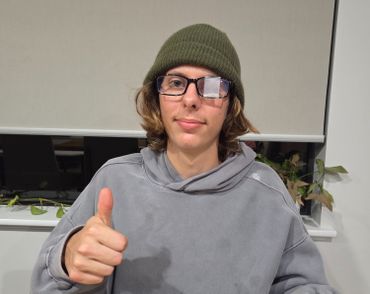
Once the CCF was stable, he was transferred back to RPH and reviewed by ENT (who were initially concerned his left ear canal would collapse), Ophthalmology, and Maxillofacial surgical teams. He has bilateral nerve 6 palsy (the cause of the double vision and crossed eyes) and mild left sided Horner’s Syndrome. Both Ophthalmology and a private specialist optometrist who deals with brain injury related visual impairment are hopeful that the vision issues are temporary and will improve over the coming months. In the meantime, he is wearing non-prescription glasses with tape blocking out the mid-section of one lens to prevent double vision.
He can’t hear properly and needs everyone to talk very loudly. His audiology assessment showed no nerve damage, and the hearing loss is likely due to his ear canals being obstructed about 50% from the fractures and exposed bone. Any surgery to repair this won’t be considered for months, until everything else is stable. They have suggested a bone conductor hearing aid, and I took him to Hearing Australia yesterday and they have ordered one - so hopefully we will only need to shout at him for another week!
After only 17 incredibly long days in hospital, Mitchell was discharged. It is an absolute miracle that he survived the accident and has no neurological deficit - he can walk, talk, and his cognition is completely intact.
The day before discharge, one of the surgeons said to him, “I don’t mean to call you a guinea pig, but we don’t get to see these kinds of injuries very often, and many of us haven’t treated your injuries before because, to be perfectly honest, people don’t normally survive these injuries.”
Whilst we are now home, Mitchell has a long road of recovery ahead. He isn’t really able to be left alone as he is being weaned off anti-seizure medication that was given to prevent seizures due to the extensive brain injury. As he weans, and in the few weeks that follow, he is at an increased risk of seizure. The neurosurgical team explained that “some people can teeter on the edge of seizure but because we give them Keppra it keeps it at bay, and then once they stop the Keppra they may have a seizure, and unfortunately there is no way of knowing if he will have one or not.”
He is unable to return to work until his vision returns to normal and he no longer sees double, and he is unable to drive for 6 months due to the seizure risk. We are back to Perth next week for another angiogram to make sure the left CCF has remained closed and to check that the right side has not worsened. 2 weeks later we go back to Perth again for a repeat head CT and follow up with the specialist optometrist, and then there are more appointments booked in the beginning of October.
While I am off work with him for the next 6 weeks during the Keppra wean, and while we ensure there is no seizure once he stops it, my own return to work will need to be reassessed after these appointments, with ongoing uncertainty about when I will be able to go back.
Through all of this, the support we have received from our community, friends, family, and every single person who donated and shared Mitchell’s story has carried us in ways we will never be able to fully express. Your kindness and generosity have allowed us to focus entirely on Mitchell’s recovery, with me able to stay by his bedside in the hospital and now be with him at home, and to navigate this frightening and unpredictable journey without the added fear of financial pressure. We are overwhelmed with gratitude, and we will never forget the compassion shown to our family during the scariest and most uncertain time of our lives.
From the bottom of our hearts, thank you.