- R



Support HALT – Judicial Review of the Helios Solar Farm
0% complete
£8,345 raised of £15K
138 donations
Community Group Launches Fundraiser to Challenge Helios Solar Farm Approval
A local community group has launched a public fundraising appeal to finance a Judicial Review (JR) of the recently approved Helios Solar Farm development.
The group, known as HALT, says it has serious concerns about the lawfulness of the planning decision and believes that a Judicial Review is now the only remaining legal mechanism available to test whether the approval was made correctly.
The fundraising target is £15,000, which HALT says is the minimum required to instruct a specialist planning barrister to prepare and file JR proceedings.
Scale of the proposal and local concern
The Helios scheme is a large-scale solar farm development proposed on open countryside close to local communities. The project includes extensive areas of solar panels and associated infrastructure, with potential inclusion of battery energy storage systems (BESS), subject to final configuration. The total amount of land proposed to be used in the development is approximately 1200 acres. The land is 96% Best Most Versatile (BMV) land, perfect for growing enough grain for 3.5 million loaves of bread, 6.8 million carrots, 34 million packets of crisps, or 55 million pints of beer!
Local residents have raised concerns about the scale of the development, its impact on landscape character and amenity, and the growing concentration of energy infrastructure proposals in the area.
The amount of energy generated by these 1200 acres of premium agricultural land can be generated by just 6 offshore wind turbines.
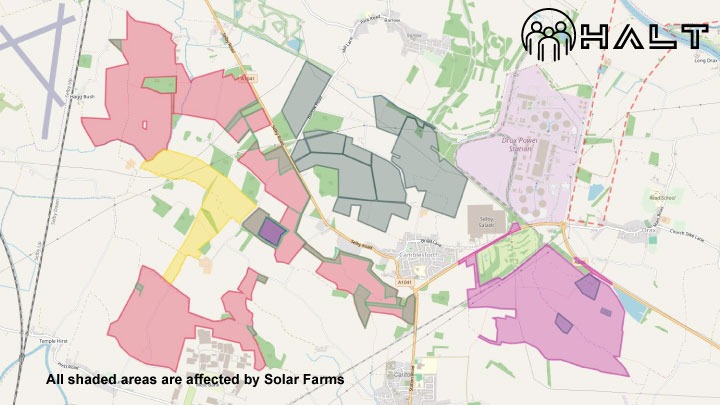
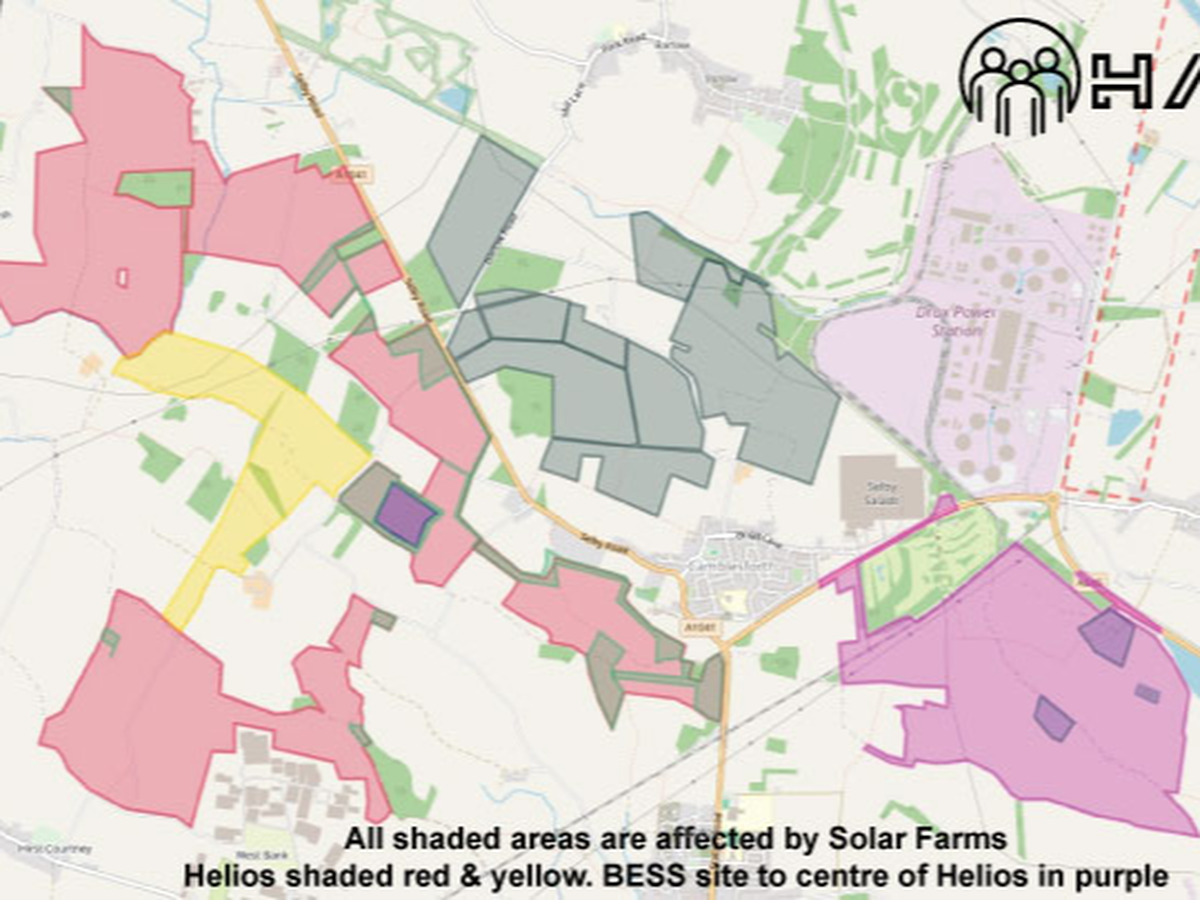
The proposed Solar Farm location is to the South of Selby, illustrated on the map around the villages of Camblesforth, Carlton, Burn, Hirst Courtney and Temple Hirst.
Why a Judicial Review is being pursued
Outline planning permission for the development has already been granted. HALT states that a Judicial Review is not about revisiting the planning merits, but about examining whether the decision-making process was lawful and whether all relevant planning considerations were properly assessed.
If the ruling is in our favour, it could help other NSIP solar farm proposal decisions where cumulative impact due diligence has not been correctly administered.
Cumulative impacts at the heart of the challenge
A central issue HALT intends to raise with legal counsel is the cumulative impact of multiple energy developments. HALT argues that cumulative impacts are a recognised material planning consideration but are frequently under-assessed when developments are considered individually.
Emerging evidence on energy capacity
HALT has also pointed to recent analysis indicating that existing and consented battery energy storage capacity may already exceed current system requirements linked to renewable energy targets. While this does not automatically prevent approval, HALT believes it raises further legal and policy questions that warrant consideration.
Fundraising approach and safeguards
HALT has stated that the £15,000 target is a hard minimum. If the full amount is not raised, the Judicial Review cannot proceed and all donations will be refunded, or provided to a community scheme.
Organizer