The City Says It Has No Use for This Building. We Do.
0% complete
$3,467 raised of
57 donations
We're a group of Roosevelt Island residents working with the Architectural Community Alliance of Roosevelt Island (ArchRIca) to raise funds for legal action before a piece of New York's history is gone for good.
The Roosevelt Island Steam Plant — a 1939 steel-frame industrial building with two masonry smokestacks more than 200 feet tall — is being torn down by City agencies who have failed to deliver on promises of transparency, health and public safety, and community engagement.
This isn't just about one building. It's about whether city agencies can skip environmental review, ignore community boards, bypass elected officials, and tear down public assets — all under the banner of an emergency that the City's own documents don't support.
We don't just want to stop a demolition. We have a vision for what this building could be, and we're ready to fight for it.
WHAT'S HAPPENING
In July 2024, the Department of Buildings issued two orders: one emergency order to seal and secure the building, which was completed, and a separate order to demolish it. Only the first was an emergency. The second is the one tearing the building down.
HPD's own written Q&A — handed to elected officials 45 minutes before a public meeting — draws exactly that line. It also says the demolition order "referenced five months." That order was issued in July 2024. Two years later, demolition still hasn't begun, and the asbestos removal that has to happen first is scheduled to run until May 2027.
Meanwhile, state environmental records show an open petroleum spill on the site (DEC Spill #2508914). Residents have documented three separate contaminated-runoff events — with photographs — since February.
THREE AGENCIES. THREE STOP-WORK ORDERS. ONE JOB
This job has been halted by three different agencies in eight months.
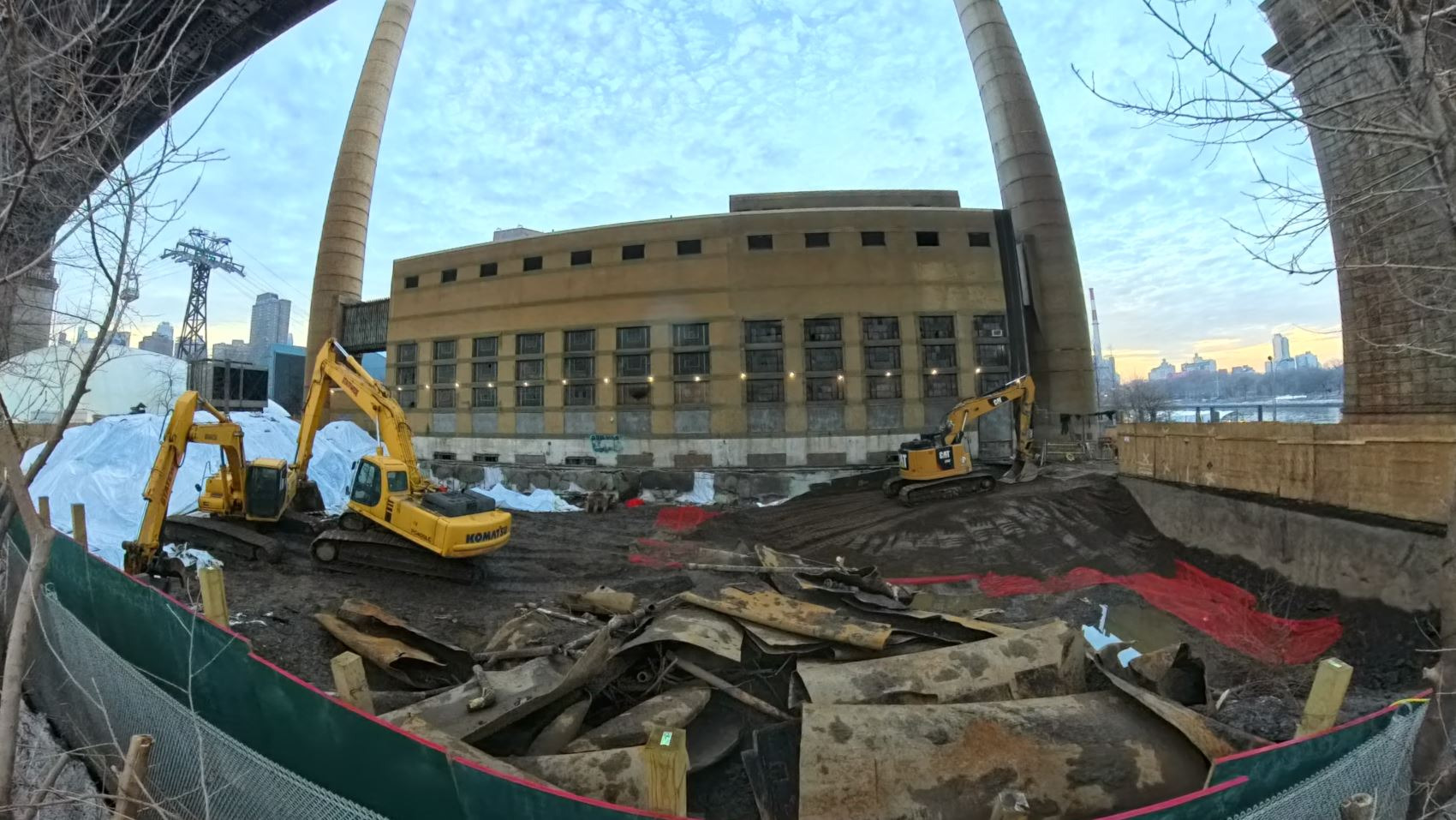
In February 2026, while contractors were pulling the site's underground fuel tanks, the State Department of Environmental Conservation inspected, found oil contamination, opened a spill case, and stopped work.
On April 15, dozens of Roosevelt Island residents packed a town hall to ask New York City officials one simple question: Where is the evidence that justifies demolishing our historic steam plant?
The city's answer? Nothing. No structural report, environmental analysis, or feasibility study. No community air monitoring plan. No commitment to pausing work before these concerns are addressed.
In June, the City's Department of Environmental Protection issued a full stop-work order after finding asbestos work performed in violation — an order stating the condition "poses a threat to human safety," carrying penalties of up to $10,000 a day. Weeks later, the Department of Buildings issued its own stop-work order and a Class 1 "immediately hazardous" violation against the demolition contractor: the façade of a smokestack had been cut open to install a steel beam, with no site safety manager present. That violation carries a $10,000 penalty. It is still open. The hearing is set for September 3, 2026.
Residents learned about that last one the way they've learned about most of this: by looking it up themselves.
A resident photographed the cut-open smokestack on June 25 and emailed every agency and elected official the next day. The Department of Buildings inspected on June 29 and issued the violation. HPD confirmed the order's existence in a single sentence on July 3 — describing it as an amendment to filings. The Class 1 hazard, the missing site safety manager, the $10,000 penalty and the hearing date weren't in that sentence. They had to be found in the City's own public records.
HPD did disclose. But only after a resident forced the question, and only partly. Residents shouldn't have to monitor permit databases to find out whether the work next to their homes is safe.
And there's a stop-work order posted at the site right now that you can't read. The Department of Environmental Protection's order is posted inside the fenced work area, behind danger tape. The Buildings Department's order is zip-tied to the construction fence, where rain has destroyed it — the text is gone. Public notice at this site isn't, in any functional sense, public.
WHY THIS MATTERS BEYOND ROOSEVELT ISLAND
The emergency order was to seal the building, and it was completed. The demolition order is separate, and it isn't an emergency. HPD's written Q&A says so. The Department of Buildings' First Deputy Commissioner said it out loud. And a demolition ordered in July 2024 that still hasn't started — behind an asbestos removal scheduled to run into 2027 — is not how emergencies behave.
Consider the contrast. A few hundred yards away, on this same island, when the Cornell Tech campus was built on the old Goldwater Hospital site — land with its own contamination — that project went through a full public environmental review with a detailed cleanup plan and continuous air monitoring, with published action levels that triggered dust suppression and, past a set threshold, stopped work. The steam plant demolition, with more potential contamination and two 200-foot chimneys full of residue, has had none of that. Same island. Two completely different standards.
The same agencies tearing this building down publicly champion preservation, reuse, and cutting carbon everywhere else in the city. Their own design and sustainability guidelines say the greenest building is the one that already exists. That's the opposite of what's happening here. If this can happen on Roosevelt Island — with no review, no transparency, and no accountability — it can happen anywhere.
THE COMMUNITY RESPONSE HAS BEEN EXTRAORDINARY
Look at what Roosevelt Island residents have achieved in just a few months, with almost no resources:
- More than 2,000 petition signatures and counting.
- Community Board 8 voted unanimously to pause the demolition on February 18.
- A Community Advisory Group was formed at the request of four elected officials — Congressman Jerrold Nadler, Council Speaker Julie Menin, Senator Liz Krueger, and Assembly Member Rebecca Seawright. It has met twice, monthly, since June.
- Borough President Hoylman-Sigal publicly called for independent air monitoring and the release of the structural report — a report the community has been asking for since December 2, 2025.
- City news coverage — including WNYC/Gothamist, the New York Post, and amNewYork — plus 18 articles in the Roosevelt Islander spanning 14 years of broken promises.
Every one of these accomplishments was done by volunteers. The next phase takes resources.
HOW YOUR DONATION WILL BE USED
We're past the petition phase. Roosevelt Island residents have taken the City's decision to court — and are doing it without a lawyer. No court has paused anything. Work at the site continues. That's exactly why this next phase matters.
Your donations will support:
- Legal assistance
- Filing fees
- Service processing and other legal costs
- Independent experts to walk the site and offer fair and impartial assessments for the site's future
(No funds will be used for personal income. If any funds remain after the campaign, they'll be donated to ArchRIca for ongoing community advocacy on Roosevelt Island.)
THIS IS URGENT — AND THE SCHEDULE ISN'T IN OUR HANDS
HPD has stated in writing that there is "no projected start date for smokestack demolition or demolition of the main building." The stated order of operations is contaminated soil removal, then backfill, then scaffolding around the stacks, then the stacks come down. Residents get five business days' notice.
But that's not reassuring. It means the stacks come down on a schedule the community doesn't control and can't see coming — and work at the stacks has already begun. Twelve days after HPD told the Advisory Group no chimney work would happen before the next meeting, a smokestack was cut open. Once the scaffolding goes up, the window to ask for anything different is closed. This is that window.
- People are in the fall zone: The western smokestack stands feet from an occupied, air-supported tennis structure — a pressurized fabric roof with people underneath it. A falling brick hits the ground at roughly 85 miles per hour — enough to puncture the bubble and trap those inside. Standard practice for taking down a chimney this size calls for an exclusion zone of at least 120 feet in every direction. Inside that radius here: the tennis structure, the tram, Main Street, and Firefighters Field, where children play. No exclusion zone has been posted, and no evacuation plan has been shared.
- Proximity risks: The Queensboro Bridge pedestrian and bike path runs about 40 feet away, at roughly the elevation of the chimney tops. The Roosevelt Island tram passes directly alongside. Neither has overhead protection.
- Toxic legacy: The stacks are lined on the inside with roughly 75 years of hardened #6 fuel oil residue. The City has tested that residue for asbestos and nothing else — no lead, no PCBs, no combustion byproducts. Its stated plan for containing it during demolition is to spray water. Community air monitoring hasn't started, and won't start until contaminated soil removal begins. Everything measured so far is asbestos only, sampled at the work area — not at the perimeter, not where people live.
WHAT THIS COULD BECOME
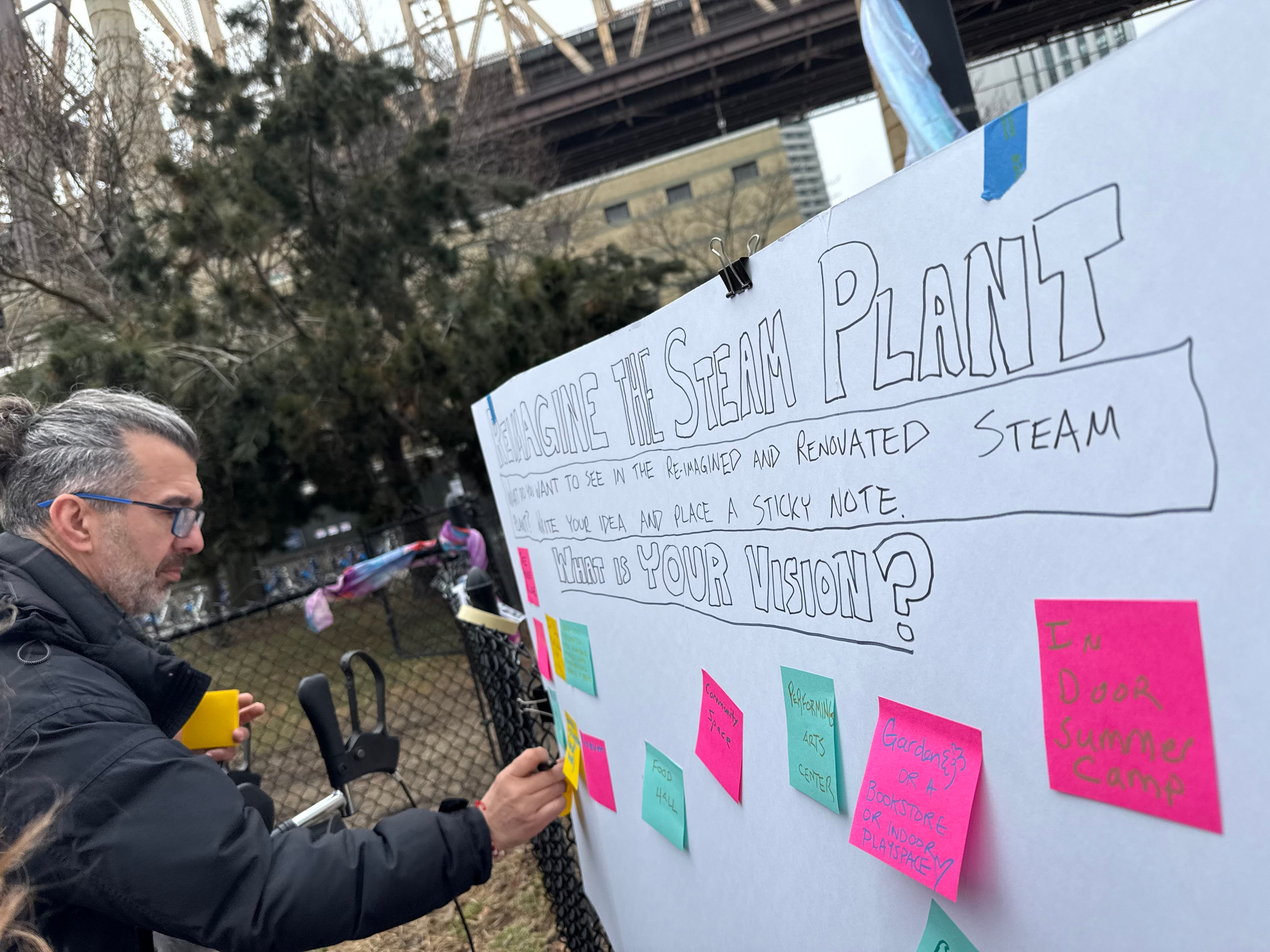
The city says it has no use for this building. We do. The steam plant could hold affordable and mixed-income homes and much-needed community and cultural space. The smokestacks could be assets — imagine a glass elevator carrying visitors 200 feet up for unmatched views, or a bicycle-and-pedestrian elevator connecting to the Queensboro Bridge.
Cities like London (Battersea Power Station, Tate Modern), Barcelona (Tres Xemeneies), and Brooklyn (Domino Sugar) have proven that adaptive reuse creates world-class landmarks. An independent specialist found these stacks can be repaired for about $700,000 — almost identical to the city's $750,000 demolition cost.
We deserve a real process that respects our voice and takes adaptive reuse seriously. But that's only possible if the building is still standing.
Every dollar helps us slow this down, demand answers, and hold New York City accountable. Please give what you can, and share this page.