People Over Profits: Plymouth — A Neighborhood Legal Fight That Shouldn’t Exist
We are a group of Plymouth residents who did everything the system asks of ordinary people — and were still forced into an expensive legal battle just to be heard.
Neighbors submitted letters.
Neighbors showed up to public hearings.
Neighbors raised documented concerns about traffic safety, flooding, zoning compliance, historic preservation, and the long-term impact on a working-class residential neighborhood.
Despite those concerns, the Plymouth Zoning Board of Appeals approved a large apartment project (ZBA Case 4195) that our attorney believes was approved in excess of the Board’s legal authority.
This fundraiser exists because the only way residents can challenge a flawed zoning approval is through costly litigation — a reality that prevents most people from ever pushing back.
Why We Are in Court
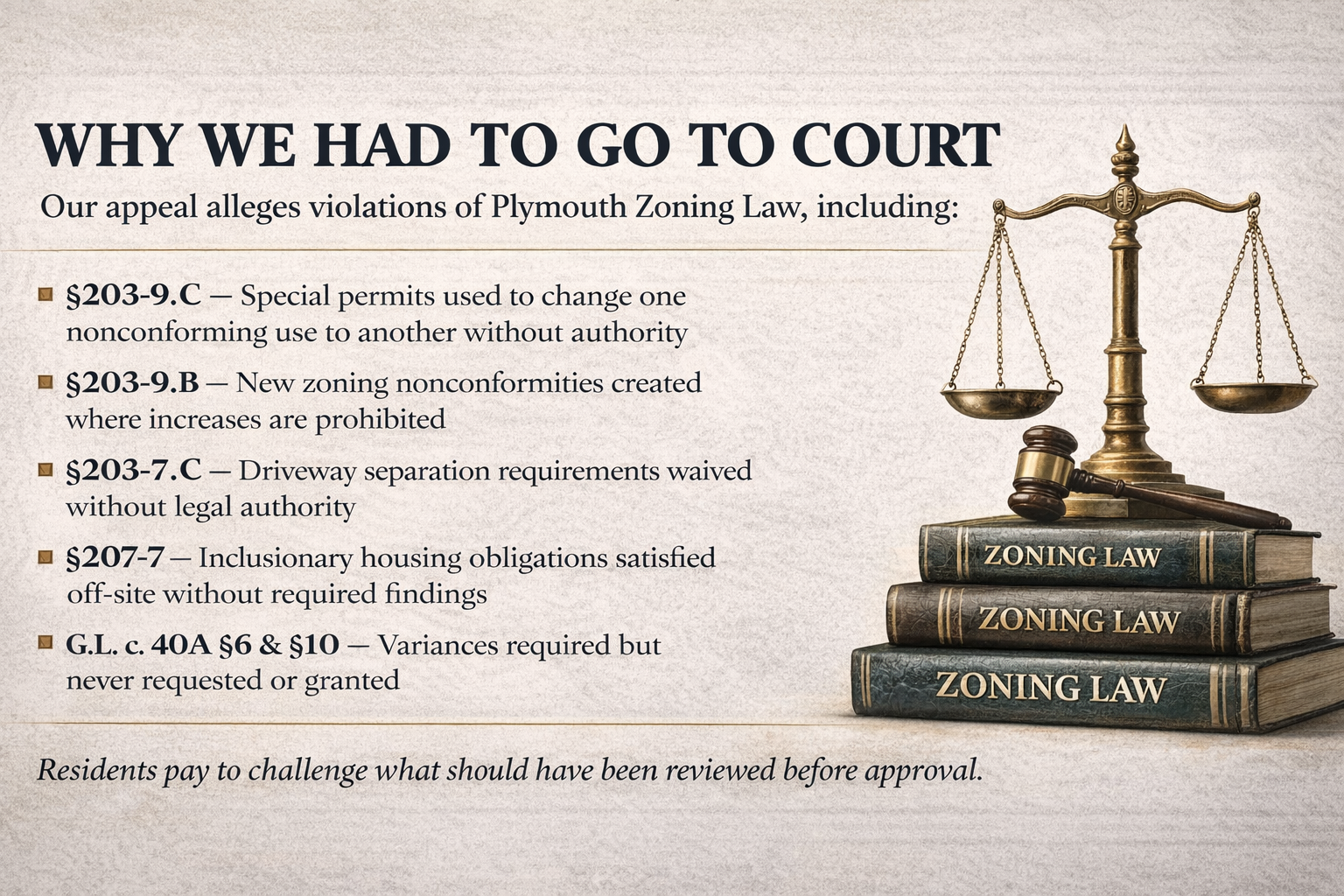
Our appeal alleges that the ZBA exceeded its authority by approving a project that:
• Created new zoning nonconformities without granting required variances
• Waived driveway separation and setback requirements without legal authority
• Approved a multifamily project in a zoning district where it is not allowed by right
• Allowed affordable housing obligations to be satisfied off-site without required findings
• Failed to meaningfully address site-specific safety, traffic, drainage, and neighborhood impacts raised by residents
These issues were raised on the public record before approval. The only remaining remedy is a court appeal.
Who Is Impacted
This project directly affects nearly 20 households, including homes built in 1672 and 1840, in a long-established neighborhood of modest and historic houses.
Residents described:
• Dangerous traffic conditions and near misses on Sandwich Street
• Increased turning movements at an already hazardous location
• Flooding and groundwater issues where sump pumps run continuously
• Construction risks to fragile fieldstone foundations
• Loss of privacy, light, and safety from a building placed extremely close to abutting homes
A traffic study was conducted, but residents repeatedly explained that it did not reflect the lived reality of navigating this stretch of road every day — concerns that were raised during public hearings.
The Systemic Problem
Zoning Boards of Appeals cannot be sued for money damages. When a legally flawed decision is made, the financial burden of correcting that decision falls entirely on residents who must pay to challenge it in court.
If residents cannot afford the appeal:
• The approval stands
• The project moves forward
• The neighborhood is permanently changed
This structure discourages challenges and allows flawed decisions to repeat elsewhere.
What We Are Doing
We have retained one of the top land-use attorneys in Boston.
Three directly affected neighbors are named plaintiffs.
Nearly 20 others are contributing what they can and standing with us.
So far, we have:
• Paid a $4,500 attorney retainer
• Received our first $2,000 legal bill, due within 15 days
Total legal costs are expected to range from $20,000 to $50,000, and could approach $100,000 if litigation continues.
Every dollar raised goes directly to legal fees.
Why This Matters Beyond Our Neighborhood
Most people never challenge zoning approvals because they simply can’t afford to. That reality allows mistakes to stand and encourages a system where enforcement depends on who has the resources to fight back.
We are standing up not only for our own neighborhood, but in hopes of drawing attention to these flaws so future residents don’t have to face the same impossible choice: stay silent or risk financial ruin.
This is not about stopping growth.
It is about accountability, fairness, and a process that works as intended.
How You Can Help
• Donate if you’re able — every dollar helps
• Share this fundraiser to raise awareness
• Help us prove that neighborhoods still matter
Even small contributions make a real difference. So does spreading the word.
Thank you for standing with us — not just for today, but for the neighbors who come next.
Organizer