

Building a Lifeline for Western Idaho and Eastern Oregon
Be the first to donate
Inspire others and help Brock build momentum.
1st donor
Building a Lifeline for Western Idaho and Eastern Oregon
Community Supply Link is being built around a simple idea: our communities already have many of the resources people need. What is often missing is an efficient way to connect those resources with the organizations and people who need them.
Across Western Idaho and Eastern Oregon, grocery stores, farms, restaurants, bakeries, food processors, distributors, manufacturers, and other businesses regularly have usable products that could potentially be donated. At the same time, food pantries, churches, senior centers, community meal programs, animal rescues, shelters, and other nonprofit organizations are working every day to help people with limited resources.
There is an enormous amount of goodwill on both sides.
The problem is logistics.
A small food pantry may have only a handful of volunteers. A church may run its food program only a few days each month. A senior center may already be stretching its staff and funding to provide meals and services. An animal rescue may be operated almost entirely by volunteers.
These organizations should not also have to call dozens of businesses, maintain dozens of donor relationships, find someone with a truck, schedule pickups, coordinate delivery times, track what is available, determine where it should go, and repeat that process every week.
Businesses often face the same challenge from the other side.
A local farm, grocery store, restaurant, manufacturer, or distributor may have perfectly usable food, supplies, or other resources they are willing to donate. The willingness to help is already there. The difficult part is figuring out what happens next.
Who actually needs the donation?
Which organizations can accept it?
Who has the transportation to pick it up?
How quickly can someone get there?
Which organization has the storage capacity to handle it?
What happens when one organization only needs part of the donation?
Who coordinates the remaining product?
And when another donation becomes available next week, who does the business call?
For many businesses, donating can become another logistics problem they have to manage. Employees have to contact multiple organizations, coordinate schedules, determine transportation, and find a recipient capable of accepting what they have available.
Community Supply Link is being built to remove that burden.
Instead of asking businesses to maintain relationships with numerous food pantries, churches, senior centers, shelters, rescues, and other organizations, they can have one regional point of contact.
Community Supply Link handles the connection.
A donor tells us what is available, where it is located, how much there is, and when it needs to be collected. We coordinate with participating organizations, determine where the resources can have the greatest use, arrange transportation, and move those resources where they are needed.
If one organization cannot use the entire donation, we can coordinate distribution among multiple participating organizations rather than forcing the donor to find additional recipients.
Over time, this creates something much more useful than a collection of individual donor relationships. It creates a coordinated regional network connecting businesses, farms, nonprofits, churches, food programs, senior services, animal organizations, volunteers, transportation resources, and community partners.
For donors, the idea is simple:
One contact. One pickup. One coordinated network.
You provide the resources. Community Supply Link helps make sure they reach the community.
ONE PHONE CALL. ONE CONNECTION. ONE NETWORK.
Imagine a local business has several hundred pounds of usable food available.
Instead of an employee calling five different food pantries trying to find someone who can pick it up, they contact Community Supply Link.
When a donation becomes available, Community Supply Link determines which participating organizations need it, which organizations can safely accept it, and how the donation can be distributed efficiently.
From there, we handle the logistics.
We coordinate with the donor, schedule the pickup, transport the donation, deliver it to the appropriate organization or organizations, and document what was moved and where it went.
The goal is to make the process simple for everyone involved.
The donor gets one reliable point of contact instead of having to call multiple organizations looking for someone who can accept and transport the donation.
Food pantries, churches, senior centers, shelters, and other community organizations gain access to a larger donor network without having to build and manage every donor relationship themselves.
The community benefits because more usable food and supplies can reach people who need them instead of being discarded simply because transportation or coordination was unavailable.
That is where Community Supply Link begins.
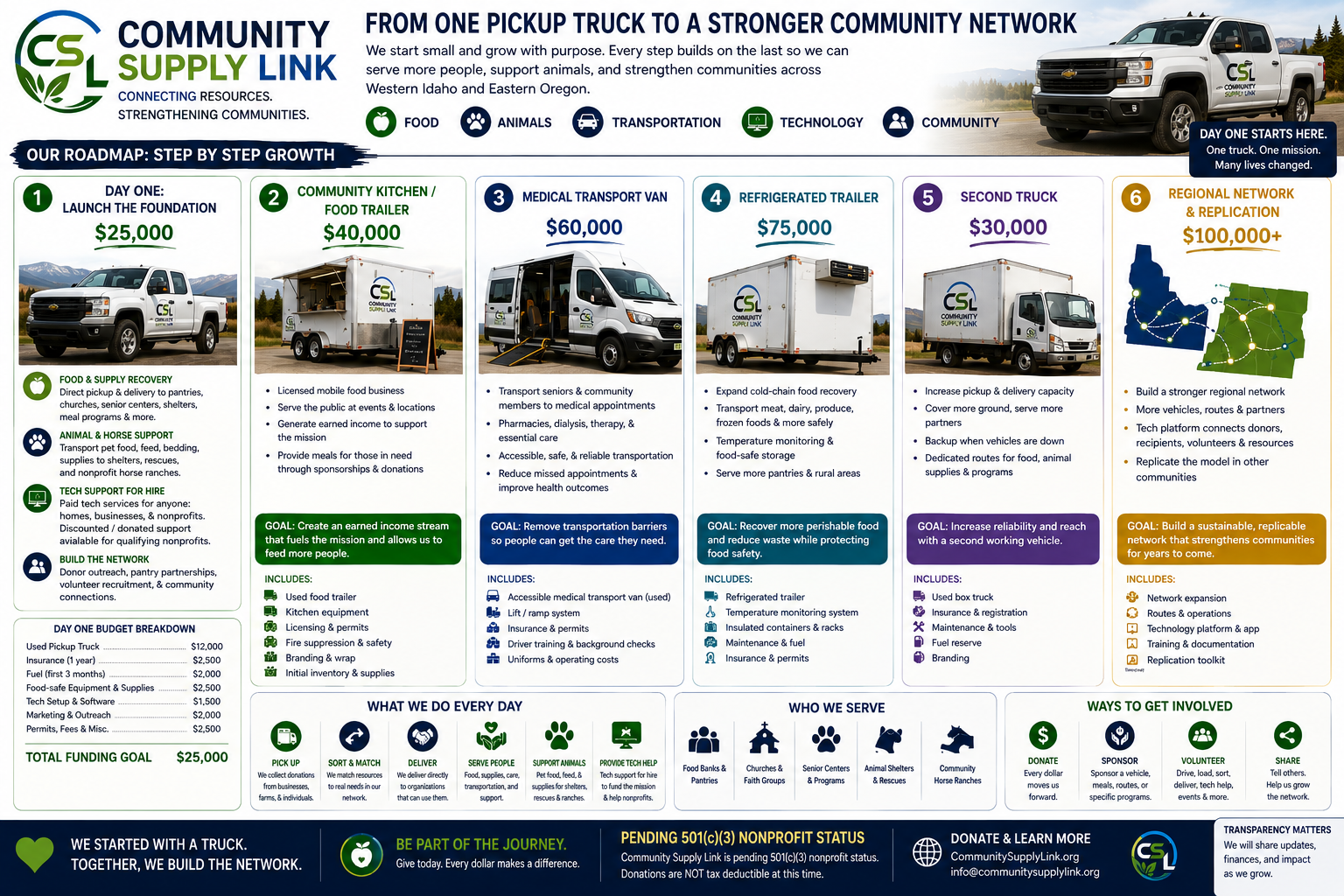
We are intentionally starting with a simple, practical model. We do not need to begin with a massive warehouse, expensive distribution center, or fleet of vehicles.
We need to prove the network works first.
The initial operation requires a dependable vehicle, proper insurance, food-safe transportation equipment, fuel, basic logistics and communication systems, committed volunteers, and strong relationships with both donors and recipient organizations.
Our first vehicle will essentially become a mobile connection between those two sides of the community.
As donations become available, we can develop regular routes instead of treating every pickup as an isolated trip. A single route could eventually collect resources from several businesses and deliver them to multiple organizations based on what each organization actually needs.
This allows us to use fuel, vehicles, volunteer time, and donated resources more efficiently.
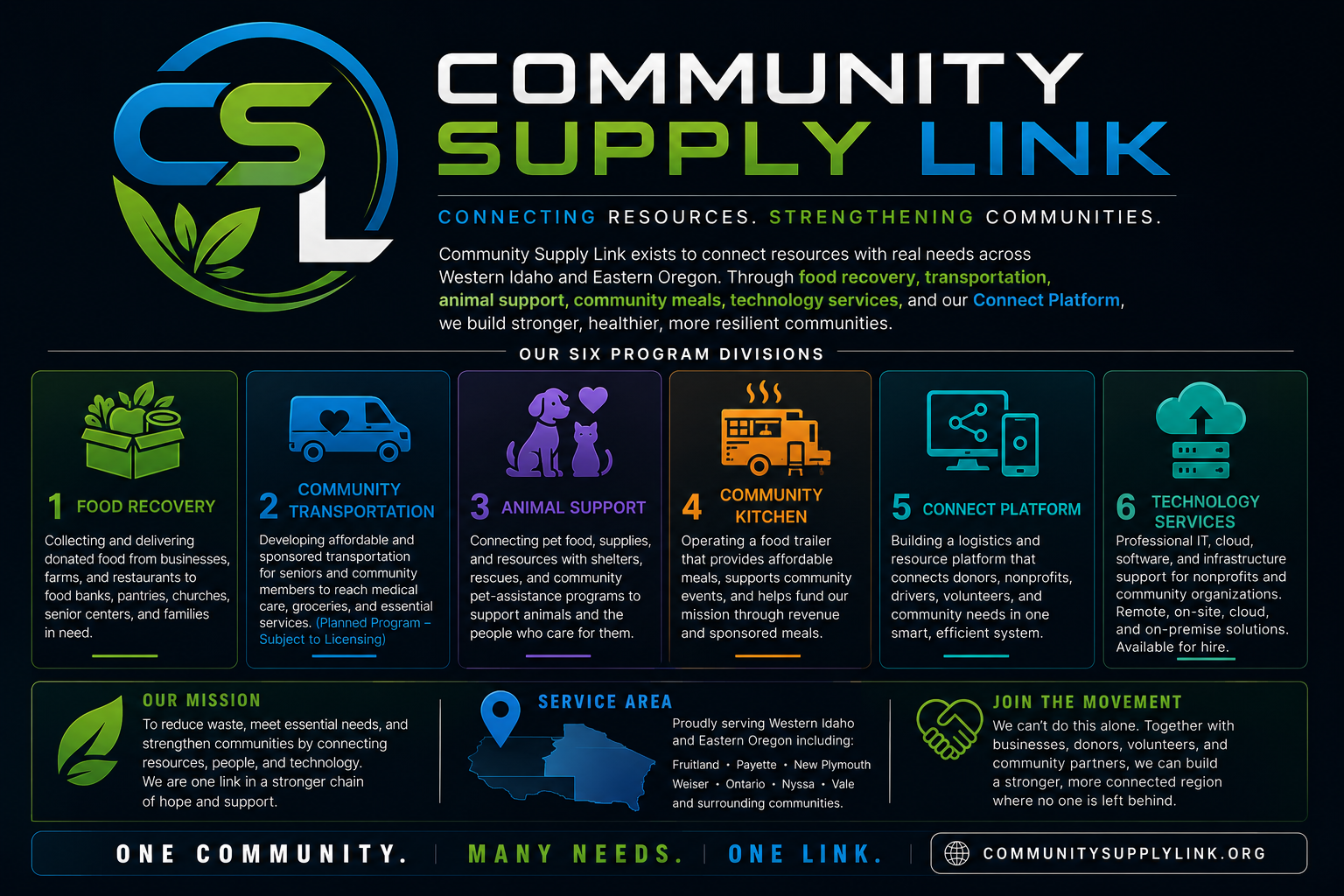
Community Supply Link will begin in Fruitland, Idaho, with the goal of developing a dependable regional network throughout Western Idaho and Eastern Oregon. Our initial service area will include Fruitland, Payette, New Plymouth, Weiser, Ontario, Nyssa, Vale, and surrounding rural communities.
We will expand based on actual community demand rather than trying to grow faster than the organization can responsibly support.
As more donors participate, more recipient organizations join, additional volunteers become available, and funding increases, we can add routes, vehicles, refrigerated transportation, equipment, drivers, and eventually additional regional hubs.
What begins with one vehicle connecting a handful of organizations can grow into a coordinated regional logistics network serving dozens of donors and community organizations.
We are starting small because we want to build something sustainable.
One vehicle.
One route.
One relationship at a time.
Then we build the network from there.
FOOD RECOVERY AND COMMUNITY DISTRIBUTION
Food recovery will be one of the core foundations of Community Supply Link.
Every day, usable food reaches a point where it may no longer make sense for a business to sell it, even though there is nothing inherently wrong with the food itself.
Fresh produce may be the wrong size, shape, or appearance for retail shelves. A farmer may have more produce than can economically be harvested, packed, or sold. A distributor may have excess inventory after an order changes. A manufacturer may change packaging or discontinue a product line. A bakery may have bread and baked goods approaching the end of their normal retail window. Grocery stores may remove products from sale while those products can still be safely used. Restaurants and commercial kitchens may also have qualifying surplus that can potentially be redirected.
Individually, these situations may involve a few boxes, several cases, a pallet, or occasionally a much larger quantity. Across an entire region, however, they represent a significant amount of food.
At the same time, food pantries, churches, senior centers, community meal programs, and other nonprofit organizations are actively trying to obtain many of these exact same resources.
The food exists.
The need exists.
What is often missing is the connection between them.
Community Supply Link is being created to help build that connection.
We plan to develop a regional donor network consisting of farms, growers, packing facilities, food processors, manufacturers, grocery stores, restaurants, bakeries, wholesalers, distributors, warehouses, and other businesses that may periodically have food available for donation.
Instead of requiring every food pantry or community organization to establish and maintain relationships with dozens of individual businesses, Community Supply Link can maintain those relationships on behalf of the broader network.
A donor only needs to tell us what is available, approximately how much there is, where it is located, any handling requirements, and when it needs to be collected.
Community Supply Link can then determine which participating organizations need the product and have the ability to safely receive it.
Sometimes the answer may be one organization.
Other times, a large donation may need to be divided among several organizations.
A pantry may only have room for twenty cases of a product when a donor has sixty available. Instead of forcing either side to turn down the donation, Community Supply Link can coordinate the first twenty cases to that pantry and locate appropriate destinations for the remaining forty.
That coordination is one of the most important parts of the model.
Whenever practical, we want food to move through the shortest possible chain:
Donor to Community Supply Link to recipient.
Our vehicle becomes a mobile connection between supply and need.
This direct-delivery approach is especially important during the early stages of Community Supply Link because it allows us to begin helping organizations without immediately taking on the enormous cost of operating a warehouse.
Warehousing food is not as simple as renting an empty building.
A proper food distribution facility can require commercial rent or property expenses, utilities, insurance, shelving, pallet equipment, refrigeration, freezer capacity, sanitation procedures, pest control, inventory management, temperature monitoring, cleaning, staffing, security, loading equipment, and regulatory compliance.
Those expenses can consume money that could otherwise be used to move food.
For that reason, we want the first phase of Community Supply Link to remain lean.
If a business in Ontario, Oregon has several hundred pounds of food available and organizations in Fruitland and Payette, Idaho can use it, we should not automatically need to transport that food to a warehouse, unload it, inventory it, store it, reload it, and transport it again.
We can pick it up and take it where it needs to go.
That saves time.
It reduces handling.
It reduces transportation steps.
It reduces infrastructure costs.
Most importantly, it helps get food into the community faster.
As Community Supply Link grows, some storage and transfer capacity may become valuable or necessary. Refrigerated and frozen donations may require cold-storage infrastructure. Shelf-stable products may sometimes need temporary storage while distribution is coordinated. Large agricultural or commercial donations may require pallet handling and short-term staging.
Those capabilities can be developed when the volume of donations actually justifies them.
The first objective is much simpler.
Build the relationships.
Know what organizations need.
Know what donors have available.
Put a reliable vehicle between them.
Pick it up.
Move it safely.
Get it where it can do some good.
Document the impact.
Then do it again.
Over time, those individual trips become regular routes. Individual donors become long-term partners. Individual food pantries become part of a shared distribution network.
What begins as a truck picking up food in Ontario and delivering it to Payette can eventually become a coordinated regional food-recovery system serving communities throughout Western Idaho and Eastern Oregon.
The food is already here.
The organizations are already here.
The people willing to help are already here.
Community Supply Link is building the logistics necessary to connect them.
A SINGLE POINT OF CONTACT FOR FOOD BANKS AND PANTRIES
One of the most important goals behind Community Supply Link is making life easier for the organizations already serving our communities.
We are not trying to replace existing food banks, food pantries, churches, senior centers, meal programs, or other nonprofit organizations. We are not trying to create another organization competing for the same people, resources, and donations.
We want to build infrastructure that helps those organizations do more with the resources they already have.
Many smaller food pantries operate with limited staff, volunteers, vehicles, storage space, and funding. Their time should be spent serving their communities, not calling dozens of businesses trying to locate food and then figuring out how to transport it.
Community Supply Link wants to take on that work.
Instead of a pantry maintaining separate relationships with grocery stores, farms, bakeries, restaurants, manufacturers, distributors, and food processors, the pantry can maintain one relationship with Community Supply Link.
The pantry tells us what it needs.
That could include canned vegetables, bread, fresh produce, meat, dairy products, eggs, rice, beans, bottled water, prepared foods, hygiene products, diapers, cleaning supplies, pet food, or other resources its community regularly requests.
We take that information and look across the entire donor network.
The pantry should not have to figure out which twenty businesses might have those products available.
That becomes our job.
As Community Supply Link grows, we want to build a detailed profile for every participating organization so we understand not only what it needs, but what it can realistically accept.
For example, one pantry may have several commercial freezers but very little refrigerated space. Another may have plenty of shelving for canned and dry goods but no freezer at all. A church may only distribute food twice each month. A senior center may need smaller quantities of specific products on a regular schedule. Another organization may have enough volunteers and storage capacity to receive several pallets at once.
Those differences matter.
Community Supply Link can maintain information about each organization’s current needs, operating hours, delivery availability, storage capacity, refrigeration and freezer capacity, preferred quantities, distribution schedule, service population, and other practical limitations.
That allows us to move away from simply asking, “Who will take this?”
Instead, we can ask, “Where will this donation actually be most useful?”
If a donor offers 100 cases of frozen food, there is little value in delivering all of it to an organization that can only safely store 20 cases.
Community Supply Link could send 20 cases there, another 30 to an organization with available freezer capacity in a neighboring community, and the remaining 50 to another participating organization that has both the need and capacity.
The donor still deals with one point of contact.
The receiving organizations receive quantities they can actually use.
Community Supply Link coordinates everything between them.
The same system works in the opposite direction.
If several organizations report that they are running low on canned vegetables, Community Supply Link now knows there is regional demand for canned vegetables. When we speak with grocery stores, distributors, manufacturers, food processors, or other potential donors, we are no longer making a general request for “anything you can donate.”
We can identify specific needs.
That makes the network more useful to donors as well.
Over time, Community Supply Link can begin identifying patterns.
We may discover that several organizations consistently need bread every week. Another group may regularly need fresh produce. Senior programs may have recurring needs for particular foods. Animal rescues may consistently need pet food and litter.
Those patterns allow us to plan rather than constantly react.
Eventually, our technology platform can make much of this process easier.
Participating organizations could maintain a simple needs list showing what they currently need, what they have enough of, and what they cannot accept.
Donors could report available resources.
Community Supply Link could then see supply and demand across the entire region instead of relying entirely on phone calls, emails, and spreadsheets.
The result is not simply another food distribution organization.
It is shared logistics infrastructure for the organizations already doing the work.
Instead of twenty organizations each trying to maintain twenty donor relationships, Community Supply Link can build one coordinated network connecting all of them.
Food banks and pantries can focus on serving people.
Donors can focus on running their businesses.
Community Supply Link handles the connection between them.
One point of contact for the donor.
One point of contact for the pantry.
One coordinated network working across the region.
HELPING SMALLER AND RURAL COMMUNITIES
Our region includes many rural communities where distance creates additional challenges.
A resource being available twenty, thirty, or fifty miles away does not necessarily mean a small organization can access it.
Transportation costs money.
Vehicles require maintenance.
Volunteers have schedules.
Fuel costs money.
Refrigerated products have time and temperature requirements.
A small organization may decline a donation simply because it has no practical way to retrieve it.
Community Supply Link can change that equation.
One vehicle making a planned regional route can potentially serve several donors and several recipient organizations during the same trip.
That is far more efficient than asking five different organizations to send five different vehicles.
As the network grows, route planning becomes increasingly important.
If we know where donations originate and where resources are needed, we can combine pickups and deliveries into efficient routes.
That means fewer unnecessary miles, lower fuel costs, better use of volunteer time, and more resources reaching their destination.
SENIOR AND COMMUNITY TRANSPORTATION
Food is only one transportation problem facing rural communities.
Transportation itself can become a barrier to basic services.
A senior may no longer drive.
Someone may have a medical appointment in another city.
A person may need transportation to a pharmacy, grocery store, community service provider, or other essential destination.
The distances between communities in Western Idaho and Eastern Oregon can make these problems more difficult.
As Community Supply Link becomes established, we want to develop a dedicated community transportation program.
This portion of the project will require careful development.
Transporting people is very different from transporting boxes of food.
Passenger transportation involves additional insurance, vehicle requirements, driver qualifications, accessibility considerations, scheduling, safety procedures, and potentially different regulatory requirements depending on the service being provided.
Crossing the Idaho and Oregon state line adds another layer that must be handled correctly.
We want to build this program responsibly.
Our long-term objective is to determine which transportation programs can qualify for reimbursement, grants, contracts, sponsorships, partnerships, or other funding while still allowing us to provide affordable or no-cost transportation to qualifying community members.
Eventually, Community Supply Link could coordinate transportation through the same technology platform used for resource logistics.
A person or participating organization could request transportation.
The system could determine availability.
A qualified driver could receive the assignment.
Transportation could be documented and coordinated through one regional system.
ANIMAL SHELTERS, RESCUES, AND PET ASSISTANCE
Community Supply Link will also include animals in our resource network.
Animal shelters and rescues constantly need supplies.
Pet food.
Cat litter.
Blankets.
Towels.
Kennels.
Crates.
Cleaning products.
Bowls.
Leashes.
Pet carriers.
Medical and veterinary supplies when legally appropriate.
Many businesses and individuals are willing to donate these products, but the same logistics problem exists.
Someone has to connect the donation with an organization that can use it.
We want animal shelters, rescues, foster organizations, and pet-assistance programs to become participating members of the Community Supply Link network.
This could eventually include helping community organizations provide pet food assistance to seniors and families experiencing financial hardship.
Pets are family members for many people.
Someone struggling financially should not have to choose between feeding themselves and feeding their dog or cat.
THE COMMUNITY SUPPLY LINK FOOD TRAILER
We also want Community Supply Link to develop something different from the traditional donation model.
A community food trailer.
The trailer would operate as a legitimate food business while supporting the nonprofit mission.
The concept is straightforward.
We make good food.
We sell meals to the public.
Revenue helps support Community Supply Link operations.
At the same time, part of the program supports meals for people who cannot afford them.
This gives Community Supply Link an earned-revenue component rather than depending entirely upon donations.
Donations and grants are incredibly important, but organizations become stronger when they have multiple sources of funding.
A food trailer could attend community events, fairs, festivals, business locations, fundraisers, and other events.
Customers could purchase meals normally.
Businesses could sponsor meals.
Customers could potentially purchase an additional meal for somebody else.
Community partners could sponsor community meal events.
Revenue generated by the trailer could help pay for fuel, vehicle maintenance, insurance, equipment, and other Community Supply Link programs.
The goal is not simply to give away food.
The goal is to build an organization capable of continuously generating resources that can then be reinvested into the community.
TECHNOLOGY SERVICES FOR NONPROFITS AND COMMUNITY ORGANIZATIONS
There is another resource many small nonprofits desperately need but rarely have the budget to maintain internally.
Technology.
A small church, food pantry, senior center, animal rescue, or nonprofit may need a website, computers, Wi-Fi, networking, email, cloud storage, backups, cybersecurity, databases, technical support, software development, or help managing information.
Hiring a full-time IT professional may be completely unrealistic.
Commercial technology consulting can also be expensive.
Community Supply Link plans to develop technology services that can support nonprofit institutions and other community organizations remotely, through cloud services, and on-site when needed.
Services could include computer and device support, network setup, cloud infrastructure, websites, software development, database administration, cybersecurity guidance, backups, data protection, account management, technical troubleshooting, automation, and technology planning.
These services can serve two purposes.
First, they can help smaller organizations access professional technology expertise.
Second, paid technology work can become another source of earned revenue supporting Community Supply Link’s charitable programs.
This creates another way for businesses and organizations to support the mission.
Instead of simply donating money, an organization could hire Community Supply Link for legitimate professional technology services.
Revenue generated from those services can help fund the broader operation.
BUILDING THE COMMUNITY SUPPLY LINK APPLICATION
The long-term vision is larger than operating trucks.
We want to build the technology needed to coordinate the entire system.
At first, much of this can be handled manually.
Phone calls.
Email.
Spreadsheets.
Text messages.
Simple route planning.
That is enough to prove the model.
Once we understand how the network actually operates, we want to build the Community Supply Link platform around those real-world needs.
Imagine a business opening an application and selecting:
“I have a donation.”
They enter what they have, how much is available, where it is located, whether it requires refrigeration, and when it must be collected.
Participating organizations maintain their own profiles describing what they need and what they can accept.
The system can identify potential matches.
A coordinator approves the distribution.
A driver receives the pickup.
The route is generated.
The donation is collected.
Delivery is confirmed.
The transaction becomes part of Community Supply Link’s impact reporting.
That information becomes extremely valuable.
We could measure pounds of food recovered.
Number of deliveries.
Number of donors participating.
Number of recipient organizations.
Miles driven.
Communities served.
Volunteer hours.
Estimated resources redirected from waste.
Meals supported.
Animal supplies distributed.
Transportation provided.
The platform could eventually handle volunteer scheduling, donor management, recurring pickups, vehicle management, route optimization, transportation requests, partner communication, reporting, and other logistics.
BUILDING SOMETHING OTHER COMMUNITIES CAN USE
We do not want the technology to stop at the Idaho and Oregon border.
If the Community Supply Link model works here, there is no reason the underlying system cannot help organizations elsewhere.
A community in another state faces many of the same problems.
Businesses have resources.
Nonprofits need resources.
Volunteers want to help.
Vehicles are available.
But everyone is disconnected.
The Community Supply Link platform could eventually allow another region to establish its own local network without building the entire technical infrastructure from scratch.
That is the larger vision.
We start with one truck in Fruitland.
We learn.
We build relationships.
We measure what works.
We improve the process.
Then we turn that process into technology that can help other communities do the same thing.
WHY WE ARE ASKING FOR HELP NOW
Everything begins with establishing the first working operation.
We need to build the foundation before we can build the network.
Funds raised through this campaign will help with startup expenses such as nonprofit formation, professional and administrative expenses, insurance, vehicle acquisition, vehicle registration, maintenance, fuel, food-safe transportation equipment, insulated containers, carts, shelving, straps, temperature-monitoring equipment, communications equipment, website and technology infrastructure, donor outreach, partner development, and an initial operating reserve.
As funding increases, we can begin pursuing larger capabilities.
Refrigerated transportation.
Freezer and cold-storage equipment.
Additional vehicles.
Passenger transportation.
Accessibility equipment.
The community food trailer.
Warehouse or transfer space if eventually justified.
Additional technology infrastructure.
The Community Supply Link application.
Paid operational staff as the workload becomes too large for volunteers alone.
We want to grow according to actual demand rather than building an expensive organization before the community network exists.
That is why the first goal is simple.
Get the first vehicle moving.
HOW BUSINESSES CAN HELP WITHOUT WRITING A CHECK
Money is important, but Community Supply Link is fundamentally about resources.
Businesses may be able to help without making a traditional cash donation.
A farmer may donate produce.
A grocery store may donate food.
A bakery may donate bread.
A restaurant may donate qualifying surplus.
A food manufacturer may donate inventory.
A distributor may donate cases of products.
A pet store may donate pet food.
A veterinarian may donate appropriate supplies.
A tire shop may help with tires.
A mechanic may donate labor.
A dealership may help with a vehicle.
A fuel distributor or gas station may sponsor fuel.
An insurance company may help with coverage.
A technology company may donate equipment.
A telecommunications company may help with connectivity.
A restaurant may sponsor community meals.
A printing company may donate signs.
A construction company may help build future facilities.
A volunteer may simply donate several hours.
Every one of those contributions solves a real operational problem.
That is why our name is Community Supply Link.
We are building the link between resources and needs.
ACCOUNTABILITY MATTERS
As Community Supply Link develops, we want measurable impact to be part of the organization from the beginning.
We do not simply want to say that we helped.
We want to be able to show what happened.
How much food did we recover?
Where did it go?
How many organizations did we serve?
How many miles did we drive?
How many businesses participated?
How many volunteer hours were contributed?
How much pet food and animal supplies were delivered?
How many transportation trips were completed?
How many meals were provided?
How much did each program cost to operate?
How much funding went directly into programs?
Which routes are efficient?
Where are the greatest unmet needs?
Technology will eventually make much of this reporting automatic.
Good information helps us make better decisions, demonstrate results to donors, improve grant applications, identify inefficient operations, and show businesses what their contributions actually accomplished.
WE ARE NOT TRYING TO REPLACE EXISTING ORGANIZATIONS
This point matters.
Community Supply Link is not being created because food banks, churches, senior centers, shelters, rescues, and other community organizations are failing.
Quite the opposite.
Many of these organizations accomplish remarkable things with very limited resources.
We want to strengthen them.
We do not need another organization duplicating everything they already do.
We need infrastructure connecting them.
Think of Community Supply Link as the transportation, logistics, technology, and coordination layer behind organizations already serving the community.
They maintain the relationship with the people they serve.
We help move the resources.
A food pantry can focus on feeding families.
A senior center can focus on seniors.
A church can focus on its community programs.
An animal rescue can focus on animals.
Community Supply Link can focus on connecting the pieces.
WHERE WE BEGIN
Community Supply Link will launch from Fruitland, Idaho.
Our initial network will focus on Western Idaho and Eastern Oregon, particularly the Western Treasure Valley and surrounding rural communities.
That includes Fruitland, Payette, New Plymouth, Weiser, Ontario, Nyssa, Vale, and surrounding areas.
We have deliberately chosen a regional approach because our communities are connected regardless of which side of the state line they are on.
People work across the border.
Businesses serve customers across the border.
Families live across the border.
Food and agricultural supply chains cross the border.
Community needs do not stop at a state line.
We want Community Supply Link to reflect the way this region actually functions.
WHAT SUCCESS LOOKS LIKE
Success does not begin with a giant warehouse or a fleet of twenty trucks.
Success begins when a business calls because it has something useful.
We answer.
A community organization needs it.
We match them.
A vehicle picks it up.
The donation arrives.
Nothing useful goes to waste.
The donor knows who to call next time.
The recipient knows who to call when it needs something.
Then another donor joins.
Another pantry joins.
Another church joins.
Another rescue joins.
Another volunteer joins.
Routes become regular.
Relationships become dependable.
Technology begins coordinating what people previously handled manually.
Eventually, instead of dozens of isolated organizations trying to solve the same logistics problems separately, we have a shared regional network.
That is what we are trying to build.
HOW YOU CAN HELP
If you can contribute financially, your donation will help us establish the foundation and put the first Community Supply Link operation on the road.
If you cannot donate financially, please share this campaign.
Someone who sees your share may own a grocery store.
Someone may manage a restaurant.
Someone may work for a food distributor.
Someone may own a truck.
Someone may know a farmer.
Someone may manage a senior center.
Someone may volunteer at a food pantry.
Someone may operate an animal rescue.
Someone may own a repair shop.
Someone may be looking for exactly this kind of project to support.
And if you own or represent a business, nonprofit, church, food pantry, senior center, shelter, rescue, farm, restaurant, grocery store, manufacturer, distributor, transportation company, technology company, or other organization in Western Idaho or Eastern Oregon, we want to hear from you.
You do not necessarily need to know what you can contribute yet.
The first step is simply becoming connected.
THE BIGGER IDEA
Community Supply Link is ultimately about more than food.
It is about recognizing that communities already contain an incredible amount of knowledge, equipment, food, transportation, technology, labor, professional skills, and generosity.
Those resources become much more powerful when they are connected.
One business cannot solve food insecurity.
One food pantry cannot build an entire regional logistics system.
One church cannot provide every community service.
One volunteer cannot drive every route.
One donor cannot fund everything.
They do not have to.
Each one only has to become another link.
That is the organization we want to build.
A network where businesses know where to send resources.
Where community organizations have one place to ask for logistical support.
Where volunteers know where they are needed.
Where technology helps coordinate instead of complicate.
Where surplus becomes supply.
Where transportation becomes access.
Where professional services help strengthen nonprofit institutions.
Where buying a meal can help provide another.
Where helping an animal shelter is part of helping the community.
Where rural communities can share resources instead of trying to solve every problem independently.
And where something that begins with one vehicle in Fruitland, Idaho, can eventually become a model other communities can build upon.
One community.
Many needs.
One link.
Community Supply Link
Connecting Resources. Strengthening Communities.
CommunitySupplyLink.org
Organizer