- D
- C

Welcome to the Go Fund Me Page for the Julio Bras Hayward Portuguese Centennial Park located across from the PFSA (former IDES) Portuguese Hall at the corner of C St and Foothill. We are in the process of raising $15,000 to restore the park to its original 1976 glory. Your contribution to our 501c3 fund is fully tax deductible. Please read the following for a description of the history of the Park:
It was 1976, a Bicentennial year for our country and the Centennial year for Hayward, California. A Hayward Centennial Committee of 100 people was formed and led by Councilman Julio Bras.
When deciding on a project to celebrate both milestones, the Centennial Committee drew inspiration from Hayward’s sister city, Faro, Portugal. The project was to be a replica of a traditional Portuguese Praça (plaza), reflecting features of Faro, right here in Hayward. The park would be a combined salute to the United States, the Portuguese Pioneer Settlers of Hayward, and our friends in Faro.
The project chairman was Carlos Costa and though construction of the park only took from June to September, plans were on the drawing board as early as 1975. The Centennial Committee coordinated closely with Faro, Portugal about designs and ideas to execute the final plan. The site at Foothill & C Streets, across from IDES #14 hall (now PFSA 5/36) was selected as it was the hub of Portuguese social life in Hayward. The 1975 estimate for the cost of the park was $165,000.
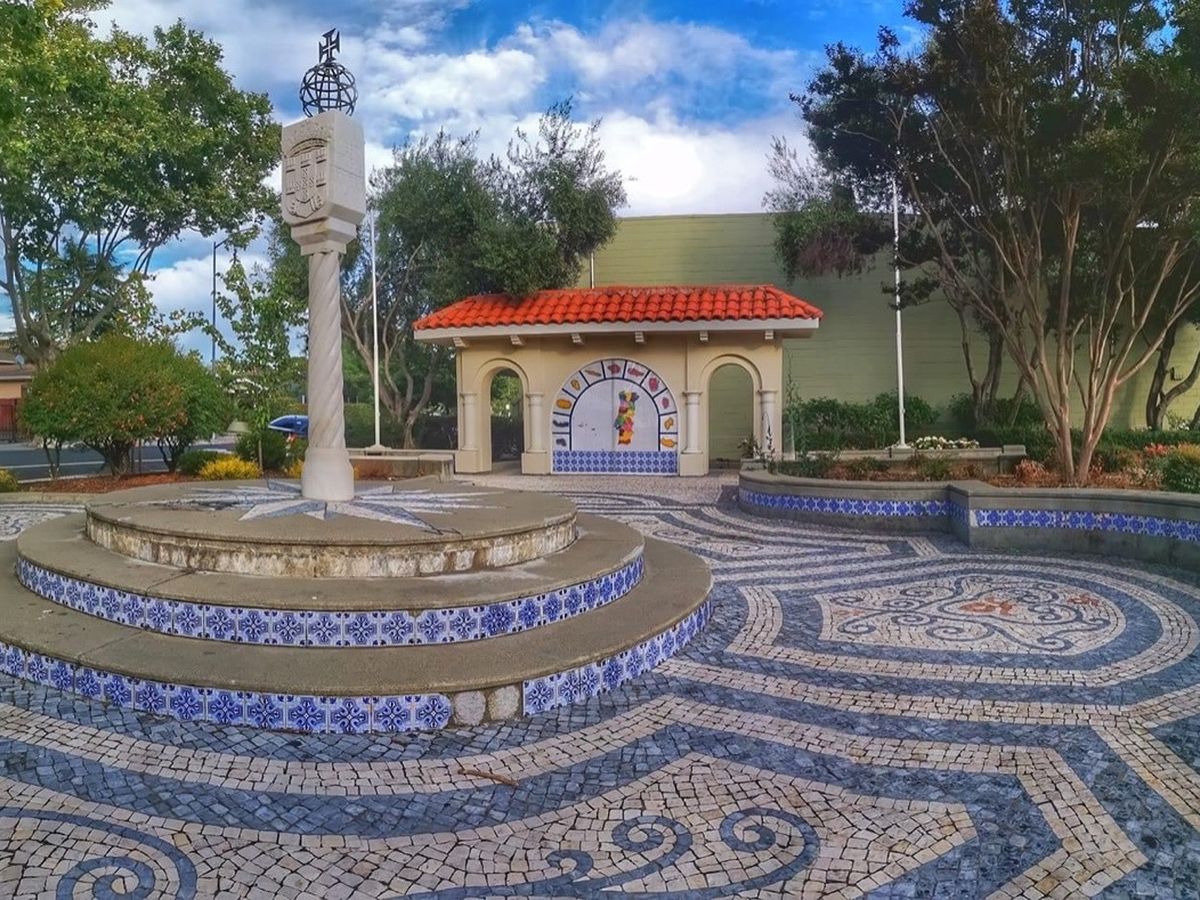
Ceramic tiles are a way of life and history in Portugal and the tiles are called azulejos in Portuguese. All of the azulejos at this park were produced by Aleluia Cerâmicas in Aveiro, Portugal, famous for their exquisite tile art. The azulejos border the gardens, are featured in the center monument map and also circle the pied de terre that the marble monument stands on in the center. The large tile map of Portugal, located in the center of the monument, was designed by the Hayward Area Recreation Department, and fired by Aleluia Cerâmicas in Aveiro, Portugal.
Beneath your feet is a traditional Portuguese stone pathway known in Portuguese as “calçada Portuguesa”, or simply, “calçada”. Our sister city of Faro’s contributions include park benches, lighting fixtures, 70 tons of limestone and two stone-cutting artisans, known as calceteiros, flown from Faro to execute the intricate floor design that is also reflected across the Atlantic in Faro. The calceteiros were Americo L. Marcelino (38 years old) and his apprentice Jose Martins (42 years old). Americo and Jose, both Faro city employees, stayed at the home of City Councilman Julio Bras for approximately four months while completing this work of art.
The calceteiros chipped away to fit the calçada just right. Tapping the hammer, they turned hunks of stone into triangles, hexagons or a seashell for the design. They would squat and hammer for hours tapping each stone into place on a bed of sand. After each section of stone was set into its sandy bed, Martins brushed a mixture of sand and concrete into the cracks. The layer of rock was then pounded with a “maco,” a 20 lb. oak mallet, evening the layer without use of a level. More cement was then brushed into the cracks, the pavement wetted down and the cement allowed to harden.
On one end of the park, the calceteiros crafted an anchor and rope design. Towards the center, a Caravel (traditional Portuguese ship), floats atop the stones. The center of the park features intricate designs found on calçada (stone pathways) in the town of Faro. “Hayward” is spelled out with calçada, the city seal is featured, and the Faro flag and coat of arms are designed. The park has a time capsule that will be exhumed March 11, 2076 – 100 years from the Centennial. “Faro” is spelled out next to the time capsule.
The central marble monument was designed by João Matamouros, a councilman in Faro. The monument is called a padrão, a stone pillar left by Portuguese maritime explorers. The padrão stands upon a pied a terre in the middle of a navigation compass design.
The clay tile roofed monument that encases the tile map of Portugal features a granite monument on the backside. The engraved granite reads “The Portuguese Centennial Park Committee acknowledges the contribution of funds to this park, honoring the Portuguese heritage from families of the present and in memory of those deceased.” Many names and organizations are featured. The roof is reminiscent of the curved terracotta roofs in Portugal. The Algarve region of Portugal is known for its terracotta. The pillared arches are reminiscent of Faro’s “Arco da Vila”, a neo-classical archway that is the entrance to Algarve’s old quarter (Cidade Velha).
The original landscaping design included plants and trees like those in Portugal that would thrive in our similar Mediterranean climate, including olive trees, cork oak trees and ornamental pomegranate trees.
The park, an authentic reproduction of a typical Portuguese praça, was to be the only park in the United States with authentic Portuguese calçada laid by a Portuguese calceteiro.
The park was dedicated on October 14, 1979. Attendees were: Faro Mayor Joaquim Lopes Belchior, Hayward Mayor Ilene Weinreb, many other Hayward city officials and employees, and members of many Portuguese organizations. After the dedication ceremonies and performances, a grand community celebration and dance followed at the IDES Hall. The events lasted through the week and culminated in a banquet at Centennial Hall.
Organizer and beneficiary
JFrancisco Zermeno
Beneficiary