- P
- G
- A

Upgrade the SDL buildbot
0% complete
$3,386 raised of $1.2K
82 donations
Hello! We have an awesome buildbot for Simple Directmedia Layer, but it's getting a little too big for its hardware.
If you haven't heard of SDL, it's the game toolkit library that powers tons of important pieces of tech, including the Steam Client and Steam Link, and the vast majority of games on Linux, from small little casual games to big massive triple-A blockbusters.
Currently, SDL's buildbot hosts virtual machines for nine operating systems, building for 21 different platforms . Every commit to SDL builds on everything we can reasonably target, so we catch problems before you do. It not only handles the common platforms like Windows, macOS and Linux, but also mobile platforms, and even niche targets like OS/2, QNX and Haiku. Most importantly: it handles running static analysis on every code change, which can find bugs you would never think to track down before they become disasters.
For many of the platforms, the buildbot uploads binaries for every commit, so you can, say, get a Raspberry Pi build of the latest SDL without having to build it yourself.
If nothing else, it's nice to sit back and watch the waterfall of builds, knowing that everything is working smoothly.
The buildbot has, over many years now, made releases work way more smoothly on platforms we aren't working on every day, and ensured we wrote portable code and didn't quietly break things that are only discovered much later in the field. This has the benefit of not only making releases more reliable, but also letting people trust that the latest in revision control is likely in reasonable shape at any moment.
All these virtual machines are crammed into a Shuttle PC from 2012:
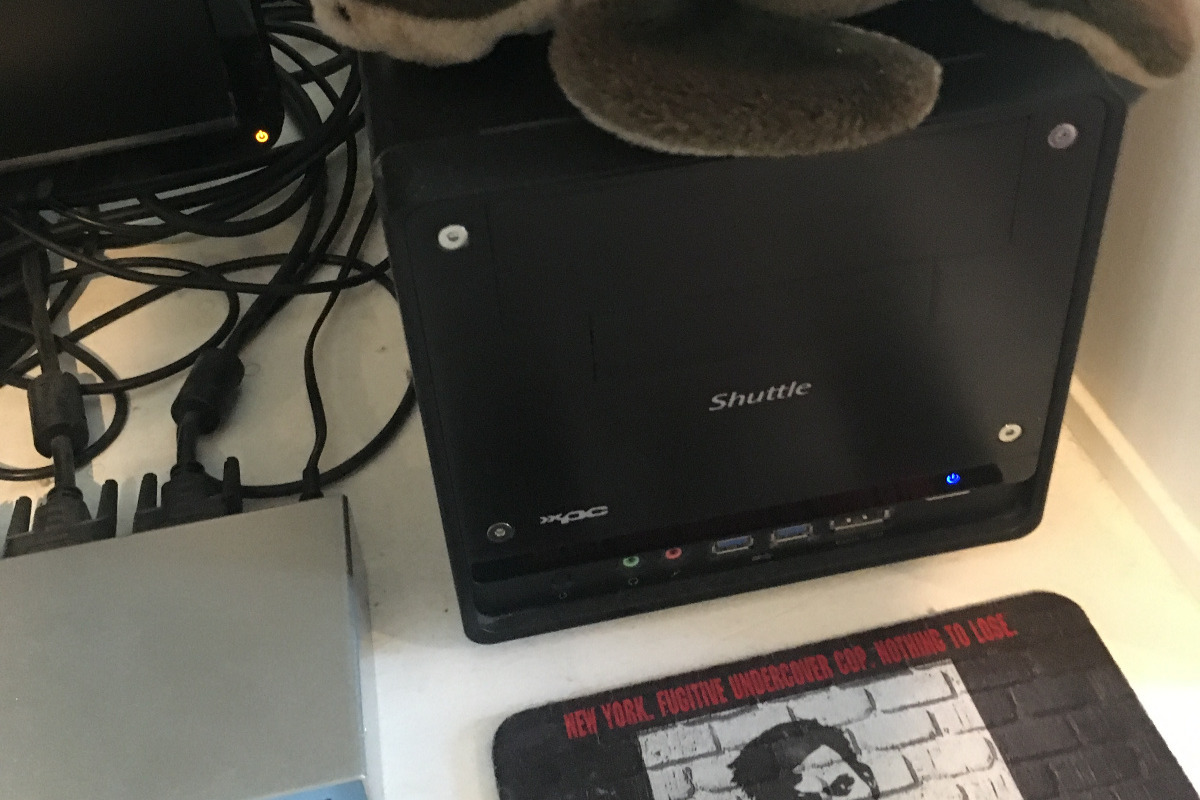
For the desk space, it's not a bad machine: it's maxed out with 4 CPU cores and 32 gigabytes of RAM. But try running ten operating systems on that at once, and you find out how quickly you run out of resources. Once the buildbots start whirring along, trying to wake the screen by wiggling the mouse can take quite some time, and the machine lives in a quagmire of swap i/o.
A single commit to SDL--a project that builds on an ancient Macbook in about 30 seconds--takes about 30 minutes for all the buildbots to churn through.
I would like to upgrade the hardware to something beefier--lots of cores, lots of RAM--but I don't have the money to purchase big iron for this.
We are at a moment in computers where you can get a refurbished machine of obscene proportions--16 cores, a bazillion gigs of RAM--for about a thousand dollars. I want to snatch one of these up and get our buildbot humming along again.
Donations go to that about-1000 dollar target plus a little more for the usual crowdsourcing fees and shipping, etc. If funding is successful, I go out and get a computer and migrate the system to it on the day it arrives. Once upgraded, we, the SDL developers, get feedback much much faster for any changes we make.
Will you throw in a few bucks?
Thanks!
--ryan.
@icculus on Twitter
If you haven't heard of SDL, it's the game toolkit library that powers tons of important pieces of tech, including the Steam Client and Steam Link, and the vast majority of games on Linux, from small little casual games to big massive triple-A blockbusters.
Currently, SDL's buildbot hosts virtual machines for nine operating systems, building for 21 different platforms . Every commit to SDL builds on everything we can reasonably target, so we catch problems before you do. It not only handles the common platforms like Windows, macOS and Linux, but also mobile platforms, and even niche targets like OS/2, QNX and Haiku. Most importantly: it handles running static analysis on every code change, which can find bugs you would never think to track down before they become disasters.
For many of the platforms, the buildbot uploads binaries for every commit, so you can, say, get a Raspberry Pi build of the latest SDL without having to build it yourself.
If nothing else, it's nice to sit back and watch the waterfall of builds, knowing that everything is working smoothly.
The buildbot has, over many years now, made releases work way more smoothly on platforms we aren't working on every day, and ensured we wrote portable code and didn't quietly break things that are only discovered much later in the field. This has the benefit of not only making releases more reliable, but also letting people trust that the latest in revision control is likely in reasonable shape at any moment.
All these virtual machines are crammed into a Shuttle PC from 2012:
For the desk space, it's not a bad machine: it's maxed out with 4 CPU cores and 32 gigabytes of RAM. But try running ten operating systems on that at once, and you find out how quickly you run out of resources. Once the buildbots start whirring along, trying to wake the screen by wiggling the mouse can take quite some time, and the machine lives in a quagmire of swap i/o.
A single commit to SDL--a project that builds on an ancient Macbook in about 30 seconds--takes about 30 minutes for all the buildbots to churn through.
I would like to upgrade the hardware to something beefier--lots of cores, lots of RAM--but I don't have the money to purchase big iron for this.
We are at a moment in computers where you can get a refurbished machine of obscene proportions--16 cores, a bazillion gigs of RAM--for about a thousand dollars. I want to snatch one of these up and get our buildbot humming along again.
Donations go to that about-1000 dollar target plus a little more for the usual crowdsourcing fees and shipping, etc. If funding is successful, I go out and get a computer and migrate the system to it on the day it arrives. Once upgraded, we, the SDL developers, get feedback much much faster for any changes we make.
Will you throw in a few bucks?
Thanks!
--ryan.
@icculus on Twitter