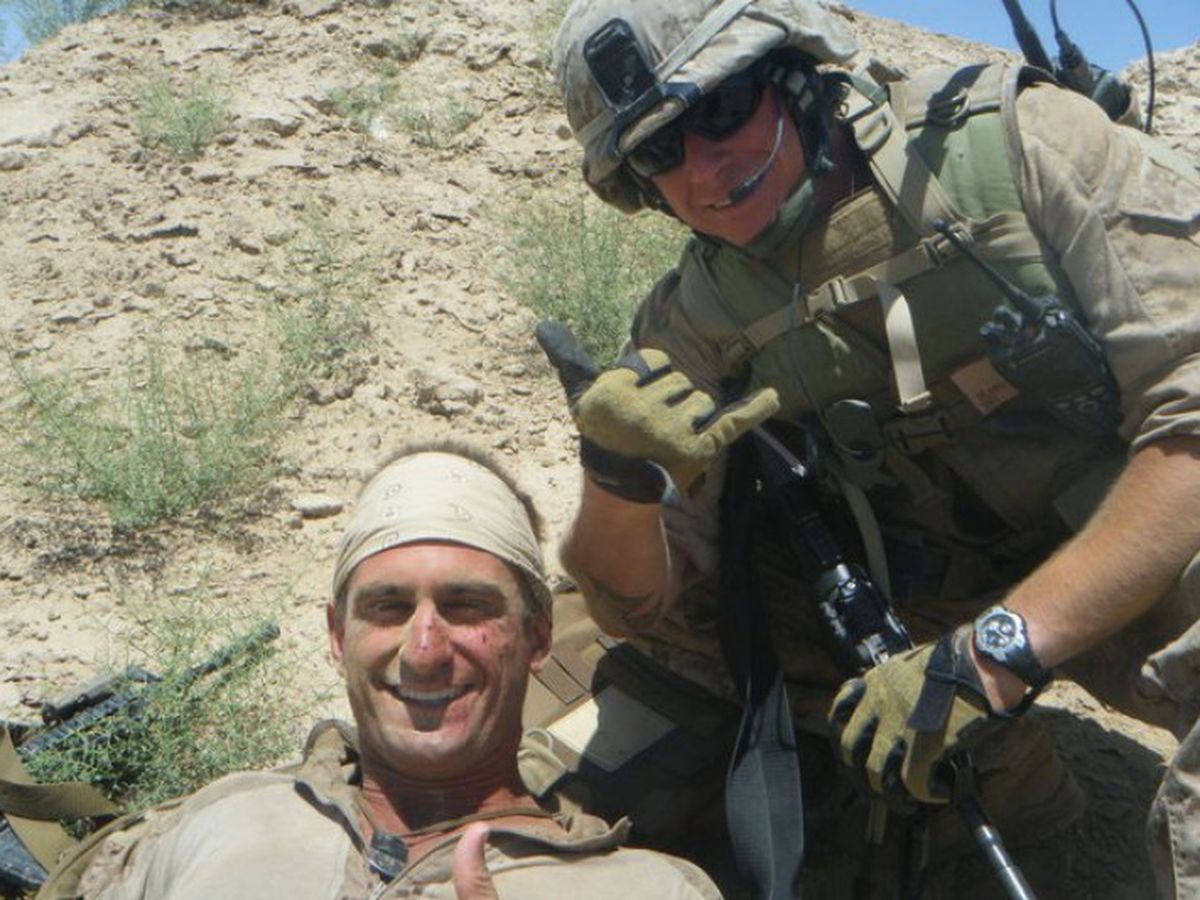
- M
- A
- J
UNITEOURTROOPS.COM
TO REFORM MILITARY TRANSITION ASSISTANCE
Ending Veteran Unemployment, Homelessness, and Suicide Means Addressing the Root Causes.
THE LAST DAYS OF SGT. JEREMY SEARS
Sgt. Jeremy Sears was discharged from the US Marine Corps in 2012. His service-connected disability benefits application fell into the heart of a 600,000-claim processing backlog. Though it was acknowledged that Jeremy had traumatic brain injury and hearing loss caused by his military service, the VA did not grant any disability pay.
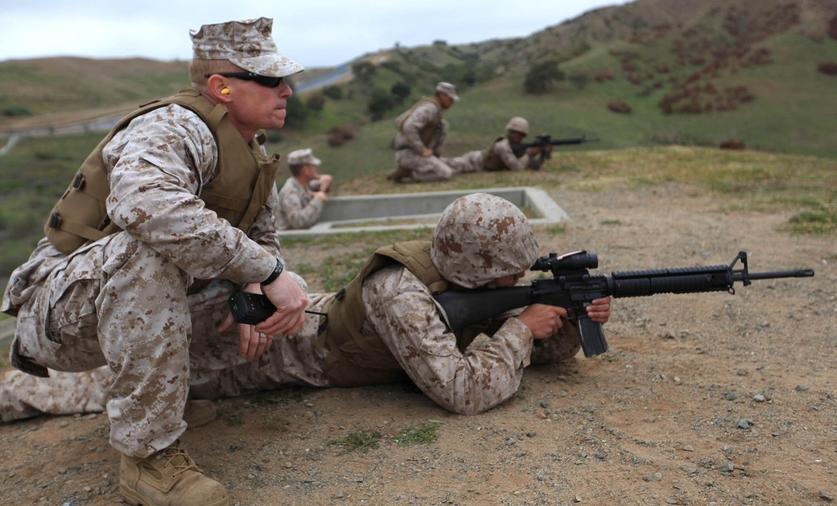 Sears in a live-fire training exercise at Camp Pendleton.
Photo courtesy Lance Cpl. Derrick K. Irions, USMC.
Jeremy signed up as a rifleman — the building block of the Marine Corps — in 2004. He was stationed at Camp Pendleton with the 2nd Battalion, 5th Marine Regiment. In his eight years in uniform, Jeremy deployed several times to Iraq. His final combat tour was to Afghanistan in 2010, where he survived his second roadside bomb (once losing consciousness).
Jeremy's VA primary care doctor continued to give him refills of Vicodin, a narcotic painkiller, for 22 months without requiring a face-to-face visit or a suicide assessment. Jeremy struggled to find work for two years post-separation. On October 6, 2014, the former combat Marine went to an Oceanside shooting range while his wife was at work. He rented a gun and turned it on himself.
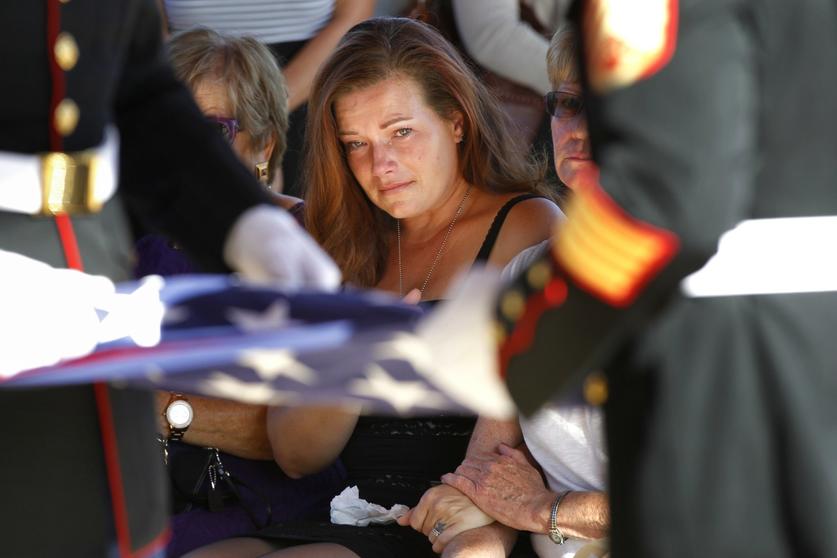 Tami Sears watches as Marines fold a flag during a memorial service for her husband, Marine Jeremy Sears at Miramar National Cemetery.
Photo courtesy of K.C. Alfred / UT San Diego.
An internal investigation by the U.S. Veterans Affairs Inspector General found that the San Diego VA system botched his care and Jeremy should have been awarded disability.
THE EXPLOSION THAT NEARLY KILLED RYAN LOYA
Ryan Loya, USMC, joined the Marine Corp in 2007, received orders to 2nd Battalion, 5th Marine Regiment, was promoted to Sergeant within four years, and served as drill instructor at MCRD San Diego for 2.5 years. Ryan deployed four times, two of which were to Afghanistan.
On his 3rd deployment in May 2010, Ryan was Squad Leader of 13 Marines at Marjah. When two of his men were separated by an IED, and lacking EOD support, Ryan located the wire trace to clear his men. He was subsequently blown into a nearby river where he was pulled out by his friend, and mentor, Sgt. Jeremy Sears. Refusing Medivac, Ryan walked his squad 2000 meters back to base. He was awarded the Purple Heart.
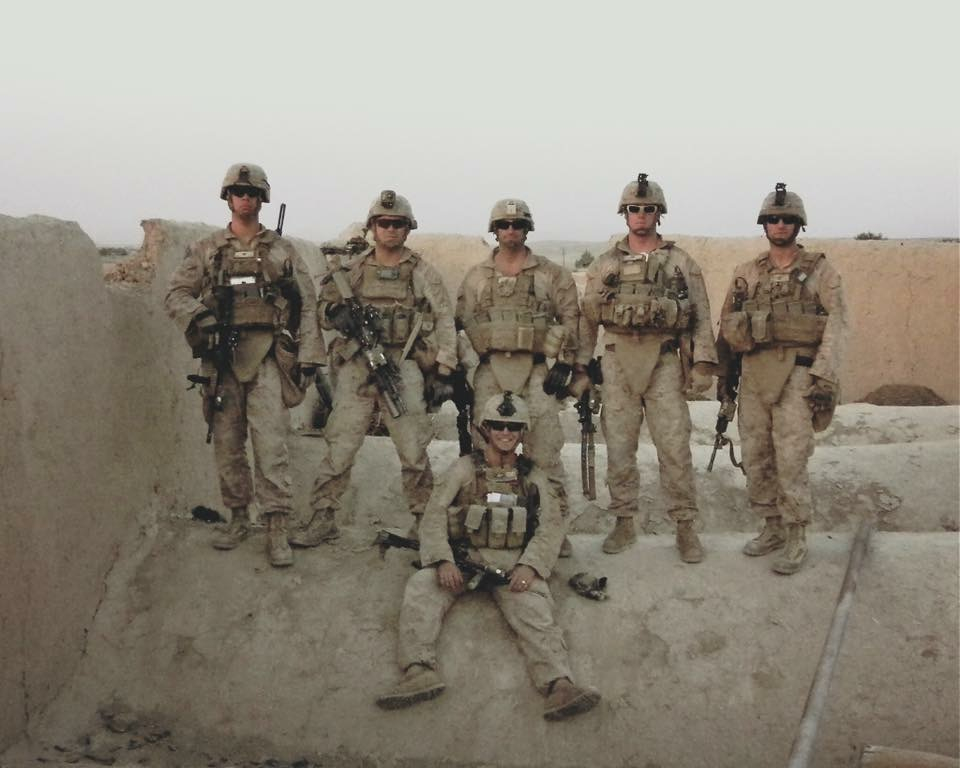 Sgt. Ryan Loya (top row, center) with Fox 2/5 in Afghanistan, 2012.
Ryan spent the next weeks at Landstahl Medical Center in Germany, and at Walter Reed Hospital in Bethesda, MD, before finally returning to San Diego for rehabilitation. His left ear drum was gone. Only 50% of his right remained. Ryan had burns, and small rocks and shrapnel imbedded throughout the left side of my face and neck. The daily migraines were excruciating. The worst, however, was his memory and reading comprehension. The explosion had reduced Loya to a 5th grade reading and comprehension level.
Determined to rehabilitate on his own, Ryan succeeded within six months, passed a slew of tests and returned to combat. He was awarded the Navy and Marine Corps Commendation Medal with "V" for Valor for acts of heroism on his final deployment.
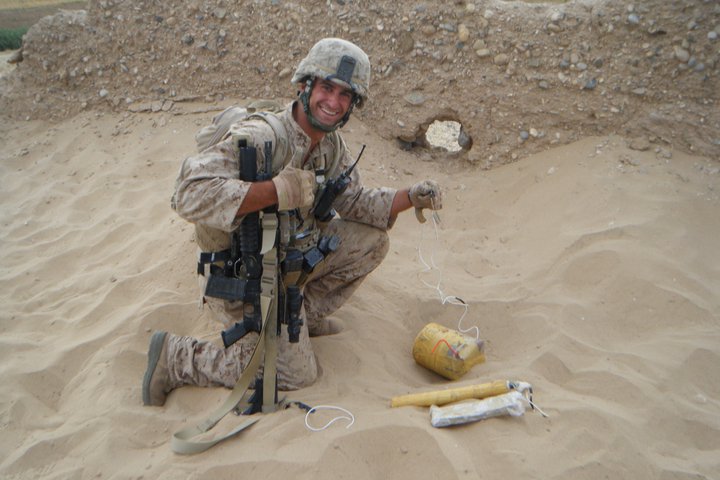 Cpl. Ryan Loya dismantles an IED in in the town of Marjah, Helmand Province, Afghanistan.
THE ISSUE
The mission of DoD is to provide the military forces needed to deter war and to protect the security of our country. The Marine Corps further highlights that its purpose is also its promise, “We win our nation’s battles. We develop quality citizens. These are the promises the Marine Corps makes to our nation and to our Marines.” In creating Soldiers, Sailors, Airmen and Marines, the DoD is equally responsible for ensuring that transitioning servicemembers are aptly prepared for re-entry into the civilian sector through TAP.
More than five years after the VOW Act was passed, the DoD is failing to deliver impactful TAP services because servicemembers are still being released back into society without the tools needed to find gainful employment and continue positive contribution to society. Demonstrative of the DoD’s failure are the Veteran suicide, Veteran unemployment, and Veteran homelessness rates. While the VA and DOL implement programs to reduce these rates post-service, it is from within the DoD that these issues originate, and where prevention starts.
Veterans constitute 8.5 percent of the U.S. population, yet 20 percent of suicides in the U.S. are Veteran suicides. According to the VA’s Office of Suicide Prevention, in its 2016 reports:
• An average of 20 Veterans died by suicide each day in 2014.
• In 2014, risk for suicide was 21 percent higher among Veterans when compared with U.S. civilian adults.
• The risk for suicide among female veterans was 2.4 times higher when compared with U.S. civilian adult females.
• Since 2001, the age-adjusted rate of suicide among U.S. Veterans has increased by 32.2%.
• Since 2001, the age-adjusted rate of suicide among U.S. Veteran males has increased by 30.5%, while suicide among U.S. civilian adult males increased by only 0.3%.
In addition to the tragedy of Veteran suicide, according to the VA 2015 Veteran Economic Opportunity Report, approximately one out of two (53%) separating Post-9/11 Veterans will be unemployed, with the average duration of unemployment on the rise from 18 weeks in the last six years to 22 weeks in 2013. The U.S. Department of Housing and Urban Development (HUD) estimates that 39,471 veterans are homeless on any given night. Veterans are 50% more likely to become homeless than other Americans, with 1.4 million Veterans, approximately, considered at risk of homelessness due to poverty, lack of support networks, and dismal living conditions in overcrowded or substandard housing. According to a VA 2012 report, nearly half or more of homeless Veterans were diagnosed with some mental disorders, about double their domiciled counterparts. The percent of homeless Veterans diagnosed with TBI was nearly 2–3 times higher than their domiciled counterparts.
Prevention must begin within DoD, specifically through TAP. Unfortunately, TAP continues to be grossly underfunded. Recently released, the Budget of the United States Government, Fiscal Year 2017 highlights the President’s approval to fund DoD with 582.7 billion, the VA with 182.3 billion, and the DOL with 12.8 billion. Under the DOL, only $14.6 million is allocated for carrying out TAP under 38 U.S.C. 4113 and 10 U.S.C. 1144. This equates to 0.11% of the DOL budget, and 0.002% of the DoD budget.
It is imperative that our nation improves TAP services to reduce Veteran homelessness, unemployment and suicide at onset. Investment in a more robust TAP is wise, and has the capacity to reduce costs in the long term, such as unemployment payout. The Loya-Sears Bill lays out a comprehensive plan to raise the level of services offered to those who sacrifice everything for our nation’s security.
WHAT IS TAP?
Transition Assistance Programs (TAP) are a series of programs and services, mandated by Congress, which provide information, tools and training to prepare active duty servicemembers and their families for a successful transition back to civilian life.
In 2013, at the direction of the President of the United States, the Department of Defense (DoD) entered into interagency agreements with the Department of Labor (DOL), Department of Veterans Affairs (VA), Department of Education (ED), United States Coast Guard (USCG) (representing the Department of Homeland Security), United States Small Business Administration (SBA), and the United States Office of Personnel Management (OPM) to collaborate on the redesigned Transition Assistance Program (TAP).
According to a January 31, 2013 Memorandum of Understanding, “Successful transition is an important and collaborative effort,” in which the aforementioned agencies agreed to align focus on making servicemembers career ready and meet Career Readiness Standards (CRS). To enable servicemembers to meet CRSs, a set of outcome-based curricula was added to TAP, known as Transition GPS (Goals, Plans, Success). In accordance with the “VOW to Hire Heroes Act of 2011,” the Office of the Undersecretary of Defense (Personnel and Readiness) (OUSD (P&R)), Transition to Veterans Program Office (TVPO) is responsible for designing, overseeing, and evaluating TAP.
Although the organization name and procedures for TAP vary, all military branches are supposed to offer the same benefits and services. Transition Assistance offices are located on most military installations in the United States, with some overseas. TAP has different names based on the branch of service, designated as follows:
• ARMY: Soldier for Life – Transition Assistance Program (SFL-TAP)
• MARINE CORPS: MCCS Transition Readiness Program (TRS)
• NAVY: Transition Goals, Plans, Success (Transition GPS)
• AIR FORCE: Airman & Family Readiness, Transition Assistance Program (TAP)
• COAST GUARD: Office of Work-Life Programs – Transition Assistance Program (TAP)
THE LOYA-SEARS BILL OF 2017
The Loya-Sears Bill proposes the following:
I. Mandate Active Duty Servicemembers in All Military Branches to Begin Transition Assistance Programs (TAP) at Onset of Eligibility
II. Standardize TAP Across Branches
III. Expand Duration and Breadth of Transition Assistance Curriculum
IV. Utilize services provided by national and local Veteran Service Organizations to fill service gaps
V. Expand Servicemember Eligibility for Permanent Change of Station (PCS)
READ THE LOYA-SEARS BILL IN FULL AT:
UNITEOURTROOPS.COM/LOYA-SEARS-BILL
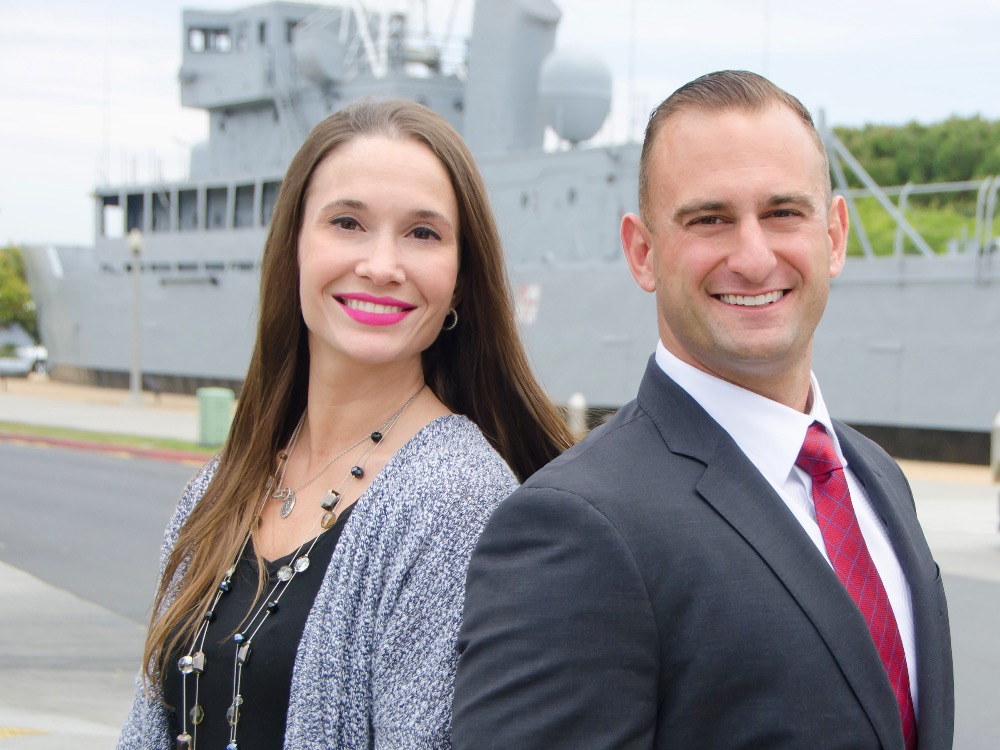 Katherine Kostreva and Ryan Loya, San Diego, CA.
GOFUNDME AND TEAM RYKAT
During his own separation from the US Marine Corp, Sgt. Ryan Loya was met with multiple roadblocks. Requests to transfer to the Marine Corps Recruiting office in NYC were repeatedly denied, though it was a crucial element in his transition to New York University, where he was recently accepted. Ryan attended a week long TAP course at Camp Pendleton, which consisted of five days of 7 hours classes covering transition basics. The culmination was a job fair on Friday afternoon, outside the classroom building. In attendance were a local university, a pipefitting company, border patrol, and a moving company, to name a few. Over 80% of separating servicemembers return to their home of record located outside of the state in which they are stationed. The DoD is aware of this statistic, yet companies with a national network are not presented at these weekly job fairs. And why is blue collar work the acceptable norm at TAP job fairs?
The Marine Corps TAP program is operated by Marine Corps Community Services (MCCS), which maintains a closed network of affiliates that it provides to job seeking servicemembers. Companies like JP Morgan should be allowed into these weekly fairs, but are not (there are job fairs larger in scope hosted semi-annually, but not accessible to all separating servicemembers due to timing and location). As an example, JP Morgan founded the Veteran Jobs Mission in 2011 consisting of a coalition of 235 companies that hire Veterans. Since inception, the program has hired 360,000 Veterans, with 11,000 hired by JP Morgan itself. Coalitions like this one should be heavily promoted heavily to transitioning servicemembers.
Katherine Kostreva, a publicist from NYC, and Ryan's fiancé, decided to write a bill, based on Ryan's difficult transition experience. Katherine has worked with multiple Veteran Service Organizations, and after attending TAP and the job fair with Ryan, decided it was time to take action. Together, she and Ryan drafted the Loya-Sears Bill of 2017, a comprehensive bill to dramatically improve military transition assistance, and therefore reduce Veteran unemployment, homelessness and suicide, in the long-term.
Funds raised through this GoFundMe campaign will be used to jumpstart the first year of costs associated with promoting the Loya-Sears Bill of 2017, to ensure it becomes an ACT. This includes a great amount of travel to visit companies and politicians scattered across our great country. Costs include the following, but not limited to:
• Office Expenses [Office rental, printing, postage, phone, internet, software fees]
• Travel [Gas, tolls, train/MTA, airfare, hotel and food; NOTE: Katherine and Ryan are traveling across the country by car starting January 10, 2017]
• Special Events [Conference and convention tickets, advertising at events, purchasing of tables to distribute materials]
We thank you in advance for your support! If you have questions, please email us.
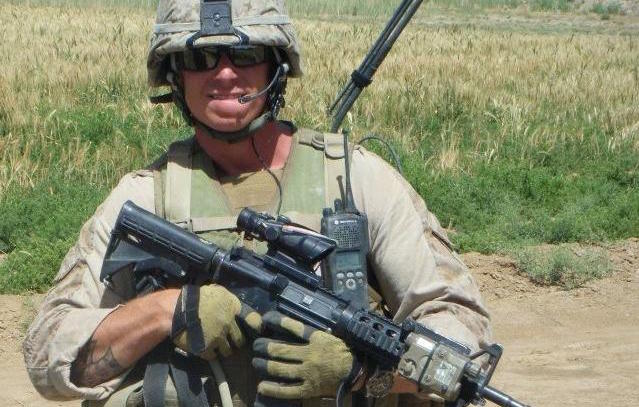 In Memory of Sgt. Jeremy Sears, USMC
Husband, Brother, Son, Marine
Semper Fi and God Bless
News Sources:
Excerpts on Jeremy Sears are pulled from articles in the San Diego Union-Tribune, as written by Jeanette Steele.
The last moments of Jeremy Sears
Report: VA botched Marine vet’s care
Statistical Sources:
• About the Department of Defense (DoD)
• About DoD TAP
• VA Suicide Prevention Program, Facts about Veteran Suicide July 2016
• U.S Department of Veterans Affairs, Suicide Among Veterans and Other Americans 2001–2014, Office of Suicide Prevention
• 2015 Veteran Economic Opportunity Report, Department of Veterans Affairs
• 2016 PIT Estimate of Homeless Veterans by State
• National Coalition for Homeless Veterans, Background & Statistics
• Homeless Incidence and Risk Factors for Becoming Homeless in Veterans, Department of Veterans Affairs Office of Inspector General
• Budget of the U.S. Government, Fiscal Year 2017, Office of Management and Budget
TO REFORM MILITARY TRANSITION ASSISTANCE
Ending Veteran Unemployment, Homelessness, and Suicide Means Addressing the Root Causes.
THE LAST DAYS OF SGT. JEREMY SEARS
Sgt. Jeremy Sears was discharged from the US Marine Corps in 2012. His service-connected disability benefits application fell into the heart of a 600,000-claim processing backlog. Though it was acknowledged that Jeremy had traumatic brain injury and hearing loss caused by his military service, the VA did not grant any disability pay.
Sears in a live-fire training exercise at Camp Pendleton.Photo courtesy Lance Cpl. Derrick K. Irions, USMC.
Jeremy signed up as a rifleman — the building block of the Marine Corps — in 2004. He was stationed at Camp Pendleton with the 2nd Battalion, 5th Marine Regiment. In his eight years in uniform, Jeremy deployed several times to Iraq. His final combat tour was to Afghanistan in 2010, where he survived his second roadside bomb (once losing consciousness).
Jeremy's VA primary care doctor continued to give him refills of Vicodin, a narcotic painkiller, for 22 months without requiring a face-to-face visit or a suicide assessment. Jeremy struggled to find work for two years post-separation. On October 6, 2014, the former combat Marine went to an Oceanside shooting range while his wife was at work. He rented a gun and turned it on himself.
Tami Sears watches as Marines fold a flag during a memorial service for her husband, Marine Jeremy Sears at Miramar National Cemetery.Photo courtesy of K.C. Alfred / UT San Diego.
An internal investigation by the U.S. Veterans Affairs Inspector General found that the San Diego VA system botched his care and Jeremy should have been awarded disability.
THE EXPLOSION THAT NEARLY KILLED RYAN LOYA
Ryan Loya, USMC, joined the Marine Corp in 2007, received orders to 2nd Battalion, 5th Marine Regiment, was promoted to Sergeant within four years, and served as drill instructor at MCRD San Diego for 2.5 years. Ryan deployed four times, two of which were to Afghanistan.
On his 3rd deployment in May 2010, Ryan was Squad Leader of 13 Marines at Marjah. When two of his men were separated by an IED, and lacking EOD support, Ryan located the wire trace to clear his men. He was subsequently blown into a nearby river where he was pulled out by his friend, and mentor, Sgt. Jeremy Sears. Refusing Medivac, Ryan walked his squad 2000 meters back to base. He was awarded the Purple Heart.
Sgt. Ryan Loya (top row, center) with Fox 2/5 in Afghanistan, 2012. Ryan spent the next weeks at Landstahl Medical Center in Germany, and at Walter Reed Hospital in Bethesda, MD, before finally returning to San Diego for rehabilitation. His left ear drum was gone. Only 50% of his right remained. Ryan had burns, and small rocks and shrapnel imbedded throughout the left side of my face and neck. The daily migraines were excruciating. The worst, however, was his memory and reading comprehension. The explosion had reduced Loya to a 5th grade reading and comprehension level.
Determined to rehabilitate on his own, Ryan succeeded within six months, passed a slew of tests and returned to combat. He was awarded the Navy and Marine Corps Commendation Medal with "V" for Valor for acts of heroism on his final deployment.
Cpl. Ryan Loya dismantles an IED in in the town of Marjah, Helmand Province, Afghanistan.THE ISSUE
The mission of DoD is to provide the military forces needed to deter war and to protect the security of our country. The Marine Corps further highlights that its purpose is also its promise, “We win our nation’s battles. We develop quality citizens. These are the promises the Marine Corps makes to our nation and to our Marines.” In creating Soldiers, Sailors, Airmen and Marines, the DoD is equally responsible for ensuring that transitioning servicemembers are aptly prepared for re-entry into the civilian sector through TAP.
More than five years after the VOW Act was passed, the DoD is failing to deliver impactful TAP services because servicemembers are still being released back into society without the tools needed to find gainful employment and continue positive contribution to society. Demonstrative of the DoD’s failure are the Veteran suicide, Veteran unemployment, and Veteran homelessness rates. While the VA and DOL implement programs to reduce these rates post-service, it is from within the DoD that these issues originate, and where prevention starts.
Veterans constitute 8.5 percent of the U.S. population, yet 20 percent of suicides in the U.S. are Veteran suicides. According to the VA’s Office of Suicide Prevention, in its 2016 reports:
• An average of 20 Veterans died by suicide each day in 2014.
• In 2014, risk for suicide was 21 percent higher among Veterans when compared with U.S. civilian adults.
• The risk for suicide among female veterans was 2.4 times higher when compared with U.S. civilian adult females.
• Since 2001, the age-adjusted rate of suicide among U.S. Veterans has increased by 32.2%.
• Since 2001, the age-adjusted rate of suicide among U.S. Veteran males has increased by 30.5%, while suicide among U.S. civilian adult males increased by only 0.3%.
In addition to the tragedy of Veteran suicide, according to the VA 2015 Veteran Economic Opportunity Report, approximately one out of two (53%) separating Post-9/11 Veterans will be unemployed, with the average duration of unemployment on the rise from 18 weeks in the last six years to 22 weeks in 2013. The U.S. Department of Housing and Urban Development (HUD) estimates that 39,471 veterans are homeless on any given night. Veterans are 50% more likely to become homeless than other Americans, with 1.4 million Veterans, approximately, considered at risk of homelessness due to poverty, lack of support networks, and dismal living conditions in overcrowded or substandard housing. According to a VA 2012 report, nearly half or more of homeless Veterans were diagnosed with some mental disorders, about double their domiciled counterparts. The percent of homeless Veterans diagnosed with TBI was nearly 2–3 times higher than their domiciled counterparts.
Prevention must begin within DoD, specifically through TAP. Unfortunately, TAP continues to be grossly underfunded. Recently released, the Budget of the United States Government, Fiscal Year 2017 highlights the President’s approval to fund DoD with 582.7 billion, the VA with 182.3 billion, and the DOL with 12.8 billion. Under the DOL, only $14.6 million is allocated for carrying out TAP under 38 U.S.C. 4113 and 10 U.S.C. 1144. This equates to 0.11% of the DOL budget, and 0.002% of the DoD budget.
It is imperative that our nation improves TAP services to reduce Veteran homelessness, unemployment and suicide at onset. Investment in a more robust TAP is wise, and has the capacity to reduce costs in the long term, such as unemployment payout. The Loya-Sears Bill lays out a comprehensive plan to raise the level of services offered to those who sacrifice everything for our nation’s security.
WHAT IS TAP?
Transition Assistance Programs (TAP) are a series of programs and services, mandated by Congress, which provide information, tools and training to prepare active duty servicemembers and their families for a successful transition back to civilian life.
In 2013, at the direction of the President of the United States, the Department of Defense (DoD) entered into interagency agreements with the Department of Labor (DOL), Department of Veterans Affairs (VA), Department of Education (ED), United States Coast Guard (USCG) (representing the Department of Homeland Security), United States Small Business Administration (SBA), and the United States Office of Personnel Management (OPM) to collaborate on the redesigned Transition Assistance Program (TAP).
According to a January 31, 2013 Memorandum of Understanding, “Successful transition is an important and collaborative effort,” in which the aforementioned agencies agreed to align focus on making servicemembers career ready and meet Career Readiness Standards (CRS). To enable servicemembers to meet CRSs, a set of outcome-based curricula was added to TAP, known as Transition GPS (Goals, Plans, Success). In accordance with the “VOW to Hire Heroes Act of 2011,” the Office of the Undersecretary of Defense (Personnel and Readiness) (OUSD (P&R)), Transition to Veterans Program Office (TVPO) is responsible for designing, overseeing, and evaluating TAP.
Although the organization name and procedures for TAP vary, all military branches are supposed to offer the same benefits and services. Transition Assistance offices are located on most military installations in the United States, with some overseas. TAP has different names based on the branch of service, designated as follows:
• ARMY: Soldier for Life – Transition Assistance Program (SFL-TAP)
• MARINE CORPS: MCCS Transition Readiness Program (TRS)
• NAVY: Transition Goals, Plans, Success (Transition GPS)
• AIR FORCE: Airman & Family Readiness, Transition Assistance Program (TAP)
• COAST GUARD: Office of Work-Life Programs – Transition Assistance Program (TAP)
THE LOYA-SEARS BILL OF 2017
The Loya-Sears Bill proposes the following:
I. Mandate Active Duty Servicemembers in All Military Branches to Begin Transition Assistance Programs (TAP) at Onset of Eligibility
II. Standardize TAP Across Branches
III. Expand Duration and Breadth of Transition Assistance Curriculum
IV. Utilize services provided by national and local Veteran Service Organizations to fill service gaps
V. Expand Servicemember Eligibility for Permanent Change of Station (PCS)
READ THE LOYA-SEARS BILL IN FULL AT:
UNITEOURTROOPS.COM/LOYA-SEARS-BILL
Katherine Kostreva and Ryan Loya, San Diego, CA.GOFUNDME AND TEAM RYKAT
During his own separation from the US Marine Corp, Sgt. Ryan Loya was met with multiple roadblocks. Requests to transfer to the Marine Corps Recruiting office in NYC were repeatedly denied, though it was a crucial element in his transition to New York University, where he was recently accepted. Ryan attended a week long TAP course at Camp Pendleton, which consisted of five days of 7 hours classes covering transition basics. The culmination was a job fair on Friday afternoon, outside the classroom building. In attendance were a local university, a pipefitting company, border patrol, and a moving company, to name a few. Over 80% of separating servicemembers return to their home of record located outside of the state in which they are stationed. The DoD is aware of this statistic, yet companies with a national network are not presented at these weekly job fairs. And why is blue collar work the acceptable norm at TAP job fairs?
The Marine Corps TAP program is operated by Marine Corps Community Services (MCCS), which maintains a closed network of affiliates that it provides to job seeking servicemembers. Companies like JP Morgan should be allowed into these weekly fairs, but are not (there are job fairs larger in scope hosted semi-annually, but not accessible to all separating servicemembers due to timing and location). As an example, JP Morgan founded the Veteran Jobs Mission in 2011 consisting of a coalition of 235 companies that hire Veterans. Since inception, the program has hired 360,000 Veterans, with 11,000 hired by JP Morgan itself. Coalitions like this one should be heavily promoted heavily to transitioning servicemembers.
Katherine Kostreva, a publicist from NYC, and Ryan's fiancé, decided to write a bill, based on Ryan's difficult transition experience. Katherine has worked with multiple Veteran Service Organizations, and after attending TAP and the job fair with Ryan, decided it was time to take action. Together, she and Ryan drafted the Loya-Sears Bill of 2017, a comprehensive bill to dramatically improve military transition assistance, and therefore reduce Veteran unemployment, homelessness and suicide, in the long-term.
Funds raised through this GoFundMe campaign will be used to jumpstart the first year of costs associated with promoting the Loya-Sears Bill of 2017, to ensure it becomes an ACT. This includes a great amount of travel to visit companies and politicians scattered across our great country. Costs include the following, but not limited to:
• Office Expenses [Office rental, printing, postage, phone, internet, software fees]
• Travel [Gas, tolls, train/MTA, airfare, hotel and food; NOTE: Katherine and Ryan are traveling across the country by car starting January 10, 2017]
• Special Events [Conference and convention tickets, advertising at events, purchasing of tables to distribute materials]
We thank you in advance for your support! If you have questions, please email us.
In Memory of Sgt. Jeremy Sears, USMCHusband, Brother, Son, Marine
Semper Fi and God Bless
News Sources:
Excerpts on Jeremy Sears are pulled from articles in the San Diego Union-Tribune, as written by Jeanette Steele.
The last moments of Jeremy Sears
Report: VA botched Marine vet’s care
Statistical Sources:
• About the Department of Defense (DoD)
• About DoD TAP
• VA Suicide Prevention Program, Facts about Veteran Suicide July 2016
• U.S Department of Veterans Affairs, Suicide Among Veterans and Other Americans 2001–2014, Office of Suicide Prevention
• 2015 Veteran Economic Opportunity Report, Department of Veterans Affairs
• 2016 PIT Estimate of Homeless Veterans by State
• National Coalition for Homeless Veterans, Background & Statistics
• Homeless Incidence and Risk Factors for Becoming Homeless in Veterans, Department of Veterans Affairs Office of Inspector General
• Budget of the U.S. Government, Fiscal Year 2017, Office of Management and Budget