- A
- H
Help Sarah Save Her Sight
0% complete
$6,504 raised of $5K
70 donations
Sarah Denney is at risk of losing her eye sight. It would be life-changing for her and her family if this were to happen. Sarah lives in Baltimore, Maryland. There is a surgeon in Philadelphia who may be able to help her save her sight. It will be a painful, difficult surgery with a long recovery. There will be many expenses for Sarah and her family during this period. They will need somewhere to stay during her initial period of healing as she will be unable to travel. There will also be expensive equipment that she needs to rent. Sarah will have to lie face down for 3-4 weeks. She will run out of paid leave before she can return to work. She is trying her best to be upbeat and positive leading up to this surgery. If we can come together to at least help lessen her financial burdens, she can go in to this surgery with less stress. Please consider donating to help this mother of 2 beautiful boys fight this battle to save her sight. Any funds that remain after she has paid her expenses will be donated to the Juvenile Diabetes Research Foundation.
Sarah's story in her own words:
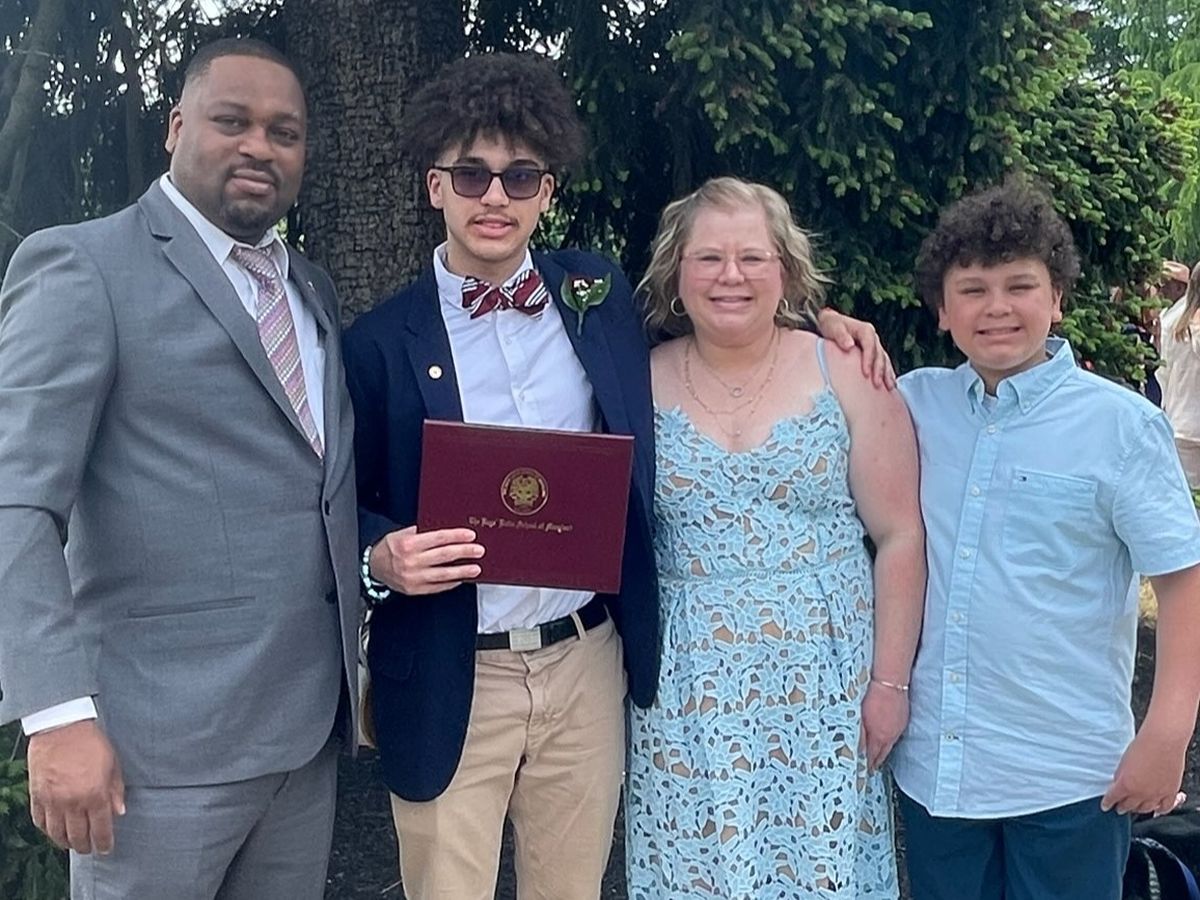
“In October 1998, at the age of 18, I was diagnosed with late onset type one (juvenile) diabetes. Doctors now believe that I may have been diabetic for up to ten years prior without knowing. Most of my life I thought that I was managing the highs and lows of my diabetes. As technology changed, my control improved. I wear a continuous glucose monitoring system that has been life changing in managing my diabetes. Despite the challenges of juvenile diabetes, my husband (Howard) and I were blessed with two amazing sons, Howard (age 19) and Samuel (age 12).
Part of my care is going to the endocrinologist every three months and having diabetic eye exams yearly. These are two things that I have always done faithfully, which makes what is happening to me an even greater shock. This past July I was away for a weekend at the beach with my boys. I woke up Sunday morning with what I thought was an ocular migraine. I had black lash-like lines across my right eye and some blurred vision. Like a true mom, I told the boys that I would be fine and we should stick to our plans and enjoy the day. The next day I hadn't improved, so I took a few more doses of my migraine medicine and rested. When I woke up that Tuesday and still had not improved, I decided to call the eye doctor. What I thought was going to be a quick visit quickly turned into an emergency situation. The doctor who examined me was alarmed by what he saw and sent me as an emergency to Hopkins main campus. After what seemed like hours of scans and waiting we finally saw a doctor. He asked me point blank if I ever went to the eye doctor’s, because my eyes looked like diabetic eyes that never went. I was speechless. I told him that not only did I go yearly, but that I went to Hopkins, to his colleagues. I was diagnosed with advanced diabetic retinopathy in both of my eyes, with the right eye being significantly worse. I had an active bleed in my right eye which was obstructing my vision. I was informed that I required surgery, but we had to wait in hopes that the bleed would dissipate. For the next month I was unable to do much of anything physical, not even bend over to put on my shoes and socks. For a brief amount of time, I thought things were getting better because I had almost normal vision again. But, just days before my surgery date, I woke up to the same black lines and knew I had another bleed.
On September 27th, I had both of my eyes lasered and injected. As a result of the laser treatment, I have lost peripheral vision in my left eye and am showing symptoms of going color blind, which if you know me this is a big deal. I also have extreme sensitivity to light, so much so that it is hard to be outdoors during the day. My vision in my right eye is quickly worsening. The lasering has caused scar tissue to form in a way that is damaging my retina. The retinopathy is spreading like wildfire despite the laser and injections, and the bleed won't dissipate. It was at my last visit to Hopkins, in the middle of October, that I received even more devastating news. The doctor turned to the medical student and said "hand her the box of tissues she is going to cry the whole way home because she needs to mentally prepare for a prosthetic." The doctor refused to explain thoroughly to me what was happening and told me that "lots of people have prosthetics." I was beyond upset. The treatment plan had gone from A to Z in about ten minutes. I can't even describe in words all of the emotions that I felt at the time but sadness, failure, disappointment in myself, fear, and anger are just a few.
As my sister drove me home from this appointment we just cried and cried. Telling my husband was one of the hardest things I have ever had to do. He struggles with Post Traumatic Stress Disorder and a Traumatic Brain Injury as a result of multiple deployments as a Marine. Ironically, he also almost lost his eyesight due to an injury sustained in Iraq. I knew immediately the bad memories it would stir up for him.
With the support of my family, I quickly started to prepare for the worst. In my mind the surgery to remove my eye was going to approach rapidly. In one of my ten thousand phone calls to my sister and her husband, they insisted that I go for a second opinion. I was willing to but was also mentally defeated and almost paralyzed with fear. As she always does she went into "fight" mode and quickly booked us an appointment at the Joslin Diabetes Center in Boston, MA. On October 25, we flew to Boston for an appointment the following morning. My experience here was AMAZING. The staff was kind, thoughtful, and most of all compassionate. Something I quickly realized I hadn't received and really needed. Upon intake the tech informed me that she wanted a more senior person on my case because of the severity. The office manager apologized multiple times for the length of our wait and the distance we had to travel. The visit with the doctor was equal to the care given by the other staff members. He explained in detail what was going on in my right eye. He went on to say that there was a surgery that could possibly save the eye, a vitrectomy. Due to the recovery of this surgery, he explained that Boston would not be the ideal place to have it. He took the time to help us research other retina specialists closer to Baltimore, and ended up recommending the Wills Eye Institute in Philadelphia.
The flight home from Boston allowed me the opportunity to reflect on the prior two months. I thought about how life literally changes in the blink of an eye, how grateful I was for my family and friends, how fucked up and unfair life can be, but also how glorious and rewarding it can be. I thought about how even if I didn't lose my eye that my life had quickly changed forever, I was not able to navigate the airports without my sister’s help, kindness and patience. Most of all, I decided that I was not going to let this be the end of my story, because I have so much left to give.
The Friday after our visit to Boston, my family drove to Ithaca for a much needed parents’ weekend to see our son Howard at college. This trip was literally what I thought would be the last time I would physically see him. We had not told him much about what was going on as to not distract him, but my younger son, Sam knew something was up. Both of our boys are wise beyond their years. They took my medical update in stride and reassured me that they knew I would be strong and “okay".
That following Tuesday, October 31st, my husband and I went to the Wills Eye Institute in Philadelphia. The doctor here agreed to perform the vitrectomy. He said that my right eye is very problematic but that he would be hopeful that he could save the eye. However, he also explained that my eyesight will not be better afterwards. I have a cataract that will be exacerbated afterwards; it gets worse with each surgery.
My surgery is scheduled for December 11th. The recovery is 3- 4 weeks face down. I have multiple pre-op appointments leading up to this that require travel to Philadelphia and Delaware (Wills has an office in Delaware). In the meantime, I am trying to continue to work full time, get all of the pre-op paperwork completed and get the forms for FMLA completed. I am trying to create a sense of “normal” for Sam, prepare for a month of recovery, and restore my faith in God.
If you made it to the end, thank you for reading my story. It is my hope that I can spread awareness and possibly help others prevent this in themselves.”