Hi, thank you for stumble upon this short film project fundraising campaign page.
Before the following lengthy proposal, we would like to introduce ourselves a little bit. We are a team of international students from China, currently studying at the Japan Institute of the Moving Image in Kanagawa, Japan.
Most of the student staff in our team are university freshman, however, the core members of our team consist of people who have already worked as a semi-professional in the industry for years (like our screenwriter/director, and our DP), some of us have graduated from university already (like me, the producer of the film, who had my education in Canada but came to Japan just to pursue a film career). Despite the experience, as international students, we all feel like we are backed by a time limit. Therefore, albeit it being our first original project, our team are immensely involved and focused in making it into a reality, the type that not just satisfies as a minimum viable work, but one that people involved can be proud of. You can even say that we are driven by a sense of purpose, a call of duty.
And in order to make this project comes to fruition, we have to employ every help we can find.
All the funds received in this campaign will go to my Canadian bank account, there, it will be converted into Japanese yen according to the rate at the time, and be transfered to my Japanese bank account, to be used as the budget for the short film. Every transaction of the fund starting from the CAD to JPY conversion will be posted in the campaign page, as well as periodic updates as the project progresses to its next phase. Me and my team fully intend to make this campaign as transparent as possible.
Below is our formal proposal for the short film.
I hope we can peek your interest and earn your support!
--------------------------------------------------------------------------
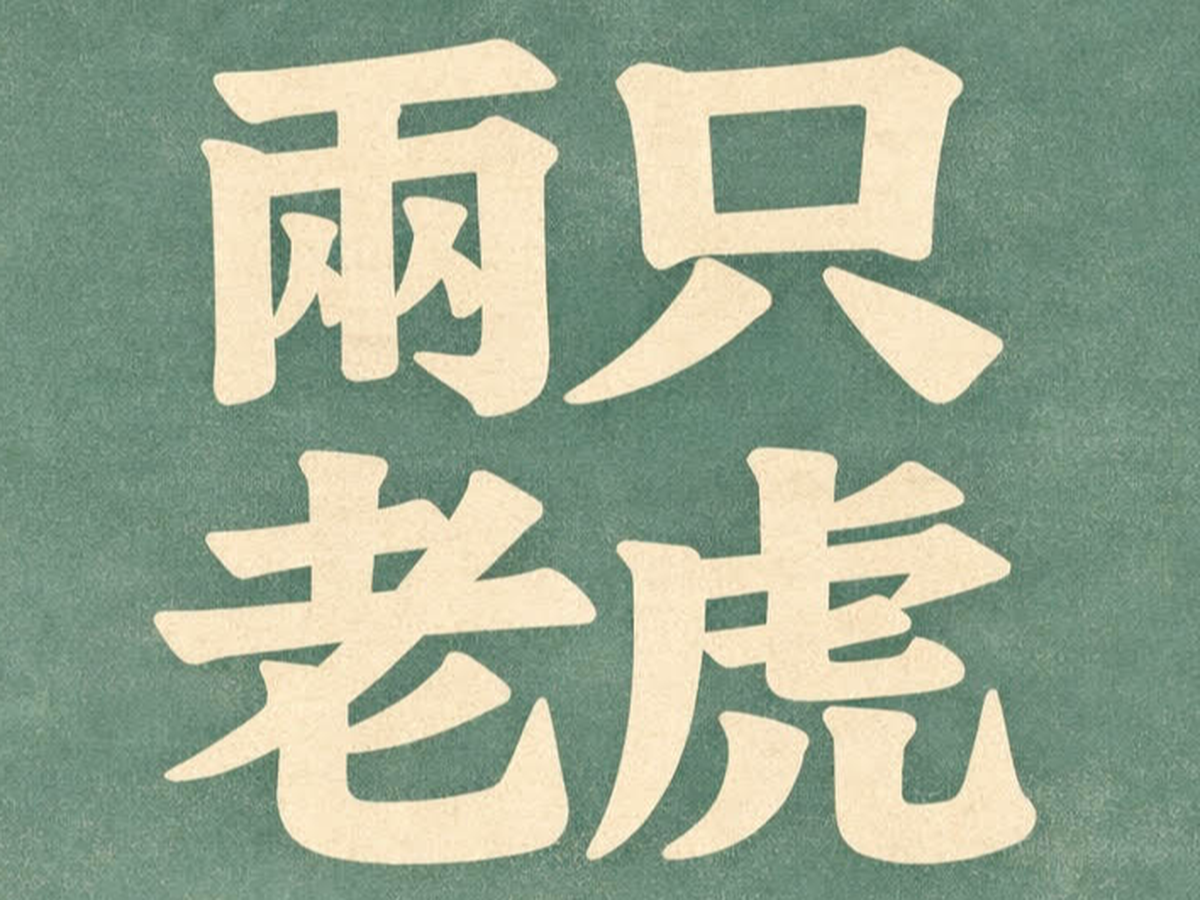
Two Tigers - Crowdfunding Short Film Proposal
Project Concept
When adults struggle over their own interests, family and marriage turn into mere transactions, love dissolves into silence and negligence, and children become bargaining chips.
Project Statement
This short film focuses on traditional Chinese family values, the living conditions of Chinese families in Japan, and the dramatic tension between female subjectivity in the family and the collectivism of the family itself. The film aims to demonstrate the unfortunate circumstance where individual identity, emotions, and dignity are rendered invisible because of self-interest when preservation of the family becomes the highest priority.
Rather than offering clear moral judgments or definitive conclusions, the film deliberately resists assigning right or wrong within the story. No single character can be simply labeled as correct or mistaken. Instead, by tracing the dynamics of the marriage of one particular family, the film seeks to portray the dilemmas immigrant families face as they struggle to fulfill their needs in a foreign society.
General Information
Title: Two Tigers
Genre: Domestic drama
Runtime: 30min (short)
Language: Chinese, Japanese
Keywords: Domestic, Immigrants, Female Perspective, LGBTQ+, Moral Dilemma
Title Significance
The film’s title, Two Tigers, originates from the Mandarin version of the well-known French nursery rhyme Frère Jacque. The song’s lyrics are as follows:
Two tigers, Two tigers,
Run so fast, Run so fast!
One does not have ears!
One doesn't have a tail!
That's so strange, That's so strange!
In this film, the husband, Chen Jianguo, who remains emotionally indifferent toward his wife Lin Jing, is portrayed as the tiger that has lost its ears — unable and unwilling to hear what truly matters. By contrast, Lin Jing, forced to confront one unsettling truth after another, resembles a tiger that has lost its tail, gradually losing her balance and her sense of direction in life.
The simple remark, “That’s so strange” spoken by their innocent and candid son Chen Youzhen, becomes the most direct and poignant question in the film — an unfiltered response that exposes the silent dissonance at the heart of the family.
Story Synopsis
Living in Tokyo, husband Chen Jianguo and wife Lin Jing, after years of emotional disconnection, begin their divorce process. As the proceedings unfold, the couple becomes locked in a conflict over the custody of their son, Chen Youzhen.
Through information obtained from a private investigator, Lin Jing gradually uncovers her husband’s true character, one that forces her to reexamine their family and marriage. As more truths come to light, she is compelled to confront not only the true reason behind the divorce, but also her own identity within the family.
Main Characters
Lin Jing (35) — Wife
Having endured long-term negligence from her husband, she decides to divorce. In the custody dispute, she takes a firm stance and refuses to yield, pushing the fight into a stalemate. As the proceedings unfold, she is forced to confront a series of long-hidden truths, compelling her to reassess her own position within the family.
Chen Jianguo (35) — Husband
For many years, he has maintained the appearance of a stable family through silence over conflict and disregarding of his wife. Each time he is caught between family and responsibility, he chooses retreating rather than resolving. During the divorce proceedings, the influence of his family of origin reinforces his fixation on gaining custody of the child. Yet he persistently refuses to articulate the true reasons behind this obsession, avoiding explanation until the very end.
Ito Ryo (35) — Chen Jianguo’s lover
A Japanese man living in Tokyo who has maintained a long-concealed affair with Chen Jianguo. Gentle in temperament and orderly in his daily life, he is not someone who deliberately intervenes in another person’s marriage. Yet, as a consequence of his desire, he ends up destabilizing Chen and Lin’s family. As familial relationships gradually lose their balance, Ito Ryo becomes a “place of escape” for Chen Jianguo, allowing him to postpone confronting reality.
Chen Youzhen (6) — Son
Born and raised in Japan, he is a child who cannot fully understand the Chinese language. Within the family, he is unintentionally yet consistently pushed aside. While unable to comprehend the unspoken circumstances among the adults, his intuition still lets him sense the delicate shifts and turns within the family. Caught in his parents’ conflict, Chen Youzhen gradually becomes the “vessel” that is being pushed around by his parents for personal gains. Yet he can only response to reality by humming his favorite song, the Two Tigers. His perspective offers the film its most innocent — and most piercing — gaze upon the family’s disintegration.
P.I (40)
Simply put, this is the detective who sets everything in motion. It is through the evidence he provides that Lin Jing is inevitably drawn into chaos. Visually and in character, he is far from the conventional image of a serious detective: large in stature, perpetually carefree, and at times unreliable. He functions both as the catalyst for the story and as a source of comic relief.
Director’s Note
The creation of Two Tigers originates from my long-term observation of what is often described in contemporary China as “the widowed marriages” — the relationships in which emotional and domestic responsibilities are unevenly borne within the couple. For many years, I have continued to reflect on a central question: what does marriage grant to the “father,” and conversely, what does it take away from the “mother”?
In this film, the self-centered Chen Jianguo is portrayed as a “tiger that has lost its ears,” as he can only hear himself speaking. While Lin Jing, as she continues to perform the roles of “mother” and “wife,” gradually loses her footing as a “woman,” is portrayed as the “tiger that has lost its tale.” The child Chen Youzhen, who is supposed to be the symbol of happiness, is — like in reality — the “sacrificial lamb” who is expected to absorb all the pain and consequences caused by the distortion.
By Junqing Yan, Director of Two Tigers
Reference Works
The Time to Live and the Time to Die (1985)
Director: Hou Hsiao-hsien
The Falls (2021)
Director: Chung Mong-hong
Tokyo Sonata (2008)
Director: Kiyoshi Kurosawa
Moving (1993)
Director: Shinji Sōmai
Yi Yi (2000)
Director: Edward Yang
Production Information
Production Format: RED KOMODO Redcode Raw,
Exhibition Format: 4K DCP, 1.85:1, 5.1 Surround Sound
Principle Shooting Location: Tokyo, Kawasaki, Yokohama
Principle Photography: March 9th – March 20th, 2026 (12 days)
Stuff Information
Screenwriter and Director: Junqing Yan (Japan Institute of the Moving Image)
Director of Photography: Hanzhi Zhang (Japan Institute of the Moving Image)
Producer: Hengyue-Daniel Xu (Japan Institute of the Moving Image)
The production team is experienced in Japanese filming workflows and student+pro combination production structures, ensuring efficient on-set execution and flexible decision-making. With strong multilingual communication skills and cross-cultural production experience, the team is well equipped to operate in diverse working environments.
Production Schedule

Project Initiation: November 1st, 2025
Screenplay Completed: January 1st, 2026
Fundraising: December 20th, 2025 – February 28th, 2026
Staff Recruitment: December 20th, 2025 – February 28th, 2026
Location Scouting: December 11th, 2025 – February 10th, 2026
Pre-production: January 2nd, 2026 – February 28th, 2026
Principal Photography: March 9th, 2026 – March 20th, 2026
Post-production: March 23rd, 2026 – Early May 2026
Project Completion: May 2026
Current Status
The project has entered the pre-production stage. The screenplay has been finalized, the core creative team is fully assembled, location scouting for the principal shooting locations is currently underway, and funding is being gradually secured through fundraising.
Budget Information
Estimated Total Budget: JPY 2.7 – 4.2 million (approx.) = CAD 24,000 to 34,000 (approx.)
Budget Breakdown

Budget Usage
The production budget for this project is structured in three stages:
1. Pre-production and Production
2. Post- Production
3. Publishing and Distribution
For the production stage, a detailed breakdown of the minimum required budget has already been carefully reviewed and calculated (as shown in above graph). Within this minimum budget range, it is fully possible to complete principal photography.
During the post-production stage, funds will be allocated to editing, color grading, sound design, caption, and DCP production. Investment at this stage will be directed toward enhancing the overall artistic quality of the film.
In the publishing and distribution stage, funding will be used to expand the film’s reach, primarily covering festival submission fees as well as various costs and handling fees associated with distribution and screenings.
Currently, the minimum production funding for this project has yet to be fully secured, fundraising is underway through crowdfunding campaigns. The immediate priority is to secure said funding for principal photography, allowing the project to transition into active production and ensuring the film’s completion.
Publishing and Distribution Strategy
Upon completion, the film will be submitted to the Tokyo International Film Festival (Student Category) for competition. The Osaka Asian Film Festival (Non-competition Categories) and the Yokohama International Film Festival (Competition Section or Showcase Section) are also proposed domestic submission targets.
In addition, the film will also be submitted to international film festivals with a focus on short films as well as Mandarin/Cantonese-oriented film festivals such as Shanghai International Film Festival and the Macau International Film Festival for potential international distributions.
Beyond film festival submissions, the project also plans to organize campus screenings at universities and limited theatrical screenings at small-scale art-house cinemas, with the aim of expanding the film’s exhibition channels.
Potential Feature-Length Expansion
Two Tigers is conceived from the short-film stage with a clearly defined world and character relationships. While the short film is designed to stand as a complete and independent work, should production conditions permit in the future, it can also serve as a creative point of origin for a commercially viable, feature-length adaptation. Allowing for a deeper exploration of the character dynamics, family structures, as well as cross-cultural conflicts and minority groups, within a broader temporal and structural framework.
The short film functions as a testing ground for both creative and production processes, generating insights into narrative structure, visual style, and production workflow that will inform future feature development.
However, it is worth noting that the feature-length expansion remains at the conceptual stage and does not affect the short film’s independence, production and completion.
--------------------------------------------------------------------------
Thank you for reading through the entirety of our fundraising campaign.
Once again, we would like to express our determination and passion for this project. We hope that one day, you can be proud to find our short film poster on the Tokyo International Film Festival homepage.
Two Tigers production team
Organizer