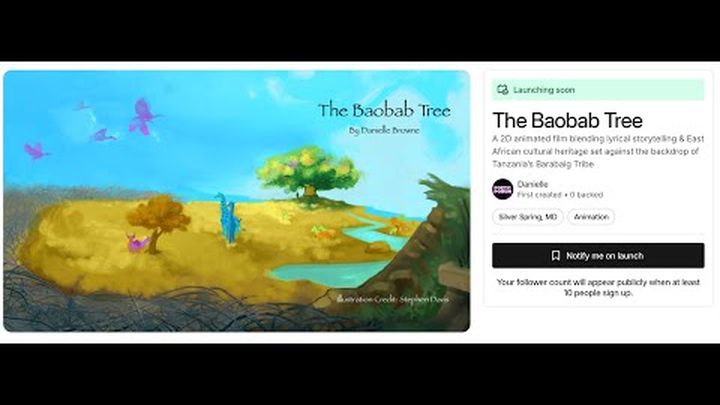
- S

We will hit our goal if only 1,000 generous people donate $50
Donate $50 today and you will be listed as CO-PRODUCER
Donate $25 today and you will be listed under SPECIAL THANKS
Synopsis: Friendship between a prideful yet lonely Baobab tree, and a 10-year-old boy, blossoms as the years go by. A century after the boy's passing, the tree meets the boy's great-great-grandson, forcing him to come to terms with his grief and the absence of his best friend.
Screenplay Accolades
StoryMode Independent Short Film Awards [June 16, 2022]: Best Short Script Award
Cordillera Int'l Film Festival Screenplay Competition [June 29, 2022]: Finalist - Short Scripts
Nashville Film Festival Screenwriting Competition [July 22, 2022]: Finalist - Short Scripts
Flickers' Rhode Island Int'l Screenplay Competition [July 23, 2022]: Finalist
Hamilton Film Festival Screenplay Competition [October 7, 2022]: Finalist -- Top 10
Pittsburgh Shorts and Script Competition [October 14, 2022]: Quarterfinalist
Festival de Largos y Cortos de Santiago [March 6, 2023]: Best Short Film Script Award
Baltimore Next Media WebFest [November 15, 2023]: Best Short Film Screenplay Award
The Baobab Tree Story
The knee-jerk reaction of many may be to say that my story is “The Giving Tree with extra steps”. However, though the characters of a boy and a tree were certainly popularized by the timeless work of Shel Silverstein, this film is not an adaptation of the beloved tale.
My story is not about unrequited love and taking more than you give in a relationship but about genuine friendship, losing loved ones, and handling grief. These concepts are emphasized through highlighting the special customs and burial ceremony of an indigenous people living in Tanzania; The Datoga Tribe -- more specifically, the Barabaig Tribe.
Living in north-central regions (near Mt. Hanang, Lake Eyasi, and Lake Basotu), the Datoga (a.k.a the Datog, Datooga, Tatooga, Tatoga, Tatog, Taturu, Mang'ati) are an agro-pastoral nomadic people considered (and consider themselves) to be one of the oldest tribes in Tanzania. There are at least 7 different tribes and the majority of them are also known by multiple names:
The Asimjeeg (Tsimajeega, Isimijeega), the Bajuta, the Barabayiiga (Barabaig, Barabayga, Barabaik, Barbaig), the Bianjiida (Biyanjiida, Utatu), the Buraadiiga (Buradiga, Bureadiga), the Gisamjanga (Kisamajeng, Gisamjang), and the Rootigaanga (Rotigenga, Rotigeenga).


The Barabaig Tribe has a very special burial ceremony that is only reserved for a highly respected elderly man within their community. A Bung'eda is built out of sticks (for fortification) and mud, formed into a cylindrical shape. The deceased is placed within the tomb, sitting upright, facing the east. This is incredibly significant because the sun rises in the east, making it so that the deceased never "sees a setting sun". This comes from the Barabaig tribe's belief that the honored man's life never ends. This is also reinforced by the rounded/cylindrical grave shape -- like a circle which has no end, the life of the deceased is eternal.

The subject of death will always be a prevalent and, often difficult, topic as its impact is far reaching - across race, gender, age, and creed. The Baobab Tree is, at its core, a story meant to help others navigate their pain through a rhyming, fantastical tale.
The Baobab Tree Character Names and Meanings
In Tanzanian culture (and many other African cultures), your name is very important and it is seen as a way to start your children off on the right foot. The names within this story have meanings that are closely tied to the characters and their personalities -- putting forth the idea that a name holds the power to reflect who we become.
Anza means "to start or to begin" in Swahili -- Anza is the first friend that Babu has on his lonely expanse of golden grass. He is not only the beginning of something new but is, quite literally, what kicks off the beginning/main plot of the story.
Babu means Grandfather in Swahili -- He is a tenacious Baobab of 1,000+ years old and he acts as, not just a friend but also as a protective paternal figure towards Anza as he watches him grow up.
Faraji means "solace or comfort" in Swahili -- you can see this directly through how he treats and talks to Babu. Faraji is very kind and, even upon meeting Babu for the first time, wants to help him through his grief. Faraji is a voice of reassurance that is gentle and understanding.
The Baobab Tree Character Perspectives on Losing Loved Ones
It was very important for me to capture each character's perspective on the main theme of this story: loss. I wanted to show that, across these differing opinions, each character's belief (and, by extension, all of our individual beliefs about death and how we express them) are valid.
Anza is not fearful of what is to come. In his eyes, he has fully lived, and views coming to the end of his life as "going home".
Babu mirrors many of us, especially in the beginning of coping with the loss of someone we loved, and is meant to be emotionally latched onto by readers and viewers. He fluctuates between anger, sadness, and confusion, bringing emotional realism to the story as he displays the ugly-side of loss.
Faraji is a reflection of Tanzanian beliefs (a belief that I also hold that has transcended the African diaspora) about our ancestors gaining an ethereal body once they pass on. They are as they were in life but are now within a spiritual realm, watching over and protecting us. Many Black people speak and pray to their ancestors, regularly.
Meet the Team!
We are small but mighty:


My Past Work and Filmmaking Experience
I have an established track record as an independent filmmaker/director. My first short film, The Farmer and the Lightning Storm, has played at film festivals across the U.S and was submitted for consideration in the 95th Oscars.

Synopsis: Burdened by frustration and fear, the Goddess of Lightning cannot find meaning in what she does and suppresses her abilities. After hearing Lightning's frustration, a nearby farmer helps her regain confidence in her powers by offering a different point of view.
The Farmer and the Lightning Storm -- The Farmer and the Lightning Storm, to me, demonstrates a lenience and kindness that are rarely extended to Black women (especially dark-skinned Black women). As a Black woman, I wanted to showcase our humanity and vulnerability through a fantastical, rhyming narrative. We are not simply “strong” and “independent” and it is in these boxes that we are often left behind to deal with far too much on our own; obligated to present an image of strength. We have apprehensions and insecurities and, in those moments, it takes a certain gentleness, patience, and compassion to allow us to feel heard as well as be vulnerable and soft. This film offers a calm, merciful, and non-judgmental exchange between two Black women; mirroring my own experiences, and the support I have always been afforded by the Black women in my life.

The Baobab Tree will be my 8th animation project! With all of my previous, independently-made projects under my belt, my track record speaks for itself! My previous works include the following short projects:

The Strength of A Soul -- a rhyming, narrative story that focuses on a Black woman's recent and untimely transition into the afterlife. In this short animated project, the woman must explain her life's story to the Grim Reaper, not only for his amusement but to convince him that she is worthy of going to Heaven. Unbeknownst to her, he has already made up his mind.

Thought That I Ought -- a simplistic, rhyming story that focuses on an 8-year-old girl named Molly and the power of her mind; formatted in the likeness of an animated storybook. She is incredibly excited about a secret that she has and, though she is mentally overwhelmed by it, Molly relishes in the fact that she knows something that the audience does not ... even if it turns out to be nothing at all. For this story, I had envisioned a whimsical art style that lightly followed the steps of Dr. Seuss along with the simple rhyme scheme and zany flow.

The Diary -- a "haiku", not pertaining to the natural world, but in the restrictive structure (5-7-5-7). My poem focuses on an elderly, Black woman in a nursing home who is looking back on the life she has lived. Though she is alone now, without husband and child, she wishes for nothing more than to do it all over again; not having changed a thing. Her life story is viewed through her most cherished keepsake: her diary.

Celestial Mother -- This short poem is, at its core, a surprise present for my mom for Mother's Day 2020. I had envisioned it to take place within the ethereal realm. It is a rhyming poem that describes the essence of Black women and how they nurture and mother the world; all through metaphors of nature and predominant imagery of galaxies and stars. It is meant to be a calm watching experience.

Father of Mine -- This poem is, at its core, a surprise present for my dad on Father's Day 2020. I had envisioned this poem to take place within the natural realm. Father of Mine is a rhyming poem that shows Black fathers as our teachers, mentors, and creators; all through metaphors and the predominant imagery of nature.

Ars Poëtica -- This shirt, rhyming poem was created to show what poetry means to me in a very lighthearted and simplified manner. I had envisioned this poem to take place in front of plain backgrounds, with the imagery in the foreground given more attention and detail as they morph and bend along with the lines of the poem.
Why This Story?
When I started The Baobab Tree in 2020, I was moved to write a story about loss and grief after the death of my Uncle. While continuing to draft The Baobab Tree in memory of him, I lost my Auntie and my Great-Aunt not too long after, in 2021. Then, my father passed away on September 20th, 2023 after a long battle with depression and other health issues.

My family and I have been going through a whirlwind of immense pain and grief. I wanted to write a story that could capture that sense of grief we all know so well, display the beginnings of what healing looks like through leaning on a community of family and friends, as well as showcase what healing looks like for the Barabaig tribe and their cultural viewpoint on death [and even, by extension, a viewpoint that transcends the African Diaspora] -- not solely as a sad procession but as a celebration of life; to drink, dance, and be merry.
This story is dedicated to my family members who have passed on and I am asking for your help to make sure this story gets told.
What We Need (The Budget)
Film production began with animation expenses totaling $77,200. We have since completed the character designs and the animatics stage in addition to reducing the film by 4-minutes. We have come so far. This campaign is for $47,000 -- to cover the cost of the animation and clean & color stages. Any extra funds will be allocated towards the film score!
*Up-to-date budget below*

Animation is very expensive, and the majority of the studios that can afford to produce large-budget animated films are tied to large corporations that finance productions in return for control and copyright.
I want to retain ownership, direction, and oversight, which is typically a deal breaker for corporate financing. I want to make sure that this film stays true to its story and does not veer away from the love and care with which it was made. We have the opportunity to be a part of the independent animation movement, as a small-team, without having to give-in to large corporation funding and control. And, with this project, we can prove it can be done! But, to do that, we're going to need your help.
Take a look at what is possible with our current budget:
Animation references:

Credit to Daniel Cardona for pulling these references together
Background:


Credit to Stephen Davis
Characters:

Credit to Daniel Cardona

Credit to Daniel Cardona

Credit to Daniel Cardona

Credit to Stephen Davis

Credit to Stephen Davis

Credit to Stephen Davis
Other Ways You Can Help
If you are not able to pledge to this fund, that is fine! I only ask that you please share this post so that this campaign can reach its goal.
At the end of the day, while my team and I appreciate your contributions, I am also looking to find my people/niche and build community. Please consider following the campaign and subscribing to my YouTube channel [Poetic Poison Youtube Channel Link ]!
You can also follow me on Twitter [Poetic Poison Ivy Twitter Link ].
I also post behind-the-scenes content for all of my videos! If you would like to see Daniel's art updates, hear the voices for The Baobab Tree and more, head on over to my Patreon! [Poetic Poison Patreon Link ] .

No matter where you look me up, drop in and say hello! Thank you for supporting independent animation and Black stories!
