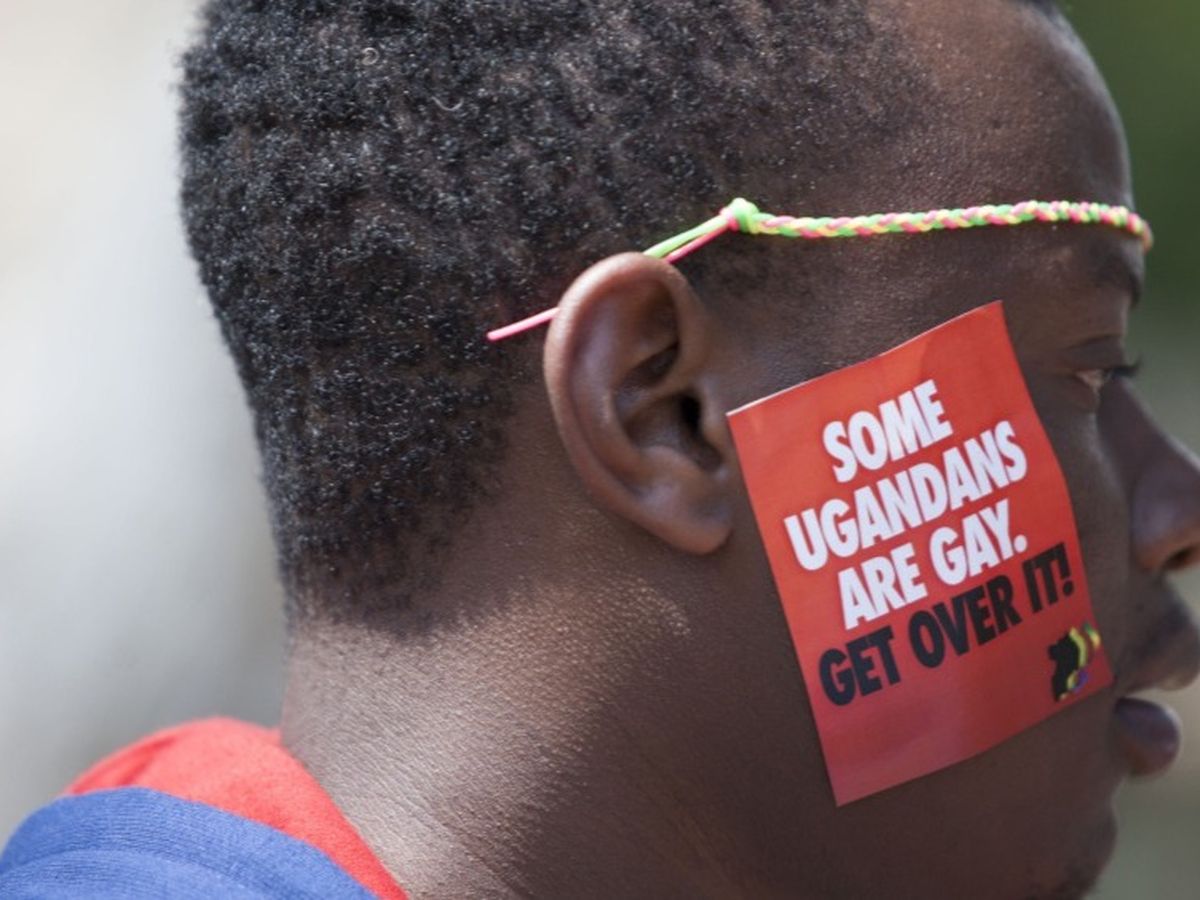
Help 32 Youth Survive Uganda's New Anti-Gay Laws!
0% complete
$7,910 raised of $20K
59 donations
Last May, Uganda’s draconian new LGBTQ laws drove 32 gay, mostly illiterate young adults, and 5 teens, out of their homes, schools, jobs and even families—and into dependency on my dear friend, Conrad* (Ugandan, 30 y.o., living there—and daily risking a life sentence for helping them). Since then, in solidarity, and with your now over $6000 , they leased land, fenced it and built a “safe-house” (safe from rape, beatings, hard rains, and malaria), with solar electricity, 12 bunk beds, at least a meal a day, trauma counseling as needed, and the security to create real community. Now, and with your continuing help, they are creating a 6 mo. Integrated Literacy Program with English, math, business, computer skills and climate focus to qualify for much safer jobs (as explained below).
Spring, 2024 The HOST Project
[Please see the timing & funds needed below this 5 part program description]
1. Safe House Continuing food, shelter, counseling, community building and security for the remaining 23 in residence (out of the original 32) while developing the job skills and opportunities as laid out below.
2. Schooling Three of the 5 teens will continue in day school ($100 each, by mid-January, one time payment of half their tuition for the whole Spring Term*). A fourth, John, newly abandoned by his guardians is now also living at the Safe House, while attending his last year of high school, ($240 for the term) and Shana will return to boarding school ($300 for the four month term.) Thus all of the teens can continue moving steadily towards the successful completion of their national exams.
3. Integrated Literacy Program With their immediate situation now secured—thanks to your donations and emotional support—the 22 young adults still living in the “Safe House” have sorted out how to help each other get their lives back on track and become again self-supporting, but this time in more secure workplaces—while also staying connected as a community. With the part time help of three instructors, including "Conrad", they will use the next six months to gain the scarce and valued skills that qualify them for positions that tend to be much safer, i.e. in professional and office environments. (Please the two paragraphs at the end, after my sign-off below, for details on this program.)
4. Job Development and Placement Along with overseeing these studies, two of the teachers are also undertaking discreet inquiries and job development efforts, in both home and more distant communities, seeking positions and partners able to offer safer employment for their 22 graduates.
Also, noting this 2023’s accomplishments, with your aid, five of the young adults relocated to relatively safer jobs in the UAE. They are doing well enough, remain in touch, and see themselves still as “members of this community”. They expect in spring to start gradually paying back their costs so that your donations to them can then be “recycled” to help still others to safety.
Most of the 22 hope to make it work in Uganda, but some do want to emigrate and will need help doing so.
5. Network of Resilience & Relationships What began by accident in May as a group of isolated individuals driven together by desperation, has become—with the shelter, safety and mutual support your donations have made possible—a true community, and an enduring one. If all goes well, by mid-2024, the original 32, rescued the year before, will all be settled in relatively safe situations, in jobs and new homes, continuing in day or boarding school, or starting university.
Meanwhile, supplementary means of safe transition (not describable here for security reasons) are underway that will permit what will have proven itself a viable integrated literacy program, initiated on an emergency basis, and dependent on your gifts, to become a largely self-supporting and on-going program of safe transition for still other, especially younger, LGBTQ Ugandans in need of its support and services.
Over time, all involved along the way with the HOST Project, in any capacity, will now have that community there for them to stay as connected to as they wish, none isolated or alone, but continuing within reach of others whom they can trust, enjoy and turn to for mutual help.
And for the donors? To the extent that you wish to, the people you can come to know through this process, the humans behind the headlines, can be among those you love, share with and learn from half a planet away,
Monthly Needs
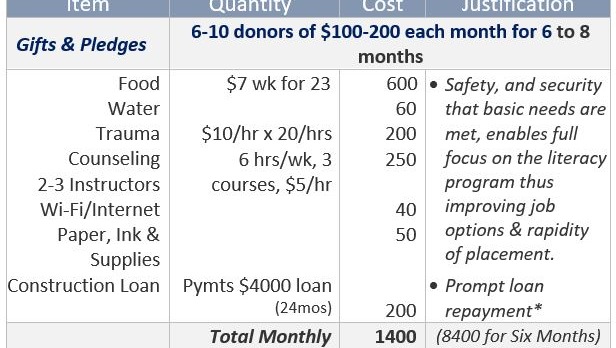
Anything you are able to give towards these needs, at any point!, is very much needed and welcome. If you would like to give some amount regularly over these coming few months, please contact me to explore it. Where that's possible, it does help greatly to relieve people (and their fundraisers!) of the stress of "not knowing where the next meal is coming from"-- quite literally--eliminating the weekly fear of hunger, and reducing the shame, even guilt, these youth may feel for repeatedly having to ask "still more" of you. And that security, in turn, can make it that much easier for them to fully focus over these next months of intense effort to learn the difficult new skills they need if they are indeed to get beyond such dependency and into the new jobs they can then qualify for--jobs with both more respect and more safety--and their own opportunities to "pay it forward", reusing your donations to meet the needs of still others.
One-Time Gifts
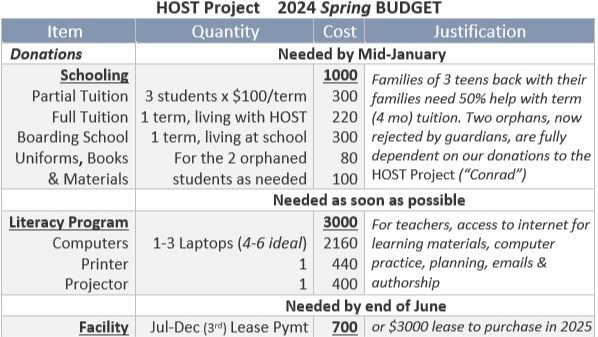
At the same, one-time gifts are also precious right now, as well--any amount you can manage--since both student tuitions and much of the equipment for the literacy program depend on those lump sums showing up in January--while later such gifts, towards additional laptops, can increase the speed and level of competency students can manage.
Getting Personal
Donations meet urgent needs, but the impacts go beyond money. Donations convey the living truth that these youths are not alone, they deserve a good life, and they are much valued, just at a time when they most need to hear it. In fact, even when you're unable to donate money, your personal connection and interest mean much to those recovering from rejection in their own communities, so do reach out if you feel drawn to do so. You can share your own stories, get copies of the three reports "Conrad" has put out that contain some of their individual stories, and connect by contacting me via this website.
Giving Feedback
Below, I've gone into more detail about the purposes and plans of the HOST Project, as these have been evolving among those living this all out, and more about the context for it. As you read over all of this, the overview and budget above, and the details below, you may well have questions, insights, concerns and inspirations--even a desire to help with this effort in some way, or some other responses. If any of these, please do feel free to reach out by emailing me via this website. I thank you in advance for your heartful attention to what is here, any thoughts you have to share and the chance to connect further.
Nancy Clover Glock-Grueneich
How the Integrated Literacy Program will work
Depending on donations, and initially on volunteers, the new program started Monday, January 11 and will run through Friday, June 15, 2024. Three part-time instructors, including one member of the community as a “teacher in training”, will work with the other residential members (now 22 out of the original 32) to become fully literate in English, arithmetic, business and computer skills, and with an emphasis on how these can connect with achieving climate resilience. Teachers and student-colleagues are working together to develop the particulars of what content and contexts they’ll focus on, and the processes, tools and materials they’ll use or create.
Recognizing that this is an adult program, intended to strengthen confidence, competence and agency, the contexts and content around which the skills are practiced, must themselves serve practical uses and student priorities at every point possible. The intention here is also to draw upon such “each one, teach one” educational approaches, as are embodied in “Letter to a Teacher” (Italy), Tostan (Senegal), WORTH (Nepal), Paulo Freire’s work (Brazil), and Foxfire Magazine (USA) and John Dewey (USA).
As fully as feasible, students will choose their focus and practice their skills as part of moving ahead with their own interests, needs, talents and ambitions. Practical research, problem-solving, and team-building skills will grow along with learning or sharing their own knowledge, and finding and testing other sources—local and on their internet, about their own and others communities, lives, projects, issues, as well as the natural world they are in and affect.
How literacy and related skills increase LGBTQ security in Uganda
Of the LGTBQ members who’ve come out in the past to fight for their rights and protect their own, 90% are literate. Of those who are illiterate or minimally literate, 95% do not dare come out, because of the communities they tend to be part of, and the kinds of work situations available to them.
Professional offices, retail and service operations, who expect literacy of those they hire, tend as a group to be more cosmopolitan and less homo-phobic. Even where influenced by the anti-gay norms of the surrounding society, they are less likely to see it as their job to pursue suspicions they may have, or as their duty to “turn someone in”. And some, indeed, even when not too public about it, can themselves be human rights advocates, unwilling to harm gays, gay themselves, or with family or friends who are.
In addition, professional offices and other such places, have their own practical reasons to just “live and let live", for English literacy, math, basic computer and practical organizational skills, among non-professional workers in an office, are at a premium. And when English is the only language a given office has in common—the most common situation—having all who are employed there literate and speaking English, able to handle numbers and computers and manage problems well—whatever their job—retail and file clerks; stock managers; cleaners or errand-runners. Such combinations of skills can be hard to find and good to hang onto. Stores and offices will be anxious to hire, and hesitant to lose those who show up with such valuable skills.
As it now stands, of the 22 adults living in the Safe House, eighteen are illiterate or semi-literate, and even the four who are literate—and can help with the others—are themselves also anxious to strengthen their own employability and security further by developing the business, computer and math skills the integrated program will offer.
Even though they’re each increasingly anxious to get out of dependency and on with their lives, at this point the 18 without literacy still have only the old dangers to go back to, without the protections that literacy and related skills could provide. And as long as they are dependent on odd-jobs, and communities of others similarly circumstanced, they will continue to be much more vulnerable to discovery, to vigilante beatings or worse, and/or to being turned in as criminals. Even their fellow day laborers, who might otherwise leave them alone, with the new laws, will no longer risk protecting them when their own failure to report a suspected homosexual is itself a criminal offense punishable by prison. And unlike the situation in professional offices, they gain no benefit from taking such risks onto themselves.
After taking all of this into consideration, the members agreed that that a literacy program was both much needed and a logical next step from where they are now. They sketched out what it would take for it to work, the costs, risks, and the desire and capacity of the group as it is now, without adding too much more, to actually pull it off,
and came up with the plan laid out above and the budget laid out here.
If the donor support needed could be there for at least the first six months, the idea is to continue to shelter and provide for the remaining young adults long enough to complete this Integrated Literacy Program and thus increase their longer term employability and job safety. And it also seems that even beyond the benefits of literacy, for them to be able to stay together these further six months, and helping each other learn, they would be that much more fully healed, the solidarity of their community deepened, the job prospects of each strengthened, and their chances for good lives (even if still partly hidden) would otherwise be greatly improved.
Finally--and again--thank you so much for you care and attention for what has been shared here, and for doing what you can. And do reach out (via this website) with ideas, questions, suggestions--or just to connect!
Organizer