- J
- R
The Vermont Reptile and Amphibian Atlas 2027 Fundraiser
0% complete
$1,558 raised of $25K
26 donations
Eight years ago, we organized our first fundraiser. In addition to funding our educational outreach, data gathering, and conservation efforts, the fundraiser was also motivated by a decline in our regular grant funding, a pressing need to get all our data digitized for future use, and to assign accurate latitude and longitude coordinates to older records. Our fundraiser was a huge success, so we now hold annual winter fundraisers in hopes of raising $25,000 or more to support Herp Atlas projects that are not adequately funded by our grants. One ongoing concern for this coming year is what will happen to our funding that comes from the federal level (US Fish & Wildlife Service and the USDA’s Forest Service). Our work with USDA’s Natural Resource Conservation Service was cut two years ago, and has not been reinstated. We will continue our conservation work nonetheless. I hope you can help with a donation.
Donations can be made in a few ways:
- By sending a check made out to James S. Andrews to: The Vermont Reptile and Amphibian Atlas, 642 Smead Road, Salisbury, VT 05769 (your donation stretches further, with no fees or overhead expenses lost)
- Through this GoFundMe site
- Via our online shop or the PayPal button on our website
- If you need to donate to a 501(c)(3) non-profit, you can send a check made out to Vermont Family Forests to: The Vermont Reptile and Amphibian Atlas, 642 Smead Road, Salisbury, VT 05769.* Vermont Family Forests is our fiscal sponsor, and they are a registered 501(c)(3) non-profit.
*If your fund requires that a check be sent directly to Vermont Family Forests (P.O. Box 254, 14 School Street, Suite 202A, Bristol, VT 05443), please notify them that your donation is for the Vermont Reptile and Amphibian Atlas, and please also contact us directly about your donation.
**Checks should not be made out to the Vermont Reptile and Amphibian Atlas. We can’t cash them that way.
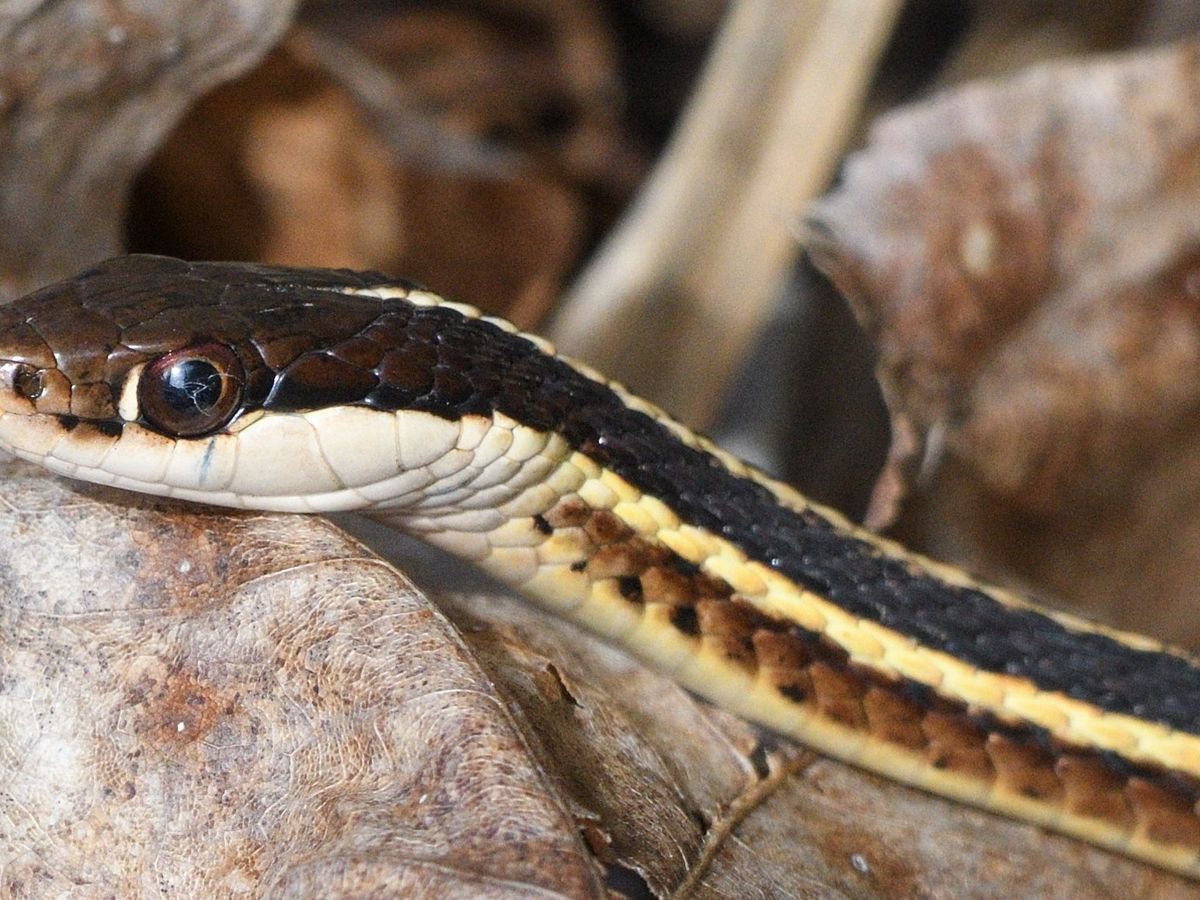
Our photo this year (at the top of the page) shows an Eastern Ribbonsnake, an S2 species of special concern in Vermont, which was photographed by Grace C. In 2026, we received 11 verified reports of Eastern Ribbonsnakes. One of these (found and photographed by Mary Droege and her son) was the first documented Ribbonsnake in Castleton. This species looks similar to the Common Gartersnake, but has some unique field marks: a bright white upper lip, reddish-brown color on top of the head, a white bar in front of the eye, a thin black line behind the eye, and a mahogany stripe on the lower sides. Keep your eyes out for this rare species and have your camera ready to snap a photo!
Ongoing goals for 2027
The primary goal of the Atlas is to gather and disseminate the data that are needed on the reptiles and amphibians of Vermont in a way that involves and informs Vermont individuals and organizations so that they can become more informed and effective stewards of wildlife habitat.
This coming year we will continue to:
- encourage everyone to photograph and report the reptiles and amphibians they see in Vermont.
- review all records, correct misidentifications, answer questions, and respond to the contributors with useful conservation suggestions when appropriate.
- work with the local press to get information out on the natural history and conservation of all of Vermont’s reptiles and amphibians. Although reptiles and amphibians are our area of expertise, they serve as vehicles for the conservation of all living things in Vermont.
- offer field trips and presentations and work with both private organizations and government agencies to help promote the conservation of reptiles and amphibians specifically and all wildlife in general.
- update our website, make additional videos, and make that information available to the public through our Herp Update newsletters and social media.
Short-term goals for 2027
Coordinates and elevations
We continue to add latitude and longitude coordinates to all records of common herps from Vermont. All new records have lat longs assigned to them, and all rare and unusual species have been assigned coordinates, but older records of more common herps still need lat longs assigned to them. We recently began adding elevation and elevational accuracy data to each report, which we believe will help us understand the distribution of some species. We plan to have one young wildlife biologist working part-time this winter on this project, and your funds will directly support this biologist.
Field Surveys
We will personally fill in new town records or update historic records for over 50 Vermont towns.
Publications
We published a foldable guide to the amphibians of Vermont in 2023; this year, we hope to put together a foldable guide to the reptiles of Vermont.
What progress have we made recently?
Update of the Website and Outreach
Regular updates and improvements have continued to be made to our website by Kate Kelly and Kir Talmage. In addition, we send out periodic Herp Update newsletters to a group of over 600 people and the local press. These updates get added to our website and our social media pages so that they are available to anyone. Our Facebook page (~4,295 followers, up from 3,400 last year) and new Instagram account (now with 332 followers (up from ~200 followers last year) have been quite successful, with 709,154 views of our regular Facebook posts, and 27,347 views on Instagram. We updated information on our remaining data gaps, and kept up-to-date information on upcoming presentations and field trips on our website. We updated the Vermont Herp Conservation Status list to reflect changes made in cooperation with VT Fish and Wildlife, and we provided information on Act 47’s herptile protections.
Coordinates
All our new records are entered into our database with latitude and longitude coordinates for point mapping. Some smartphone photos show us almost exactly where the photos came from. This was not always the case. Older records most often came with physical descriptions of roads or landmarks describing the location. We had previously finished reviewing and assigning of lat/longs to all reports of S1 through S4 species. Records with lat longs assigned now total over 125,000 (up from 116,000 last year) out of a total of 134,731 (up from 129,000 last year). We continue to add lat/longs to older reports of S5 species. This project will be ongoing for a few more years.
Contributed records from the public
From October 1, 2025, through September 30, 2026, 970 (649 new) contributors provided 5,686 new records that were entered into the Vermont Reptile and Amphibian Atlas Database. This brings the total number of reports entered to almost 135,000.
Sightings during this period came from 246 towns, cities, grants, and gores, and all Vermont counties. They included all of Vermont’s native species except Boreal Chorus Frog (probably extirpated from Vermont, last reported in 1999), North American Racer (last reported in 2024), and Fowler’s Toad (last reported in 2021).
Over the past year, we have entered 391 verified new reports of S1 species, 116 verified reports of S2 species, 2,060 reports of S3 species, 201 reports of S4 species, and 2,512 reports of S5 species. We have filled in at least 72 data gaps for S4 and S5 species over the past year. In addition, we have added negative reports (unsuccessful searches), unverified reports, reports of significant crossing areas, reports of significant herptile habitat, and data from long-term monitoring sites into our database.
Targeted survey efforts
During this period, we personally visited 53 “towns” (including cities, gores, or grants) to gather new records or update old reports. Many survey trips focused on those “towns” that have had the least survey effort. This is usually the result of low numbers of residents. Other trips focused on species that are not often reported by citizen scientists. These include the Northern Dusky Salamander (Desmognathus fuscus) and Spring Salamander (Gyrinophilus porphyriticus). We also worked with Luke Groff of VT Fish and Wildlife on our annual search for North American Racers in southeastern Vermont.
Field trips, presentations, and media outreach
During this time, we had WCAX with us on one turtle event and we provided our annual interview on Vermont herptiles for Vermont Public’s Vermont Edition.
We did another Habitats and Highways training for the Vermont Agency of Transportation and Fish and Wildlife.
Presentations and/or field trips were provided for, or in association with, the Salisbury Conservation Commission, the Forest and Field Club (in Ferrisburgh), the CVU Forest and Field Class, Shelburne Farms, Shelburne Natural Resources and Conservation Commission, the Dummerston Conservation Commission, the Caledonia County Natural Resources Conservation District, Vermont Center for Ecostudies, ECHO, the Dead Creek Wildlife Festival, and the Herricks Cove Wildlife Festival. In addition, my assistants Kate Kelly and Ira Powsner each helped with bioblitzes in association with ECHO, and Ira gave a presentation for ECHO.
Exotic species
Every year, we receive a few reports of non-native reptiles and amphibians that were either released or escaped pets, or they were accidentally transported via boats, trucks, RVs, and cars. During this time period, we received five reports of Pond Sliders (Trachemys scripta) from four different towns (Castleton, South Burlington, Springfield, and Windsor-2). This brings the total of Pond Slider reports in our database to 30 reports from 20 towns. Five of these reports are from the Gilbrook Nature Reserve in Winooski. As mentioned in previous reports, this is a common pet turtle species that has become invasive in southern New England.
Another common pet species, the African Spurred Tortoise (Centrochelys sulcata), was reported this year from Lyndon. It was captured and taken to a dealer in Massachusetts.
Although we have populations of Common Five-lined Skink (Plestiodon fasciatus) in Vermont, the reports we received from Burlington, Elmore, Essex Junction, Middletown Springs, Plainfield and Woodstock are all assumed to be transported individuals. This lizard is quite common in the southeast, and it is easily and often transported.
Hypothetical species
We received three reports of Eastern Box Turtles (Terrapene carolina), one each from Rockingham, Sudbury, and Weston. Since the Sudbury report is in western Vermont and far from the Massachusetts border, it is almost certainly a released pet. The origin of the Rockingham and Weston turtles is less clear, and they could potentially be native turtles. This is a species that could likely survive our winters, so a released pet might be seen over a period of years.
New locations
We received three convincing reports of Spotted Turtles from unexpected towns and locations; these were forwarded to Luke Groff and Molly Parren of VT Fish and Wildlife to investigate.
Data sharing
This past year, we provided Vermont distribution records of herptile species to the Vermont Endangered Species Committee, Vermont Fish and Wildlife, and UVM graduate students. Wood Turtle records were again provided to Kiley Briggs of the Orianne Society. Vernal pool records were shared with the Vermont Center for Ecostudies (VCE), and data was reviewed from both VCE and North Branch Nature Center.
We continue to regularly provide information to contributors from target towns where we need more data. We send these contributors a list of common reptiles and amphibians that are expected to be in their towns but have not yet been photo documented, or species for which we need updated reports and photos. For towns that have a good chance of providing habitat for rarer species, we include our list of herptiles that should always be documented. As in previous years, we provided this sort of data to residents of over twenty towns. Many of these exchanges resulted in new town records.
The Forest Ecosystem Monitoring Cooperative and the Colby Hill Ecological Project continue to get exported monitoring data and reports, but they pay for the monitoring and reports.
Significant herptile sightings were shared with Vermont Fish & Wildlife herpetologist Luke Groff as they were received, and reports of all S1-S3 herptiles are forwarded to Vermont Fish and Wildlife annually.
Awards
Environmental Excellence Award for the Monkton Amphibian and Wildlife Crossing, from the Federal Highway Administration (with others). 2017
Award for Excellence in Herpetofaunal Conservation, from Northeast Partners in Reptile and Amphibian Conservation. 2017
Sally Laughlin Award for the Protection of Threatened and Endangered Species in the state of Vermont, from the Secretary of the VT Agency of Natural Resources. 2019
USDOT, Federal Highway Administration Environmental Excellence Award, for Vermont Highways and Habitats, Road Ecology Training for Transportation Professionals (with others). 2022
Eco-Spirit Award from Spirit In Nature, to honor Jim’s public education, outreach and citizen science work in support of Vermont’s reptiles and amphibians. 2025
Transborder Award, from Northeast Transportation and Wildlife Collaborative, awarded to Jim and others who produced a regional Highways & Habitats training focused on the northeastern US. 2026
Local Leadership Award, from the Vermont Natural Resources Council, to honor Kate Kelly’s work at the Vermont Reptile & Amphibian Atlas, Hinesburg Conservation Commission, and Lewis Creek Association. 2026
Thank you for your support!