The Vermont Reptile and Amphibian Atlas 2026 Fundraiser
0% complete
$25,428 raised of $25K
174 donations
Seven years ago, we organized our first fundraiser. In addition to funding our educational outreach, data gathering, and conservation efforts, the fundraiser was also motivated by a decline in our regular grant funding, a pressing need to get all our data digitized for future use and to assign accurate latitude and longitude coordinates to older records. Our fundraiser was a huge success, so we now hold annual winter fundraisers in hopes of raising $25,000 or more to support Herp Atlas projects that are not adequately funded by our grants. One ongoing concern for this coming year is what will happen to our grants that come from the federal level (US Fish & Wildlife Service and the USDA’s Forest Service). The USDA’s Natural Resource Conservation Service had funded four trainings and cooperative work on their conservation projects until their funding was cut this last spring. We will continue our conservation work nonetheless. I hope you can help with a donation.
Donations can be made in a few ways:
- By sending a check made out to James S. Andrews to: The Vermont Reptile and Amphibian Atlas, 642 Smead Road, Salisbury, VT 05769 (your donation stretches further, with no fees or overhead expenses lost)
- Through this GoFundMe site - make sure to click "Give once" if you don't wish to donate monthly
- Via our online shop or the PayPal button on our website
- If you need to donate to a 501c3 non-profit, you can send a check made out to Vermont Family Forests to: The Vermont Reptile and Amphibian Atlas, 642 Smead Road, Salisbury, VT 05769.* Vermont Family Forests is our fiscal sponsor and they are a registered 501c3 non-profit.
*If your fund requires that a check be sent directly to Vermont Family Forests (P.O. Box 254, Bristol, VT 05443), please notify them that your donation is for the Vermont Reptile and Amphibian Atlas, and please also contact us directly about your donation.
**Checks should not be made out to the Vermont Reptile and Amphibian Atlas. We can’t cash them that way.
No giveaways or promotions are offered in exchange for any donations made to this GoFundMe.
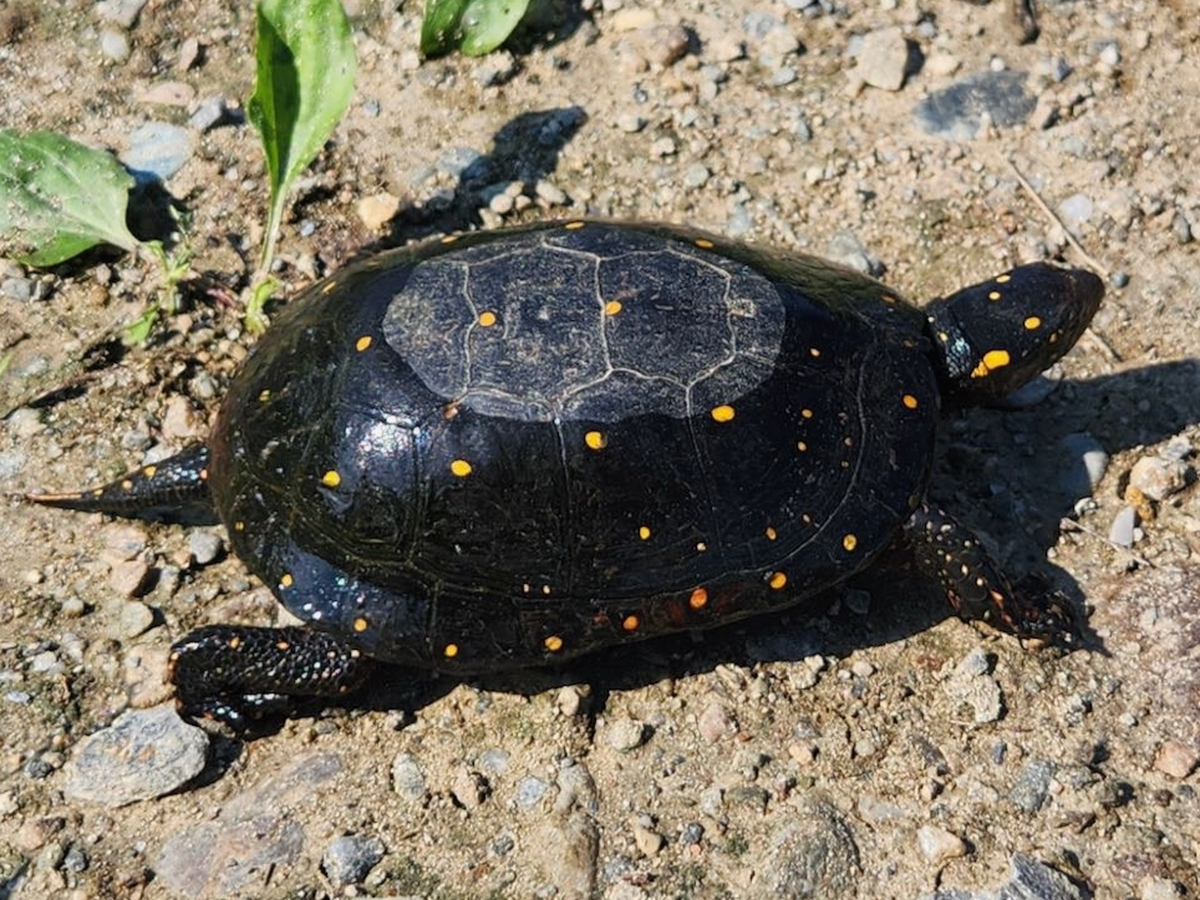
Our photo this year (at the top of the page) shows a state-endangered Spotted Turtle , photographed and reported by a contributor. As of this spring, we only knew of three populations of Spotted Turtles in Vermont. Working with the Vermont Department of Fish and Wildlife, we expect this report and photo will lead us to the fourth known population in Vermont.
Ongoing goals for 2026
The goal of the Atlas is to gather and disseminate the data that are needed to conserve the reptiles and amphibians of Vermont, in a way that involves and informs Vermont individuals and organizations so that they can become more informed and effective stewards of wildlife and their habitat.
This coming year we will continue to:
- encourage everyone to photograph and report the reptiles and amphibians they see in Vermont.
- review all records, correct misidentifications, answer questions, and respond to the contributors with useful conservation suggestions when appropriate.
- work with the local press to get information out on the natural history and conservation of all of Vermont’s reptiles and amphibians. Although reptiles and amphibians are our area of expertise, they serve as vehicles for the conservation of all living things in Vermont.
- offer field trips and presentations and work with both private organizations and government agencies to help promote the conservation of reptiles and amphibians specifically and all wildlife in general.
- update our website, make additional videos, and make that information available to the public through our Herp Update newsletters and social media.
Short-term goals for 2026
Coordinates and elevations
We continue to add latitude and longitude coordinates to all records of common herps from Vermont. All new records have lat longs assigned to them, and all rare and unusual species have been assigned coordinates, but older records of more common herps still need lat longs assigned to them. We recently began adding elevation and elevational accuracy data to each report, which we believe will help us understand the distribution of some species. We hope to have two young wildlife biologists working part-time this winter on this project, and your funds will directly support these biologists.
Field Surveys
We will personally fill in new town records or update historic records for over 50 Vermont towns (last year we visited 98 towns!).
Publications
We published a foldable guide to the amphibians of Vermont in 2023; this year, we hope to put together a foldable guide to the reptiles of Vermont.
What progress have we made recently?
Publications
Every 5-8 years, we print an updated version of our Vermont Reptile and Amphibian Atlas with our latest distribution maps, as well as many other updated charts, tables, and lists of resources. The previous printed edition was completed in 2019. We have now finished and printed our new 2025 edition. We sent complimentary copies to state herpetologists in Vermont and many of our neighboring states. This new edition is also now available through our website at VtHerpAtlas.org.
Update of the Website and Outreach
Regular updates and improvements have continued to be made to our website by Kate Kelly and Kir Talmage. In addition, we send out periodic Herp Update newsletters to a group of over 500 people and the local press. These Updates get added to our website and our social media pages so that they are available to anyone. Our Facebook page (~3,400 followers) was quite successful, so in 2025 we started a new Instagram account (now with ~200 followers). We updated many of our charts, tables, and lists of resources as part of our printed 2025 Atlas, and these are now available on our website.
Coordinates
All our new records are entered into our database with latitude and longitude coordinates for point mapping. Some smartphone photos show us almost exactly where the photos came from. This was not always the case. Older records most often came with physical descriptions of roads or landmarks describing the location. We had previously finished reviewing and assigning of lat longs to all reports of S1 through S4 species. Records with lat longs assigned now total over 116,000 of 129,000 records. This is 7,000 more than last year at this time. We are continuing to add lat longs to older reports of S5 species. All towns in Addison and Rutland Counties have been finished along with all the towns bordering Lake Champlain. We are very pleased with this progress. This project will be ongoing for a few more years.
Contributed records from the public
From October 1, 2024, through September 30, 2025, 781 contributors (471 for the first time) provided 3,555 new records that were entered into the Vermont Reptile and Amphibian Atlas Database. This brings the total number of reports entered to almost 130,000.
Sightings during this period came from 251 towns, cities, grants, and gores, and all Vermont counties. They included all of Vermont’s native species except Boreal Chorus Frog (probably extirpated from Vermont, last reported in 1999), North American Racer (last reported in 2024), and Fowler’s Toad (last reported in 2021). We did add one report of a Fowler’s Toad from an island in the Connecticut River in NH.
Over the past year, we have entered 95 verified new reports of S1 species, 147 verified reports of S2 species, 416 reports of S3 species, 190 new reports of S4 species, and 2,499 reports of S5 species. In addition, we have added negative reports (unsuccessful searches), unverified reports, reports of significant crossing areas, reports of significant herptile habitat, and data from long-term monitoring sites into our database.
Targeted survey efforts
During this period, we personally visited 98 towns (or cities, gores, or grants) to gather new records. Many survey trips focused on those “towns” (including cities, gores, and grants) that have had the least survey effort. This is usually the result of low numbers of residents. Other trips focused on species that are not often reported by citizen scientists. These include the Northern Dusky Salamander (Desmognathus fuscus) and Spring Salamander (Gyrinophilus porphyriticus). We filled in over 165 data gaps (species/town combinations) with these trips.
Field trips, presentations, and media outreach
During this time, I met with writers and press for a number of interviews and news pieces on Vermont herptiles. These include two Wildlife Watch shows for WCAX TV, an episode on Across the Fence, and our annual interview on Vermont herptiles for Vermont Public’s Vermont Edition.
The trainings for staff of the Natural Resource Conservation Service (NRCS) did not take place this year due to Federal Government cutbacks, but we did do a training series called Habitats and Highways for the Vermont Agency of Transportation and Fish and Wildlife.
Presentations and field trips included both a presentation and field trip for the Hannaford Career Center in Middlebury, field trips and/or presentations for the Lewis Creek Association, the Salisbury Conservation Commission, the New Haven Conservation Commission, the Dummerston Conservation Commission, Vermont Coverts, Bonnyvale Environmental Education Center, Farm and Wilderness Conservation, the Dead Creek Wildlife Festival, and the Herricks Cove Wildlife Festival. In addition, our assistant Ira Powsner provided presentations and/or field trips for the Vermont Institute of Natural Science and the UVM Herpetology Club, and Kate Kelly presented to the Hinesburg Conservation Commission and nearby residents.
Exotic species
Every year, we receive a few reports of non-native reptiles and amphibians that were either released or escaped pets, or they were accidentally transported via boats, trucks, RVs, and cars. We received our first-ever report of a Northwestern Salamander (Ambystoma gracile). It was found in Monkton and came to Vermont with a shipment of shrubs from Oregon. We also entered our first report of a Southern Alligator Lizard (Elgaria multicarinata). It was found in a house in Bridport. All other non-native herptiles reported this year have also been reported in previous years. We received our fifth report of an African Spurred Tortoise (Centrochelys sulcata). This one was in Cavendish and was clearly an escaped pet. We received our fourth report of a Brown Anole (Anolis sagrei). It was found in Johnson and it apparently hitched a ride on a truck from Florida. We also received our fourth report of a Mediterranean House Gecko (Hemidactylus turcicus). This is the third Mediterranean House Gecko reported from a heated warehouse in Middlebury. It is possible that there is a breeding population in that warehouse. Lastly, four Pond Sliders (Trachemys scripta) were reported. This brings the total of Pond Slider reports in our database to 27. This year, one was in the Intervale in Burlington, another nearby in the Memorial Park in Winooski, another in Gilbrook Nature Area in Winooski, and the fourth one at Buckner Preserve in West Haven. This is a common pet turtle species that has become invasive in southern New England. As our climate continues to warm, they could become invasive in Vermont.
Hypothetical species
We received two new reports of Eastern Box Turtles (Terrapene carolina). Based on their locations (Red Rocks Park in South Burlington and Crawford Forest in Waterbury), these were both likely released pets.
New locations
We received a report and photo of a Spotted Turtle from a new site in Addison County. We also got reports documenting three new sites for Common Five-lined Skink (Plestiodon fasciatus). All of these new sites were in Benson and within two miles of a previously known population on the shore of Lake Champlain.
Newly historic
Since this atlas effort has been ongoing for over 25 years, we now find it necessary to update species/town combinations where a given species has not been reported from a given town in over 25 years.
Data sharing
This past year, we provided Vermont distribution records of herptile species to the Vermont Endangered Species Committee, The Nature Conservancy of Vermont, Vermont Fish and Wildlife, a steering committee for the Monkton Town Forest, and the Watershed Center. Wood Turtle records were again provided to Kiley Briggs of the Orianne Society.
We continue to be aggressive about providing data to contributors from target towns where we need more data. What we provide to these people is a list of common reptiles and amphibians that are expected to be in their towns but have not yet been photo documented, or species for which we need updated reports and photos. For towns that have a good chance of providing habitat for rarer species, we include our list of herptiles that should always be documented. As in previous years, we provided this sort of data to residents of over twenty towns. Many of these exchanges resulted in new town records.
The Forest Ecosystem Monitoring Cooperative and the Colby Hill Ecological Project continue to get exported monitoring data and reports, but they pay for the monitoring and reports.
Significant herptile sightings were shared with Vermont Fish & Wildlife herpetologist Luke Groff as they were received, and reports of all S1-S3 herptiles are forwarded to Vermont Fish and Wildlife annually.
Legislation
Working with the Reptile and Amphibian Scientific Advisory Group to the Vermont Endangered Species Committee, we helped initiate two important pieces of legislation. Before this legislation, anyone with a current hunting license could shoot many of the reptiles and amphibians we were trying to protect. As of January 1, 2027, all reptiles and amphibians will be protected unless it is a common (S5) species and VT Fish and Wildlife gathers the data to show that the species can withstand hunting pressure.
In addition, we helped initiate legislation that should help prevent the invasive Pond Slider from being imported and released in Vermont. That legislation went into effect on July 1 of this year.
Awards
Environmental Excellence Award for the Monkton Amphibian and Wildlife Crossing, from the Federal Highway Administration (with others). 2017
Award for Excellence in Herpetofaunal Conservation, from Northeast Partners in Reptile and Amphibian Conservation. 2017
Sally Laughlin Award for the Protection of Threatened and Endangered Species in the state of Vermont, from the Secretary of the VT Agency of Natural Resources. 2019
USDOT, Federal Highway Administration Environmental Excellence Award, for Vermont Highways and Habitats, Road Ecology Training for Transportation Professionals (with others). 2022
Eco-Spirit Award from Spirit In Nature, to honor Jim’s public education, outreach and citizen science work in support of Vermont’s reptiles and amphibians. 2025
Thank you for your support!