- M
- M
The Ramsey Loft's resident breeding flock of 15 pigeons needs help moving out of housing that was meant to be temporary.
My husband and I purchased a house in 2023 on 4.6 acres of land.
It was only within our budget because it came as is, with a number of repairs that still need to be made.
We were not able to move in until May 2024, which is just how long it took us to run ground wire in my Husband's home office, and install air conditioning units in three of the rooms.
We still do not have central AC.
The flock has been in quarantine this entire time, having to make due with supervised flight outings, until we can get the buildings hooked to power, insulated, and temperature controlled.
We only expected that to take a few months at most, but my husband suffered a pay cut of $10,000 per year shortly after we moved in.
And shortly after that, hurricane Helene tore through.
Between the severe paycut, and how long contractors have been booked out, we've had a really hard time saving up for these significant expenses.
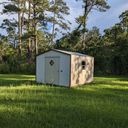
It took us until January of this year to move the loft and a shed over from the previous property, and neither of them are presently suitable for habitation.
We plan to outfit the large, empty 10x12 first, as that will be the flock's permanent home.
We need:
Wiring installed for two more outlets.
Insulation. (Spray foam, if we can get it. We'll install foam sheets and fiberglass if not)
Drywall or particleboard
FRP panels
LVP flooring that I can easily clean and the birds can easily grip.
Ventilation grates
Temperature control (either a mini split or a good quality window unit)
Before the flock can actually move out into the finished loft, we'll need at least a temporary frame for wire or netting around the front door, so I can open it and not risk an accidental escape.
The old loft will not need as much work to be the new quarantine building.
Old FRP will have to come down.
The damaged insulation will need replaced, at least one new outlet will have to be installed.
New FRP will have to go up on the walls and ceiling.
Old flooring will have to come up and be replaced.
A new window unit will be needed.
The porch will need to have rotten 2x4's replaced
And the safety screen around the porch will need to be replaced.
And we would like to erect a large aviary to house rescues long term, with out risk to our breeding flock.
We already have a car port that can be enclosed, but we will need a solid floor, predator proof enclosing, and a protected, escape proof door.
Based on how much minor repairs to individual rooms of the house have cost, I estimate that any step involving a contractor will cost between $1,000 and $2,000.
I hope the modifications to the new loft and repairs to the old one cost less than $10,000 a building, and that erecting the aviary won't cost much beyond that, but $20,000 is my rough estimate of what we'll need in total.
We will be funding as much as we can ourselves.
This campaign is just to help us get it done sooner.
As a matter of faith, I tithe 10% of all my income, donations included, for the sake of full disclosure.
Upon completion of the lofts, even if completion costs less than our stated goal, we will close down the campaign.
We hope to finish the breeding loft by January, when the new vaccine vials for PMV and Paratyphoid are available for sale.
This flock represents five generations of work towards developing a unique breed specifically for therapy work.
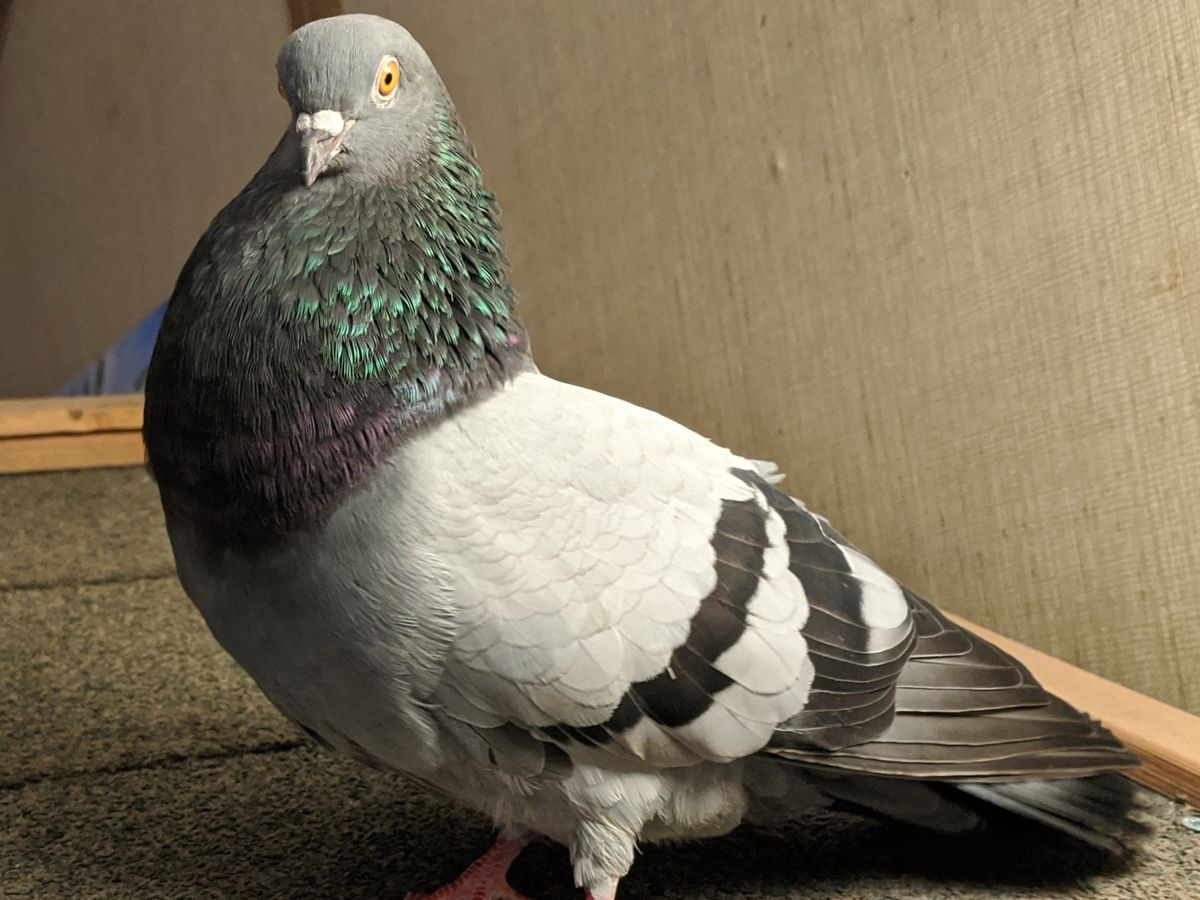
This is the pigeon that started it all.
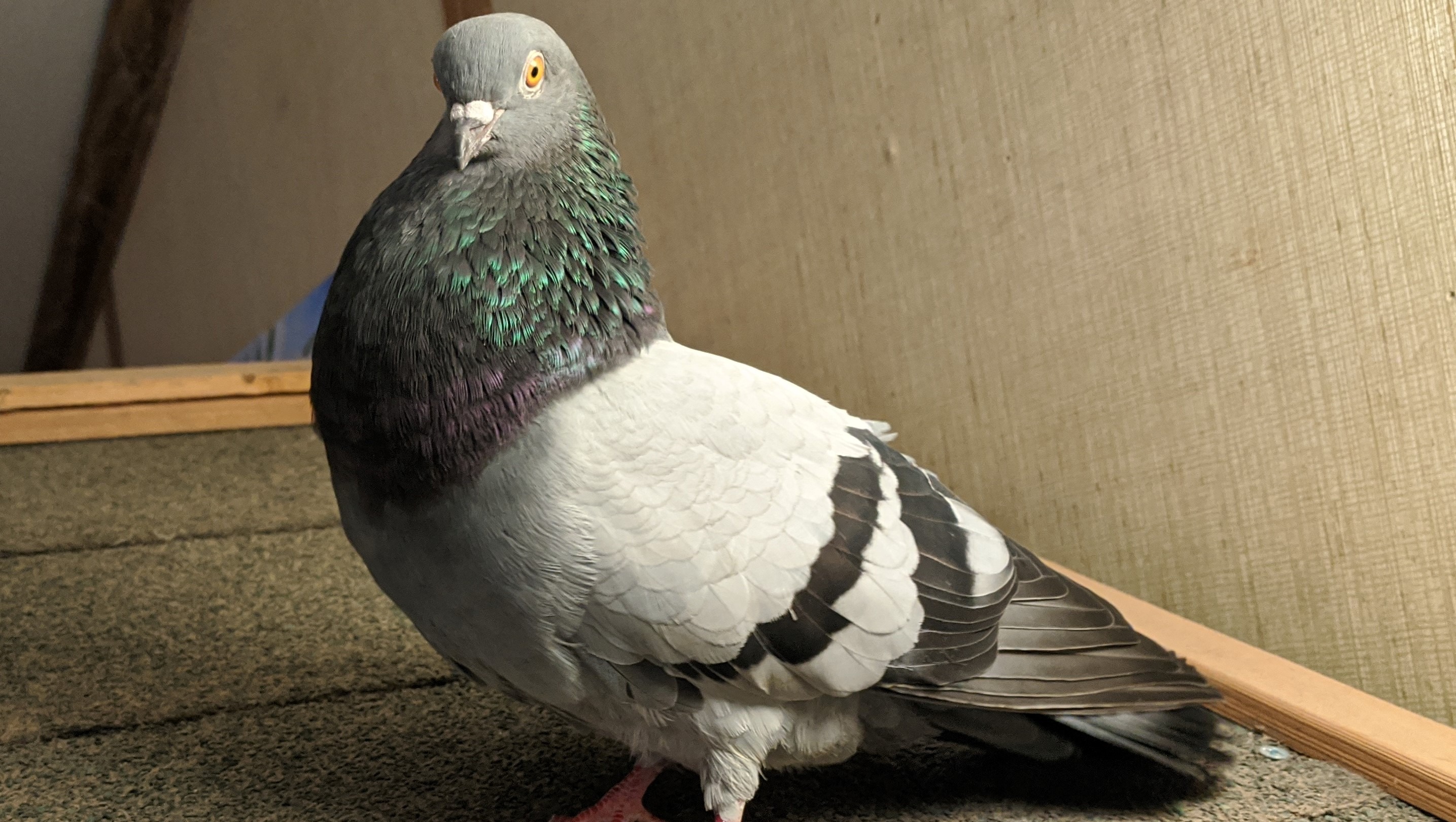
His name is Ankhou.
This is his story.
And the inspiration for the Assistance Pigeon Project.
Ankhou came into my life when he was found in a parting lot by a kind older woman, so severely emaciated that his body could not grow bones and feathers at the same time.
I raised and showed Rignneck Doves and a few show breeds of pigeon at the time, and volunteered with the local wildlife rehab as a specialist in rearing orphaned birds in the family Columbidae.
Native doves, like Mourning Doves, were fostered by a designated Ringneck pair, then soft released.
But not feral pigeons.
Feral Pigeons don't belong in wildlife rehab, because they aren't wildlife.
They are a mix of domesticated performance and show breeds: the avian equivalent of stray dogs.
So I see releasing a feral pigeon into the wild as equivalent to returning a stray puppy to the street as soon as the vet's given it a clean bill of health.
If we got a racer or roller in and their owner didn't want them back, or if an injured or orphaned feral came in, they would get a throat swab and fecal smear, be treated for wounds, disease or parasites, receive vaccinations for PMV and Paratyphoid, and then be fostered until their hopefully forever home could be found.
This was the plan for Ankhou.
But his bond with me started me down a journey of discovery I never would have expected.
Animal behavior has always fascinated me, and pigeons are social birds whose intelligence has been very closely studied.
Let me lay out some ground work:
Pigeon flocks are basically huge, extended families, living in what amount to ancestral apartment buildings.
Their social structure is shockingly similar to a village of related humans.
Because their cognition in general is on par with a primate. https://www.sciencedaily.com/releases/2009/02/090212141143.htm
In fact, their brain wiring is similar to our own. https://www.sciencedaily.com/releases/2013/07/130717095336.htm
It is *so* similar that they are a model species for cognitive study!
Pigeons categorize things the way we do
Using similar visual cues
This extends into facial recognition: both to identify individuals, and differentiate between moods using an individual's expressions.
This study involving pigeons and crows proved that both birds recognize individual humans by face and voice. https://www.sciencedaily.com/releases/2012/06/120622163056.htm
Even feral pigeons who have never been handled are very good at this and have a very long memory.
And they are among the very few birds able to recognize themselves as individuals: Not only in a mirror, but in a video, with delay, beyond the cut off at which three year old humans cease to recognize themselves.
(For reference, a human toddler can no longer recognize themself if the video has a delay of three seconds or more.)
So, these birds are self aware, with roughly the intelligence of a human toddler.
Unlike other birds, pigeon parents don't chase their weaned young out of their territory, unless there are not enough resources to support them all.
Pigeon kids stay with their flock or move in with their mate's flock and live in that group for life.
Like us, they build knowledge over generations: https://www.sciencedaily.com/releases/2017/04/170418094512.htm
Which means that individual flocks can legitimately be said to have true cultures.
Like many human societies try to be, pigeon flocks are democratic meritocracies.
They vote on everything they plan to do away from the colony as a group.
Every bird involved in that activity votes, with only slightly higher weight given to the vote of birds best at the task at hand.
The bird most skilled in that task leads that mission out.
The most skilled navigator leads back.
This flexible organization is vital to efficient navigation. https://www.sciencedaily.com/releases/2015/06/150609213053.htm
If there is not a clear majority vote, flockmates compromise. https://www.sciencedaily.com/releases/2006/11/061106145043.htm
Leaders that refuse to compromise when the rest of the flock votes against them lose their position. Their flockmates will simply refuse to follow them. https://www.audubon.org/news/in-homing-pigeon-flocks-bad-bosses-quickly-get-demoted
Pigeons are even capable of understanding *abstract* concepts like *space* and *time*! https://www.sciencedaily.com/releases/2017/12/171204144805.htm
All that adds up to a fully self aware bird with the intelligence of a human toddler, which instinctively understands cooperation and compromise, and is thus hard wired to expect to have a say in every group activity.
But their potential to learn how we communicate is what really sets them apart, and makes working with them very interesting:
As established, pigeons are pattern mappers.
Language is a pattern; mapping sounds to specific objects, individuals, places, actions, and concepts.
We have already established that they categorize like we do.
This study suggests that they may be able to learn "the equivalent of words" by the same mechanic as human children. https://www.sciencedaily.com/releases/2015/02/150204184447.htm
And this one proved that they can differentiate real words from acronyms with the same number of letters. https://www.sciencedaily.com/releases/2016/09/160919111535.htm
I got curious, and wanted to find out if learning "the equivalent of words" could translate into actually learning to understand spoken language.
Ankhou's rehabilitation took months longer than it would have for a healthy fledgling, so we made the decision to keep him permanently.
He became a house pet, free flying in my home the way an indoor cat or dog free roams.
Just to see if he was capable of learning words the way a toddler does, as the study above suggests, I modeled spoken English for him the same way human parents do for our children: I named objects and places, introduced him to individuals by name, and talked him through our actions and his own, every day, from the time he started free roaming the house.
He's not a parrot.
He would never be able to repeat any of them back to us.
But he could respond with clear understanding to full sentences, answer yes or no questions, and, through verbal context alone, he picked up the concepts of consent and apology, learned to ask me for help, and figured out how to point with his beak to direct me..
One Saturday the Dear Hubby and I were sitting with him on the sofa, and we told him: "We need to get up. Get down, please, 'Khou."
He refused. (He *liked* snuggle time on the sofa and would do his damnedest to convince us not to go yet)
But when my husband told him "I need to put on pants, Big Man.", Ankhou looked down at his Dad's bare legs, sighed, and hopped down from his knee.
My husband did not mention his legs. Nor did he gesture to them when he said the word "pants".
Ankhou made the connection that "pants" go on legs by himself.
The most important things I taught him were how to answer yes or no, and the difference between "Hey, can I/ I want to x" and "I need you to x"
For example, he could tell me he didn't want me to pet him, or didn't want to step up or play or sit with me right then by turning his back or walking away when I asked if I could or if he wanted to.
Not a necessity, so no means no, and I respect his "no" by not doing that right now.
He would agree by either approaching me or going to do the thing of his own volition, if it was something he could physically do without my help or direction.
But I couldn't let him say no to everything.
For example: I did not ask him if he wanted to go to bed. If he said no, and I had to say, "you have to", he'd learn from that (by pigeon standards) that he can't trust me to respect him when he says "no".
By pigeon standards, that means he just can't trust me. Period.
I got around that, while still allowing him to have the say he needed in the matter, by asking: "Do you want me or your dad to take you to bed? Or do you want to go by yourself?"
His answer would either be to come to me, stare at my husband until he went to offer his hand, or fly to his perch in the bedroom himself.
There was not much choice I could give him for vet visits, meds, or detangling hair from his foot, so I would tell him "I need to (whichever one)", and then pick him up to do it.
Meds, nail trims, and hair foot detangles can be done on the spot, so I would just warn him that I needed to, pick him up, talk him through it while I worked, and then say "Ok. We're done now." and immediately let him up the second I was done.
It was reassuring for him that I tried to be quick about unpleasant necessities, and he trusted that they weren't just to hurt or scare him for no reason.
Most of the time, he wouldn't even fly away after.
Vet visits are a longer thing, but I designed a harness for full, comfortable mobility and trained him in it to make going out in public less scary.
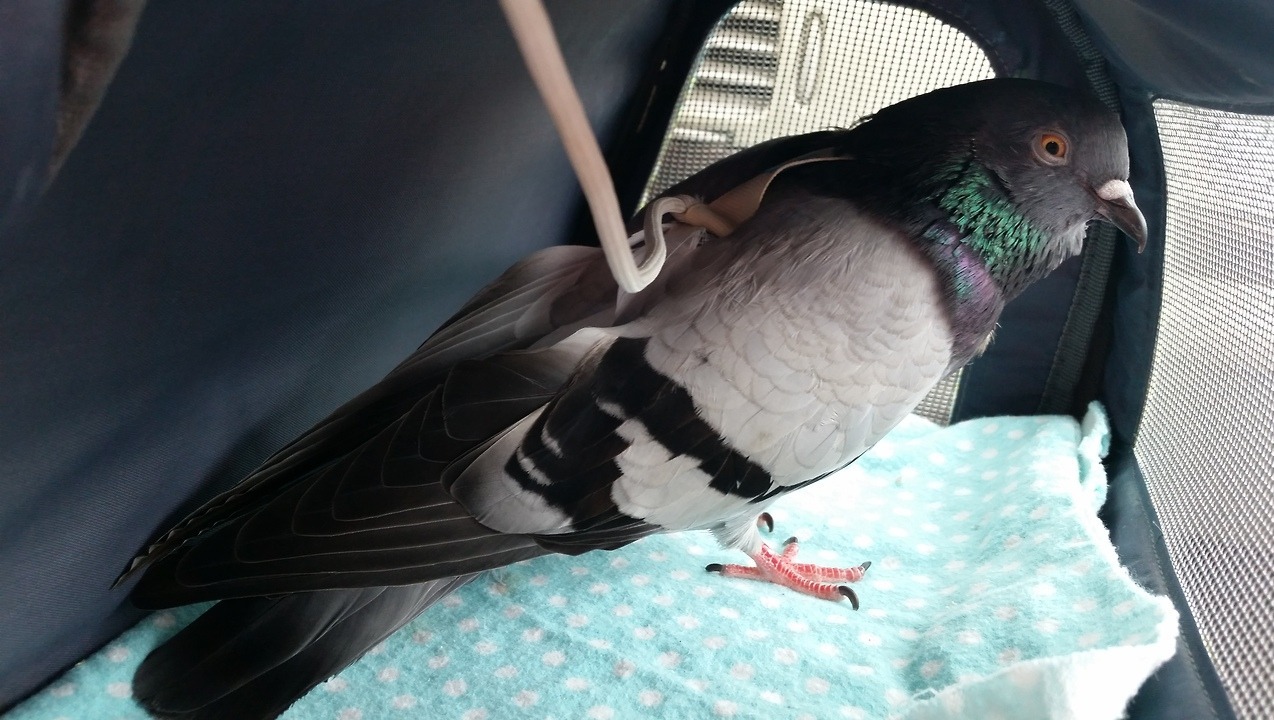
I differentiated between adventures he could decline, if he wasn't interested in leaving the house, and appointments we needed to keep by either asking "Wanna come on an adventure?" or telling him "It's time to go to work!"
Parks or pet, craft, hardware, or bookstores that allowed pets were "Adventures" he could decline.
Vet appointments were "Going to work".
He didn't have a specific job. I was not training him for anything but communication and comfort with public travel.
But because of a number of disabilities, vet visits were stressful for me.
I am an autistic woman with ADHD, CPTSD, and severe social anxiety, prone to such crippling anxiety attacks that I didn't consider driving myself to be safe for a great many years.
While my husband worked away from home, if family was not able to take me and a sick bird to the vet, I had to travel by uber.
Which meant that I had to wait for a stranger to pick me up, hope there was one available in time to make the appointment in the first place, hope they were ok with bringing a pigeon to a vet appointment, and then call a different one to go home, hope to God I wasn't taking up space in the vet's lobby for too long waiting for one, and get one that was ok with having a pigeon in their car.
Some times, it would take a whole string of cancelled rides before I could get one that was willing to carry a pigeon, even one in a carrier, wearing a harness.
Under severe enough duress, I lose abilities to communicate one by one:
At first, my throat physically closes. It tightens so hard that I can't make myself heard.
I can still type and move otherwise, though, and just transition from verbal to written communication.
But under further duress, my hands shake so badly that I can't type, even with a stylus.
After that, I stop registering symbols. My brain can no longer translate them.
I can't, for example, find the Uber app on my phone to attempt to get a safe ride home.
I can't remember what the discord or text symbols are, to try to tell a family member I need help.
Even if I already have notepad or discord or text open in that state, letters don't mean anything to me anymore and I can't connect them together into words.
Past that, I can no longer register being spoken to, because audible words are just noise.
During an especially bad episode, all of those things would hit at once, and, from my perspective, all connections to language were severed like cutting a series of strings with a razorblade.
I couldn't read, spoken words were just upset sounding noise, and I couldn't get away or tell anyone that I needed help.
Let me tell you, that state is mind numbingly terrifying to get stuck in away from home!
From an outside perspective, I'd just freeze or sink down with a thousand yard stare.
Because Ankhou had this very trusting, communicative relationship with me, this basically catatonic shut down where I could no longer communicate with him or process the world around me freaked him tf out!
So he got good at reading warning signs that I couldn't register, and worked out ways to communicate to me when I was in danger of suffering an episode.
If he pressed his side against my cheek, that was my cue to be still and focus on slowing my breathing.
But if he stood on my chest and went up on tiptoe to get me to look at him, that warned that I had 10-20 seconds before the world around me became meaningless, so I should sit.
He figured out warnings for these very literally crippling anxiety attacks completely of his own volition, and even figured out a 4 step process to bring me back out of a shut down that he was not able to prevent for what ever reason.
First, he would push his head, then entire body under my hand and stand so it would slide down his back, like a kitten trying to force its way under a hand for pets.
That would trigger me to stroke him automatically.
Rhythmically stroking something soft and warm, especially if you can feel it breathing, slows the heart rate and one's own breathing, and that tells the body that the danger has passed and it can stop pumping adrenaline and cortisol into your bloodstream.
Once I was doing that reliably, he would hunker in my lap and nest grunt: triggering my echolalia (a compulsion among those of us on the autism spectrum to mimic simple noises)
When he got me into a steady rhythm of call and response, he would standup and shrug off my hand to spin and coo, a more complex sound that I was compelled to answer in a simple, but full sentence.
Something like "Oh yeah?", "Tell me all about it." Or "Yeah, buddy, sing me the song of your people."
And, like he'd flipped a switch, all of those processes to register, translate, and use language were restored all at once and I could function like a normal human being again.
That was only the first thing he taught himself to alert for.
Blood sugar spikes are similarly crippling, but those just look like I'm fighting sleep for all I'm worth and just can't win.
Somehow, Ankou knew the difference.
If I actually was just tired enough to need a nap, he would usually just snuggle in with me, either on my chest, in my lap, or on my hip.
But if I was drowsy from a blood sugar spike, he would do *everything* in his power to keep me conscious!
Which mostly involved an escalating series of bites to increasingly sensitive places.
Hands, first.
If I responded to that, sat up, and tried to move, he would monitor me closely, but no further bites would be attempted.
If I didn't respond, the space between my fingers was next.
Then the inside of my elbow. The side of my neck. My ear, and finally my eyelid.
If nothing worked, he would fly to my husband's office, throw himself at the door, and lead him to me when he opened it.
He figured out that I was diabetic before I did.
I didn't know he was alerting for blood sugar spikes until I survived the heart attack that diagnosed me as a type 2.
It clicked for me when meds got my blood sugar under better control, and as I stopped having sudden spikes, he stopped having to bite me awake to keep me conscious.
Getting blood drawn to monitor my A1C was a real problem, as my severe phobia of needles was a near instant shut down trigger that I usually needed a blindfold and physical contact with my husband or a family member to get through.
At one point, he wasn't able to get the time off work to come with me, and none of my family or friends were available.
I was going to have to uber to the appointment and back.
So I asked my GP if I could bring Ankhou.
The Dr. Allowed it, and Ankhou immediately understood the assignment: As the Phlebotomist got set up, and I started to feel my throat close, he came to the mouth of the carrier and called for me to look at him and pet him using the opposite arm from the Phlebotomist.
He insisted I keep physical contact with him and repeatedly soothe-preened my hand the way parents reassure fretful nestlings.
He never stepped outside the carrier onto the table. Didn't even look at the Phlebotomist or her equipment, or any of the room's colorful décor.
He was laser focused on keeping me from shutting down.
As soon as the phlebotomist finished, he stood up, stopped calling, stopped preening, and backed up for me to close the carrier.
Let me repeat that all of this developed naturally from training that was centered purely on teaching him a framework for human communication, and to be comfortable going out in public.
Sadly, Ankhou passed away in 2021, on the state vet's table, and I was devastated...
But he had proven beyond any shadow of doubt that pigeons can learn to understand verbal communication with a human by the same mechanic as a human toddler, as that earlier study suggested they could.
I don't think I've even scratched the surface of the potential implications of this.
Or of the potential for pigeons to act as legitimate service animals.
Only dogs and miniature horses are able to be legally certified as Service Animals in the US, but Ankhou demonstrably performed what I would consider to be legitimate Service tasks for me, of his own volition.
And I don't think he is unique in that potential.
If a malnourished feral pigeon found in a literal parking lot was naturally inclined to teach himself service tasks of his own volition, then, surely, traits of intelligence, temperament, and tractability conducive to that kind of Service work can be selectively bred for and a training program can be adapted to the unique abilities pigeons can bring as Service Animals.
The Assistance Pigeon Project's breeding and training programs focus on exactly that.
Once we achieve a reliably demonstrable result, we plan to petition for US Service Animal laws to be expanded to include working pigeons.
Five generations into that breeding program, we have produced a bird who is now my Husband's devoted ESA, with exactly the temperament I want.
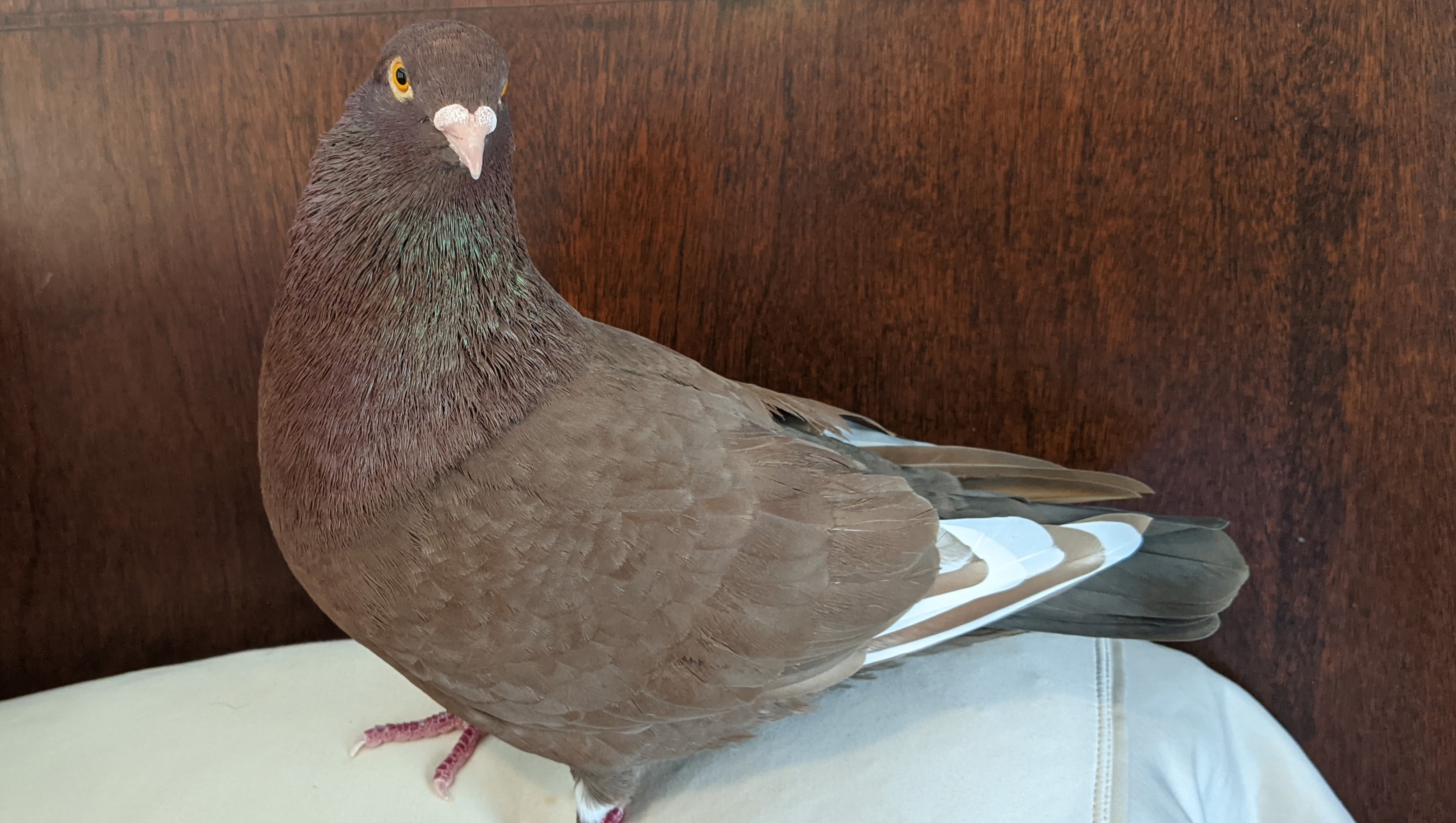
His name is Cotta
When he was seven weeks old, not long after Ankhou passed, I was cleaning the loft, and a pang of loss hit me so hard that I couldn't move.
I just sat, legs crossed, elbows on my knees, face in my hands, sobbing over the fact that I would never see him again. Regretting that I never had the chance to say goodbye...
I had no idea at the time how much of my emotional regulation Ankhou had shouldered, and I was struggling to function with out him.
I still needed an assistance bird, and was considering a hen named Diamond.
In that moment, Diamond hopped up onto my knee, and I offered her a safflower seed: a favorite treat I used for training.
She accepted, then hopped down and strolled off.
But then Cotta stepped up onto my ankle, walked up to my knee, and looked up at me.
I figured he just wanted a treat, and giving treats to babies still helped, even if it wasn't what I really needed.
But when I offered him the safflower seed, he reached for it, took it politely from my fingertips, and then, maintaining steady eye contact, leaned over and very deliberately dropped it.
He then climbed my chest, pushed his way into my arms, and let me bury my face in him and cry until the need passed.
That was everything I needed in that moment.
And when he came in, he picked up on how deeply my husband was still mourning the loss of his ESA, a blind racer named Bird-Bird, to a heart attack.
Cotta is still primarily bonded to my husband, but he knows when I need him, and just quietly seeks me out, even though I'm now the emotional support human for a neurotic mess of a bird named Cheeto.
Cotta even directed Cheeto and another bird who was just visiting for a while to monitor me when there was something wrong with my blood pressure that caused me to suffer a severe onset of vertigo.
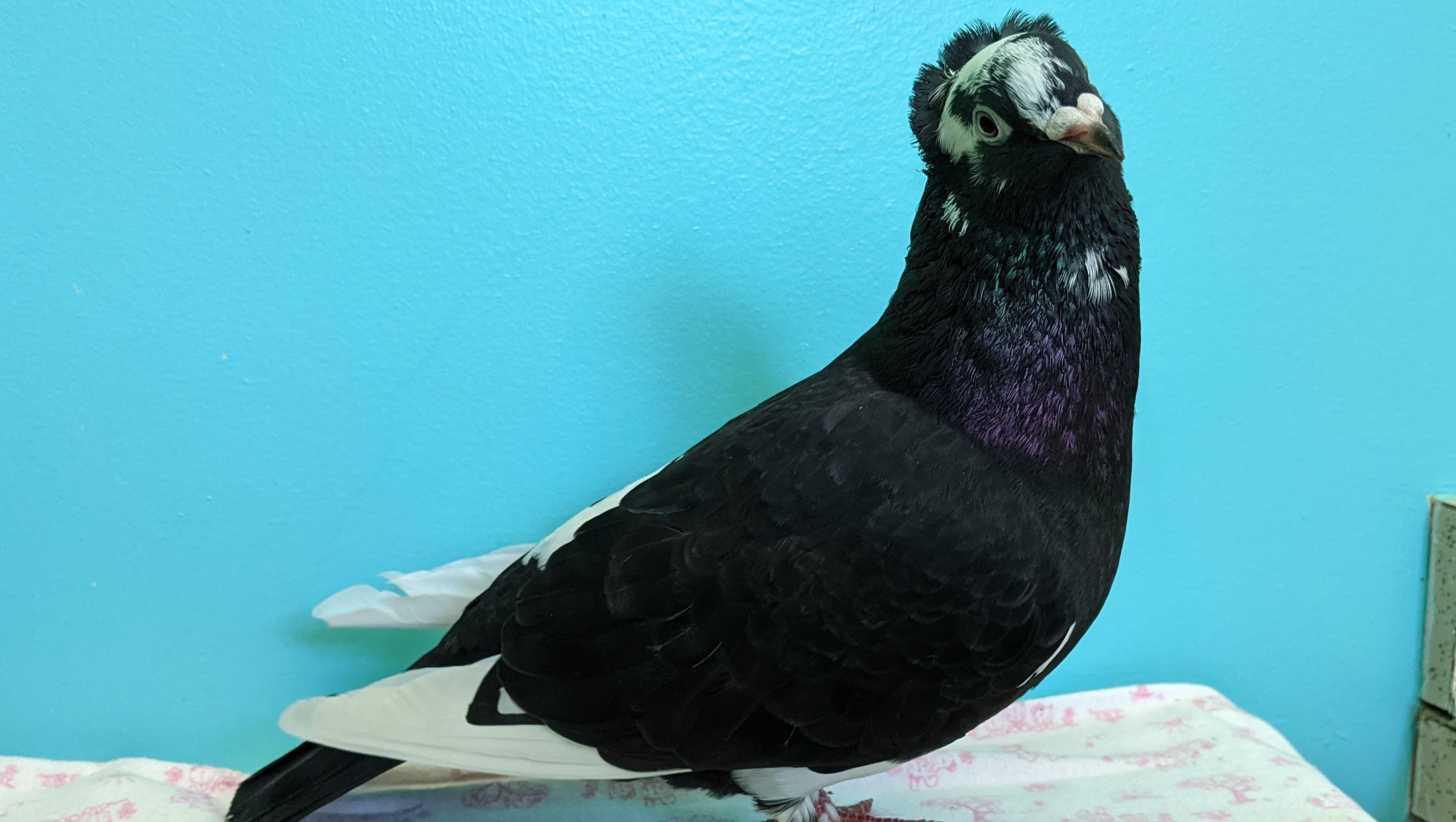
This is his Sister, Taffeta.
Her temperament is very similar to her brother's, so I have very high hopes for their offspring, when we can finally reopen.
We need for the dedicated breeding, quarantine, and rescue facilities to be constructed to a high standard, so that they last us for as many years as possible.
From the bottom of my heart, I want to thank the generous souls who have already sent funds to help us be able to get back to work on the Assistance Pigeon Project, those who will be moved to as they find us, and God who gives the increase.
Danielle Ramsey
The Ramsey Loft
Organizer