- J
- B
- K
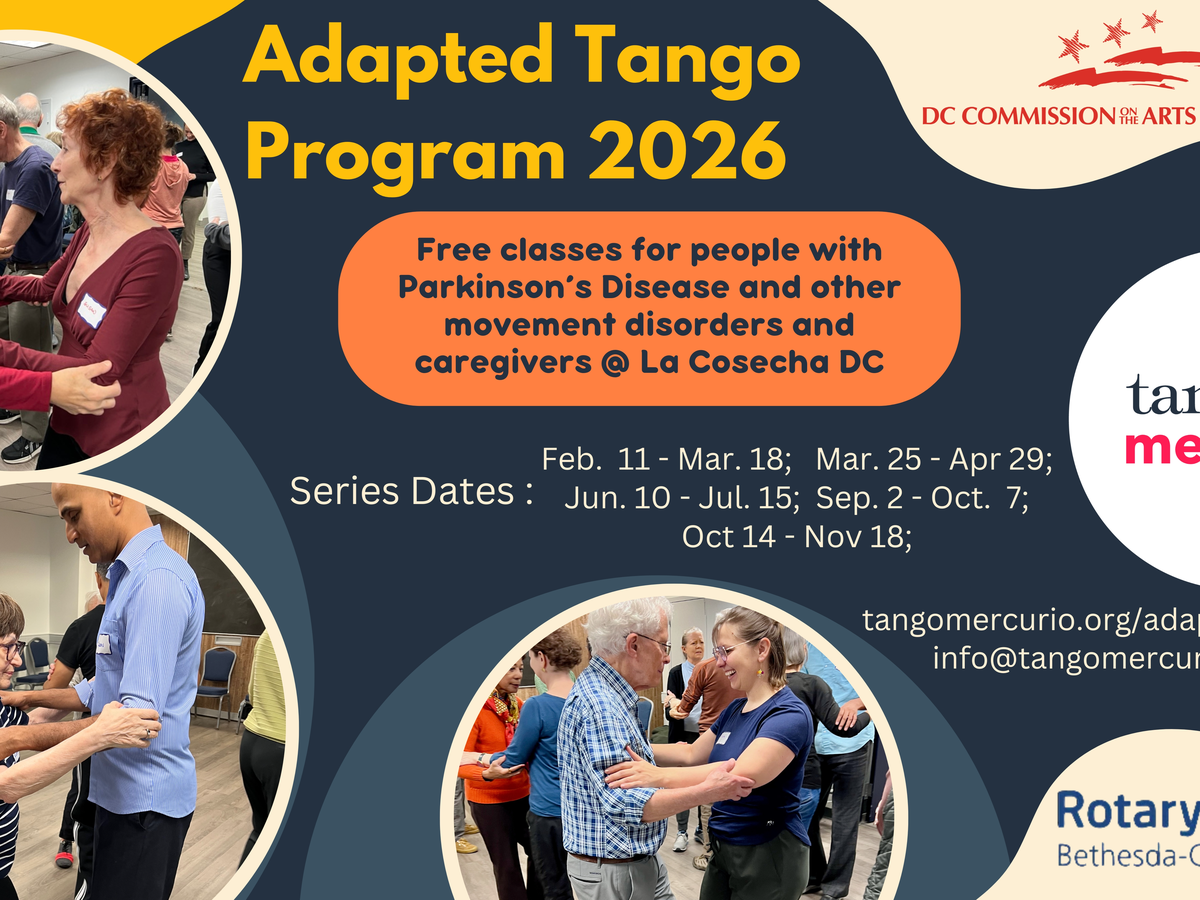
Support Free Tango Classes for People with Parkinson's
0% complete
$885 raised of
8 donations
Adapted Tango: Joy in Movement for Parkinson’s
Bringing Tango to People with Parkinson’s Disease
Tango Mercurio’s Adapted Tango Program provides the scientifically proven therapeutic benefits of partnered and improvised social dance to people with Parkinson’s disease (PD) through a safe, interesting, and fun adaptation of traditional Argentine tango. Developed by dancer and neuroscientist Dr. Madeleine Hackney, and inspired by the Tango Therapy Project in Philadelphia, our Program is offering five six-week series of classes for people with PD and their caregivers in 2026.
Why Parkinson’s?
As part of Tango Mercurio’s mission to build community through tango, our Older Adult Outreach Program has been bringing tango dance, music, and poetry to older adults in day care and residential settings in the Washington, DC area since 2019, mainly through our partnership with Arts for the Aging. Participants have included many seniors with physical or cognitive limitations, along with staff and caregivers.
According to the Parkinson’s Foundation, Parkinson’s disease is the second most-common neurodegenerative disease after Alzheimer’s. It impacts 1.1 million in the U.S., with nearly 90,000 people diagnosed every year. The disease causes motor and non-motor symptoms that can be physically, emotionally, and cognitively debilitating. There is no known cure, though medications may help relieve symptoms. Physical activity has been shown to not only maintain and improve mobility, flexibility, and balance, but also ease non-motor PD symptoms such as depression.
Why Tango?
Studies on Adapted Tango have shown that tango works as well as and sometimes better than other movement forms. As a therapeutic tool, tango is a moderate-intensity activity that offers motivation and practice in numerous real-life skills that can be challenging for people with Parkinson’s and other conditions: walking forward and backward, initiating movement and stopping it, varying speed and rhythm, placing the foot and coordinating the whole body, navigating among others, sustaining attention, working with a partner and synchronizing movement with them, leading and following, and more.
Improving Quality of Life
The United States is a country with an aging population and an epidemic of loneliness that has devastating effects on public health. Tango offers a safe space for touch, social connection, and community, along with exposure to the dance, music, and poetry of a unique art form. It enables dancers of all abilities to enjoy moderate physical activity that helps them build new neural pathways and experience social interaction, which research has demonstrated boosts happiness and well-being.
Why Give?
Our Adapted Tango Program is partially funded by generous grants from the DC Commission on the Arts and Humanities and the Bethesda-Chevy Chase Rotary Club Foundation, along with donations by Program participants and the broader tango community. Please help us make up the difference by contributing to this campaign. Your support now will help us continue to offer Adapted Tango classes free of charge to people with PD and other movement disorders and their caregivers. In 2026, we will:
• Triple the number of total Adapted Tango classes we offer from 10 to 30.
• Offer these Adapted Tango classes free of charge for participants.
• Provide one-on-one support to class participants by volunteers trained in our Adapted Tango Program and safety protocols for working with people with Parkinson’s.
• Collaborate with Dr. Pritha Ghosh, a neuroscientist at George Washington University Hospital.
• Evaluate the impact of the Adapted Tango Program on participant’s mobility, level of functioning, social support, emotional well-being, and overall quality of life.
• Form institutional partnerships with hospitals, universities, research scientists, senior residences, rehabilitation facilities, and more.
• Celebrate the healing power of dance, music, and human connection by sharing stories of this work.
Donations directly support training, instruction, administration, programming, evaluation, and documentation. Your contributions now will help us achieve our mission of building community through Argentine tango.
We are grateful for your support and interest in our work. Let us know if you would like to be added to our email list to receive announcements about the Adapted Tango Program and our other activities.
With heartfelt thanks,
Alex
S. Alexandra Russell
Program Manager, Older Adult Outreach
Tango Mercurio
[email redacted]
Organizer