
- C
- P
- C
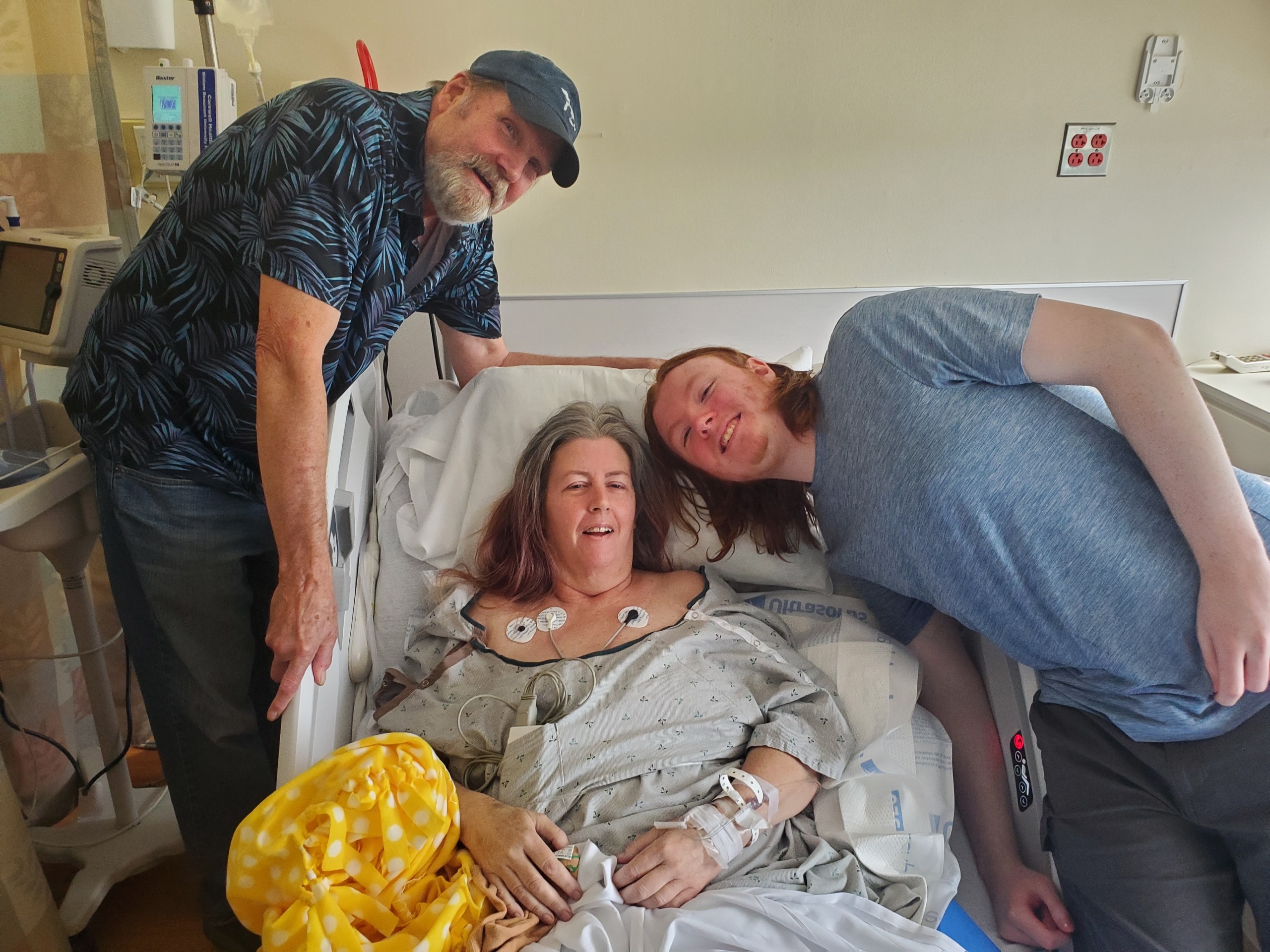


When Beth was struck with Posterior Cortical Atrophy (PCA) 5 years ago, it rocked her family and life. It has caused Clay and CJ to take on the role of caregiver to a woman who has always spent her time caring for others. Slowly, we have watched her creative light dim and have lost the bubbly personality which we have all known and loved.
PCA has no cure yet, although it's sometimes possible to somewhat slow the progression with medication. The Mayo Clinic asked Beth to be a case study for them, and she has been there 4 times so far. There's no cost for the 2 days of testing, but transportation costs to Rochester, Minnesota, meals, and lodging have been out of pocket. Locally, she sees a neurologist twice a year. We are now facing the likelihood of transfer to a care facility when she leaves the hospital, the costs of which are overwhelming, along with household expenses, including a mortgage. While they have applied for Medicaid, approval could take at least 3 months. Clay is unable to work full-time because of Beth’s condition and the constant care she now requires, and so they are now sustaining themselves on Clay’s Social Security.
Please consider supporting Beth, Clay, and CJ during this difficult journey they are on. Every bit will help them spend this time together as a family.
Posterior Cortical Atrophy
Posterior Cortical Atrophy (PCA), also called Benson’s syndrome, is a rare, visual variant of Alzheimer’s disease. It affects areas in the back of the brain responsible for spatial perception, complex visual processing, spelling, and calculation.
What Causes PCA?
In the vast majority of PCA cases, the underlying cause is Alzheimer’s disease, and the brain tissue at autopsy shows an abnormal accumulation of the proteins amyloid and tau that form the plaques and tangles seen in Alzheimer’s disease. Although PCA is almost always caused by Alzheimer’s disease, it can result from other diseases including dementia with Lewy bodies and Creutzfeldt-Jakob disease. PCA is thought to affect less than 5% of people with Alzheimer’s disease, although epidemiological studies are lacking and PCA has been under-recognized in the past.
How is Age Related to PCA?
People with PCA may often go to see an eye doctor first, thinking that their difficulties are due to a problem with their eyes and that they may need new glasses. Visual impairment commonly develops as people get older, and in most cases, a decline in vision is due to this natural aging process. In people with PCA, the visual problems are not due to problems with their eyes. Rather, the shrinking brain can no longer interpret and process the information received from the person’s healthy eyes.
What Happens in PCA?
Early symptoms of posterior cortical atrophy include blurred vision, difficulties reading (particularly following the lines of text while reading) and writing with non-visual aspects of language preserved, problems with depth perception, increased sensitivity to bright light or shiny surfaces, double vision, and difficulty seeing clearly in low light conditions. The patient may have trouble accurately reaching out to pick up an object. As the disorder progresses, other symptoms evolve such as getting lost while driving or walking in familiar places, misrecognition of familiar faces and objects, and rarely visual hallucinations. Calculation skills and the ability to make coordinated movements are affected in some cases.
While there is no definitive test for PCA, neuropsychological evaluation of cognitive skills, blood tests, brain scans, and a neurological exam may help to exclude potentially treatable causes such as infection, inflammation, or brain tumor.
PCA tends to affect people at an earlier age than typical Alzheimer’s disease, with individuals often being in their mid-fifties or early sixties when they experience the initial symptoms. As the disease progresses, word finding, day-to-day memory, and general cognitive functions may become affected, and people develop the symptoms of typical Alzheimer’s disease. In the later stages of the disease, people may experience jerking movements of their limbs and even seizures. Some people live approximately the same length of time as individuals with typical Alzheimer’s disease (on average 10–12 years following the onset of symptoms) while others live with the condition for longer.