The Story
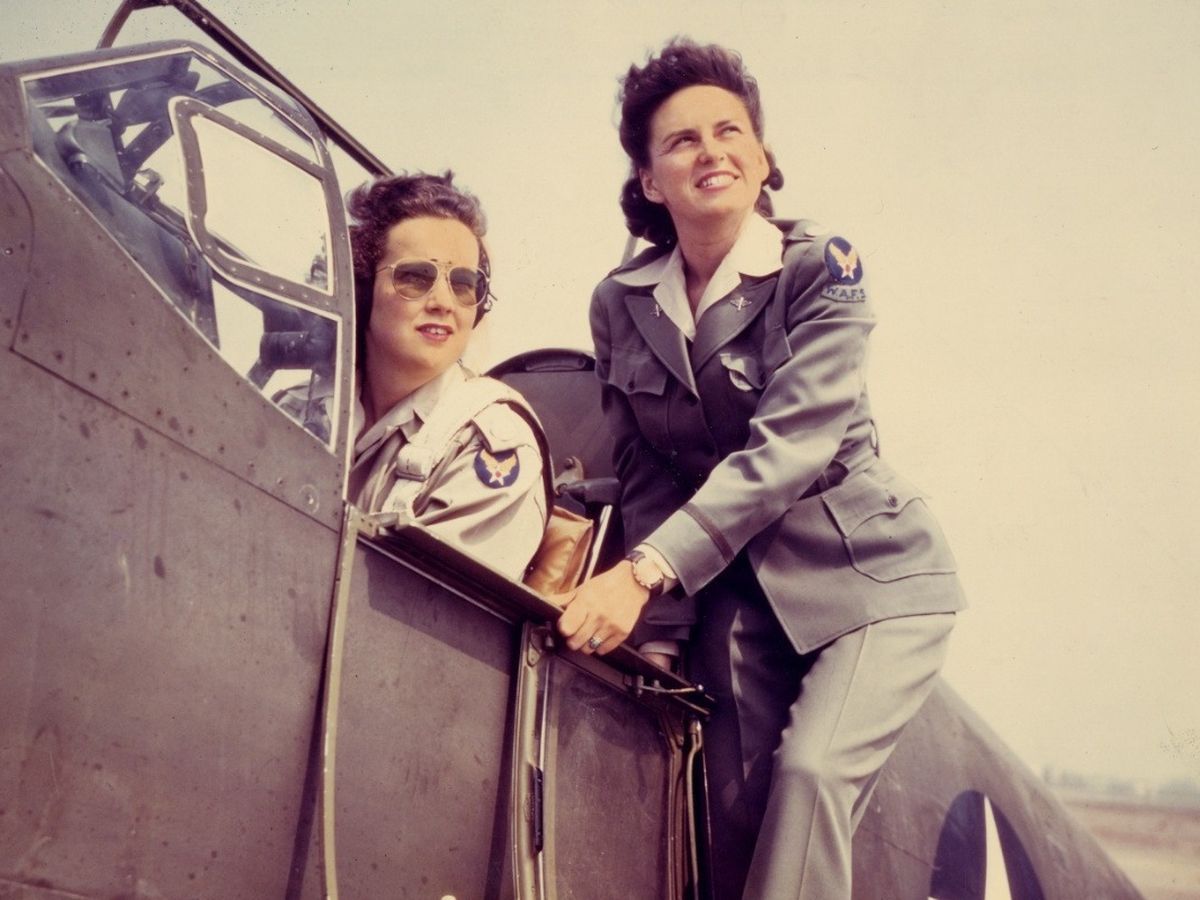
We are producing a play that tells the story of an elite squadron of woman pilots who battle prejudice, betrayal, sabotage and personal loss to prove they belong in the U.S. Army Air Corps during World War II. Their story is one of love, duty, sacrifice, and the perseverance of the human spirit.
In the fall of 1942, twenty-eight women pilots were hired to become members of the newly formed Women’s Auxiliary Ferrying Squadron (WAFS) in Wilmington, Delaware. The squadron was formed to help alleviate the pilot shortage the Army Air Corps had been experiencing since the attack on Pearl Harbor. The women freed up male ferry pilots to fly combat missions overseas. The WAFS eventually merged with the Women’s Flying Training Detachment, forming the Women’s Airforce Service Pilots (WASP).
The twenty-eight women pilots hired by the Air Transport Command to ferry planes from factories to ports of embarkation became known as The Originals. The original twenty-eight were a diverse group who came from different parts of the country and various backgrounds. They were a select group of women - some of the most experienced pilots in the country. The play focuses on the lives of five of these pilots following their experiences during the two years the Women’s Ferrying Group existed.
The Commitment
Our mission is to provide impeccable programming in the arts, history, and culture for Pacific Northwest communities. We support inter-generational collaborations between emerging artists, historians, archaeologists and educators who strive to expand workshop opportunities, classes, and performances that focus on excavating the ignored and forgotten stories of underrepresented communities. We believe that stories can help people understand each other and the arts should respond to community needs. We also strives to use theater to create community dialogues, inspire a new understanding about modern issues, and empower youth.
Many of us admire risk takers like The Originals and wonder if it is also possible for us to live our own dreams. By looking at these ordinary women who lived extraordinary lives, we see that it is possible to trust ourselves and live independent lives of personal freedom.
We are committed to producing this program so people of all ages know the stories of these five women - women who provide inspiration and hope to those of us who yearn to follow our hearts and live our dreams.
We wholeheartedly supports the National Endowment of the Arts’ assertion that projects should demonstrate “...the role of art not only as a noun, but as a verb: art as a vehicle for attracting audiences, activating people physically, increasing public safety, testing future planning ideas, empowering the public to evaluate their public spaces critically, drawing out and featuring the distinct character of a place and engendering mutual understanding.”
The Project
Our inaugural project is a play based on the lives of The Originals. This is the first story we’ve found that meets our mission. The script tells the forgotten story of the heroic women pilots who formed the Women's Auxiliary Ferrying Squadron during World War II.
The piece, adapted from an original screenplay, will be produced and performed in Olympia, Washington by a group of inter-generational women who all believe in the power of working collaboratively and across disciplines. We aim to have at least one fully produced public showing for the community so people of all ages can be inspired to find the courage to believe in themselves and pursue their passion.
This exciting new work features a small cast, a minimal imaginative set, and creative sound and light designs.
Your contributions will help fund the production and reserve performance space. If we meet our funding goal, we will also be able to provide stipends for the actors and production crew.
Like a burst of light, these women lived their lives – grasping an opportunity that slipped in and then out of history. For two brilliant years they flew airplanes for the United States military.
From the Playwright
Twenty-five years ago, I was given a book, On Silver Wings by Marianne Verges, that drastically changed the direction of my life. I read it in one sitting and from that moment on I was obsessed with the women pilots who flew for the military during World War II.
Shortly after reading the book, I decided to drive up to the Seattle Museum of Flight for a day of inspiration. As I walked in, I picked up a copy of the museum’s newsletter. I opened it and right there was a photograph of one of the pilots I had just read about – Barbara Erickson London. She was flying up from Long Beach, California to accept the Museum’s 1992 Pathfinder Award later that week.
Reading the article ruined my entire day at the museum, all I could think about was how was I going to meet this trailblazer of the skies?
The next day, I called the Museum of Flight asking for Barbara’s phone number. They said no, they couldn’t, but they’d pass my number onto her. An hour later I got a call at work. It was Barbara! I hadn’t the time yet to figure out what I wanted to say or how to say it. She went straight to her itinerary. We’d meet at her hotel the night before the award ceremony.
I was going to meet a national hero. Barbara was one of only a handful of women who had flown the B-17 Flying Fortress bomber, the P-51 Mustang, the P-38 Lightning, and dozens of other military planes during the Second World War. I was not in the coterie; I was not a pilot.
I knew that pilots regard themselves as a special lot. If you have never flown then you have never lived, was their unspoken motto. For non-pilots, there is no way to understand what it’s like piloting a plane. I decided to take my chances. I’m good at winging it, I reminded myself, and old people like me.
I forget now what I wore to meet Barbara, but I’m sure I must have tried on twenty outfits. “Pilots are linear and practical thinking,” I thought, “Maybe something with a clean, simple, tailored line like an airplane - perhaps a blazer and slacks? But wait, she’s 72, maybe old school is better, a skirt and blouse?”
I entered the hotel lobby a half hour early - just in case. Of what, I’m not sure, but I wanted to be the first one there. Barbara had been a commander during her time as a WAF and there was no way I was going to arrive after the Commander.
I turned toward the entrance of the hotel coffee shop and there stood the mighty Commander, all five-foot zero inches of her. Of course, she was early, too. No one gets the jump on the Commander.
She had jet-black, perfectly coiffed, hair and wore wire rimmed glasses. Her red lipstick was perfectly and precisely applied. Her red-painted nails, the same. She wore a straight black skirt that hung mid-knee and a tailored button-down white blouse with black vertical stripes. Over her blouse, a black blazer and on the left lapel of that blazer was a 3 inch pin the shape of a B-17. It had sparkling clear diamond-like stones embedded along the nose, wings, fuselage and tail of the bomber. I didn’t know it then, but that pin would be present on every jacket that she wore during the entire time I knew her.
I stood and stared for a moment before approaching her and thought, “This tiny woman flew the B-17 bomber?” It was hard to imagine. Except that you could see it in the way she moved. Despite her small stature I could tell, without a doubt, she was a Commander. It radiated out from her core. She walked with purpose and stood tall. She had alert discerning eyes. Eyes that scanned her surroundings, seeming to assess what action needed to be taken, if any.
I introduced myself and we shook hands. She asked if I’d had any trouble finding the hotel and suggested we get a cup of coffee. As we headed into the restaurant she let me know she had an hour to chat. We sat down at a small table covered with a white linen tablecloth. We ordered our coffee – hers black - mine with cream. After a few pleasantry questions about where I lived and how long did it take me to get there, she put her cup down, looked me in the eye and said, “What do you want to know?” Taken aback a bit by her directness I hemmed and hawed a bit, not really knowing what I specifically wanted to ask. She stared right at me waiting for a question and when none came she peppered me with her own questions. The interviewer became the interviewee. She asked what books I’d read about the WAFS. With each book I listed she gave a rating, “That’s a good one, the author did her research.” She told me to throw one book away and she meant it. “It’s trash,” she said.
Eventually, she asked the inevitable, “Are you a pilot?”
I sighed, and in a sheepish voice said, “No, not yet.”
I told her how much I loved planes and that the other day I’d seen two Japanese Zero fighters fly overhead and how I almost peed my pants with excitement. I got in my car and followed them back to the airport to get a closer look. As I become more and more animated with my storytelling, I noticed a slight grin cross her face. My passion had been exposed. From that moment on Barbara was more than a hero to me, she was a friend.
She told me the story of December 20, 1944 - the day her group of women ferry pilots were disbanded. As Barbara told me her story, her eyes began to well up. Even though it had been fifty-two years since the disbandment, it was clear the pain still lingered. It still hurt to have her dream ripped away from her because of her gender.
We finished our coffee and it was exactly one hour when Barbara punctually and politely ended our date. We shook hands and said our goodbyes. As I walked away I got a feeling that I’ve only experienced a few times in my life. The feeling that I had just spent the last hour with a long lost friend. Many years later she told me that as we said our goodbyes at that first meeting, she knew she had just met a kindred spirit. We were the best of friends for the next 21 years, until her death in 2013.
Meeting that tiny, larger than life, Commander altered the direction of my life drastically.
Barbara opened the door to aviation for me. She introduced me to several of the other Originals- Teresa James, the Irish flower-seller; Nancy Batson, the Southern belle; and Betty Gillies, the Mighty Atom. Because they invited me into their lives and shared all their stories, I shared their joys and their sorrows, too.
Teresa taught me that you can never let fear interrupt your adventure. Her deepest wish was to fly a UFO before she died. Batson showed me just how important it is for parents to believe in their daughters’ dreams. Betty taught me the proper way to eat Oysters Rockefeller and how to appreciate a good gin and tonic. And Barbara was the glue that held us together and connected the Originals stories to my own history. They all encouraged me to learn to fly and join the sorority of the sky.
After I learned to fly, Barbara said “Tamara, I know you’re a good pilot, but you need to to get back to what you were meant to do - write.”
I attempted to produce a documentary about the women flyers. When that didn’t come to fruition, I ended up being a historical consultant to several screenwriters in Hollywood who were working on scripts about the WAFS. None of them could finish their screenplays. My naïveté led me to start working on my own screenplay. How hard could it be, after all? Twelve years later, I submitted my finished script, FlyGirls, to a producer. When I pitched it, I was told, “Great story. Nobody will finance a movie with all female leads”.
I was devastated. I had failed the Commander. I couldn't figure out how to fulfill my mission. And then I met Claribel Gross, our Director. Claribel, Katherine, and I decided to adapt my screenplay into the script that has become the play we’re producing.
This play is my love story to Barbara and all the other Originals I knew ...
A heartfelt thank you for your generous support in helping us tell these important stories. We are so humbled by the community support we have received. If it weren't for people like you, art would never happen. Thank you, thank you, thank you!
We are producing a play that tells the story of an elite squadron of woman pilots who battle prejudice, betrayal, sabotage and personal loss to prove they belong in the U.S. Army Air Corps during World War II. Their story is one of love, duty, sacrifice, and the perseverance of the human spirit.
In the fall of 1942, twenty-eight women pilots were hired to become members of the newly formed Women’s Auxiliary Ferrying Squadron (WAFS) in Wilmington, Delaware. The squadron was formed to help alleviate the pilot shortage the Army Air Corps had been experiencing since the attack on Pearl Harbor. The women freed up male ferry pilots to fly combat missions overseas. The WAFS eventually merged with the Women’s Flying Training Detachment, forming the Women’s Airforce Service Pilots (WASP).
The twenty-eight women pilots hired by the Air Transport Command to ferry planes from factories to ports of embarkation became known as The Originals. The original twenty-eight were a diverse group who came from different parts of the country and various backgrounds. They were a select group of women - some of the most experienced pilots in the country. The play focuses on the lives of five of these pilots following their experiences during the two years the Women’s Ferrying Group existed.
The Commitment
Our mission is to provide impeccable programming in the arts, history, and culture for Pacific Northwest communities. We support inter-generational collaborations between emerging artists, historians, archaeologists and educators who strive to expand workshop opportunities, classes, and performances that focus on excavating the ignored and forgotten stories of underrepresented communities. We believe that stories can help people understand each other and the arts should respond to community needs. We also strives to use theater to create community dialogues, inspire a new understanding about modern issues, and empower youth.
Many of us admire risk takers like The Originals and wonder if it is also possible for us to live our own dreams. By looking at these ordinary women who lived extraordinary lives, we see that it is possible to trust ourselves and live independent lives of personal freedom.
We are committed to producing this program so people of all ages know the stories of these five women - women who provide inspiration and hope to those of us who yearn to follow our hearts and live our dreams.
We wholeheartedly supports the National Endowment of the Arts’ assertion that projects should demonstrate “...the role of art not only as a noun, but as a verb: art as a vehicle for attracting audiences, activating people physically, increasing public safety, testing future planning ideas, empowering the public to evaluate their public spaces critically, drawing out and featuring the distinct character of a place and engendering mutual understanding.”
The Project
Our inaugural project is a play based on the lives of The Originals. This is the first story we’ve found that meets our mission. The script tells the forgotten story of the heroic women pilots who formed the Women's Auxiliary Ferrying Squadron during World War II.
The piece, adapted from an original screenplay, will be produced and performed in Olympia, Washington by a group of inter-generational women who all believe in the power of working collaboratively and across disciplines. We aim to have at least one fully produced public showing for the community so people of all ages can be inspired to find the courage to believe in themselves and pursue their passion.
This exciting new work features a small cast, a minimal imaginative set, and creative sound and light designs.
Your contributions will help fund the production and reserve performance space. If we meet our funding goal, we will also be able to provide stipends for the actors and production crew.
Like a burst of light, these women lived their lives – grasping an opportunity that slipped in and then out of history. For two brilliant years they flew airplanes for the United States military.
From the Playwright
Twenty-five years ago, I was given a book, On Silver Wings by Marianne Verges, that drastically changed the direction of my life. I read it in one sitting and from that moment on I was obsessed with the women pilots who flew for the military during World War II.
Shortly after reading the book, I decided to drive up to the Seattle Museum of Flight for a day of inspiration. As I walked in, I picked up a copy of the museum’s newsletter. I opened it and right there was a photograph of one of the pilots I had just read about – Barbara Erickson London. She was flying up from Long Beach, California to accept the Museum’s 1992 Pathfinder Award later that week.
Reading the article ruined my entire day at the museum, all I could think about was how was I going to meet this trailblazer of the skies?
The next day, I called the Museum of Flight asking for Barbara’s phone number. They said no, they couldn’t, but they’d pass my number onto her. An hour later I got a call at work. It was Barbara! I hadn’t the time yet to figure out what I wanted to say or how to say it. She went straight to her itinerary. We’d meet at her hotel the night before the award ceremony.
I was going to meet a national hero. Barbara was one of only a handful of women who had flown the B-17 Flying Fortress bomber, the P-51 Mustang, the P-38 Lightning, and dozens of other military planes during the Second World War. I was not in the coterie; I was not a pilot.
I knew that pilots regard themselves as a special lot. If you have never flown then you have never lived, was their unspoken motto. For non-pilots, there is no way to understand what it’s like piloting a plane. I decided to take my chances. I’m good at winging it, I reminded myself, and old people like me.
I forget now what I wore to meet Barbara, but I’m sure I must have tried on twenty outfits. “Pilots are linear and practical thinking,” I thought, “Maybe something with a clean, simple, tailored line like an airplane - perhaps a blazer and slacks? But wait, she’s 72, maybe old school is better, a skirt and blouse?”
I entered the hotel lobby a half hour early - just in case. Of what, I’m not sure, but I wanted to be the first one there. Barbara had been a commander during her time as a WAF and there was no way I was going to arrive after the Commander.
I turned toward the entrance of the hotel coffee shop and there stood the mighty Commander, all five-foot zero inches of her. Of course, she was early, too. No one gets the jump on the Commander.
She had jet-black, perfectly coiffed, hair and wore wire rimmed glasses. Her red lipstick was perfectly and precisely applied. Her red-painted nails, the same. She wore a straight black skirt that hung mid-knee and a tailored button-down white blouse with black vertical stripes. Over her blouse, a black blazer and on the left lapel of that blazer was a 3 inch pin the shape of a B-17. It had sparkling clear diamond-like stones embedded along the nose, wings, fuselage and tail of the bomber. I didn’t know it then, but that pin would be present on every jacket that she wore during the entire time I knew her.
I stood and stared for a moment before approaching her and thought, “This tiny woman flew the B-17 bomber?” It was hard to imagine. Except that you could see it in the way she moved. Despite her small stature I could tell, without a doubt, she was a Commander. It radiated out from her core. She walked with purpose and stood tall. She had alert discerning eyes. Eyes that scanned her surroundings, seeming to assess what action needed to be taken, if any.
I introduced myself and we shook hands. She asked if I’d had any trouble finding the hotel and suggested we get a cup of coffee. As we headed into the restaurant she let me know she had an hour to chat. We sat down at a small table covered with a white linen tablecloth. We ordered our coffee – hers black - mine with cream. After a few pleasantry questions about where I lived and how long did it take me to get there, she put her cup down, looked me in the eye and said, “What do you want to know?” Taken aback a bit by her directness I hemmed and hawed a bit, not really knowing what I specifically wanted to ask. She stared right at me waiting for a question and when none came she peppered me with her own questions. The interviewer became the interviewee. She asked what books I’d read about the WAFS. With each book I listed she gave a rating, “That’s a good one, the author did her research.” She told me to throw one book away and she meant it. “It’s trash,” she said.
Eventually, she asked the inevitable, “Are you a pilot?”
I sighed, and in a sheepish voice said, “No, not yet.”
I told her how much I loved planes and that the other day I’d seen two Japanese Zero fighters fly overhead and how I almost peed my pants with excitement. I got in my car and followed them back to the airport to get a closer look. As I become more and more animated with my storytelling, I noticed a slight grin cross her face. My passion had been exposed. From that moment on Barbara was more than a hero to me, she was a friend.
She told me the story of December 20, 1944 - the day her group of women ferry pilots were disbanded. As Barbara told me her story, her eyes began to well up. Even though it had been fifty-two years since the disbandment, it was clear the pain still lingered. It still hurt to have her dream ripped away from her because of her gender.
We finished our coffee and it was exactly one hour when Barbara punctually and politely ended our date. We shook hands and said our goodbyes. As I walked away I got a feeling that I’ve only experienced a few times in my life. The feeling that I had just spent the last hour with a long lost friend. Many years later she told me that as we said our goodbyes at that first meeting, she knew she had just met a kindred spirit. We were the best of friends for the next 21 years, until her death in 2013.
Meeting that tiny, larger than life, Commander altered the direction of my life drastically.
Barbara opened the door to aviation for me. She introduced me to several of the other Originals- Teresa James, the Irish flower-seller; Nancy Batson, the Southern belle; and Betty Gillies, the Mighty Atom. Because they invited me into their lives and shared all their stories, I shared their joys and their sorrows, too.
Teresa taught me that you can never let fear interrupt your adventure. Her deepest wish was to fly a UFO before she died. Batson showed me just how important it is for parents to believe in their daughters’ dreams. Betty taught me the proper way to eat Oysters Rockefeller and how to appreciate a good gin and tonic. And Barbara was the glue that held us together and connected the Originals stories to my own history. They all encouraged me to learn to fly and join the sorority of the sky.
After I learned to fly, Barbara said “Tamara, I know you’re a good pilot, but you need to to get back to what you were meant to do - write.”
I attempted to produce a documentary about the women flyers. When that didn’t come to fruition, I ended up being a historical consultant to several screenwriters in Hollywood who were working on scripts about the WAFS. None of them could finish their screenplays. My naïveté led me to start working on my own screenplay. How hard could it be, after all? Twelve years later, I submitted my finished script, FlyGirls, to a producer. When I pitched it, I was told, “Great story. Nobody will finance a movie with all female leads”.
I was devastated. I had failed the Commander. I couldn't figure out how to fulfill my mission. And then I met Claribel Gross, our Director. Claribel, Katherine, and I decided to adapt my screenplay into the script that has become the play we’re producing.
This play is my love story to Barbara and all the other Originals I knew ...
A heartfelt thank you for your generous support in helping us tell these important stories. We are so humbled by the community support we have received. If it weren't for people like you, art would never happen. Thank you, thank you, thank you!