- C
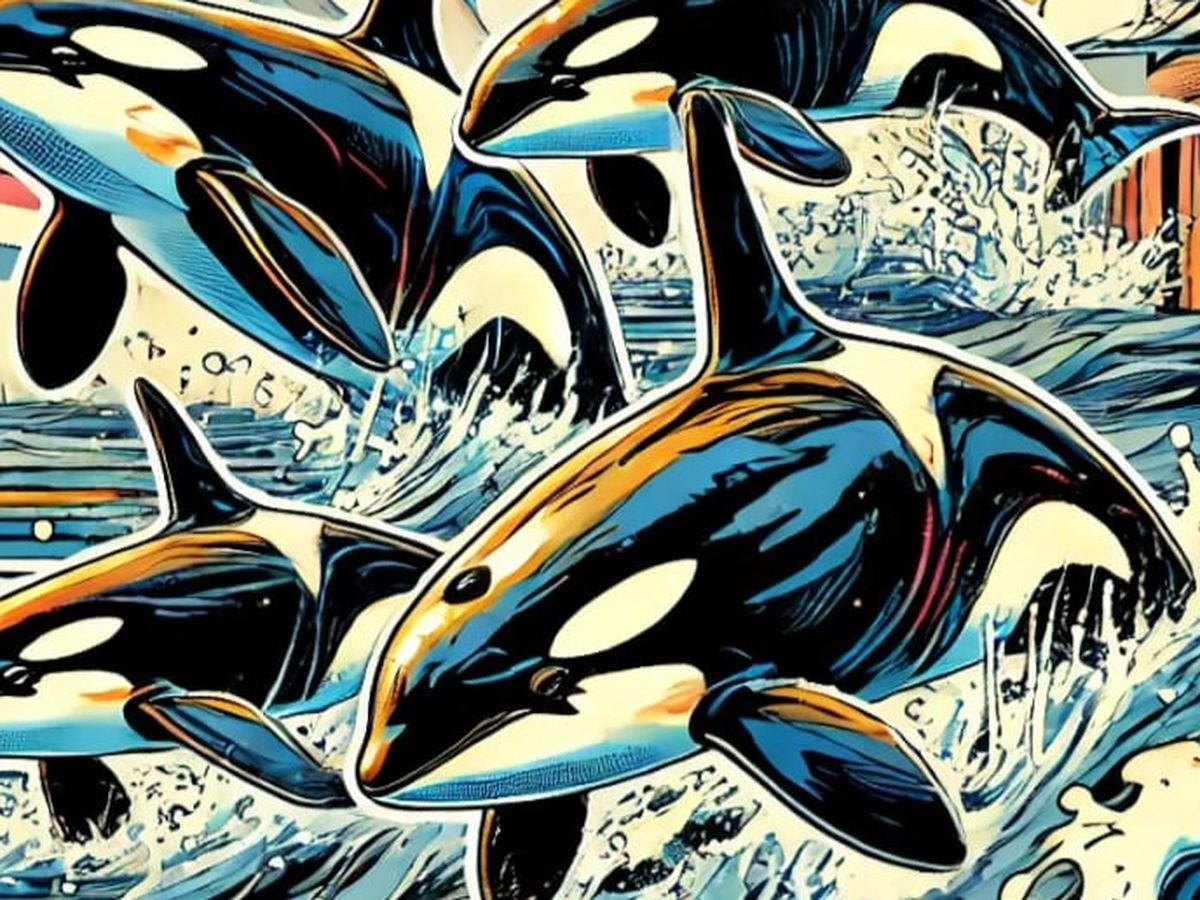
Our Planet Orca.."Our Ocean Needs You" to protect the Ocean
0% complete
£280 raised of £6.2K
9 donations
The Blue Orca Initiative..to raise funds to support the organisations that clean up the Ocean and protect its creatures..
..as part of the fund-raising, the Blue Orca "Our Ocean Needs You" campaign 100% cotton t-shirt is available in two colours, marine-blue and sky-blue..and funds from the t-shirts are donated to selected organisations
Mother Teresa - " We ourselves may feel that what we are doing is
just a drop in the ocean. ..but if that drop was not in the ocean, I think the ocean would be less because of that missing drop "
"Our Ocean Needs You"
..Make your Drop in the Ocean..
..view the Blue Orca OONY Campaign t-shirt: Our Ocean Needs You
..get the Blue Orca OONY Campaign t-shirt: Our Ocean Needs You
...Awaken Awareness
.. participate in actions to Protect the Ocean, wear the message to show the world that they also must make their Drop in the Ocean !
Ocean recovery is not achieved in a Day..
It is achieved through continual action,
day after day
...Drop by Drop
What Drop in the Ocean is being made by you ?
..a Drop is practical participation by citizens, mariners, researchers, organisations and businesses that share a commitment to Ocean recovery.
...Many Drops. One Ocean
The UN Decade of the Ocean (2020-2030)
..The Sustainable Development Goals (SDG)
Goal 14 "Life Below Water" is dedicated to:
"the conservation and sustainable use of the Ocean, seas, and marine resources. The Goal is to prevent marine pollution, protect coastal ecosystems, end overfishing, and combat ocean acidification to preserve planetary health"
...
What is your Drop in the Ocean? ..maybe an Ocean-management activity within SDG 14..or just taking care as an Ocean-user..
..sailing, kite-surfing, scuba, surfing..or just a family beach holiday by the sea..perhaps a vessel captain ?
Your every careful action is contributing your Drop in the Ocean..
..and wearing the Our Ocean Needs You t-shirt expresses that you are caring for the Ocean..
..to let us know that you would like to be allocated an Our Ocean Needs You t-shirt go to Instagram @orcascare and message us with details of your Ocean activity..
..tell us what you've been, or are still, involved in..actions by seafarers mostly show they understand and care..on land, .it could be just having watched the documentary "Ocean with David Attenborough" or, it could be about a beach clean-up in which you've taken part..or, maybe as teacher you have Ocean education as part of your students' programmes .
...every Ocean-care action can be a Drop in the Ocean !
..get the Blue Orca OONY Campaign t-shirt: Our Ocean Needs You
..donate a contribution to the t-shirt capmpaign,..here at GoFundMe Our Planet Orca
"Our Ocean Needs You" . . "your Drop in the Ocean matters.."
...
The Toxins in the Ocean ..PCB
Today, the ocean faces serious threats ..from climate change warming the Ocean waters to the pollution/toxic contamination from chemicals including PCB that are damaging ecosystems and their marine and other creatures.
..what plans do you and your community have for activities and events to help increase the awareness of the Ocean and its marine creatures ?
For example, World Whale and Dolphin Day is July 23 this year, 2026..
..each action, event, activity, however small, becomes a Drop in the Ocean..and helps both public and decision-makers be more aware of the urgent steps needing to be taken to protect the Ocean’s value in its role as the Earth’s life-support system for all creatures, including humans..
.. Protecting the ocean means working together to preserve marine life while ensuring the well-being of human coastal communities.
The Blue Orca Initiative projects include working to organically remove contaminating toxins, especially toxic PCBs, in the marine habitat, home to the sentinel apex species, the orca..
The Initiative raises funds to carry out decontamination through bioremediation..remediation and recovery only through organic substances including biochar and fungi..
..the Blue Orca Initiative works to support the research into developing and applying the most effective combinations of organic matter that will counteract and destroy "forever chemicals" including PCB.
Donations covering t-shirt purchase cost can be made here at GoFundMe Our Planet Orca
..to get updates on the Blue Orca Initiative Ocean Clean-Up progress follow us on
Instagram @orcascare
and
...
How do Forever Chemicals destroy Ocean life..?
Introduction.. "forever chemicals".. the invisible killers, toxins that accumulate in humans, animals and plants, forever .. on land and in the Ocean
Forever chemicals ..
..PFAs (per- and polyfluoroalkyl substances) , a type of some 9,000 chemical compounds that are used to make products resistant to water, stains and heat
..PCBs (polychlorinated biphenyls) , man-made organic chemicals, produced by Monsanto for use in electrical equipment, paints, and plastics for their stability , banned in the US in 1979 due to severe health and environmental risks like cancer, immune issues, and developmental problems; their contamination persists in the environment
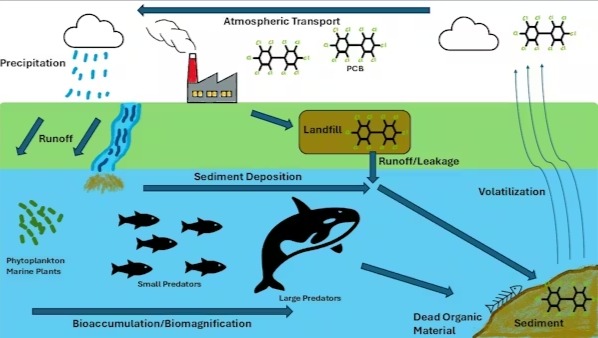
PCBs can enter the environment through landfill runoff and cycle through land, air and water .. ©David Ramotowski
- ..“forever chemicals” , POPs (Persistent Organic Chemicals) , accumulate in humans, animals and plants, forever , because once created they do not naturally break down.. and they are then found everywhere, globally, on land, in the sea and in the air.
- .. these forever toxins are linked to cancer, birth defects, liver disease, thyroid disease, plummeting sperm counts, low fertility, kidney disease, decreased immunity and a range of other serious health problems..
- ..Forever Chemicals must be Cleaned Up...Forever
Read More below and at Patreon..
Patreon
..free membership www.patreon.com/OurPlanetOrca
Our website: www.ourplanetorca.net
..read more information about chemical pollution in the Ocean..and on land
Our Instagram: @orcascare
..engage with the online community that cares about the Ocean and contribute your thoughts/opinions on action to take
" I can do things you cannot, you can do things I cannot; together we can do great things " - Mother Teresa
...
- The Our Planet Orca Mission
Hello!
..our mission at Our Planet Orca is to protect and support the health and ensure the future survival of groups of the Critically Endangered wild Iberian orcas of Spain, and the orca communities in other areas globally.
..we are working to clean out the toxic "forever chemicals" contaminating their local water in their marine habitat, the Ocean..
Our Planet Orca is working to increase awareness of the condition of the Iberian orca population now under threat of Extinction..and take the actions needed to reduce the causes of the Threat..
.. action includes supporting and taking action on the clean up of the Ocean marine habitat where toxic forever chemicals including PFAs and PCBs bioaccumulate in the orca blubber, threatening the survival of calves as well as the mothers..
Destruction of reproduction
..too often the toxins accumulated in the female orca blubber transfer in the mother's milk at the birth of a calf...killing the calf at birth or within its first three months of life...the low survival rate of the new calves means that the community loses viability to thrive and survive. .ending with Extinction.
- our website: www.ourplanetorca.net
- our Instagram: @orcascare
- Patreon ..free membership www.patreon.com/OurPlanetOrca
- view the Blue Orca campaign t-shirt "Our Ocean Needs You
...
The reason for toxic PCBs being in the Ocean
.. short video 1:57"
For use in industry Monsanto first manufactured PCBs back in 1927 and continued until PCB was banned in 1976..
Multiple lawsuits have been and are in process, 2026, against Monsanto for the contamination by their product, PCB, and by their other infamous product glyphosate, the chemical herbicide in weedkiller Round-Up
............
The film: Survival .."Gala, Voice of the Ocean"
The story of the death of what was one of the few remaining Iberian orcas..(IB6) Gala, Voice of the Ocean is in development as a film to explain the PCB contamination issue..full details of the film and its director are to be confirmed shortly during 2026.
The orca, Gala, is the orca representative of all marine species affected by the poisoning of their ocean habitat as well as her own kind, although sadly she is now with us only in spirit, and soon on screen, to tell us about her life.
Through the telling of the heart-wrenching story of Gala the 60' minute film will carry the message to the public, to governments/regulators and perhaps most of all to the chemical corporations:
..the message is that
1. the toxins in the Ocean, the "forever chemicals", especially PFAs and PCBs have been created by the chemical industry over decades and are still causing uncountable levels and types of damage to all living species, in the Ocean and on land.
2. the damage needs to be remedied, needs to be cleaned up by the industry that caused it..
..how to urge and convince these corporate entities to take remedial action is the message, the theme, of the film, made clear by watching Gala's story unfold..
Gala..The beginning
In 2022 Gala, a female Iberian orca, some thirty years old, travelled from her home on the south-western coast of Spain, and died stranded on a beach some 2,000 kms away to the north at Cadzand, Netherlands.
Alone and faraway from home..a companion orca, Titan, either her son or her brother, was seen near her on the beach but hasn't been seen again..
..the emaciated body of Gala was found on her necropsy to have been destroyed by starvation and by the accumulation of toxic forever chemicals in her blubber, her teeth and organs, all ruined..
Now, her skeleton hangs on public display at the Naturalis Biodiversity Centre in Leiden, Netherlands
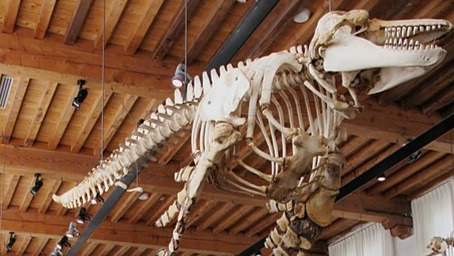
Gala, on display at the Naturalis Biodiversity Center, Netherlands
Her Journey
..when she stranded on the shallow shelving beach at Cadzand was she heading north to try to escape the toxic home seas in the south?
Our film Gala , Voice of the Ocean will ensure that the Voice of the orcas is heard..
Background - why the focus on the orcas?
A sentinel species, orcas are apex predators with a key role in their ecosystem, the global Ocean.
The damage by chemical pollutants that is happening to them and their fellow marine creatures is also happening in our human bodies ..as a concerned human you might see that as also a good reason to participate in getting the problem sorted..!
..Clean Up the Ocean!
The Mission
Over half of the studied killer whales populations around the globe are severely affected by "forever chemicals"..
..among the most potent chemical toxins PCB (polychlorinated biphenyl) is causing the most damage with some killer whale groups..the North Sea/Scotland and Iberian groups have been found to now carry 25 times more PCBs than amounts known to be enough to alter fertility by damage done to the endocrine system.
The toxic pollution in the Ocean causes the infertility which leads to the potential Extinction of the affected orcas and other marine mammals..and it's looking as if humankind may also be suffering the same scary situation... damaged fertility, no more humans..
The OPO Mission is to clean up/remove the toxins from the Ocean..using only natural, organic material.
Locations
Orcas inhabit almost all parts of the world’s ocean, including both cold and warm ecosystems.
This global distribution testifies to their adaptability and unrivaled status as the ocean’s apex predator.
With a dedication unparalleled in marine life orcas have even been observed following prey across one Ocean region to another, traversing massive distances just so they can have a bite to eat..
Donations and Funding
As well as specifically to support the production this year, 2025/26, of "Gala, Voice of the Ocean" donations to Our Planet Orca will support the ongoing CleanUp mission costs, including:
- research studies
- lab-tests of water and eDNA samples
- purchase of equipment and supplies
- participation in scientific research trips
- workshop and conference support
- scientific staff recruitment
The film
Donations are contributions to costs for the first, development stage of making the film..
Development includes scripting, location scouting and attachment of talent, a first payment to the director..
..Production costs, including pre-production, filming days, editing, are budgeted to be contributed by two sponsors, with a view to the balance being covered by the streamer that will be invited to participate.. maybe the same steamer as the one who produced "Blackfish" !
..pledges are also welcomed to be put in place to contribute to the budget..donations and pledges contributing in total £10,000+ will have an opportunity to participate in the bioremediation journey to Clean Up the Ocean !
If the film funding doesn't meet the cost budget then the film will be adjusted to be a shorter version as a You Tube documentary and continue to make known the story of Gala...
...donations received will be reallocated to the other costs of the project and specifically to keeping track of the bioremediation action to clean up the toxins to ensure it is achieving results..
.. the donations will also be allocated to support the cost of ongoing ocean-water sampling tests in the area in and around the Strait of Gibraltar..
Toxic Strait
..the Strait and surrounding area is one of the world's hottest hotspots of contamination because of the heavy shipping traffic and the toxic run-off from the agricultural and industrial land along the coast..and is set as the main testing area of the organic bioremediation mix that is underpinning the clean-up..
Information for global network
As part of the Our Planet Orca awareness work. resources and information about how to reduce the impact of the toxic pollution are being provided by Our Planet Orca to local groups worldwide to help them care for their local orca population.
Focus is on smaller orca populations of which several, including the Critically Endangered South Atlantic Iberian orcas and the Pacific NorthWest orcas, the Southern Residents, are on the IUCN Red List as considered to be in danger of Extinction
Help to clean up and detoxify
How can you help the work to clean up and detoxify the marine environment of the orcas and their fellow marine creatures?
..every donation, no matter the size, helps the groups to work on the clean-up of ocean pollutants and the raising of awareness about the damage being done to the ocean habitat of the orca, and to it's fellow marine creatures..and also to the health of humankind
The toxic contamination threat
The pollution by chemical toxins, especially PCBs, is a significant threat not only to marine life but also to human health due to the persistence of the toxins in the environment and their bioaccumulation in food chains.
The health risks for humans are broad and severe, ranging from cancer and reproductive harm to immune system suppression and developmental damage
Clean the Ocean
.. the work underway is to find, develop and deliver natural sustainable ways, called bioremediation, to neutralise and remove the toxins and chemicals that are polluting the orcas' ocean and marine environment

..did Gala die while trying to escape the polluting toxins in her home waters?
Please click the link below to Donate
or Share this message to spread the word about our project.
Thank you!

Male and female orca, Endangered by infertility
The team, project and mission
As environmental activists and longtime whale-watchers we are founders of the project Our Planet Orca, together with Orcas Care .
The data-gathering team is based in the Tarifa area, seasonal home of the Critically Endangered South Atlantic Iberian orca, on the Atlantic coast of Southern Spain.

A young orca.. female, with a sickle-shaped curved dorsal fin..
Our Planet Orca (OPO) is acting globally to provide resources and information to local orca awareness and protection groups..
.. to carry out and expand each group's daily activities in increasing awareness of the need for protection of wild orcas in the group's local area
.. to provide the resources to local groups to work to clean out the pollutants in the waters affecting Resident orcas in designated local Marine Protection Areas

Working to help a stranded orca survive..
Global Care
From Spain in the south to Shetland and beyond in the north/Arctic, from Valdés Argentina to Vancouver Canada, and in local waters all around the globe as well as in the deep ocean the iconic orca is well-known, but little known about, until recently.
The degraded condition of all the orca marine habitats, and of the creatures that are also in the orcas' domain, is becoming clearer.. ..an increased care is required to halt the modern-day destruction of the ocean being caused by toxic chemical pollutants, Persistent Organic Pollutants (POPs) including PCBs and PFAs
About Orcas
"..their black and white markings add to their beauty..
..while also seeming terrifying.."
..orcas are pack-hunting creatures that feed on everything from salmon to blue whales, able to take out even great white sharks..
..an apex predator, at the top of the marine habitat food chain,
among the most formidable animals in the ocean, the orca has evolved over 55 million years from being a land-based mammal, similar in size to a wolf.

..the orca evolved from being a land-based mammal..

The pakicetus, the walking whale

Orca, "Gala IB6"
2023, Naturalis Biodiversity Centre, Leiden
Orca evolution
Just as elephant ancestry spans over 55 million years on the planet so have orcas existed on the planet for more than 50 million years.
The orca evolved from land-dwelling mammals in a process that took millions of years to become the marine creatures we see today..the distinctive black and white appearance and remarkably intelligent behaviours with a brain five times larger than the human brain, with a body size and weight equivalent to that of a ten ton truck, or an adult elephant..
While elephants can live for 70 years, orcas can live for 50 to 90 years..the length of life of both these majestic mammal species is being shortened by the activities of humankind..
The role of the orca in their marine environment is pivotal, influencing the ecosystem in profound ways..
..sadly, Man in his usual way is complicating the lives of the orcas, and of their prey, by destroying their habitat and environment, the global ocean, with the toxic chemical pollutants that are destroying the health of all marine creatures.
The Mission
It is the mission of Our Planet Orca to work -
- to research the ways to restore and maintain restored the habitat which has been home for the orcas, and their many fellow marine creatures, for millions of years..
- to halt and neutralise the damage being done to ocean waters and the marine environment by man-made Persistent Organic Pollutants (POP)
Persistent Organic Pollutants
The orcas' apex predator position at the top of the food chain has exposed them to a wide range of POPs in the ocean.
These heavy metals and other contaminants have accumulated over time through a process called biomagnification, the increase in concentration of a substance, e.g a pesticide, in the tissues of organisms at successively higher levels in a food chain.
The blubber of orcas is showing a high concentration of a range of pollutants and toxins, including PCBs, leading to immune system damage and infertility..
..when orcas are hungry and working hard, they metabolize fat, releasing PCBs and other toxic chemicals from their blubber into their bloodstreams where the pollutants can damage the immune system, increasing disease risk.
PCBs can act as neurotoxins, causing potential disorientation, further complicating the hunt for food resulting in starvation causing the percentage of PCBs in the bodies to increase and amplify the impacts.
There remain very few places on the planet where pollutants such as PCBs have not reached, so humankind also is affected by them -
..these deadly toxins are in our food, in the air we breathe, in products used in our daily lives such as paint, varnish and soap, and in waste coming from some consumer products such as waterproof textiles, furniture, plastics and electronic equipment.
The health risks are broad and severe, ranging from cancer and reproductive harm to immune system suppression and developmental damage
Our Planet Orca is working to
- increase the awareness of the need for humankind activities to change, to end the contamination of the ocean by
.. cleaning up the impact of those damaging activities
.. eliminating ineffectually-controlled storage of POPs
While control/elimination of the use of well-known toxins DDT and of CFCs is ongoing there remains work to be done to eliminate badly-managed stocks of these and the other highly carcinogenic chemical compounds including widely-dispersed PCB (polychlorinated biphenyls) which induce both carcinogenic and non-carcinogenic effects on humans and animals.
More International agreements
It may seem that stopping the destruction of the ocean is a big ask but so was the ask to halt the destruction of the ozone layer..
..the recovery of the ozone layer has been made possible by the successful elimination from the stratosphere of the harmful industrial chemicals, together referred to as Ozone Depleting Substances or ODS (including the CFCs used in sprays).
To clean up and protect the ozone layer in the stratosphere, some 35 kms above the earth's surface, international agreements were made and acted upon in the 1980s to reduce the production of chemicals, among them the CFCs which were the main cause of the hole in the ozone layer, now healed.
This was achieved through the implementation of the 1989 Montreal Protocol..and that agreement was reached because enough people cared and worked together to achieve it.
In the same way, Our Planet Orca wants to see the London Convention and London Protocol, international treaties of global application, together with the Stockholm Convention, the global chemicals management treaty on Persistent Organic Pollutants, working to protect the marine environment from the pollution caused by the dumping and leaching of toxic wastes and other matter into the ocean.
OPO is also working to push for further more intense action to neutralise the existing toxins in the Ocean..and that action needs to be energised and implemented by many more of the 152 signatories to the Stockholm Convention
Clean up PCBs
..PCB, a highly carcinogenic chemical compound and one of the most toxic contaminants in the ocean, is a chlorinated hydrocarbon, varying in consistency from thin, light-colored liquids to yellow or black waxy solids.

PCBs are used by the electricity industry

PCBs in old fluorescent light ballasts
Banned
PCB was banned in 1979 after 50 years in production but the toxic chemical has been, and still is, leaching into soil and seas, worldwide.
Over 100 years since the 1920's it has been accumulating in the blubber of the long-lived orcas, ingested from contaminated large prey-fish such as tuna..the same tuna stocks that are fished to serve up as a high-priced tasty dish for humans to enjoy..
"From buildings, landfills and sediments, the PCBs continue to filter into our rivers and end up in our seas.
Due to the persistent nature of PCBs they then build up through the food chain, with the highest volumes and worst effects seen in top predators, like dolphins, sharks and killer whales
"..over half of the studied killer whales populations around the globe are severely affected by chemicals known as PCBs; their use was banned in the 1980s, but they’re still being detected in the western Mediterranean, in the waters of the south-west of the Iberian peninsula and the Strait of Gibraltar"
Strait of Gibraltar
Since 2016, the international press has reported that "High concentrations of toxic chemicals are affecting orca populations in Western European waters."
"..the toxic contamination effects result in fewer and fewer animals over time in these populations, where we rarely observe newborn killer whales."
"The organochlorine contamination concentrations in blubber found in the Strait of Gibraltar pilot whale population exceeds by 15 times the accepted toxicity threshold in blubber of marine mammals which might affect their reproduction and immune system.
Early studies show that "stranded and biopsied cetaceans of the waters of the Strait of Gibraltar have one of the highest organochlorine polychlorinated biphenyl (PCB) concentrations in the world.
High toxic levels
This high level of contamination can lead to increased virus infection and transmission and to an increased mortality rate when infected.
Since 1988 it has been reported that "In the Strait of Gibraltar, high contaminant loads may exacerbate the severity of the disease and favour transmission between species"
Some killer whales now carry 25 times more PCBs than amounts shown to alter fertility, with additional damage by mothers nursing a calf by passing the pollutants along during birth or through breast milk
Unlike many land-based predators, such as polar bears, orcas have a hard time getting rid of PCBs. Their livers can’t metabolize them the same way that those of polar bears do; and orcas don’t make fur, which is an important excretion route of the compounds for the bears.
"As well as the Strait of Gibraltar, the situation is worst in the oceans around Brazil, the northeast Pacific and around the UK. The models show that these populations have virtually been halved during the half century where PCBs have been present."
Jean-Pierre Desforges, Aarhus University
The Iberian orca is now classified on the IUCN Red List as a "critically endangered species", just one classification away from Extinction in the wild.
PCB ongoing damage
"Global mismanagement and inequities make elimination of these persistent chemicals unlikely."
..elimination of these chemicals is unlikely.. "this analysis is an international wake-up call to limit the production of hazardous chemicals, like PCBs, and to responsibly eliminate PCB stocks, but shockingly little progress has been made.”
.. almost a half of the 152 signatories to the Stockholm Convention on Persistent Organic Pollutants are unaware of the amounts and locations of PCB stocks in their country.."
– Lisa Melymuk, Assistant Professor of Environmental Chemistry, Masaryk University
Chemicals of Mass Destruction
"A lack of administrative, financial, and political capacities are key impediments to successfully managing PCB stocks, especially in low-income countries, despite these countries not being responsible for most PCB production or use..
As a consequence, only 30 percent of signatories to the Stockholm Convention are on track to meet the target of environmentally sound management and to remove their stocks of highly-hazardous polychlorinated biphenyls (PCBs) by the 2028 deadline set forth in the Stockholm Convention.. more than 10 million tonnes of PCB-containing materials remain and pose public health and environmental threats globally."
.. and meanwhile the orcas at risk continue on track to extinction..
The U.S., the world’s largest producer and user of PCBs, has decreased its sizable stocks by only about 3 percent since 2006. Despite having the financial capacity to responsibly eliminate PCBs, the U.S. has no regulatory deadlines to do so, is not a party to the Stockholm Convention, and its PCB inventory is poorly documented"
PCB remediation
To hasten the clean-up, as an alternative to waiting for international governments and other connected entities to start to act to show more concern, OPO is working on raising and dedicating funds to engage with chemists and chemical engineers to develop effective remedial action.
The focus of the chemists is to research and develop current knowledge and resources to find a natural, sustainable cost-effective solution to ending past and present contamination of the ocean, and the connected waterways, the rivers and run-off from the land.
Bioremediation
Research is showing that one of the most promising and immediate solutions is the application of fungi to contaminated water.
Focus is on utilizing the well-known degradation capability of one specific fungus, the oyster mushroom, and the results to date are promising using the mushroom substrate, an important by-product of the oyster mushroom industry.
Current research is showing the effectiveness of marine fungi in degrading PCBs
- in optimal environmental conditions
- with specific strains of fungi
These fungal processes need to be widely applied in the Ocean and in other marine environments to clean up the PCB-contaminated sites from which PCBs are leaching into waterways and sediments in coastal areas..this is a main focus for action by Our Planet Orca.

Bioremediation..Pleurotus ostreatus, the common edible oyster mushroom
Next stage, the forum
Following on from the early funding stages to develop the tools to use to Increase Awareness OPO is applying the project's next stage funding (provided by Project Sponsors) to create a forum, in an online journal format, within which chemists and chemical and other engineers can add to and access research into how to create and apply the remedial substances that will neutralise the toxins.
The main task of the forum will be to work to enable continuing research and action to implement the development and application of fungi to neutralise PCB in the ocean.
.. ongoing contact is being developed with the chemical companies that manufactured PCB to encourage them to contribute resources to cleaning up the accumulated impact of their range of products, including PCB, already contaminating the ocean.
The reduction in pollution will contribute to halting the current destruction of the orcas, and their fellow marine creatures, and their environment, by the pollution from industrial toxins and other ill-considered human activities.
Example:
With 73 individuals remaining, Southern Resident orcas, the most endangered population of killer whales in the U.S, live mostly off British Columbia, Washington and Oregon, but also travel to forage widely off the coast.
The Southern Residents are seasonal visitors, spending the spring, summer and Fall hunting for salmon throughout the inland and coastal waterways of Washington and British Columbia..
..now they can be seen starving to death in a world with on-demand salmon, pollutant-filled cities and heavily trafficked waterways..and river-dams that are reducing the ability of the salmon to travel upriver to spawn.
The “strong increase” in skin lesions on the orcas' bodies is believed by scientists to be due to the decreasing ability of their immune systems to deal with disease.
"The lesions appear to be the symptom of serious underlying conditions affecting the whales’ health – from immune suppression to infertility – and their presence, as in any cetacean, is a warning sign that things are not well"
With 99% of the animals studied exhibiting the lesions, the consequences could be disastrous for the fragile population of southern resident orcas"
Our Planet Orca is working to assist local organisations in their campaign for dams to be opened up to allow the Chinook salmon to access upriver to their spawning grounds and return to open water where the orcas roam..and feed..
If actions are taken, the most optimistic "road to recovery" shows the population of Southern Resident orcas rising from 74 in 2024 to over 200 in the next century.
.. "worst case" inaction would mean the Southern Resident population would be extinct in 50 years.
Orcas are Dolphins
Orcas, like humans, live in groups, pods, with distinctive languages, diets, traditions and rituals, with family pods moving/migrating from place to place as food sources change with the seasons.
Regional groups identify themselves with their own dialect of sounds, immediately recognising outsiders by the dialect sounds they make..
The orca is a dolphin not a whale, even though incorrectly also called killer-whale.. although the world's top marine predator, a greater marine predator than the great white shark, orcas in the wild do not attack humans..
..evolved over many millennia, some 51,000 orcas are estimated to be left on the planet, although data collection is limited with insufficient data about some of the populations to assess their status.
Orca families live globally across the worldwide ocean, with some of the smallest pods, families, fighting to survive in waters off coastlines densely inhabited by humans, such as the coastal waters off Washington and British Columbia and on the Atlantic coasts of Iberia, Europe
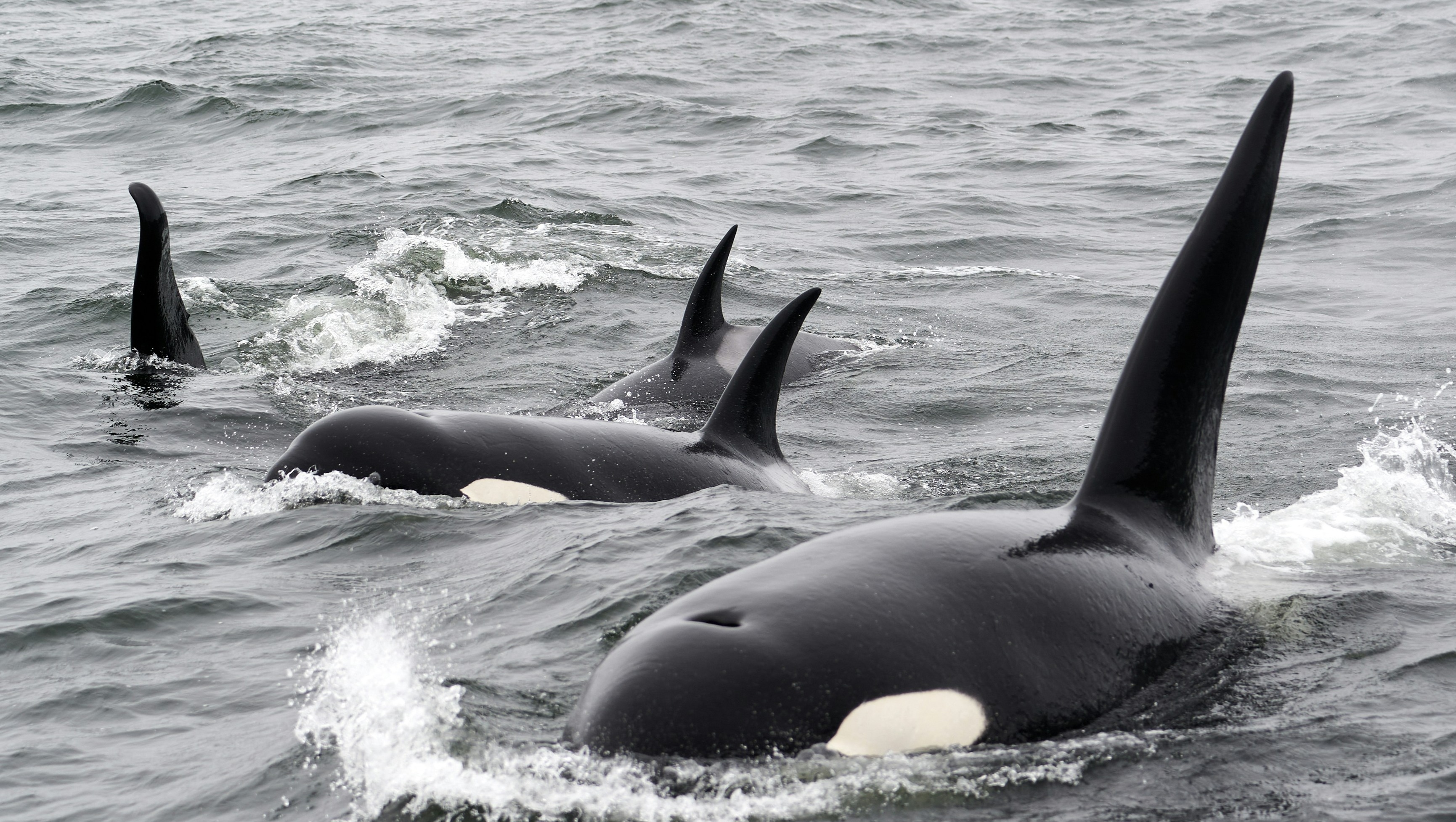
A pod of orcas, Monterey Bay, California
..many orca pods live in the open ocean and off remote coasts, far away from human communities but are still affected by the far-reaching carelessness of human activities causing degradation and destruction of the marine environment.
If orcas and their habitat are not protected against destruction, then additional species and habitats that are a part of their lives will be impacted as well..
Protection locally
Our Planet Orca is working globally to provide local orca awareness and protection organisations and groups with resources and information to carry out and expand their daily activities to protect wild orcas in their local area waters..
Each local group is asked to take local area action to participate in the decontamination work being facilitated by OPO to clean up the marine habitat worldwide.
Funding
In the early stages of this GoFundMe campaign as well as supporting the early production costs of making the film "Gala, Voice of the Ocean" funds that are donated are being put to work to increase awareness in each of the communities that have orcas resident in the nearby local waters.
With increased awareness actions can be more easily taken at a local level to care for and enhance the well-being of the local orcas, the Residents, including coordination of findings and solutions to decontaminate the local waters.
Increase Awareness
The increase of Awareness of local groups is through the creation and distribution of videos, blogs and other educational online Content.
It delivers to foundations, corporations and environmental concerns, as well as citizens of all communities, the messages of information and action-support that are needed to support the orcas and keep working to clean up their orca marine habitat.
Next stage, specialists
At the next stage after this GoFundMe campaign reaches its target available funds, contributed by project sponsors, will be applied to retain specialist consultants, including marine biologists, chemical engineers and research analysts, to provide consultations on and assessments of marine contamination.
These assessments will be the core of the information provided to local groups with information for targeted specific action and activities.
Continuing Awareness, photo-ID/AI
A part of the Awareness campaign works through AI-driven analysis to locate the orca pods in different areas and draw together information related to each animal..and add to the much-needed data for study.
A photoID database has been built by many locations to keep track of their local population - an AI App is being researched for development by OPO to enable quicker and simpler cross-reference between the databases so as to use the matching images to follow orca migratory and feeding cycles and patterns.
More info about the Awareness campaign, and the tools/platforms being used, are added regularly on OPO platforms, with activities and result updates sent direct to Donors..Free Membership is available at the OPO Patreon account so as to receive regular updates by email and link .. www.patreon.com/OurPlanetOrca
Donors
As well as receiving regular information updates on their selected orca area Donors have the opportunity:
- to participate in trips to locations where orcas can be observed in the wild without disturbing then (for example, from shore-based watch-points)
- to receive free copies of OPO posters and educational
e-booklets and access OPO t-shirts and hoodies
Next steps
Location preparation and discovering and contacting local groups world-wide is moving forward fast ..and contact is welcomed from local groups of orca-carers wishing to participate..
..in the meantime, donations, even with small amounts, to this fundraiser, Sharing the request so as to reach a wider audience, will help next steps to be planned and more work undertaken..
..Orcas Care ! ..Thanks for listening
Our website: www.ourplanetorca.net
Our Instagram: @orcascare
Patreon: www.patreon.com/OurPlanetOrca
Campaign t-shirt: view the Our Ocean Needs You tshirts
OPO Associated Platforms :
. Orca Art at Kestrel Gallery
1. Patreon
If you wish to contribute and Follow through Patreon as well as/or instead of a Donation here on GoFundMe, go to..
Free Follower
You can sign up with Patreon as a Free Follower with just your email as a Follower, no cost.
Paid membership
..for $4/month (€3.60, £3.10) you receive from Patreon all the updates on progress and on orca-watching trips
..paid level Patreon members have access to a gift from Our Planet Orca of personalised items including clothing items such as hoodies..just right for whale-watching on cliff-tops!
2. Go Fund Me Donation
When donating please note that the Tip Slider is set by the GFM platform and not by OPO, with the "tip" paid to the platform not to OPO...the slider is fully adjustable, even down to zero to pay no tip
3. Orca Art
Prints of our cover image together with other digital AI images created by Ben Vale for his Soul Experience collection are available to view and purchase at https://www.artpal.com/KestrelGallery#i5
Donations are made to Our Planet Orca from art sales by the Gallery
..

"Shared Connection"
..........

"Thoughts combined"
...........
Organizer
