- J
- T
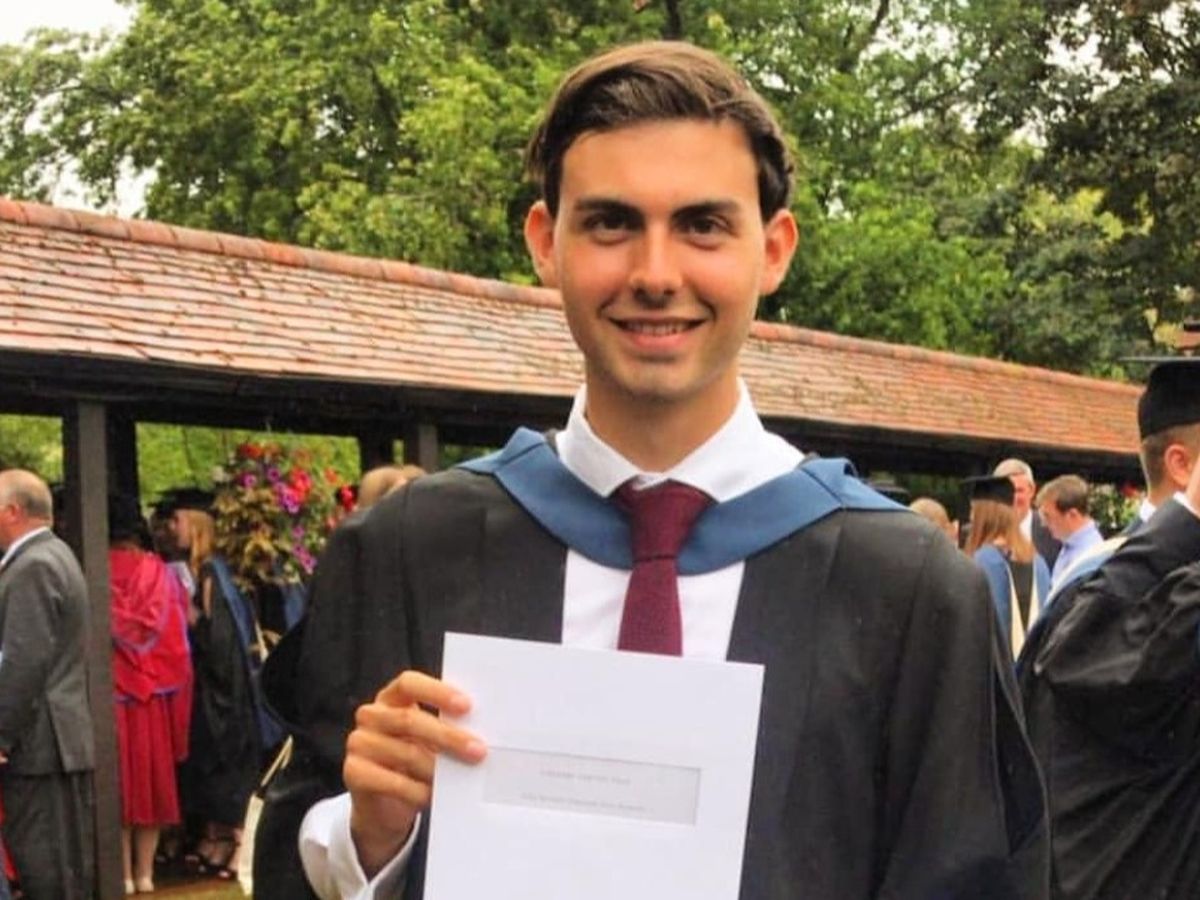
Greetings everyone, my name is Lillo and I am reaching out to you today as a young man who is £6,800 away from realising a life-changing opportunity.
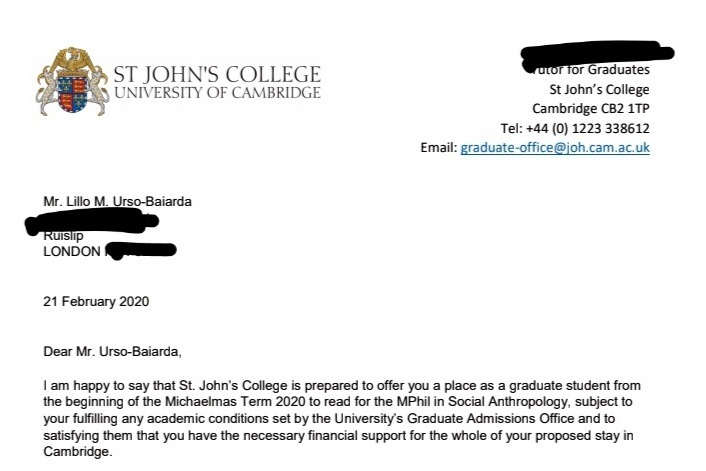
This February, I was delighted to discover that I had received an offer of postgraduate study from St. John’s College at the University of Cambridge for an MPhil in Social Anthropology. As fortunate as I am to be in my position, it is with regret that I currently fall short of the total financial requirement to fulfil this dream.
My one-year course fee alone is £19,587, and on top of this, accommodation bills are expected to cost £6,567 for the eleven months that I will be in residence. This amounts to £26,154 before even considering the cost of living and other associated costs of education. Given how difficult it has been to get myself into this position, I am determined not to let this financial barrier prevent me from taking up my place at Cambridge, as is so often the case for students from state schools and modest backgrounds like myself, and indeed those far less advantaged than my own.
Therefore, another maximum student loan, a long year’s worth of savings, over 20 unique grant applications and one aired letter to Prince Charles later (an anthropology and Cambridge alumnus), and I have managed to bring this deficit down from £26,154 to £6,800. I had been very reluctant to create a GoFundMe page, and still feel uneasy in light of events this year that have left other individuals and health organisations in positions far more worthy of philanthropy than myself. However, with only one month to go until I am set to begin my course, I am left with very little choice. I should add that, as I am able to pay my fees in three instalments, I intend on confirming my offer whilst trying to raise funds to cover the final instalment in April during my studies, if this is not possible before. I do not expect to cover the entire £6,800 deficit through GoFundMe alone and am continually searching for new grant opportunities, but any money raised would be hugely appreciated and a real step in the right direction.
To hear more about the fascinating discipline of anthropology and what I intend to do with my master's degree, my financial pursuits, and how your donation could earn you a written acknowledgement in my dissertation, please do read on. Thank you!
Why Social Anthropology?
Anthropology is concerned with the study of humanity. Social anthropology, specifically, is the study of human societies and culture, and seeks to explore the similarities and differences in the ways in which the myriad societies, past and present on earth, organise themselves, primarily through economics, politics, religion and kinship. Work in the discipline contributes to a broader understanding of what it is to be human, and speaks to the diversity of human beings as well as what unites us.
My first encounter with anthropology came in the final year of my undergraduate degree in Human Geography at the University of Reading. I undertook a module delivered by anthropologist Dr Thomas Grisaffi, titled ‘Development in Latin America’, where I excelled as I was won over by the critical nature of the discipline and its use of ethnography (a research method that involves observing and interacting with a study's participants in their real-life environment) to address political problems. It was an eye-opening experience to learn how indigenous, vernacular ways of thinking were so often overlooked in Latin America in place of western theories of development and homogeneous economic policies. Getting to know the world from the perspective of local peoples is crucial before diagnosing their ‘development’.
What do I intend to use my degree for?
It is my intention to use my Cambridge MPhil to enter a career shaping social policy, be this through a think tank or another governmental advisory institution. Channelling my skills and empathy of human research into positive developments within our own society is what motivates me to undertake social anthropology as a discipline, and there really is no better institution than Cambridge to provide me with the springboard and links to make that happen.
Outside of a vocational use, there is something incredibly enlightening and uplifting about studying social anthropology. Reading into the discipline quickly makes you question every small facet of our cultural norms and day-to-day lives: these challenges can concern trivial things like table etiquette, to more broader ideas around political and economic theory. Once an anthropological lens is applied, everything becomes interesting, and I’m sure that this world-leading course, delivered by world-leading academics will develop my critical nature further and continue to serve my appetite for curiosity.
My pursuit of funding
Regrettably, I was not fortunate enough to be one of the 10% of graduate offer holders to receive a funded scholarship from Cambridge. Rather, since I received my offer of study in January, to try to meet the course fees I have managed to save £5,500 of my graduate salary, and have made unique applications for grants from over 20 charities. Finding the necessary charities who support students in my position demands a great deal of time and energy that one in full-time employment rarely has, given the lack of a free, centralised database. This only adds to the disappointing reality that only three of the 20+ charities that I had rested my hopes of a Cambridge education on have got back to me. Couple that with being left on read by Prince Charles, and it is easy to see how one could lose faith.
Faith was not lost, however, and I am incredibly fortunate to have received two, £1,000 grants from The Sidney Perry Foundation and The Humanitarian Trust off the back of my applications. Combining these with my savings and £11,220 maximum postgraduate student loan, I still fall short of the minimum financial requirement by £6,800, but I am determined to keep pushing, considering the ground I have made.
What’s in it for you?
The late, great anthropologist Marcel Mauss was one of the first to shine light upon the silent expectation of reciprocity when ‘giving’, so allow me to outline some very visible methods of reciprocation that I can offer you:
Any donation of £20 or more - your name written in indelible ink in the acknowledgements section of my dissertation, forever
Any donation of £50 or more - a years worth of free Fantasy Football consultation, including deep audits of your team and transfer suggestions upon request (top 1% and top 2% global finishes in FPL in the past two respective seasons)
Any donation of £100 or more - a signed photo of me matriculating, accompanied by a heartfelt message sent straight to you (at this point it is important to stress the irony behind this action)
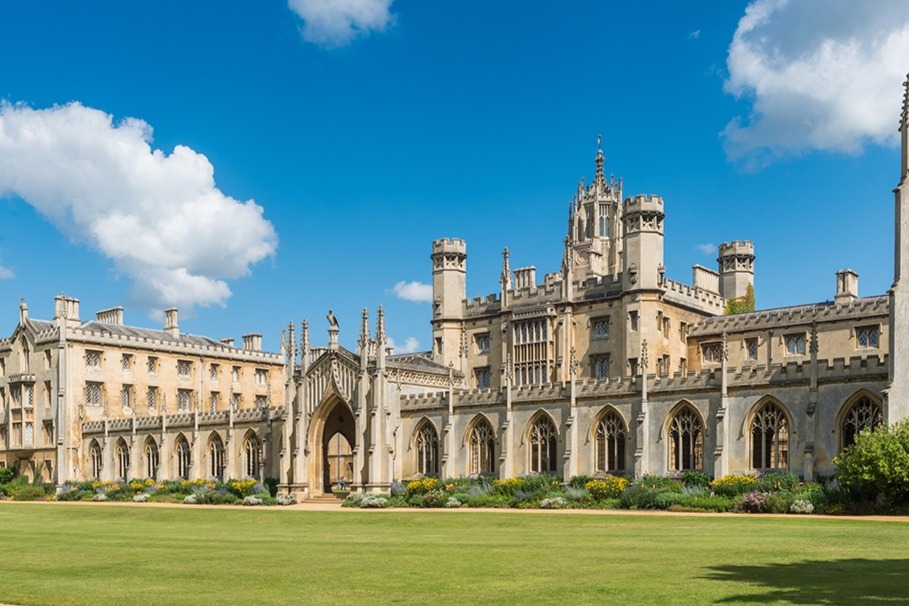
Any donation above of £250 or more - an invitation to dine as a guest with me at St. John’s 16th-century Great Hall, you are welcome to decline
Any donation above of £500 or more - I am so confident that this will not happen that I pledge to entering a half marathon in your honour
It goes without saying that I am incredibly grateful to anybody who is generous enough to donate their hard-earned funds to my cause, no matter the size of your donation. If you are unable to donate, then I would encourage you to consider signing this petition to enable greater governmental support for students from lower income backgrounds looking to pursue postgraduate study.
Thank you for your support and for taking action against financial barriers to education!
This February, I was delighted to discover that I had received an offer of postgraduate study from St. John’s College at the University of Cambridge for an MPhil in Social Anthropology. As fortunate as I am to be in my position, it is with regret that I currently fall short of the total financial requirement to fulfil this dream.
My one-year course fee alone is £19,587, and on top of this, accommodation bills are expected to cost £6,567 for the eleven months that I will be in residence. This amounts to £26,154 before even considering the cost of living and other associated costs of education. Given how difficult it has been to get myself into this position, I am determined not to let this financial barrier prevent me from taking up my place at Cambridge, as is so often the case for students from state schools and modest backgrounds like myself, and indeed those far less advantaged than my own.
Therefore, another maximum student loan, a long year’s worth of savings, over 20 unique grant applications and one aired letter to Prince Charles later (an anthropology and Cambridge alumnus), and I have managed to bring this deficit down from £26,154 to £6,800. I had been very reluctant to create a GoFundMe page, and still feel uneasy in light of events this year that have left other individuals and health organisations in positions far more worthy of philanthropy than myself. However, with only one month to go until I am set to begin my course, I am left with very little choice. I should add that, as I am able to pay my fees in three instalments, I intend on confirming my offer whilst trying to raise funds to cover the final instalment in April during my studies, if this is not possible before. I do not expect to cover the entire £6,800 deficit through GoFundMe alone and am continually searching for new grant opportunities, but any money raised would be hugely appreciated and a real step in the right direction.
To hear more about the fascinating discipline of anthropology and what I intend to do with my master's degree, my financial pursuits, and how your donation could earn you a written acknowledgement in my dissertation, please do read on. Thank you!
Why Social Anthropology?
Anthropology is concerned with the study of humanity. Social anthropology, specifically, is the study of human societies and culture, and seeks to explore the similarities and differences in the ways in which the myriad societies, past and present on earth, organise themselves, primarily through economics, politics, religion and kinship. Work in the discipline contributes to a broader understanding of what it is to be human, and speaks to the diversity of human beings as well as what unites us.
My first encounter with anthropology came in the final year of my undergraduate degree in Human Geography at the University of Reading. I undertook a module delivered by anthropologist Dr Thomas Grisaffi, titled ‘Development in Latin America’, where I excelled as I was won over by the critical nature of the discipline and its use of ethnography (a research method that involves observing and interacting with a study's participants in their real-life environment) to address political problems. It was an eye-opening experience to learn how indigenous, vernacular ways of thinking were so often overlooked in Latin America in place of western theories of development and homogeneous economic policies. Getting to know the world from the perspective of local peoples is crucial before diagnosing their ‘development’.
What do I intend to use my degree for?
It is my intention to use my Cambridge MPhil to enter a career shaping social policy, be this through a think tank or another governmental advisory institution. Channelling my skills and empathy of human research into positive developments within our own society is what motivates me to undertake social anthropology as a discipline, and there really is no better institution than Cambridge to provide me with the springboard and links to make that happen.
Outside of a vocational use, there is something incredibly enlightening and uplifting about studying social anthropology. Reading into the discipline quickly makes you question every small facet of our cultural norms and day-to-day lives: these challenges can concern trivial things like table etiquette, to more broader ideas around political and economic theory. Once an anthropological lens is applied, everything becomes interesting, and I’m sure that this world-leading course, delivered by world-leading academics will develop my critical nature further and continue to serve my appetite for curiosity.
My pursuit of funding
Regrettably, I was not fortunate enough to be one of the 10% of graduate offer holders to receive a funded scholarship from Cambridge. Rather, since I received my offer of study in January, to try to meet the course fees I have managed to save £5,500 of my graduate salary, and have made unique applications for grants from over 20 charities. Finding the necessary charities who support students in my position demands a great deal of time and energy that one in full-time employment rarely has, given the lack of a free, centralised database. This only adds to the disappointing reality that only three of the 20+ charities that I had rested my hopes of a Cambridge education on have got back to me. Couple that with being left on read by Prince Charles, and it is easy to see how one could lose faith.
Faith was not lost, however, and I am incredibly fortunate to have received two, £1,000 grants from The Sidney Perry Foundation and The Humanitarian Trust off the back of my applications. Combining these with my savings and £11,220 maximum postgraduate student loan, I still fall short of the minimum financial requirement by £6,800, but I am determined to keep pushing, considering the ground I have made.
What’s in it for you?
The late, great anthropologist Marcel Mauss was one of the first to shine light upon the silent expectation of reciprocity when ‘giving’, so allow me to outline some very visible methods of reciprocation that I can offer you:
Any donation of £20 or more - your name written in indelible ink in the acknowledgements section of my dissertation, forever
Any donation of £50 or more - a years worth of free Fantasy Football consultation, including deep audits of your team and transfer suggestions upon request (top 1% and top 2% global finishes in FPL in the past two respective seasons)
Any donation of £100 or more - a signed photo of me matriculating, accompanied by a heartfelt message sent straight to you (at this point it is important to stress the irony behind this action)
Any donation above of £250 or more - an invitation to dine as a guest with me at St. John’s 16th-century Great Hall, you are welcome to decline
Any donation above of £500 or more - I am so confident that this will not happen that I pledge to entering a half marathon in your honour
It goes without saying that I am incredibly grateful to anybody who is generous enough to donate their hard-earned funds to my cause, no matter the size of your donation. If you are unable to donate, then I would encourage you to consider signing this petition to enable greater governmental support for students from lower income backgrounds looking to pursue postgraduate study.
Thank you for your support and for taking action against financial barriers to education!
Organizer
Lillo Baiarda
Organizer