
- J
- R
On a chilly morning in December of 2015, six days before Christmas, Caedmon Anders Page came screaming his way into the world. To us - his parents - he was absolutely perfect. Ten perfect tiny fingers that grasped our own with such dependency. Ten perfect, tiny, kissable toes. And as first-time parents often do, we fell in love with this scrawny, seven-pound person in a way we had never fallen in love before.
Our baby, though, didn’t seem quite as enamored with my husband or I, if we were honest. Specifically, he didn’t seem to enjoy being held. Even those very first days in the hospital, we noticed Caedmon preferred sleeping in his bassinet to falling asleep in our arms. And when I tried to nurse him, he would arch his whole body away from me and cry - not once, not twice, but every single time. He seemed to not like...being touched?
We shrugged it off, though. Everybody’s wired differently, right?
The doctors assured us he was fine.
Guess our little boy’s going to be a touch-me-not, we laughed. And we moved on.
And later, even when Caedmon displayed other atypical behaviors: he was late to crawl...late to cruise...extremely late to walk...late to speak...we didn’t worry. Again, everybody develops at a different pace, right? We were sure he was A-ok.
Time passed, and Caedmon turned two, ushering in all the accompanying stereotypic “terribles”: the tantrums, the defiance, the intensity. And boy was he intense.
Are all two-year-olds this intense?, we wondered.
At meal time, Caedmon cried and thrashed in his high chair every time we buckled him in to eat. He flat-out refused almost every food we offered him, even the “kiddy” ones like chicken nuggets or macaroni. And he displayed an almost obsessive aversion to getting anything messy on his hands.
At bathtime, Caedmon screamed in desperation whenever my husband or I attempted to wash his hair - swatting us, ducking away, and howling in anguish when we eventually caught him and soaked his hair with water. Combing it was yet another ordeal.
If we deviated even slightly from our predictable daily routine, Caedmon would fall apart emotionally. And the most basic transitions - waking from naptime, moving from one form of play to the next - caused Caedmon to break down.
Traveling in the car was a nightmare too, mostly because Caedmon would howl and sob any time sunlight got in his eyes. When I ran errands with him around town, I did my best to avoid all places with loud noises - blenders at coffee shops, a passing siren, even the flush of a public toilet could send Caedmon over the edge. He would clamp his hands over his ears, squeeze his eyes shut, and cry. Loudly.
Having a two-year-old was exhausting, we thought.
But in my mama-bear heart, I was quietly beginning to wonder if maybe these weren’t just age-related behaviors we were witnessing - or inexplicable personality quirks, but perhaps red flag symptoms of something deeper. Something wrong. I just had no idea what that might be.
Still, the pediatrician kept telling us Caedmon was healthy, and well-meaning friends and family assured us that Caedmon’s behavior was simply a stage, offering words like, “He’s just being a boy”, “It’s a first child thing”, and “Don’t worry, he’ll grow out of it in time.” A few people were less encouraging too, telling us that, essentially, we as his parents were to blame. If Caedmon were more strictly disciplined, they reasoned, surely he wouldn’t continue to act this way.
The problem was, we did discipline Caedmon. All the time. And it had zero effect on his behavior. By age three-and-a-half, Caedmon was still just as intense, unruly, and prone to meltdowns as he’d ever been. If anything, he was growing more intense, and as his parents, we were growing more alarmed. We noticed that Caedmon struggled to perform tasks which came easily to his peer group and that his development was lagging in gross-motor skills. We watched helplessly as he became an increasingly anxious child. He grew aggressive or impulsive whenever he felt overwhelmed, which was often. He became more demanding and difficult to calm. We learned not to even try hugging him or attempting to wipe his tears, which always backfired to make him more upset. We lived in near constant crisis.

“I wish something wasn’t wrong with me,” Caedmon confided to me one afternoon at the end of a 30-minute meltdown. (A tower of toy blocks had fallen to the floor.) “I always ruin everyone’s life! I ruin the world just by being here!”
Of course, as a mother, hearing your baby utter those words is like receiving a sucker punch to the gut. I had hoped, perhaps naively, that Caedmon was somehow unaware of his own issues. That he could still be the little boy who would flex his teeny muscles for me, tell me how he’s just like Captain America, and believe - bright eyed - that every person in the world would want to be his friend. This is the little boy who, even today, makes sure to leave picnic crumbs for the ladybugs and congratulates robins when their eggs hatch. He is so tenderhearted, so perceptive, and so full of love for the world. I’m constantly amazed by the details he notices - the way the clouds in the sky look different from day to day, the way spiderwebs show up better after it rains, or the way the sun “wakes up all the colors in the morning”, as Caedmon puts it. He loves to both observe and explore his surroundings, always keen to go on an adventure. But probably more than anything, his little heart delights in being with people, in having fun together. You will not meet a child more eager to be your friend. He loves everybody, without exception. And he is always the first person to offer his mama a dance. I love this child with my whole heart. I love the way he stands up for himself when he feels wronged and looks out for his baby brother, too. He’ll attempt any crazy antic to try and make his little brother laugh. He’s a bright little boy with such a kind heart, and it has broken my own heart to watch him struggle for so long with a condition we couldn't define.
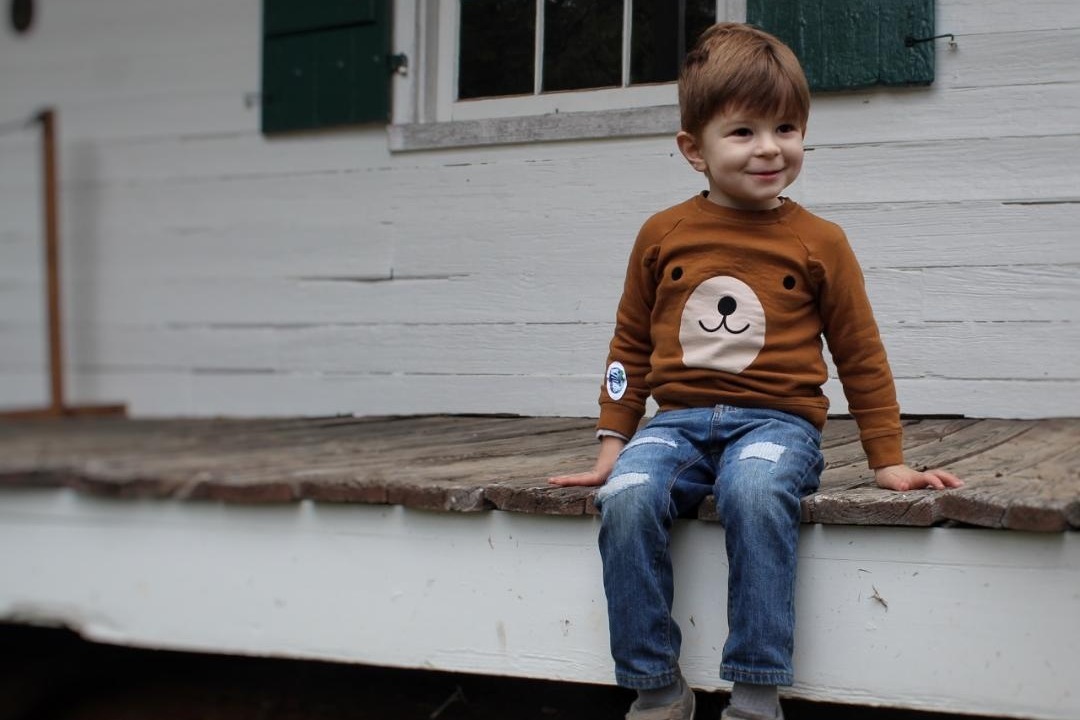
But we do have some GOOD NEWS! Finally, finally, we have the beginnings of some answers, some reasons as to the why behind Caedmon’s struggles.
Two weeks ago, my husband and I took Caedmon to an occupational therapy center where he was tested, assessed, and diagnosed with a neurophysiological condition known as Functional Disconnection Syndrome (FDS), which essentially means there’s a breakdown in the ability of Caedmon’s right and left brains to communicate. Specifically, Caedmon shows signs of Sensory Processing Disorder (SPD), which stems from an imbalance in the way Caedmon’s brain is developing, much like the childhood conditions we know as autism spectrum disorder, attention deficit/hyperactive disorder, dyslexia, and other learning and processing disorders. For those like Caedmon with an over-responsive form of Sensory Processing Disorder, sensory information (visual, auditory, tactile, etc.) goes into his brain, but it is then incorrectly interpreted and organized into a hypersensitive response. Experts liken the condition to a neurological “traffic jam”. As a result, even basic daily routines and activities prove difficult for him. Atypical responses to sensory messages can be behavioral, emotional, or attention related, or they can manifest as problems with motor abilities - all of which Caedmon displays.
Interestingly, in children with SPD, sensory input seems to have a cumulative effect. For example, a typically developing child gets a sensory message such as the blare of a passing siren, figures out the cause, and lets it go. But in children with sensory processing problems, that ability to let go of past messages is impaired, leading to a backlog of sensation that accumulates until it overwhelms the child’s coping skills.
No wonder Caedmon seems to melt down at the proverbial drop of a hat!
Think of a child like Caedmon as a busy office worker who has an in-basket but no out-basket. He finishes an assignment but, even after its done, the assignment sheet stays in the in-basket. Every time he completes another assignment, the in-basket gets more full. Eventually, he grows frustrated and finds it harder to complete new work because the pile of old work is growing precarious and he has to spend a lot of energy just making sure it doesn’t spill. At last, there’s one assignment too many. It doesn’t even have to be an important assignment; it’s just that proverbial last straw that brings down the whole mountain. It’s this cumulative effect of undisposed sensory messages that causes children with SPD to eventually fall apart, being triggered by seemingly minor sensory events.
For Caedmon specifically, underlying this diagnosis of Sensory Processing Disorder is the fact that he has retained many of his primitive infant reflexes - a significant developmental delay. (Before our visit to the occupational therapist a few weeks ago, I had no idea what many of these terms were, so just in case you’re in a similar boat, I’ll define them.) Primitive reflexes are the involuntary responses we’re born with that initially help us survive our first months outside the womb. For example, if you gently stroke a baby’s cheek, he’ll turn his head in that direction, searching for food. If you stimulate sensation against his palm, his little hand knows to grasp. Make a loud sound or sudden movement and you’ll elicit a defensive startle response.
All of these involuntary reactions are called primitive reflexes. And they’re good and helpful early on in life. But after several months, these reflexes are supposed to be superseded by a more developed brain and a more complex system of response. The problem is, in Caedmon’s case, they haven’t been. And what happens when a child retains these primitive reflexes long past when they should? Answer: the same thing that happens when any machine, computer, or person is made to deal with demands above that which they’re programmed to handle. Overload. Naturally then, a wide range of issues arise in sensory processing when our brains are running outdated and overwhelmed security software.
One such issue involves the autonomic nervous system. Caedmon’s Moro Reflex, the reflex that acts as a baby’s “fight or flight” response to the world, has not inhibited. As a result, Caedmon’s brain has a much greater tendency to switch from the parasympathetic state - known as the “rest and digest” state of being, to the sympathetic - a state of involuntary physical reaction due to perceived personal threat. Of course in Caedmon’s case, danger is almost never actually present. Nevertheless, his brain perceives otherwise, which explains Caedmon’s exaggerated reactions to sounds, sensations of hot and cold, touch, and visual and auditory input. Furthermore, when the nervous system kicks into a state of “fight or flight”, blood is diverted from the brain and our bodies react out of instinct, not logic, which goes a long way in explaining Caedmon’s emotional volatility in these situations.
For the sake of time - and potentially boring you, I won’t go into detail on each of the primitive reflexes that Caedmon has retained. Instead, I’ll simply catalog them below. I’ll also include photos of the infographics we were given by his occupational therapist, which list out associated difficulties often seen in conjunction with the retained reflex.
Primitive reflexes that Caedmon has retained:
- Grasp Reflex
- Moro (Startle) Reflex
- Rooting Reflex
- Spinal Galant Reflex
- Asymmetrical Tonic Neck Reflex (ATNR)
- Symmetrical Tonic Neck Reflex (STNR)
- Tonic Labyrinthine Reflex (TLR)
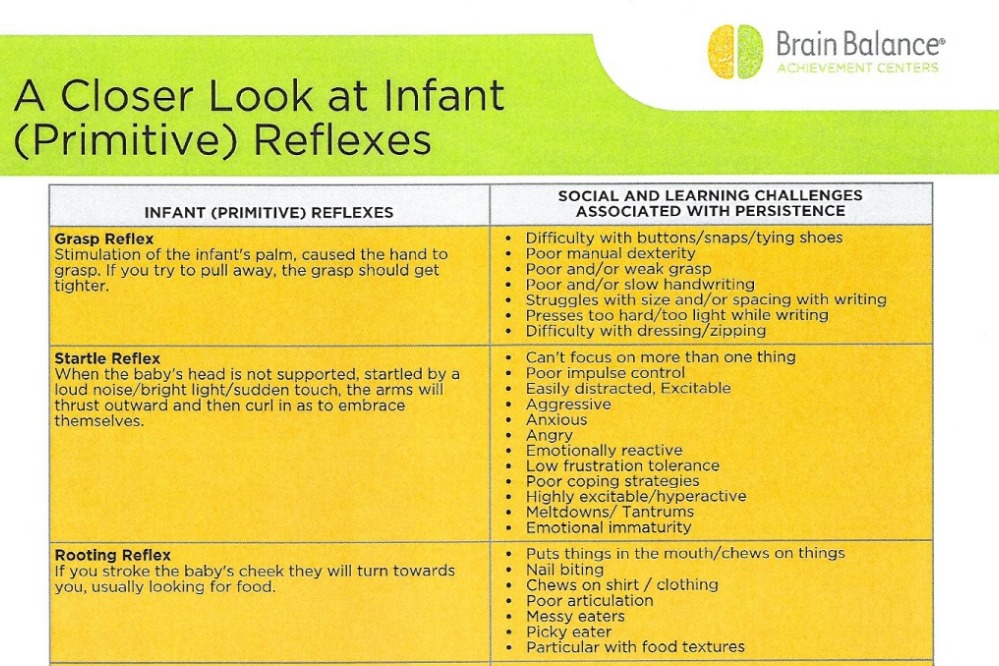
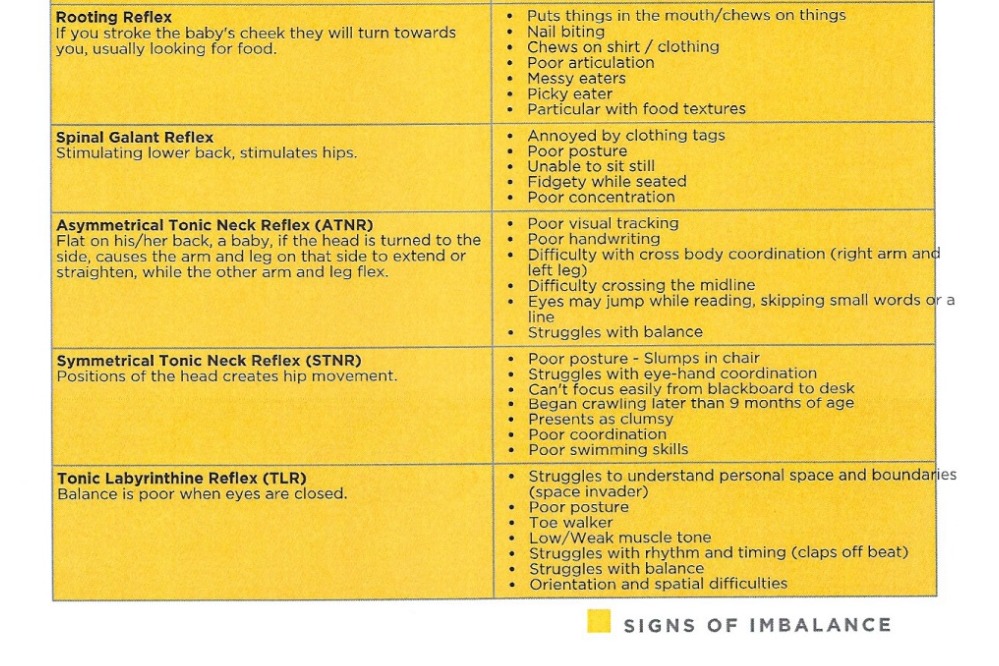
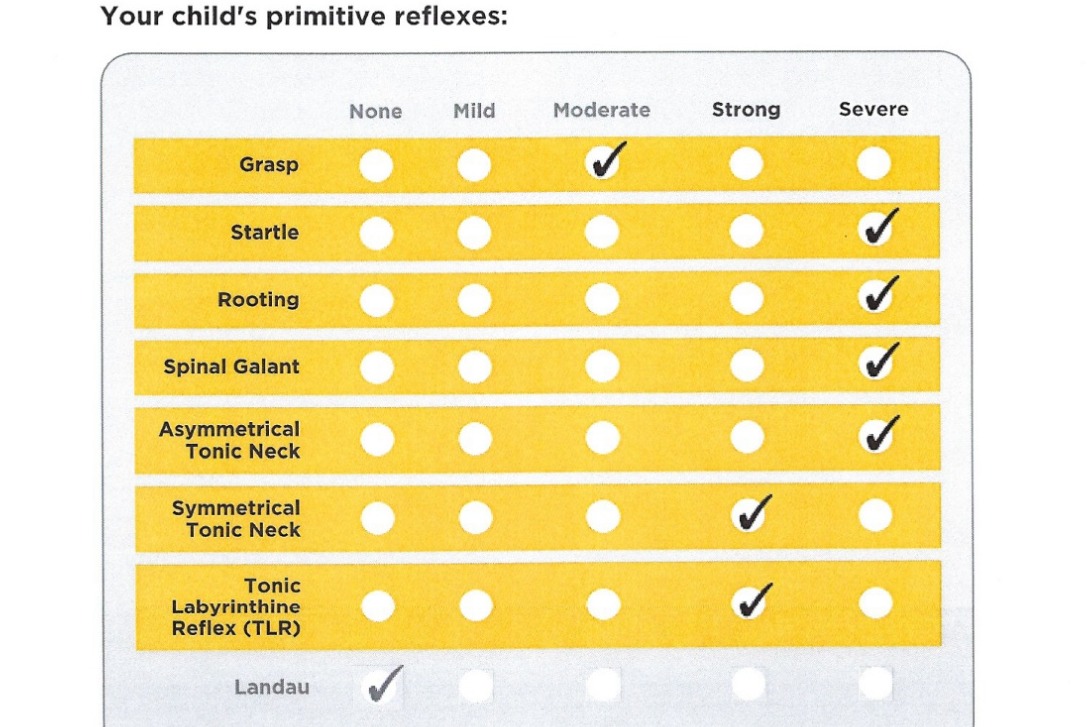
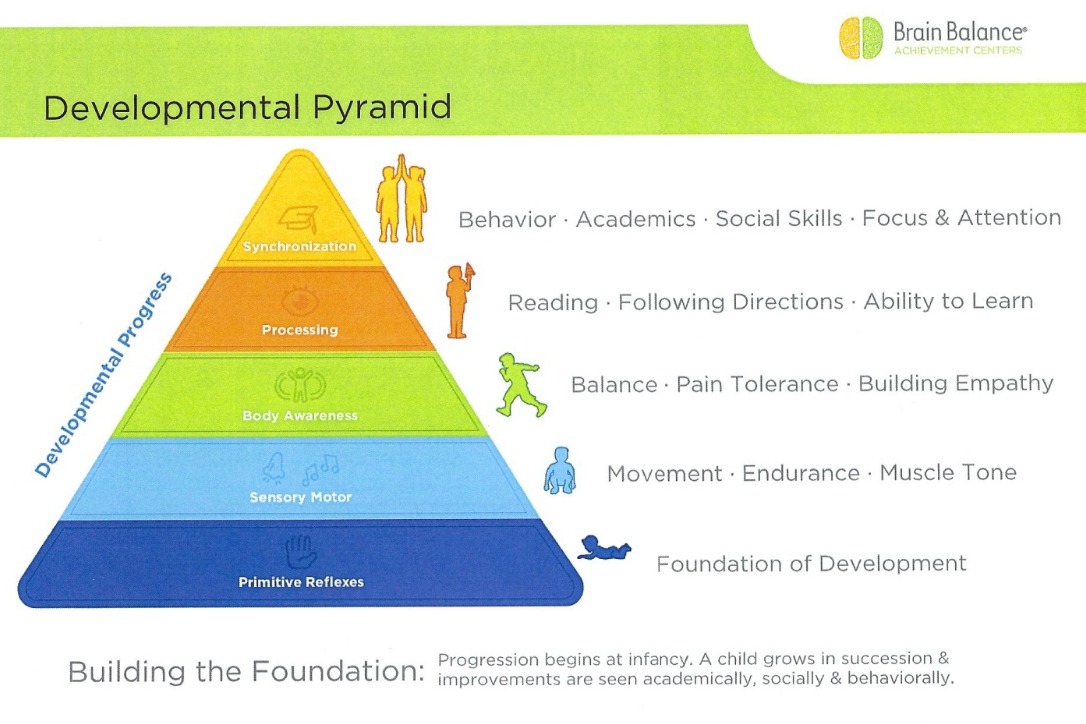
As you can see referenced in the chart above, all Caedmon's primitive reflexes except for "grasp" have been retained to a strong or severe degree, and even "grasp" is moderate. As depicted in the graphic below, these reflexes provide the foundation layer in the developmental pyramid, and it's therefore imperative to all subsequent development that we help Caedmon's brain course-correct.
So now that we know the problem, what does treatment look like? For Caedmon, the recommendation is three months of intensive occupational therapy, with him attending three one-hour sessions per week. After this initial treatment, he will be reassessed and we’ll make decisions from there. For now, Caedmon's therapists have the following goals:
1.) Decreasing his nervous system’s sympathetic response (fight or flight) and increasing his parasympathetic response (rest and digest).
2.) Improving each of the processing functions which Caedmon scores low in, as well as simultaneously working to improve all his processing skills. (It has been known for decades that “neurons that fire together, wire together”, so an integrated approach allows for much speedier progress, compared to working skills in isolation.)
3.) Promoting growth (myelination) in the currently slower-processing right hemisphere of Caedmon’s brain, so that it can better sync up with his left hemisphere.
4.) Growing Caedmon’s “upstairs brain” (the frontal cortex) through physical and cognitive stimulation. This will give his “upstairs brain” - which controls, prioritizes, and inhibits what his “downstairs brain” is doing - more speed and skill. (For reference, here’s a helpful article on the upstairs/downstairs brain analogy: https://bit.ly/33MceBO )

On a practical level, Caedmon will perform a variety of repetitive brain training activities during each session at his therapy center to mature his function in gross motor, fine motor, rhythm and timing, vestibular, proprioception, oculomotor, visual and auditory processing, touch processing, and cognitive skills. While this sort of treatment may sound intense, and on some level no doubt will be, from Caedmon’s point-of-view, it will simply look like having fun. The OT center is full of colorful toys and equipment, jungle gyms, swings, therapy balls, Play-Doh, puzzles and other games. Caedmon won’t even realize he’s in therapy.
In addition to these one-hour therapy sessions at the OT center - three per week, Caedmon will also perform daily at-home exercises to work on his core muscle and eye strength, as well as primitive reflex remediation. And we as his parents will be coached on behavioral and nutrition strategies for him, as well.
Given Caedmon’s young age (he’ll turn four years old this December), the occupational therapist who performed his assessment was initially skeptical about whether he could handle their treatment program, but after meeting Caedmon in person and testing his abilities, she is both optimistic and confident that therapy will be highly beneficial for him. She also stressed that the sooner we begin treatment, the better, as the younger a person is, the easier it is for their brain to re-wire.

With all that said, we would like to begin occupational therapy for Caedmon within the month. However, to be transparent, paying for this sort of treatment is beyond our family’s current financial means. The initial 36 sessions of occupational therapy (which amounts to roughly three months of treatment) will cost $5,799. Because Sensory Processing Disorder is not yet listed as a separate condition in the Diagnostic and Statistical Manual (keep in mind that the same was long true for many disorders that are now universally recognized), insurance does not cover treatment.
We titled this fundraiser “Life-Changing Therapy for Caedmon”, which we recognize might sound a bit dramatic, but we truly don’t believe this is an exaggeration. Occupational therapy has the potential to profoundly change our family’s everyday life, and certainly Caedmon’s life. Sensory input is constant, all day long, which means Caedmon’s nervous system is being barraged all day long, too. In addition, without remediation for his retained primitive reflexes, Caedmon will lack the ability to progress in development as he should. As Caedmon quickly approaches school age, we worry about the compounding effects this condition could have on his academic performance, social participation and acceptance by peers, and self-esteem and confidence. As we all know, so much of our adult personality and options in life are informed by our experiences in childhood, and while we don’t live in fear of Caedmon’s future, we do want to offer him every chance for success.

Ultimately, we are a family who believe that God is in control, that God is with us, and that God knows and loves our son better than even we do. In all things we trust Him, including with Caedmon. We do believe, however, that in this instance God is inviting us to ask for help. We are in need of financial assistance in order to cover the costs of Caedmon's therapy. If you would like to support us, listed below are three things you can do to help, for which we would be profoundly grateful!
1.) Consider giving whatever money you can. No donation is too small! (And it’s tax-deductible.)
2.) Share our story on social media, inviting your network to help us as well. (#HelpCaedmonThrive)
3.) Email this page - https://www.gofundme.com/lifechanging-therapy-for-caedmon - to your family and friends.
Our goal is to raise the entire $5,799, which will pay for 3 months of treatment. Any funds we receive above that amount will go toward continued therapy for Caedmon beyond the initial 36 sessions.
Thank you so much for taking the time to read our story. We will continue to update this page as Caedmon’s treatment plan unfolds.
With SO much gratitude, hope, and love,
Jake and Meagan Page
P.S. If you’re interested in further reading on SPD and/or primitive reflexes, I’d encourage you to check out the work of Lucy Jane Miller, the occupational therapist and research scientist who founded the STAR Institute (Sensory Therapies And Research Center), as well as authored the book Sensational Kids: Hope and Help for Children with Sensory Processing Disorder. For more information on primitive reflexes specifically, I’d highly recommend The Well Balanced Child, by Sally Goddard. (Thanks again for reading to the end! You win a gold star!)
Our baby, though, didn’t seem quite as enamored with my husband or I, if we were honest. Specifically, he didn’t seem to enjoy being held. Even those very first days in the hospital, we noticed Caedmon preferred sleeping in his bassinet to falling asleep in our arms. And when I tried to nurse him, he would arch his whole body away from me and cry - not once, not twice, but every single time. He seemed to not like...being touched?
We shrugged it off, though. Everybody’s wired differently, right?
The doctors assured us he was fine.
Guess our little boy’s going to be a touch-me-not, we laughed. And we moved on.
And later, even when Caedmon displayed other atypical behaviors: he was late to crawl...late to cruise...extremely late to walk...late to speak...we didn’t worry. Again, everybody develops at a different pace, right? We were sure he was A-ok.
Time passed, and Caedmon turned two, ushering in all the accompanying stereotypic “terribles”: the tantrums, the defiance, the intensity. And boy was he intense.
Are all two-year-olds this intense?, we wondered.
At meal time, Caedmon cried and thrashed in his high chair every time we buckled him in to eat. He flat-out refused almost every food we offered him, even the “kiddy” ones like chicken nuggets or macaroni. And he displayed an almost obsessive aversion to getting anything messy on his hands.
At bathtime, Caedmon screamed in desperation whenever my husband or I attempted to wash his hair - swatting us, ducking away, and howling in anguish when we eventually caught him and soaked his hair with water. Combing it was yet another ordeal.
If we deviated even slightly from our predictable daily routine, Caedmon would fall apart emotionally. And the most basic transitions - waking from naptime, moving from one form of play to the next - caused Caedmon to break down.
Traveling in the car was a nightmare too, mostly because Caedmon would howl and sob any time sunlight got in his eyes. When I ran errands with him around town, I did my best to avoid all places with loud noises - blenders at coffee shops, a passing siren, even the flush of a public toilet could send Caedmon over the edge. He would clamp his hands over his ears, squeeze his eyes shut, and cry. Loudly.
Having a two-year-old was exhausting, we thought.
But in my mama-bear heart, I was quietly beginning to wonder if maybe these weren’t just age-related behaviors we were witnessing - or inexplicable personality quirks, but perhaps red flag symptoms of something deeper. Something wrong. I just had no idea what that might be.
Still, the pediatrician kept telling us Caedmon was healthy, and well-meaning friends and family assured us that Caedmon’s behavior was simply a stage, offering words like, “He’s just being a boy”, “It’s a first child thing”, and “Don’t worry, he’ll grow out of it in time.” A few people were less encouraging too, telling us that, essentially, we as his parents were to blame. If Caedmon were more strictly disciplined, they reasoned, surely he wouldn’t continue to act this way.
The problem was, we did discipline Caedmon. All the time. And it had zero effect on his behavior. By age three-and-a-half, Caedmon was still just as intense, unruly, and prone to meltdowns as he’d ever been. If anything, he was growing more intense, and as his parents, we were growing more alarmed. We noticed that Caedmon struggled to perform tasks which came easily to his peer group and that his development was lagging in gross-motor skills. We watched helplessly as he became an increasingly anxious child. He grew aggressive or impulsive whenever he felt overwhelmed, which was often. He became more demanding and difficult to calm. We learned not to even try hugging him or attempting to wipe his tears, which always backfired to make him more upset. We lived in near constant crisis.
“I wish something wasn’t wrong with me,” Caedmon confided to me one afternoon at the end of a 30-minute meltdown. (A tower of toy blocks had fallen to the floor.) “I always ruin everyone’s life! I ruin the world just by being here!”
Of course, as a mother, hearing your baby utter those words is like receiving a sucker punch to the gut. I had hoped, perhaps naively, that Caedmon was somehow unaware of his own issues. That he could still be the little boy who would flex his teeny muscles for me, tell me how he’s just like Captain America, and believe - bright eyed - that every person in the world would want to be his friend. This is the little boy who, even today, makes sure to leave picnic crumbs for the ladybugs and congratulates robins when their eggs hatch. He is so tenderhearted, so perceptive, and so full of love for the world. I’m constantly amazed by the details he notices - the way the clouds in the sky look different from day to day, the way spiderwebs show up better after it rains, or the way the sun “wakes up all the colors in the morning”, as Caedmon puts it. He loves to both observe and explore his surroundings, always keen to go on an adventure. But probably more than anything, his little heart delights in being with people, in having fun together. You will not meet a child more eager to be your friend. He loves everybody, without exception. And he is always the first person to offer his mama a dance. I love this child with my whole heart. I love the way he stands up for himself when he feels wronged and looks out for his baby brother, too. He’ll attempt any crazy antic to try and make his little brother laugh. He’s a bright little boy with such a kind heart, and it has broken my own heart to watch him struggle for so long with a condition we couldn't define.
But we do have some GOOD NEWS! Finally, finally, we have the beginnings of some answers, some reasons as to the why behind Caedmon’s struggles.
Two weeks ago, my husband and I took Caedmon to an occupational therapy center where he was tested, assessed, and diagnosed with a neurophysiological condition known as Functional Disconnection Syndrome (FDS), which essentially means there’s a breakdown in the ability of Caedmon’s right and left brains to communicate. Specifically, Caedmon shows signs of Sensory Processing Disorder (SPD), which stems from an imbalance in the way Caedmon’s brain is developing, much like the childhood conditions we know as autism spectrum disorder, attention deficit/hyperactive disorder, dyslexia, and other learning and processing disorders. For those like Caedmon with an over-responsive form of Sensory Processing Disorder, sensory information (visual, auditory, tactile, etc.) goes into his brain, but it is then incorrectly interpreted and organized into a hypersensitive response. Experts liken the condition to a neurological “traffic jam”. As a result, even basic daily routines and activities prove difficult for him. Atypical responses to sensory messages can be behavioral, emotional, or attention related, or they can manifest as problems with motor abilities - all of which Caedmon displays.
Interestingly, in children with SPD, sensory input seems to have a cumulative effect. For example, a typically developing child gets a sensory message such as the blare of a passing siren, figures out the cause, and lets it go. But in children with sensory processing problems, that ability to let go of past messages is impaired, leading to a backlog of sensation that accumulates until it overwhelms the child’s coping skills.
No wonder Caedmon seems to melt down at the proverbial drop of a hat!
Think of a child like Caedmon as a busy office worker who has an in-basket but no out-basket. He finishes an assignment but, even after its done, the assignment sheet stays in the in-basket. Every time he completes another assignment, the in-basket gets more full. Eventually, he grows frustrated and finds it harder to complete new work because the pile of old work is growing precarious and he has to spend a lot of energy just making sure it doesn’t spill. At last, there’s one assignment too many. It doesn’t even have to be an important assignment; it’s just that proverbial last straw that brings down the whole mountain. It’s this cumulative effect of undisposed sensory messages that causes children with SPD to eventually fall apart, being triggered by seemingly minor sensory events.
For Caedmon specifically, underlying this diagnosis of Sensory Processing Disorder is the fact that he has retained many of his primitive infant reflexes - a significant developmental delay. (Before our visit to the occupational therapist a few weeks ago, I had no idea what many of these terms were, so just in case you’re in a similar boat, I’ll define them.) Primitive reflexes are the involuntary responses we’re born with that initially help us survive our first months outside the womb. For example, if you gently stroke a baby’s cheek, he’ll turn his head in that direction, searching for food. If you stimulate sensation against his palm, his little hand knows to grasp. Make a loud sound or sudden movement and you’ll elicit a defensive startle response.
All of these involuntary reactions are called primitive reflexes. And they’re good and helpful early on in life. But after several months, these reflexes are supposed to be superseded by a more developed brain and a more complex system of response. The problem is, in Caedmon’s case, they haven’t been. And what happens when a child retains these primitive reflexes long past when they should? Answer: the same thing that happens when any machine, computer, or person is made to deal with demands above that which they’re programmed to handle. Overload. Naturally then, a wide range of issues arise in sensory processing when our brains are running outdated and overwhelmed security software.
One such issue involves the autonomic nervous system. Caedmon’s Moro Reflex, the reflex that acts as a baby’s “fight or flight” response to the world, has not inhibited. As a result, Caedmon’s brain has a much greater tendency to switch from the parasympathetic state - known as the “rest and digest” state of being, to the sympathetic - a state of involuntary physical reaction due to perceived personal threat. Of course in Caedmon’s case, danger is almost never actually present. Nevertheless, his brain perceives otherwise, which explains Caedmon’s exaggerated reactions to sounds, sensations of hot and cold, touch, and visual and auditory input. Furthermore, when the nervous system kicks into a state of “fight or flight”, blood is diverted from the brain and our bodies react out of instinct, not logic, which goes a long way in explaining Caedmon’s emotional volatility in these situations.
For the sake of time - and potentially boring you, I won’t go into detail on each of the primitive reflexes that Caedmon has retained. Instead, I’ll simply catalog them below. I’ll also include photos of the infographics we were given by his occupational therapist, which list out associated difficulties often seen in conjunction with the retained reflex.
Primitive reflexes that Caedmon has retained:
- Grasp Reflex
- Moro (Startle) Reflex
- Rooting Reflex
- Spinal Galant Reflex
- Asymmetrical Tonic Neck Reflex (ATNR)
- Symmetrical Tonic Neck Reflex (STNR)
- Tonic Labyrinthine Reflex (TLR)
As you can see referenced in the chart above, all Caedmon's primitive reflexes except for "grasp" have been retained to a strong or severe degree, and even "grasp" is moderate. As depicted in the graphic below, these reflexes provide the foundation layer in the developmental pyramid, and it's therefore imperative to all subsequent development that we help Caedmon's brain course-correct.
So now that we know the problem, what does treatment look like? For Caedmon, the recommendation is three months of intensive occupational therapy, with him attending three one-hour sessions per week. After this initial treatment, he will be reassessed and we’ll make decisions from there. For now, Caedmon's therapists have the following goals:
1.) Decreasing his nervous system’s sympathetic response (fight or flight) and increasing his parasympathetic response (rest and digest).
2.) Improving each of the processing functions which Caedmon scores low in, as well as simultaneously working to improve all his processing skills. (It has been known for decades that “neurons that fire together, wire together”, so an integrated approach allows for much speedier progress, compared to working skills in isolation.)
3.) Promoting growth (myelination) in the currently slower-processing right hemisphere of Caedmon’s brain, so that it can better sync up with his left hemisphere.
4.) Growing Caedmon’s “upstairs brain” (the frontal cortex) through physical and cognitive stimulation. This will give his “upstairs brain” - which controls, prioritizes, and inhibits what his “downstairs brain” is doing - more speed and skill. (For reference, here’s a helpful article on the upstairs/downstairs brain analogy: https://bit.ly/33MceBO )
On a practical level, Caedmon will perform a variety of repetitive brain training activities during each session at his therapy center to mature his function in gross motor, fine motor, rhythm and timing, vestibular, proprioception, oculomotor, visual and auditory processing, touch processing, and cognitive skills. While this sort of treatment may sound intense, and on some level no doubt will be, from Caedmon’s point-of-view, it will simply look like having fun. The OT center is full of colorful toys and equipment, jungle gyms, swings, therapy balls, Play-Doh, puzzles and other games. Caedmon won’t even realize he’s in therapy.
In addition to these one-hour therapy sessions at the OT center - three per week, Caedmon will also perform daily at-home exercises to work on his core muscle and eye strength, as well as primitive reflex remediation. And we as his parents will be coached on behavioral and nutrition strategies for him, as well.
Given Caedmon’s young age (he’ll turn four years old this December), the occupational therapist who performed his assessment was initially skeptical about whether he could handle their treatment program, but after meeting Caedmon in person and testing his abilities, she is both optimistic and confident that therapy will be highly beneficial for him. She also stressed that the sooner we begin treatment, the better, as the younger a person is, the easier it is for their brain to re-wire.
With all that said, we would like to begin occupational therapy for Caedmon within the month. However, to be transparent, paying for this sort of treatment is beyond our family’s current financial means. The initial 36 sessions of occupational therapy (which amounts to roughly three months of treatment) will cost $5,799. Because Sensory Processing Disorder is not yet listed as a separate condition in the Diagnostic and Statistical Manual (keep in mind that the same was long true for many disorders that are now universally recognized), insurance does not cover treatment.
We titled this fundraiser “Life-Changing Therapy for Caedmon”, which we recognize might sound a bit dramatic, but we truly don’t believe this is an exaggeration. Occupational therapy has the potential to profoundly change our family’s everyday life, and certainly Caedmon’s life. Sensory input is constant, all day long, which means Caedmon’s nervous system is being barraged all day long, too. In addition, without remediation for his retained primitive reflexes, Caedmon will lack the ability to progress in development as he should. As Caedmon quickly approaches school age, we worry about the compounding effects this condition could have on his academic performance, social participation and acceptance by peers, and self-esteem and confidence. As we all know, so much of our adult personality and options in life are informed by our experiences in childhood, and while we don’t live in fear of Caedmon’s future, we do want to offer him every chance for success.
Ultimately, we are a family who believe that God is in control, that God is with us, and that God knows and loves our son better than even we do. In all things we trust Him, including with Caedmon. We do believe, however, that in this instance God is inviting us to ask for help. We are in need of financial assistance in order to cover the costs of Caedmon's therapy. If you would like to support us, listed below are three things you can do to help, for which we would be profoundly grateful!
1.) Consider giving whatever money you can. No donation is too small! (And it’s tax-deductible.)
2.) Share our story on social media, inviting your network to help us as well. (#HelpCaedmonThrive)
3.) Email this page - https://www.gofundme.com/lifechanging-therapy-for-caedmon - to your family and friends.
Our goal is to raise the entire $5,799, which will pay for 3 months of treatment. Any funds we receive above that amount will go toward continued therapy for Caedmon beyond the initial 36 sessions.
Thank you so much for taking the time to read our story. We will continue to update this page as Caedmon’s treatment plan unfolds.
With SO much gratitude, hope, and love,
Jake and Meagan Page
P.S. If you’re interested in further reading on SPD and/or primitive reflexes, I’d encourage you to check out the work of Lucy Jane Miller, the occupational therapist and research scientist who founded the STAR Institute (Sensory Therapies And Research Center), as well as authored the book Sensational Kids: Hope and Help for Children with Sensory Processing Disorder. For more information on primitive reflexes specifically, I’d highly recommend The Well Balanced Child, by Sally Goddard. (Thanks again for reading to the end! You win a gold star!)