- L
- C
- N
Help Fund Appeal in Sexual Battery Case – Access to Justice
0% complete
$33,786 raised of $40K CAD
581 donations
My name is Elisha Bonnis. I am seeking support to pursue an appeal in a civil sexual battery case in British Columbia.
While the Vancouver Police Department Sex Crimes investigators did recommend a charge of sexual assault, the Crown Counsel declined to charge based on requiring a 95% probability of conviction before they will even charge. B.C. is one of only three provinces in Canada in which the police do not charge - they make a recommendation to the Crown, and then the Crown decides. B.C. also requires the highest standard of evidence than any other province in Canada before they will bring a charge of sexual assault - higher, in fact, than the Canadian Criminal Code requires.
This is why a civil trial was my only other legal option.
After a month-long trial, the court found:
- no consent.
- no capacity to consent.
Despite these findings, the case was dismissed based on a conclusion that the defendant had a “reasonable belief” that I consented.
That finding depended almost exclusively on the defendant’s testimony, despite the evidentiary record containing multiple prior inconsistent statements by the defendant between 2016 and the trial in October 2025. The trial judge failed to address those inconsistencies in her judgment, and [58] "found both parties to be not only sincere, but also consistent in their testimony, as far as their recollections were able to support. No deliberate falsehoods were revealed against either of them".
For the first time ever in Canadian law, a case in which no consent and no capacity to consent were found, the defendant has been found to have “a reasonable but mistaken belief in consent”.
Why I Am Asking for Help
I continue to have pro bono legal representation for my appeal, meaning my lawyer is prepared to take this case forward without charging fees.
However, I am responsible for the cost of trial transcripts and required disbursements, which are essential for the appeal to proceed.
Without these materials, the Court of Appeal cannot review the case.
Without transcripts, the appeal cannot be heard.
After:
• three cancelled trials
• a month-long trial
• over $150,000 in legal costs
I do not have the resources to continue without support.
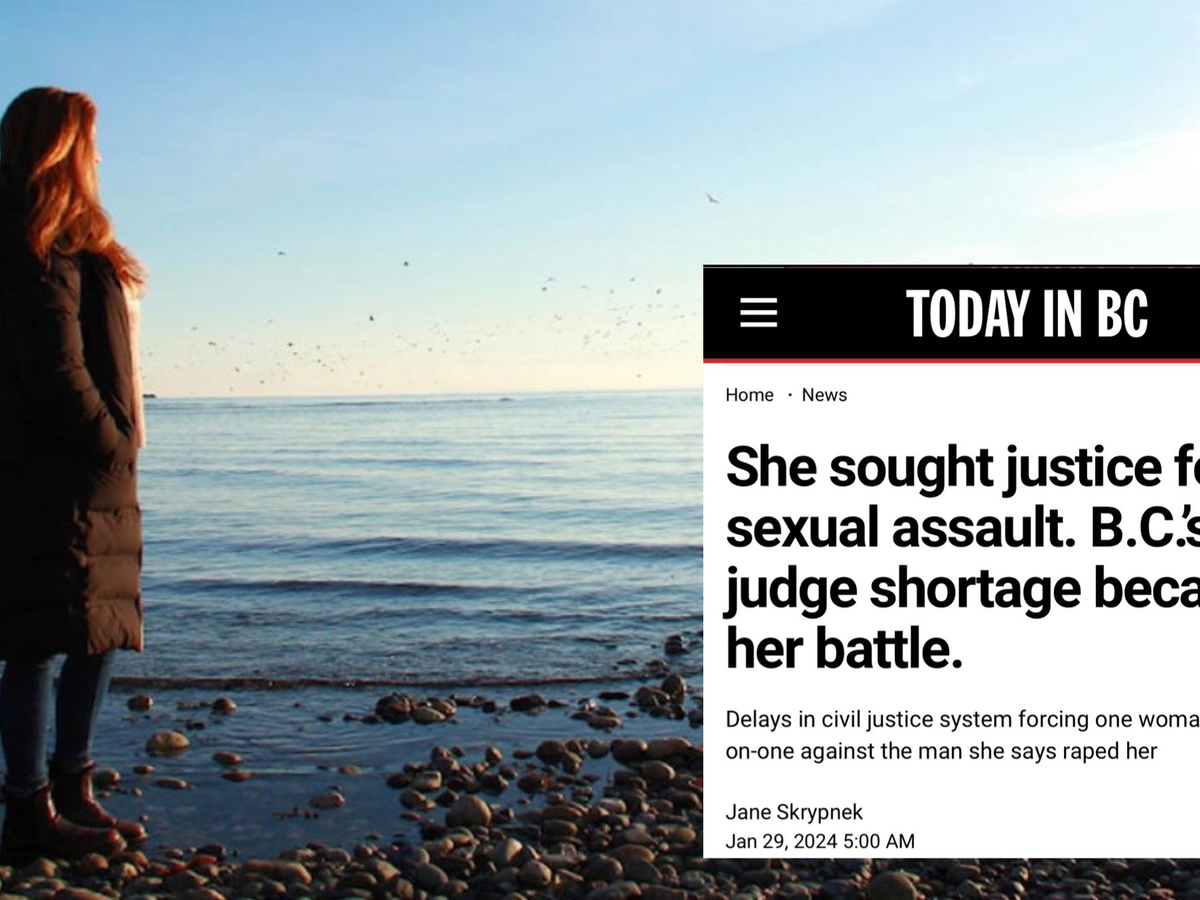
See the article for more detail regarding the adjourned and cancelled trials:
Why the Cost Is So High
Because my trial lasted a full month and involved extensive evidence, the transcripts are significantly longer than in a typical case.
For example, testimony and cross-examination alone spanned six full days, in addition to the defendant’s testimony, expert evidence, and lengthy cross-examinations.
In British Columbia, transcripts are charged per page, and multi-day testimony can result in thousands of pages.
Even when ordering only the essential portions of the trial, the cost is expected to be in the range of:
$15,000 - $20,000
Add to that court fees, filing fees, etc. and the appeal itself will be another $20,000.
These transcripts are mandatory. Without them, the Court of Appeal cannot assess whether legal errors were made.
The costs including further disbursements that come along with an appeal will be in the range of:
$20,000 - $40,000
Although I have legal representation, these costs are not covered. This means that even with a lawyer ready to argue the appeal, I cannot move forward without funding for these required materials.
This means that whether the appeal proceeds depends not on the merits of the case, but on the ability to afford the required materials.
Why This Matters
This case raises broader issues about:
• consent and capacity in the context of intoxication
• how courts assess conflicting evidence
• whether access to justice depends on financial means
Appeals are meant to ensure that legal errors can be reviewed.
But if they cannot be accessed due to cost, that safeguard becomes out of reach.
How You Can Help
Your support will go directly toward:
• trial transcripts
• required appeal disbursements
Even small contributions make a difference:
• $25 helps cover transcript pages
• $50 supports key evidence transcription
• $100+ directly moves the appeal forward
If you are able to contribute or share, it would mean a great deal.
Even with a lawyer ready to argue the appeal, it cannot proceed without these materials.
Your support will directly make it possible for the appeal to be heard.
From the Reasons for Judgment:
[92] Given that the plaintiff cannot recall what happened after she got in her bed, the defendant was the only witness present who can testify about what happened in this period. This is circumstantial evidence, but, as I have explained, it is relevant to consent, as well as whether the defendant had a reasonable belief in consent.
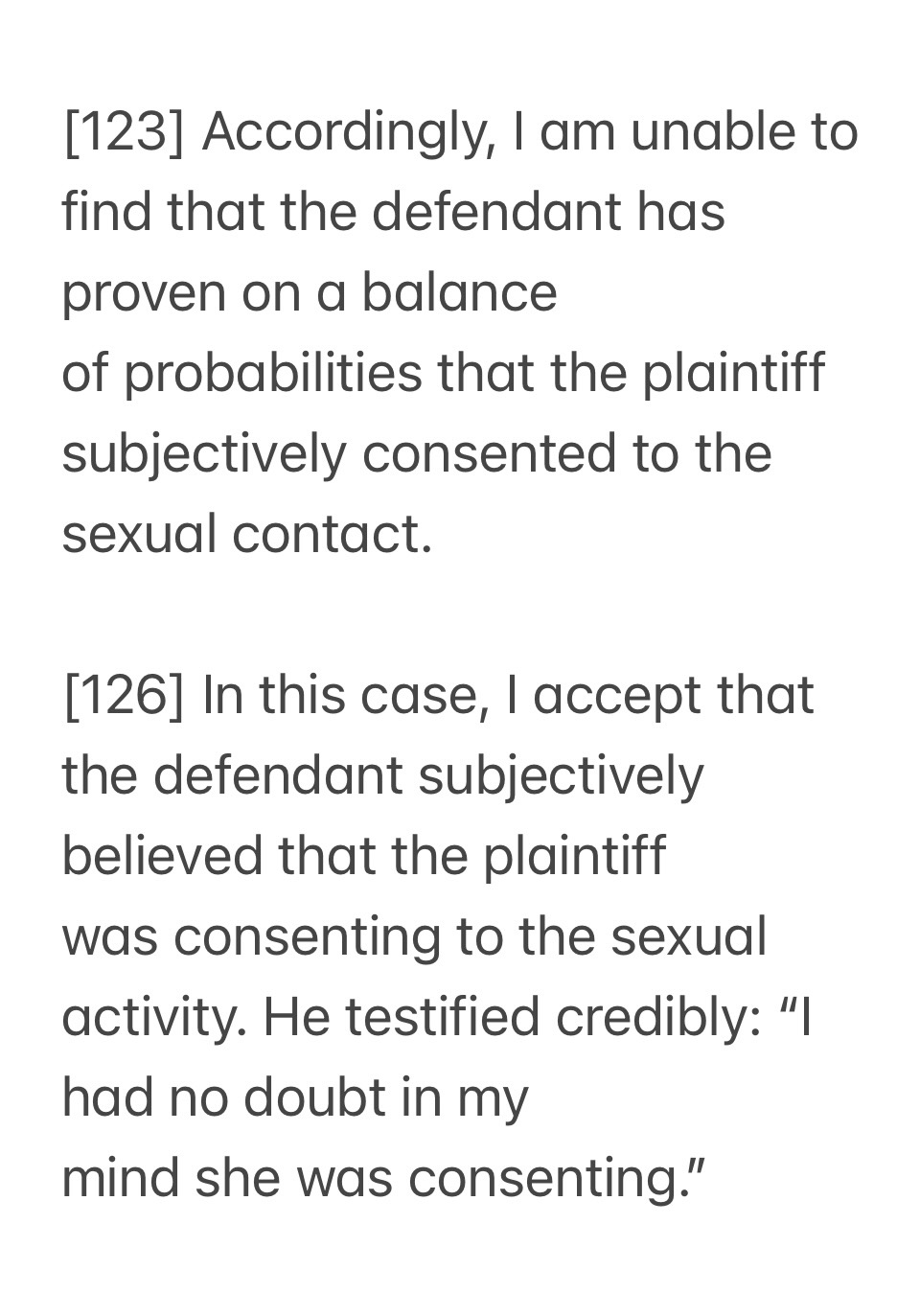
[123] Accordingly, I am unable to find that the defendant has
proven on a balance of probabilities that the plaintiff subjectively consented to the sexual contact.
[126] In this case, I accept that the defendant subjectively believed that the plaintiff was consenting to the sexual activity. He testified credibly: "I had no doubt in my mind she was consenting."
[132] It is uncontroverted that the ostensive reason they were in the taxi together was that he was making sure she got home safe. Whether that would reasonably involve him getting out of the taxi and walking her to her apartment depends in part on how intoxicated she was. She says she was extremely intoxicated. He says she did not appear to be so.
[142] I return, again, to the plaintiff's evidence that she repeatedly told the defendant throughout the night that nothing sexual would happen between them.
[146] I do not accept that the plaintiff said this as many times as she recalls she did. The defendant does not recall her doing so.
[148] Saying it once is enough.
That is an unequivocal statement of her subjective intention and wish, and it was known to the defendant. This is a significant factor in determining the defendant's "position" in assessing whether a reasonable person in his position would have later believed the plaintiff was consenting to sexual activity.
While the defendant has not proven that the plaintiff did, with capacity, change her mind, the law leaves open to him to establish that a reasonable person in his position would believe she had changed her mind.
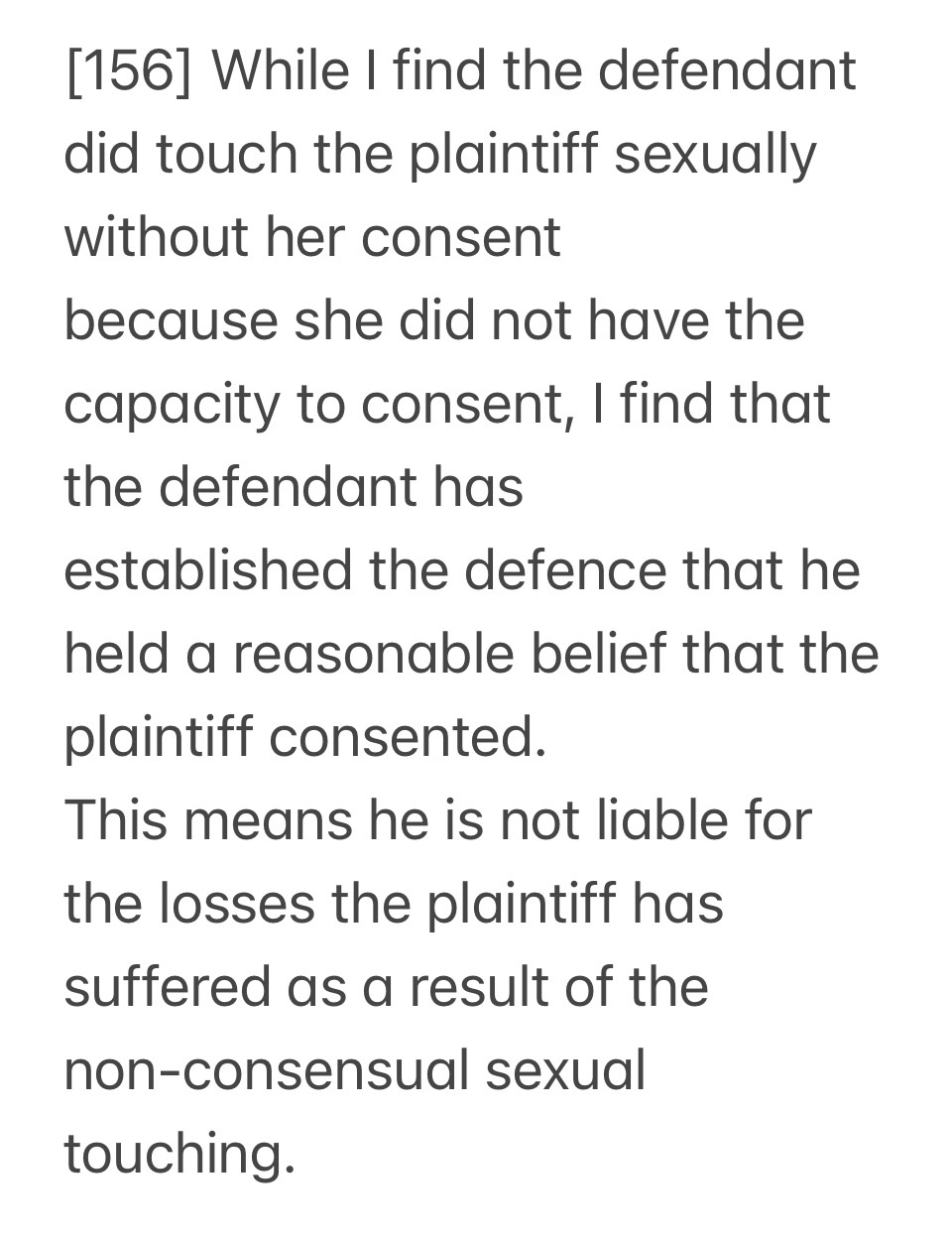
[156] While I find the defendant did touch the plaintiff sexually without her consent because she did not have the capacity to consent, I find that the defendant has established the defence that he held a reasonable belief that the plaintiff consented.
This means he is not liable for the losses the plaintiff has suffered as a result of the non-consensual sexual touching.
[157] This determination must not be taken to minimize the very serious suffering and loss the plaintiff has suffered because the defendant touched her sexually without her consent because she did not have the capacity to consent. Since the night at issue, the plaintiff has withdrawn from her thriving social and professional life, sold her home in Vancouver, retreated to increasing isolation, and ultimately left the teaching job she loved and at which she was beloved by her students and respected by her colleagues. She observes that almost half of her son’s life has been impacted by her own attempts to avoid, then confront, reconcile with, and seek justice for what happened to her. She began to harm herself physically by excoriation. She neglects her home and possessions, allowing, for example, boxes full of curriculum and teaching materials she had worked for years to produce and collect to disintegrate in the rain. While she recently began teaching again in a new district, she is only rebuilding her life slowly. She has the support of a new partner
and family and friends who love her. But she continues to suffer from the very real violation of her personal integrity. That the defendant held a reasonable belief in her consent does not diminish the violation the plaintiff experienced because she did not consent to the sexual activity: “Having control over who touches one’s body, and how, lies at the core of human dignity and autonomy”: Ewanchuk at para. 28.
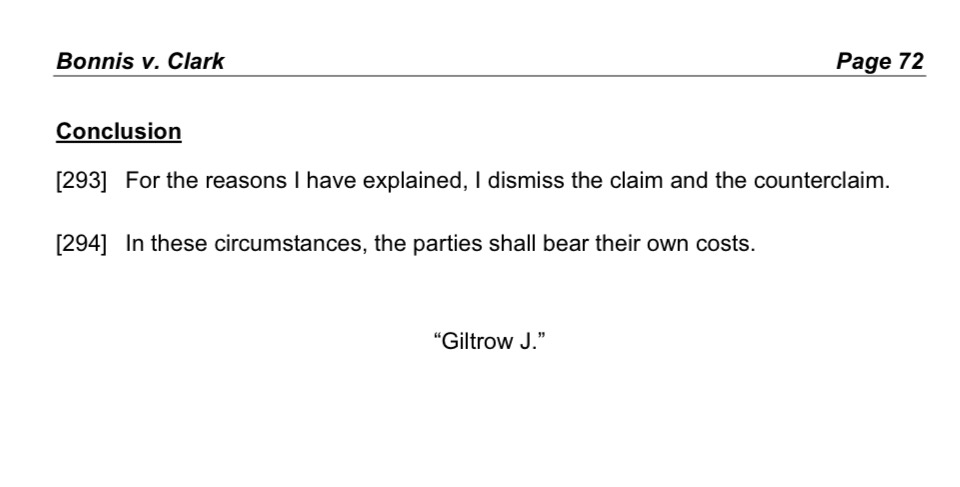
[293] For the reasons I have explained, I dismiss the claim and the counterclaim.
[294] In these circumstances, the parties shall bear their own costs.
Organizer