- B
- C
Innovative Helmets for Athlete Brain Safety
0% complete
$5,140 raised of
33 donations
My name is Eric Green and I am building a helmet company to improve the brain safety of athletes. After experiencing an injury leaving me a quadriplegic I was exposed to individuals with brain injuries. The physical, mental and emotional ramifications of a brain injury is devastating. I have made it my top priority to improve the lives of athletes who rely on helmets for safety.
The goal of the Athena Headgear is to provide an efficiently designed helmet solution to benefit brain health. Improving technology to benefit humanity is and will be the ultimate goal for the company. The significance of brain health in sports and safety is a substantial matter desiring an advanced, unique approach.
The motto of the company is based around three words.
Observe. Adapt. Evolve.
Be observant. Adapt to opportunities. Continually evolve.
Chief Medical Officer - Dr. Tim Pohlman: Retired IU Trauma Surgeon/ Former IMS Track Surgeon
“I joined Athena Headgear when I realized the company is proposing a substantial step forward in design and manufacturing of novel equipment to protect the central nervous systems of individuals participating in contact supports, and those at risk from head injury of those at risk from falls while biking riding and pursuing other outdoor activities. Many of us in the medical profession believe that participation in contact sports (for example, football), results in a season-long accumulation of numerous brain sub-concussive injuries.”
“Helmet design we propose can minimize these measurable changes in brain biochemistry and function can be expected to slow the development of degenerative processes long term.”
Athena Headgear
Helmets are designed for protecting the skull not the brain. Athena Headgear has a patented design capable of reducing the coup-contrecoup motion, the detrimental brain movement after a head collision. The design restructures the helmet to allow the padding and outer shell to contort more freely for maximum flexibility. Every component is 3D printed to provide optimal build quality and customization.
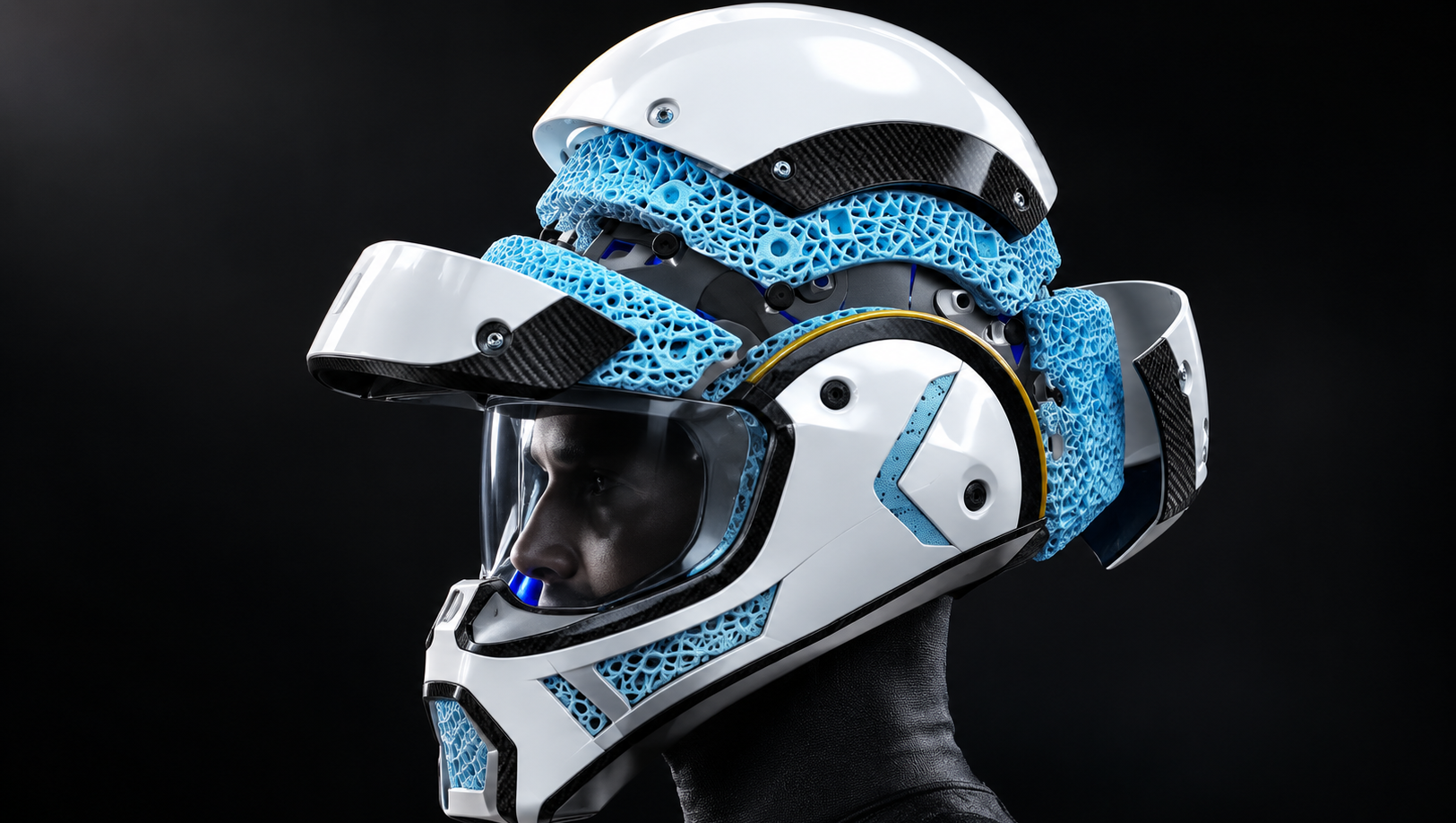
All aspects of the design can be altered for each athlete’s individual comfort, sport and aesthetics. The design better manages helmet weight for optimal center of mass performance. Center of mass improvement allows the athlete to maintain control of the helmet’s movement more efficiently. An important feature is the patented ERS, emergency release system. After an injury a very high risk factor is removing the helmet. The design allows emergency personnel to disassemble the helmet by removing two screws on each side of the head.
Sensors/Accessories - App Platform
The ability to accumulate important biometrics, data and information is incredibly valuable to improve an athlete’s performance. The customization aspect allows the athletes to select their specific metrics and allow the helmet’s design to be built around those components for quality and accuracy. All data is aggregated and displayed into an app for real-time analysis. It’s incredibly important to monitor behavior in order to protect safety. Interested parties; coaches, staff, medical personnel and parents can follow metrics in real-time to ensure safety is top priority.
Biometrics
G-Force, Heart Rate, Temperature(Person and Environment), Blood Oxygen, Respiratory, Electrical Skin Activity, GPS, Accelerometer, Humidity, Vibration, Impact Location
Accessories
Microphone, Speakers, Ocular Camera(s), Attention lighting[R,G,B], Breathing Apparatus(Filter/Mask), Cooling Mechanism(Air/Water), Heating Mechanism
Second Layer - Segmented Lattice
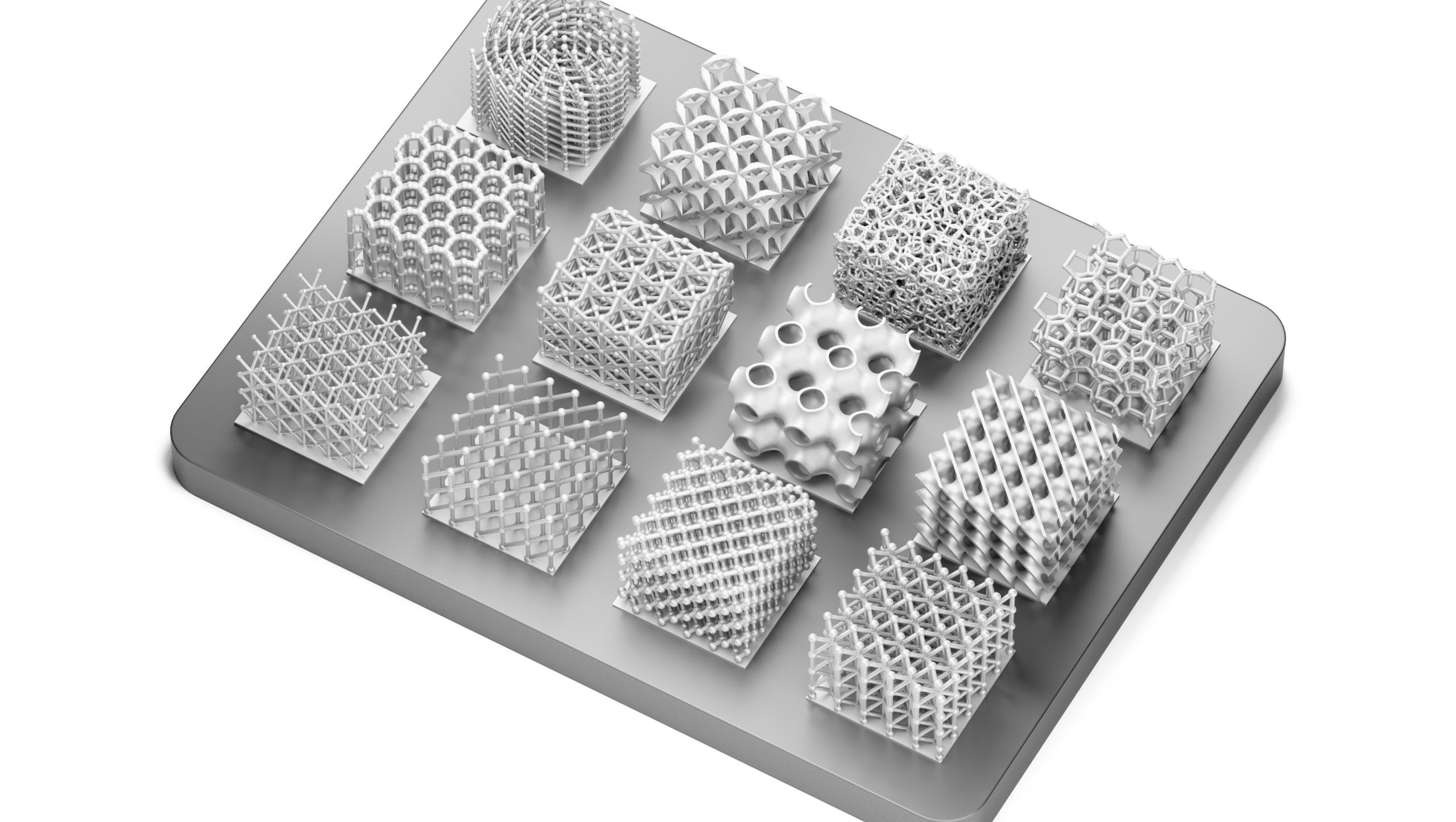
Every athlete and sport has vulnerabilities based on their performance and position. The Athena design has a unique approach to the problem. Each helmet has segmented, replaceable padding in all areas of the helmet. Each lattice segment is attached to the inner shell via inner shell through holes and small light weight screws.
Additive manufacturing technology produces highly efficient elastomeric lattice based structures for optimal impact reduction performance. Elastomeric lattice design is engineered to reduce peak tension during a crushing event. Lattice designs are particularly appealing for energy-absorbing applications. Hybrid lattice structures will combine different design types to achieve synergistic properties to optimize performance.
Third Layer - Outer Shell Segments
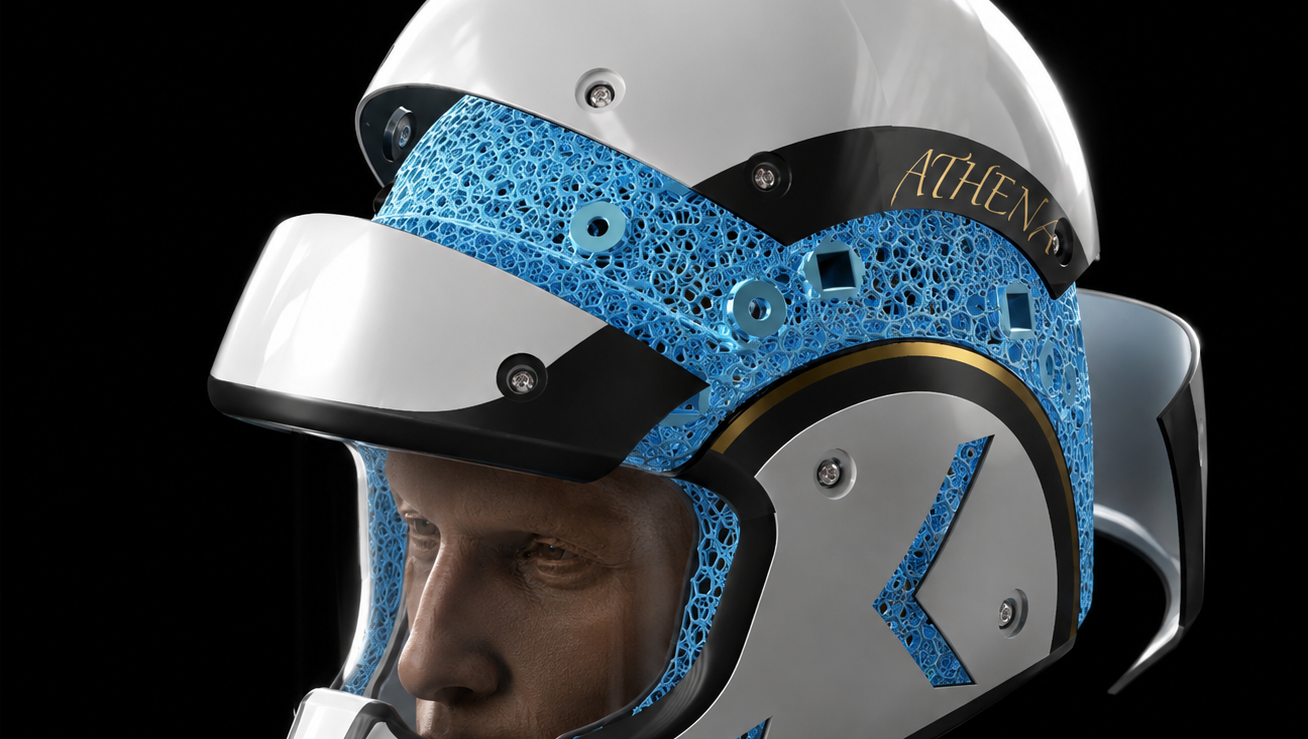
The structural design allows for the outer shell components to be much thinner than conventional helmets. Removability of the outer shell components allows for variability of design. Dependent on segment location on the helmet the outer shell can incorporate different elements such as thickness, venting, perforations, aesthetic designs and colors.
Software/Additive Manufacturing
Software is capable of taking head scans and adapting the components to the specific athlete. The ability to alter structural design based on environment and/or personal preferences is the key factor for an athlete to make the helmet a top priority.
The software also provides highly accurate simulations for testing designs. The ability to test structural variations virtually ensures the accuracy of the design and performance saving time and capital.
Additive manufacturing allows for vast versatility with materials and printing optionality. Current print technology is more than capable of providing multiple pathways for production with dozens of filaments available.
Path to Prototype and Beyond:
- Seeking $150,000 in Pre-Seed funding to establish prototype and testing verification
- $50,000 for software workflow capable of quick modifications and immediate deployment of future versions
- $50,000 for additive manufacturing multiple helmets and variations
- $20,000 for testing requirements to obey regulations
- $30,000 for unexpected issues
4-6 Months: Completion of multiple prototype versions
Includes simple prototype design of inner shell, segmented lattice padding, outer shell components, chin strap
- Thickness of inner shell will be somewhat variable within a specified range (2-5mm)
- Inner shell will be full thickness around circumference and forehead centerline to occipital region, potential lightweight opportunity based on simulation data
- Inner shell parietal, side frontal, side occipital, temporal, zygomatic, parotid, buccal regions can be lightweighted with simple pocket hex/triangle topology optimization
- Base file for inner shell will be streamlined for computational design time and customized design head-scan
- Lattice padding will be designed to accommodate individuals needs
- Lattice padding thickness and architecture will vary based on helmet segment location, user preferences and simulation data
- Outer shell will be applied onto lattice padding
- Final software product, each user imports head scan, software quickly computes, edits files and exports for additive manufacturing
Produce variable components to test weight, breathability, lattice padding and outer shell variations
Software simulations provide highly accurate data and measurements for performance
- Includes field driven analysis to identify performance
- Field capabilities include Homogenization, Stress, Structural FEA (Finite Element Analysis), Thermal, Compression, CFD (Computational Fluid Dynamics), Fatigue, MBD (MultiBody Dynamics), CFE (Crush Force Efficiency)
Additive manufacturing for initial prototype is understood
- Designs in hand with domestic 3D printing quote at least a few days, but with order receipt, initiation, print, inspection, and shipping expects at least a week or two.
- Powder-bed print tech, HP MJF printer, strong Nylon parts, good quality, more print volume for inner shell and outer shell
- Flexible lattice padding in a resin based machine to produce optimal force-absorbing properties, robustness, and resolution/quality
- Optional printer; Rapid Liquid Printing (RLP) new to market in 2026, high quality silicone
- Assembly would require a few weeks to ensure fit and modify any components
6-8 Months: Safety Testing Requirements
Will provide necessary safety measures to ensure the product is safe for consumers
- Impact Attenuation
- Penetration Resistance
- Strap Test; Dynamic/Static
- Positional Stability
- Environmental Conditions
- Compression
Any needed alterations to comply with testing requirements after initial tests
With further influx of funding
8-10 Months: Sensor integration
Applying various sensors to inner shell for monitoring (Optional)
- G-Force
- Heart Rate
- Temperature(Person and Environment),
- Blood Oxygen
- Respiratory
- Accelerometer
- Humidity
- Vibration
- Impact Location
Applying accessories to inner shell for monitoring (Optional)
- Microphone
- Camera
- GPS
- Speakers
- Ocular Camera(s)
- Attention Lighting[R,G,B]
- Breathing Apparatus(Filter/Mask),
- Cooling Mechanism(Air/Water),
- Heating Mechanism
Adapt padding layer around sensors for custom, efficient fit
10-12 Months: Safety app platform
Basic app design build, basic mechanics and sensors/accessories monitoring
- User Profile
- Helmet Type
- Inner Shell Specifications
- Lattice Padding Specifications
- Outer Shell Specifications
- Sensor Data Aggregation
1-3 Years: Full Ecosystem
Fully operational ecosystem capable of delivering complete helmet build with fully functioning sensor/accessories monitoring, design options, design features and recovery recommendations
- User Profile Scan
- Helmet Type Options
- Inner Shell Specifications w/ FEA Homogenization
- Lattice Padding Specifications w/ FEA Homogenization
- Outer Shell Specifications w/ FEA Homogenization
- Sensor Data Aggregation w/ Analysis
- Monitoring Specifications w/ Alarm Presets
- Design Variation Options for each Component
- Recovery Information, Expected Symptoms and Brain Training
- Emergency Response Reporting, Data Collection and Analysis
Initial Target Market
Customization and sensor application with monitoring is perfectly compatible with extreme sports
- Skateboarding
- Mountain Biking
- BMX
- Motocross
- Rock Climbing
- Equestrian
- Dirt Bike
- ATV
- Surfing
- Sailing
- Skiing
- Snowboarding
- Snowmobiling
- Sky Diving
- Racing
Focus on athletes with established extreme sports sponsors:
- RedBull
- Monster
- GoPro
- Oakley
- The North Face
- Vans
- Patagonia
- Columbia
- Quicksilver
The goal of Athena Headgear is not only providing the most optimal helmet for brain health but equipping athletes with an ecosystem of safety features. If you have any interest or questions please contact me.
Organizer