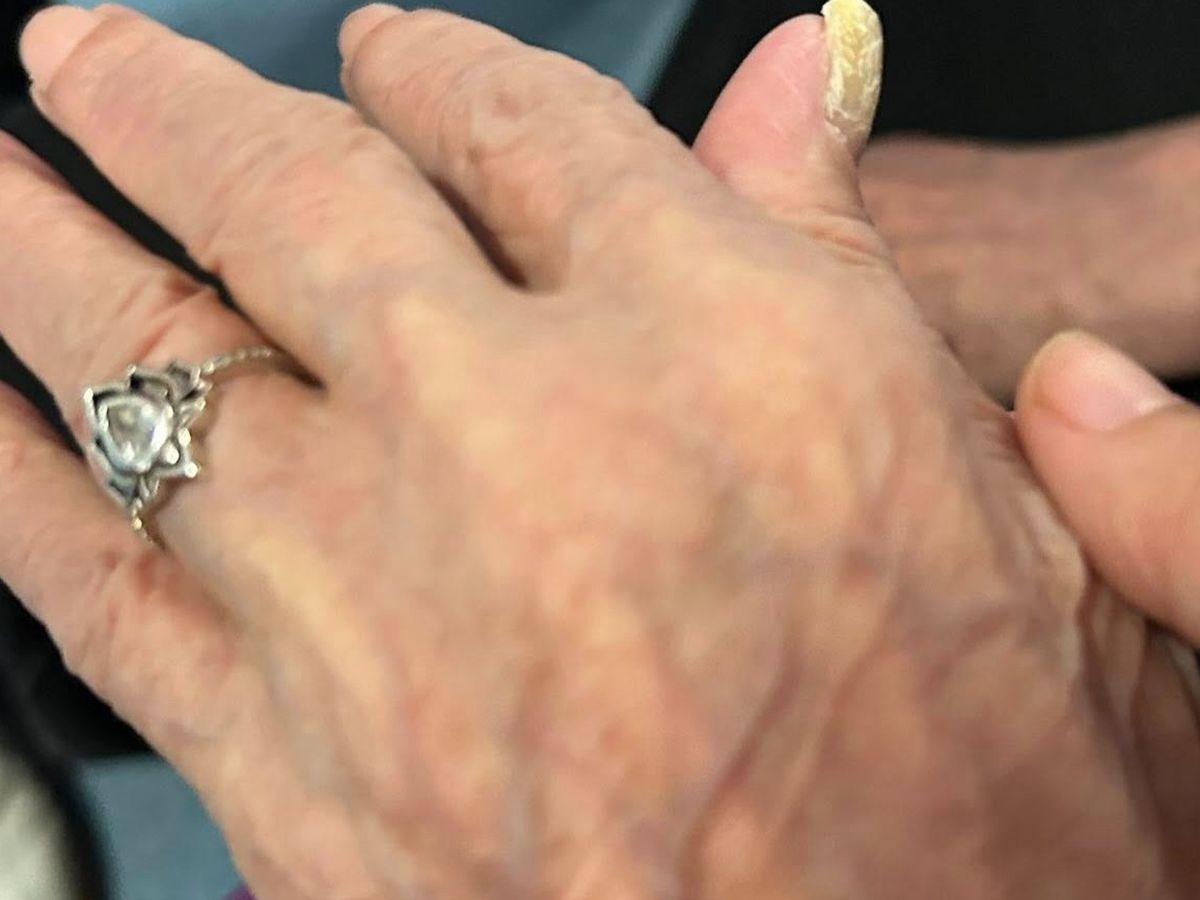
My grandmother Mei Luo had the most beautiful hands. When I was small, I would fall asleep tracing the lines of her knuckles in the dark. As I got older, I watched those lines deepen — visit by visit, year by year. I memorized them. Her hands were how I measured time. They were the most solid thing I knew.
Alzheimer’s is an erasure. It doesn’t take the body first — it takes the person who lives behind the eyes. It dissolves memory, language, recognition — all the invisible architecture of a self — until what remains is a body without its inhabitant. It took Mei Luo’s memory of me, her words, the thread of who she was. By the end, she was still there. And completely gone. I couldn’t get to her in time. I was in my senior year, surviving something of my own — an assault that left me with PTSD. I was trying to hold myself together across an ocean from the woman I loved most. I never said goodbye. That’s the part I carry. Some things, once dissolved, do not return.
I know something about erasure. I am half Asian, half ethnic minority, and autistic — a person built at the intersection of identities that a white colonialist world was not designed to hold. Ableism and racism share a root. Both operate on the same logic: that some people are more fully human than others, that some minds are worth centering and the rest should conform, mask, or disappear. It is the same mechanism as Alzheimer’s, scaled to a civilization. A slow, systemic dissolving of people who do not fit — from history, from research, from the room, from memory itself. All that is solid melts into air. The disease does it to a mind. The system does it to entire peoples.
Mei Luo did not fit the profile of who medical science builds itself around. Neither do I. That is not a coincidence. It is a pattern. And it is one I intend to spend my career dismantling for an equitable society.
As a research scientist and AI engineer in San Francisco, I’ve spent years developing diagnostic tests and building quality systems for medical devices. I want to point all of that experience at the disease that took Mei Luo — and at the broader erasure it represents. The University of Pennsylvania’s Certificate in Neuroscience is the next step. This rigorous, four-course program will help me build the skills I need to work on early detection tools for Alzheimer’s and other neurodegenerative diseases. As someone who is autistic and living with PTSD, I understand from the inside what it means when the brain doesn’t work the way the world expects. That’s not a liability in this work. It is precisely why I need to do it.
I can’t give Mei Luo her memory back. I can’t restore what the disease dissolved, or undo the years that colonialism and ableism stole from people like her and like me. But I can spend the rest of my career making sure that the people medicine has overlooked are no longer erased twice — once by disease, and once by a system that was never built for them. The funds raised will go directly toward tuition for the Penn LPS Online neuroscience certificate program, helping me take the next step in my mission to make a difference in neurotech diagnostics.
The first course — NEUR 1000: Introduction to Neuroscience at Penn — costs $2,774. I can cover $1,000 myself. I’m asking for help with the remaining $1,774. If even 30 people each gave $30, I’d be there. Every dollar moves me one step closer to the research I was born to do.
Organizer