- K
- M
- P
A Journey of Resilience: From Tragedy to Triumph
On July 14, 2003, my life took a turn that would forever alter the course of my existence. What began as an ordinary day, filled with the familiar pain of a broken heart, quickly spiraled into a moment that would change everything. I was speeding along Foothill Boulevard, trying to escape the overwhelming sadness of a recent breakup, when an impaired elderly man turned left in front of me. In a flash, my world was irrevocably changed.
I don’t remember the accident itself. The last thing I recall was a blur of motion before waking up in a world of pain and confusion. The impact had thrown me 126 feet, leaving me with a fractured skull, a broken neck, shattered ribs, and compound fractures in my right arm and leg. My helmet had come off during the crash, and I was left to face the unimaginable trauma that had befallen me. When I finally awoke, I learned that I was now a quadriplegic—paralyzed from the neck down, with a life forever changed in ways I could never have imagined.
For four long minutes, I was clinically dead, suffocating on my own vomit after aspirating due to the severity of my injuries. When the paramedics arrived, they cleared my airway, and miraculously, I began breathing again on my own—something that is almost unheard of for someone with a spinal cord injury like mine. Even in that moment, I found myself apologizing to the paramedics, not yet grasping the gravity of my situation.
When I awoke in the hospital, 11 hours after the accident, I was greeted by darkness. My eyes were swollen shut, and my ears rang from the trauma. I couldn’t move, couldn’t see, and could barely comprehend what had happened. It felt like I had been abducted by aliens—my body foreign, unrecognizable. Then, the doctor delivered the news that shattered my soul: I was paralyzed from the neck down and would never walk again. The reality of being a quadriplegic was a heavy burden, one that planted a seed of despair deep within me.
Those words planted a seed of despair in my heart. Over the next 20 years, that seed grew into a pervasive sense of hopelessness and self-destruction. I struggled to find a reason to live, asking the doctors to pull the plug, only to be told that there was no plug to pull. My life had become a nightmare, and the fight for survival as a quadriplegic seemed insurmountable.
For months, I lay flat on my back in a neck brace, receiving heavy doses of pain medication. The medical system seemed content to let me waste away, as if they were waiting to see if I would survive at all. I was the only person with a spinal cord injury in a ward of eight men, separated by nothing but curtains, left alone in a corner to grapple with the reality of my situation.
When I finally decided to fight for my life, I was transferred to Rancho Los Amigos, a renowned rehabilitation center. But my body was too damaged, too broken, to undergo the intense therapy needed for independence. After six months in the hospital, I signed myself out against doctors’ orders, desperate to return home and make sense of what had happened.
What followed was a four-year legal battle to secure a settlement that would support my future as a quadriplegic. The first trial determined that I was 35% responsible for the accident, simply because I was speeding. This was a harsh blow, as it allowed the system to take 35% of the settlement meant to secure my future. The second trial was even more harrowing—an assessment of my life’s worth, where people sat around debating when I would die and what my life was truly worth. It was a dehumanizing experience that left deep scars on my psyche.
In the end, I was awarded $18.8 million—a sum that should have secured my future. But the system, once again, failed me. I was pushed into a mediation process, pressured by lawyers who were more interested in their cut than in my well-being. The insurance company threatened to drag the case on for years, and I was left with no choice but to settle for $10 million—a decision I made out of sheer exhaustion.
After the lawyers took their share, the man who caused the accident took his, and the state of California demanded nearly $1 million for medical bills, I was left with only $2.7 million. And even that was placed in a special needs trust, which meant I had no control over the money meant to support me. The trust was mismanaged by fiduciaries, leading to the depletion of my funds and the eventual loss of the one thing I cherished most—my home.
The financial crisis of 2008 wiped out nearly half of my remaining money, and I was forced to sell my house, which had been specially modified for my needs. I have since moved five times in seven years, struggling to find accessible and affordable housing. The care I received was more focused on draining my trust than on helping me heal, leading to unnecessary surgeries and further exploitation.
For years, I was heavily medicated with fentanyl, a powerful drug that numbed both my physical and emotional pain. It wasn’t until recently that I found the strength to wean myself off of it, despite the risks. The withdrawal was excruciating, but it allowed me to see the world with new clarity. I realized that the emotional pain I had been numbing was even greater than the physical, and I began the long, arduous process of reclaiming my life.
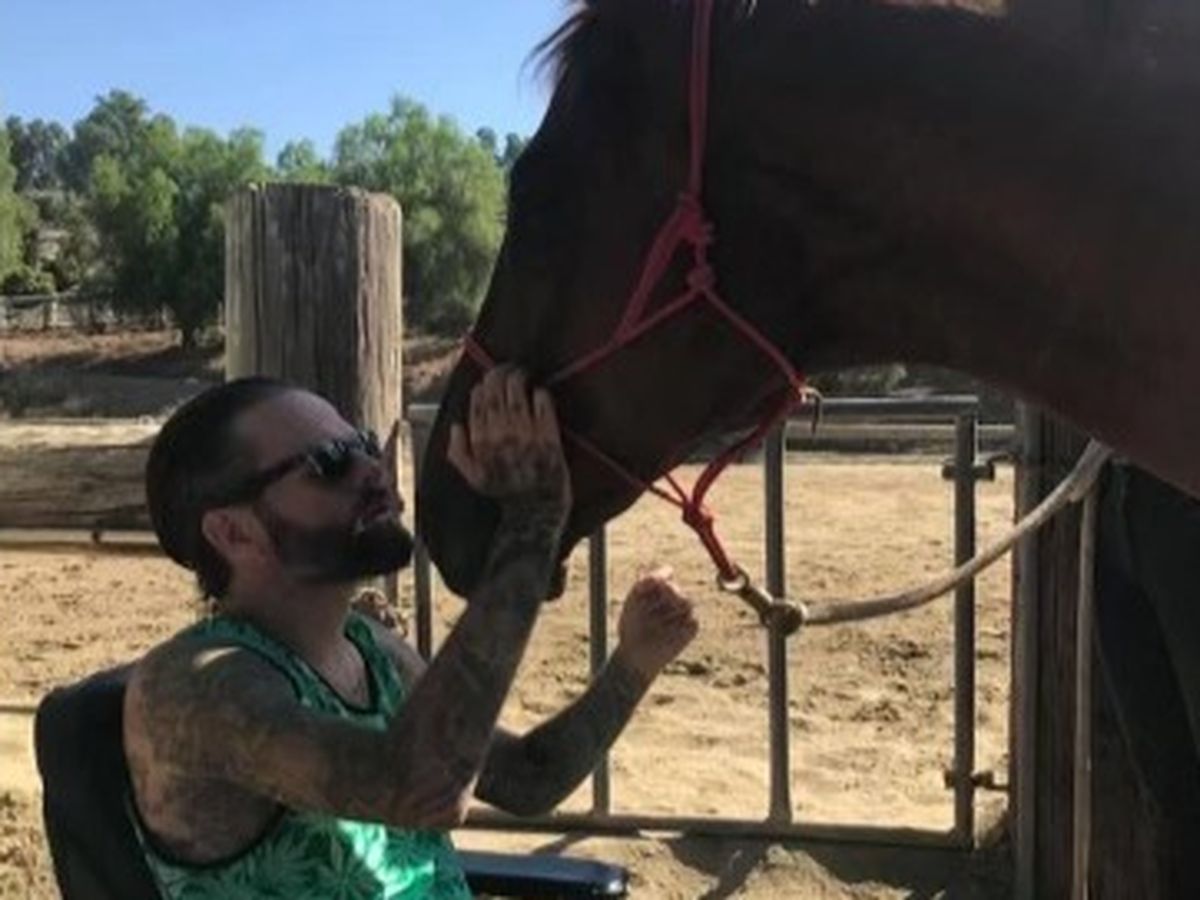
With newfound clarity, I moved back to Shadow Hills, California, where I reconnected with my mother—the one person who has supported me unconditionally throughout this journey. It was here that I rediscovered the healing power of nature, rolling through the hills I grew up in and reconnecting with the horses I had loved as a child.
One day, while watching a friend’s daughter take a horseback riding lesson, I met Johnny Higginson at the Shadow Hills Riding Club. Johnny’s kindness and the time he took to connect with me changed my life. He offered me an open invitation to visit the club whenever I wanted, and it became a place of healing for me—a sanctuary where I found peace and purpose.
In my journey toward healing, I’ve been fortunate to receive guidance and support from the UNI Foundation for Spiritual Wellness. Their compassionate approach not only helped me reconnect with the spiritual aspects of my recovery but also motivated me to take my healing to the next level. This spiritual guidance further inspired me to push beyond my perceived limits and explore new possibilities in my rehabilitation.
For the past year, I have been working with a healer who has graciously donated 4-6 hours a day, multiple days a week, to help me get out of bed and start moving again. The progress we’ve made has been nothing short of miraculous. For the first time in years, I’ve experienced movement in my legs while supported by a sling—a glimmer of hope that I might one day overcome this paralysis. However, the road ahead is still long and arduous, and my healer, who has given so much of their time and energy, deserves compensation for their dedication and expertise.
This brings me to where I am today, writing to you from a hospital bed. Despite all my efforts to heal, my health has deteriorated to the point where I need around-the-clock care. Over the past year, I made the difficult decision to leave everything I knew and loved behind, moving closer to a healer who showed me the inner strength I need to reclaim my body. But the journey has been fraught with challenges. Every day is a struggle to find the motivation to keep going, and just when I feel I’m making progress, something else knocks me down.
Right now, I’m in the hospital due to a severe E. Coli infection that spread throughout my body and nearly killed me. This infection originated from a 13-year-old bladder infection that had formed an abscess, which induced sepsis and brought me terrifyingly close to death. After surgery, I was transferred to the floor, where I woke up in immense pain due to the wound near my anus—one of the most sensitive areas for a man, especially after 21 years in a wheelchair. The anesthesia kept me comfortable for a little while, but as soon as it wore off, the pain became unbearable.
Despite my history of needing significant pain management, the hospital staff treated me as if I were seeking drugs, simply because of the high doses required to make me comfortable. They labeled me a “seeker,” a term used for those who supposedly go to the hospital just to get drugs. It took three agonizing days to get properly medicated because the hospital didn’t even have the necessary pain management drugs in their pharmacy. I lost three days in absolute suffering, unable to get ahead of my pain. How can you begin healing when you’re trapped in unmanageable pain?
On top of the excruciating physical pain, I faced discrimination due to my appearance. The staff told me that I “fit the profile” because of my love for tattoos and long hair. I was profiled, disrespected, and treated like an addict—despite the fact that I’ve chosen a life dedicated to working with people in recovery. This experience was not only shocking but also horrifying, as it highlighted the prejudice and lack of understanding that exists even in the places where people should feel safe.
After finally getting the pain under control, I was able to get out of bed and start doing my yoga and breath work—things I’ve come to rely on for my physical and mental well-being. I don’t waste days lying in bed anymore; I’ve wasted nearly a decade of my life like that and can’t afford to lose any more time.
However, the hospital failed me in more ways than one. I wasn’t even able to get a proper shower until the fourth day because they didn’t have the necessary equipment for someone in a wheelchair. I had to bring my own equipment from home. It’s astonishing how often I encounter this issue, as if it’s acceptable to just wipe someone down with wet napkins. I can’t understand why facilities aren’t set up to accommodate people in wheelchairs, especially when there are so many of us.
I filed a complaint with the chief nurse and had to speak to the highest-ranking supervising doctor about the inadequate pain management and the way I was treated. But the damage was already done. The hospital also failed to secure a bed for me in a rehabilitation center—a crucial step after any surgical procedure for someone with a spinal cord injury. Without proper rehabilitation, I’m at risk of becoming weaker instead of stronger, and yet, due to my limited insurance, I was denied this essential care. I was sent home, where I simply don’t have the care I need, and haven’t had it for nearly five years—a situation I’ve been too proud to fully admit.
But now, my situation is more dire than ever. As of January 1st, I will be homeless. My funds have completely run out, and I can no longer afford the 24-hour care, food, medicine, and proper medical attention that are essential for my survival. The system that was supposed to support me has failed, and I am left with nothing but the hope that compassionate individuals like you will step in to help. I’m not just fighting for comfort—I’m fighting for my life.
If caregivers are not available to donate their time, my only option is to hire 24-hour care, which is prohibitively expensive. The state of California only covers the cost of 9 hours of care per day, leaving me to somehow find a way to pay for the remaining hours. This is a burden I simply cannot carry alone anymore.
I currently have only one caregiver—a devoted soul who stays with me 24 hours a day, even though the state only pays for 9 of those hours. Her commitment has been a lifeline, but I’ve exhausted both her energy and the last of my savings. Now, I am in desperate need of additional caregivers—people who can understand my situation as a quadriplegic and offer the compassionate care I need to keep going.
The UNI Foundation has also taken up the cause of helping me raise the necessary funds to secure my future. Their involvement has given me hope that, with the right resources, I can continue to heal and work toward my goals.
I am humbly asking for your financial support—not just to survive, but to truly live. The reality is that I will need a tremendous amount of money to support myself through the rest of my life. The costs of intensive physical therapy, proper nutrition, stable housing, and round-the-clock care are overwhelming. These are not luxuries—they are the basic necessities that allow me to maintain my dignity and continue this fight.
I know that prayers are powerful, and I am deeply grateful for every one that is sent my way. But right now, it is financial contributions that will make the most immediate and profound impact on my life. Your generosity will directly support my recovery and long-term care, helping me to regain my strength and continue my mission of serving others.
I am living proof that even in the darkest times, there is hope. With your support, I believe I can turn this tragedy into a story of resilience and triumph. I need your help to write this next chapter—a chapter where I rise from these challenges and reclaim my life.
With all my heart,
Trevor Pullen
Organizer
