Help Sander Walk Into Freshman Year
0% complete
$9,411 raised of
34 donations
Sander's Story
Help Sander Walk Into Freshman Year
The Turning Point
The Goal: Getting Sander to his first day of High School.
To everyone who knows us—Paul, Elizabeth, and Sander—you know we are a tightly knit team. For years, we’ve shared our joys, our medical challenges.
But today, we are lifting the curtain on a private struggle. We are facing a time-sensitive path that we cannot walk alone. We are asking for your help to bridge the gap between what we can afford and what it will really cost for Sander to have the two critical complex surgeries to help him walk without pain the rest of his life.
The Situation: Six Rounds and the Very Last Embryo
Sander is the son we spent years trying to bring into this world. Our journey included a three-year struggle with IVF and six difficult rounds. Sander was the result of that final round—the very last embryo we had. We tell you this because it defines our commitment as a family. We have always gone to great lengths for Sander, and we are maintaining that same level of dedication throughout this medical process.
Sander was born with Noonan Syndrome, a genetic condition that affects his growth and skeletal development. For years, we’ve managed this with daily growth hormone shots and intensive physical therapy. But as Sander has hit his teenage growth spurt, the bones in his legs and hips have begun to rotate.
The result is chronic pain and a precipitous decline in his mobility. His surgeons have identified a narrow "biological window." Because he is still in a critical growth phase, they can perform a specialized surgery to align his bones correctly. If we miss this window, he faces a future of permanent pain and even the possibility of a wheelchair.
A Note from Sander: Life with Noonan Syndrome
"I was born with Noonan syndrome (NS). I was diagnosed with a heart condition just three days after birth. Since then, it has felt like a snowball rolling downhill, with one condition or complication following another. Growing up with NS meant numerous doctor visits, surgeries, and hospital stays, including a near-death experience last year due to complications from a routine procedure."
"I see this upcoming major surgery as a turning point. Instead of reacting to my condition, I’m now focused on what this surgery can enable for my future. It will help me stay active and finally participate in sports, which is a big goal for me. This surgery is essentially my chance to move beyond the 'patient' phase and start a healthier, more active chapter."
The Medical Details: What Sander Faces
Sander is actually having two surgeries concurrently to best leverage the narrow, closing window of time available to him due to his age and growth rate. The "Big One" is a Tibial Derotational Osteotomy followed by an 8-Plate Procedure (Please see the FAQs below for more information). This is an opportunity to fundamentally change his skeletal alignment before his growth plates close.
The Roadmap: Why the Work Starts Now
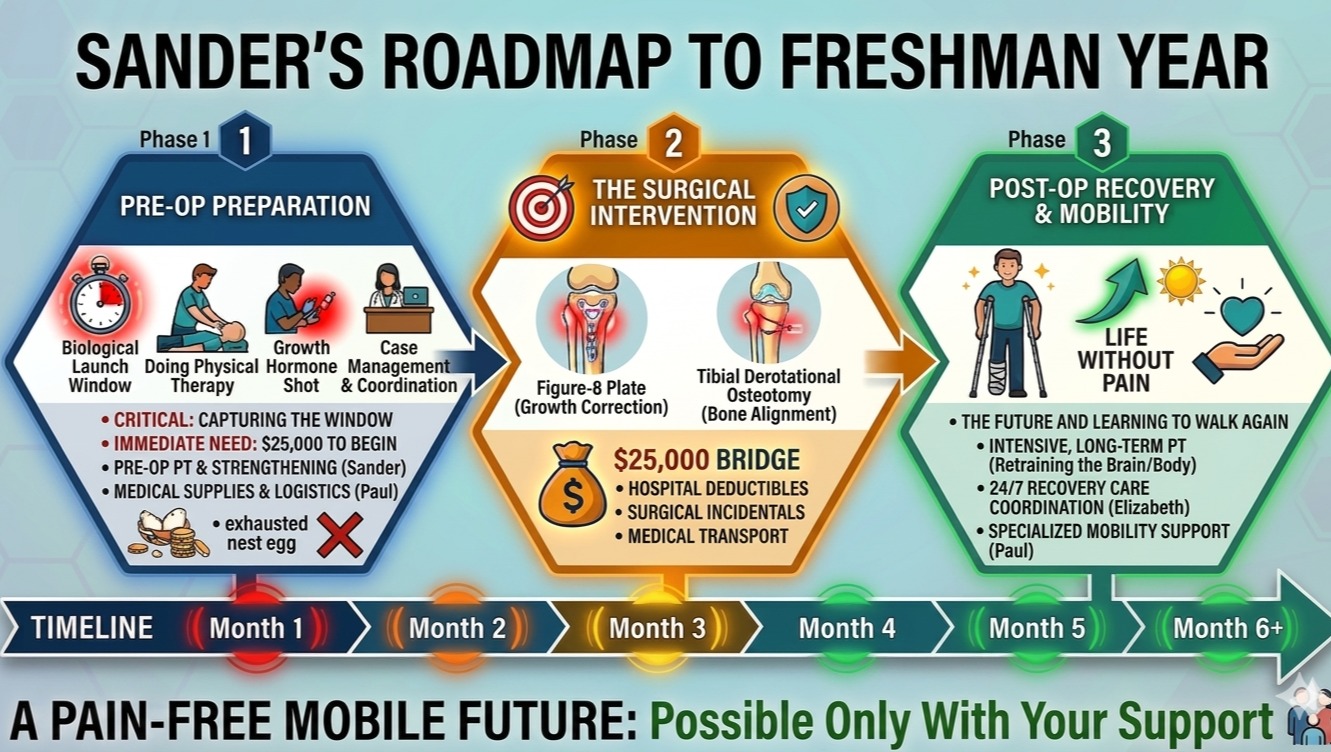
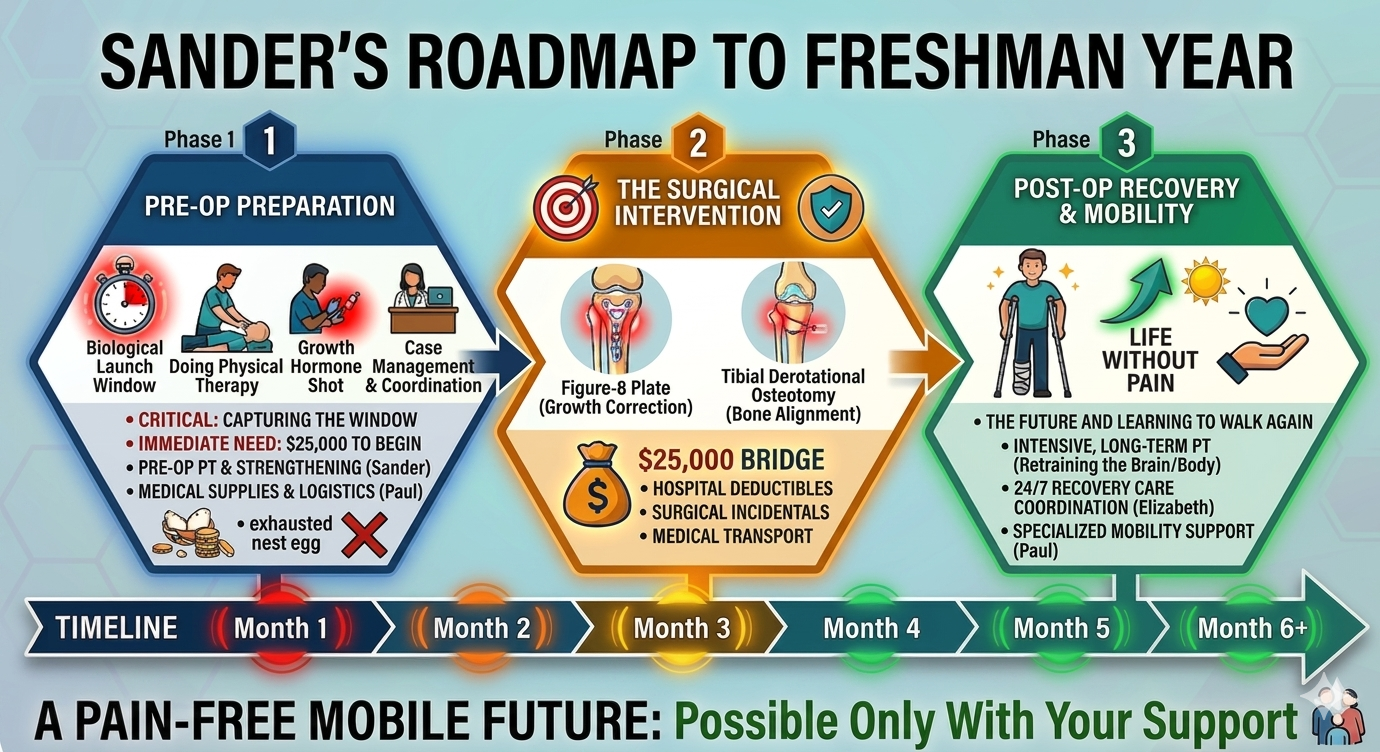
This isn't just a surgery; it is a 180-day commitment. Our plan is built on 7 Pillars of Recovery, but the foundation of everything is Household Capacity. To get Sander to the finish line, we must fund the intensive Caregiver Requirements that this journey demands of us every single day.
• Months 1 & 2: Pre-Op Preparation (April – May)
o Pillar 1: Strength Conditioning: Intensive PT to build the core strength Sander needs to navigate his recovery.
o Caregiver Requirements: Daily coordination and transportation to specialist "clearance" appointments and the logistical management of pre-surgical mandates.
• Month 3: The Surgery & Acute Recovery (June)
o Pillars 2 & 3: Reconstruction & Healing: The surgical procedure followed by the critical window of initial healing.
o Caregiver Requirements: We will be bedside throughout his hospitalization, acting as his primary advocates and case managers to ensure a seamless transition back to our home.
• Months 4 – 6: The Intensive Recovery (July – September)
o Pillars 4, 5, & 6: Bone Healing & Retraining: Retraining Sander’s brain and muscles to walk with his new alignment.
o Caregiver Requirements: This is the most demanding phase, requiring 24/7 "at-home" care and daily rehabilitation sessions.
• The Goal: Sander walking into Eden Prairie High School this fall on his own two feet.
To support this commitment, we have already moved into transitional housing—a single-level space with no stairs, configured specifically for Sander’s rehabilitation.
The $25,000 Bridge: Sustaining the Work
We believe in total transparency. Your donations are not going into a "black hole"; they are funding the seven specific pillars of Sander’s recovery and the household capacity required to reach them.
We are seeking $25,000 to serve as a bridge for this six-month undertaking. While many think of medical costs as simply hospital and surgical bills, the most significant costs occur at home. This fund is dedicated to:
• Sustaining Household Capacity: Funding the bridge that allows Elizabeth and Paul to meet these heavy Caregiver Requirements full-time, ensuring Sander is never without the advocacy and care he needs.
• Specialized Recovery Equipment: Outfitting our transitional home with the necessary mobility tools and home-rehab equipment that insurance often doesn't cover.
• Intensive Therapy Gap: Funding the aggressive physical therapy schedule required to meet Sander's high school start date.
The Team: Working Together
This isn't a burden one person can carry; it’s a team effort where we each play to our strengths:
• The Case Manager: Elizabeth coordinates the complex web of appointments, insurance hurdles, and specialist schedules with incredible care.
• The Caregiver: Paul handles the logistics of transportation and the physical demands of Sander's daily care.
• The Athlete: Sander is doing the most important work, putting in the grueling hours at PT to ensure his body is ready for the goal.
The Plain Truth: Our Journey to This Moment
Sharing our story with this level of openness isn't easy, but it is necessary. As mentioned, our journey with Sander began long before he was born. He was our miracle baby. That early battle for Sander’s life defined our family’s DNA: We do whatever it takes.
For 20 years, we ran a successful consulting business. But as I was diagnosed with a rare genetic disease and my health began a long "symptom slide," our business declined alongside my physical ability to sustain it.
To protect our son's future, we liquidated everything. We divested our portfolio, sold our home, and lived off the equity; we sold our boat and our land. We have used every resource to get to this point. While I navigated the two-year process of filing for disability, we watched Sander closely with his specialists, waiting for the exact biological window where surgery would be most effective.
During this time, I had to "duct-tape" my own health together. I chose smaller spinal procedures (some experimental and not covered at all by insurance) over a massive cranial-cervical fusion, specifically to stay functional enough to lead our family through this window for our son.
Join the Team
Once we have seen Sander safely through the doors of his high school, our plan is to restart our consulting business. We have the experience and the drive—we just need this bridge to help us get our family through this incredible challenge.
All the best,
Sander, Elizabeth & Paul
Frequently Asked Questions
Q: What is Noonan Syndrome? (The Simple Version)
A: Think of Noonan Syndrome as a genetic "glitch" in the body’s instruction manual for growth. It is often called the "most common rare disease you’ve never heard of," affecting about 1 in 2,000 people.
In Sander’s case, this "glitch" affects two main things:
The Growth Engine: His body doesn't naturally produce the right signals to grow at a normal rate, which is why he requires daily growth hormone treatments.
The Chassis (Bone Alignment): As Sander grows, his bones aren't "parking" in the right spots. Specifically, the bones in his legs and hips are rotating in a way that causes severe pain and makes walking difficult.
Q: Why is this surgery such a big deal?
A: Because he is 14 and still growing, his bones are still "soft" enough to be corrected. Surgeons call this a "Biological Window". If we wait until he stops growing, the bones "set" in their current, painful positions permanently. This surgery is a one-time chance to "reset the chassis" so he can live a mobile, pain-free life.
Q: What makes this surgery different from a standard orthopedic procedure?
A: Sander’s team at Gillette Children’s is utilizing 3D Orthopedic Mapping (Virtual Surgical Planning). Because of the complexity of his bone structure and rotation, surgeons create a digital 3D model of his legs before the first incision is ever made. This allows them to "pre-plan" the exact rotation of the Tibial Osteotomy and the placement of the Figure-8 plates with millimeter precision. This high-tech preparation is why the current “Pre-Op Surgical List” of specialist clearances and imaging is so vital.
Q: What is a Tibial Derotational Osteotomy?
A: This is a precision reconstructive surgery designed to correct the lower leg's alignment. In Sander’s case, his tibia (shin bone) has a rotational twist that causes significant pain and gait instability. During the procedure, the surgeon carefully cuts the bone, rotates it into the mathematically correct alignment determined by 3D Orthopedic Mapping, and secures it in its new position. This "reset" will enable Sander to walk with a natural, pain-free stride for the first time in his life. It is a major undertaking; the body must essentially grow an entirely new bridge of bone during an extensive, strict, non-weight-bearing recovery.
Q: What is a "Figure-8" Plate procedure?
A: Formally known as "Guided Growth," this procedure uses small, figure-8-shaped titanium plates to gently steer the direction of bone growth. Rather than a permanent "fix," these plates act like braces for the skeletal system. By placing them across specific growth plates, the surgeons can utilize Sander’s own natural growth to gradually straighten his legs over the coming months. It is a minimally invasive but highly strategic way to ensure his long-term mobility.
Q: Why are both being done at once?
A: By combining the immediate correction of the Osteotomy with the long-term guidance of the Figure-8 plates, the surgical team is addressing both the current structural pain and Sander’s future skeletal development. This "all-in-one" approach is more taxing on the initial recovery period (requiring our 5-Month Recovery Support Network), but it provides the best possible outcome for his transition into adulthood.
We will add additional FAQs as questions arise during this process.