Please Help Larry and Jill Find Stability and Relief!
0% complete
$5,461 raised of
41 donations
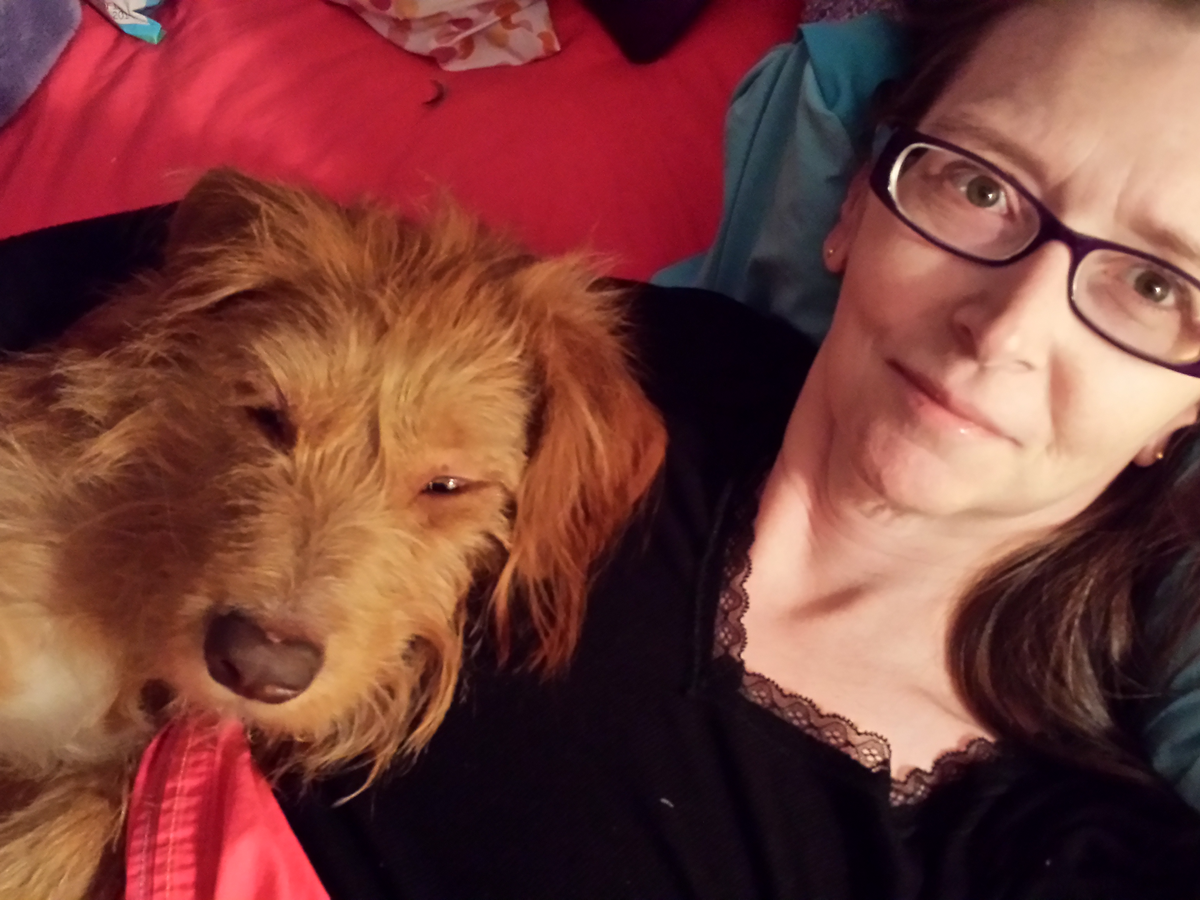
[That's not Larry in the Photo -- it's Seamus and Jill.]
THE EMERGENCY HAS BECOME MORE URGENT: We have reached a critical stage, where we are having to cancel Jill's medical appointments and forgo getting her prescriptions due to lack of fuel and funds. We are also in danger of losing our household items in storage -- now locked out -- and have been unable to make April, and shortly, May rent on the lot where our RV is on. Food is becoming scarce as well. We need to raise about $3,500 right away to keep from going under the waves on May 1. Thanks to our supporters -- thank you thank you thank you! -- we have raised part of that amount, but we still need help.
Hello,
My name is Larry Evans, and I am the full-time primary caregiver for my wife, Jill Todd. I have reached the end of my resources, and I am – quite uncomfortably – reaching out for help, relying on the kindness and generosity of friends and strangers.
I have been unable to work outside the home for quite some time; I was ordered by Jill's physicians several years ago to not leave her alone. Jill has a very complex medical history. She is very unsteady on her feet, spends most of her time now in bed, and needs assistance for tasks of living most of us take for granted, including walking to the bathroom.
Our circumstances forced us to sell the home (inherited from my mom) 3 ½ years ago and purchase a 25-year-old motorhome, which is where we live today. We have been living off of the proceeds from that sale, which unfortunately, have now run out.
We need funds for living expenses, including lot and storage rentals, medication, some medical expenses, food, and to repair systems on our home that have failed, including heat , hot water, and generator. Our ultimate goal is to relocate from central Texas to a state where we can live above 6,000 feet in elevation.
Jill's story:
Jill was severely injured in an automobile accident in April 1994, hit from behind by a vehicle traveling approximately 45 mph while she was standing still at a traffic light. She suffered severe whiplash of her neck and jaw, and injuries to her knee and back. Her accident settlement did not completely cover her medical bills accrued up until that time.
Jill has suffered a severe migraine – that never goes away – ever since.
Hers has been a life of severe pain in the 32 years since her accident – with the only exception being when we have traveled through the mountains. On a road trip 14 years ago while crossing the state of Colorado, Jill started looking at me with a somewhat puzzled look on her face. After about 5 minutes, she told me that for the first time in 18 years, her migraine had gone away – completely. It came roaring back when we descended below 6,000 feet into Denver.
Was this a fluke? No.
We traveled to New Mexico a few years later, and again, her migraine went away just as we got above 6,000 feet in elevation and returned again when we descended. We aren't sure why this happened, although changes in barometric pressure commonly trigger migraine attacks. The barometric pressure at 6,000 feet is about 80% of what it is near sea level, which seems to help.
It was our intention to relocate to the mountains, which is why I bought the motorhome, but unfortunately, Jill's declining health and complex medical problems have prohibited this move up until now.
The 1994 car accident cost Jill her career as a gifted civil litigation attorney 1 ½ years into a solo practice in Family Law, where she represented low-income people who needed a lawyer but seldom had resources to pay her for her services. She had more than 100 cases open at the time of the accident, all of whom truly needed a lawyer but had great trouble trying to pay her for her work.
Jill's injuries forced her to suddenly close her law practice. Her family was in no position to help. I was the only one who could help.
I stepped up.
I pretty much lost my career as a self-employed performing artist personal manager just as my company was beginning to turn a profit. I managed and guided the careers of singers, bands, and a movie & television actor. The amount of time I had to take off to take care of Jill started eroding my business, and I was no longer able to give my clients the attention their careers required. My colleagues in music – artists, songwriters, and business professionals – might have noticed my sudden absence from the local Austin music scene.
It wasn't until 4 years later that Jill could return to work on a limited basis, when lawyers who remembered and were familiar with her work and ability started contacting her to represent them in their personal family law matters regarding adoptions, child custody proceedings, and divorces.
She returned to work with a splitting migraine and conducted her first court trial since returning about 9 months later, in 1999. Her client prevailed. As word got out in the legal community that she had returned to work, she began to get referrals from lawyers in other fields of law – criminal defense, corporate/business, probate, immigration, etc. – who were handling unrelated matters for their clients and knew of her reputation.
Jill struggled at first and found that she could not handle more than 3 to 5 cases at one time. She had made a name for herself before the accident for winning custody for fathers at a time – 1992-93 – in Texas when the Courts still presumed that it was in the best interest of the child to be with their moms, even when moms were actually a danger to their children. Her novel winning legal arguments won her fans among her colleagues in Family Law.
Then she disappeared.
I started helping her, at first conducting legal and due diligence research on her behalf and then helping her draft motions to present in Court. I had earned my degree in English Language and had been trained in formal research as a result. I started applying the skills I had learned as an artist manager, including due diligence evaluations, to help her manage her law practice, and I helped position her with a boutique clientele of clients who could afford to pay her fees – lawyers, accountants, commercial airline pilots, bankers, engineers, and other professionals. She was very uncomfortable raising her hourly rate to be commensurate with her experience and her professional competition, and commonly worked against opposing counsel who were paid much more than her by their clients.
Jill was as much a counselor to her clients as she was a lawyer, and did all she could to get people who were at each other's throats to see the big picture and realize, if there were children involved, that they needed to work together to help their children succeed in life.
But when things did not work out and a case went to trial, she was more than there for her clients.
Jill was always prepared and quick on her feet, and she left a trail of lawyers who were in Court every day of the week and their clients asking if anyone got the license plate number of the bus that ran over them. She was that good. At first, she would not let me go into Court with her – she did not want me to watch her work – but as she started relying on me more and more as her paralegal, she relented.
I watched her very politely, and in a calm, measured voice, relentlessly pick apart her opponents and mop up the pieces on the floor in the nicest, sweetest way possible. I am fortunate that she has been kind enough to never turn that skill on me.
Sadly, Jill's health continued to fail as the chronic severe migraine pain made it more difficult for her to think on her feet. She started experiencing back pain about this time, and as her clientele had become more and more well-heeled, she became increasingly frustrated and disgusted with opposing counsel intentionally stirring up more conflict in cases in an effort to increase their billings during litigation.
Jill was forced to retire from the courtroom in 2013, just after the 59th trial of her abbreviated career. Her trial record was 58 and 1.
Jill had told me that she aspired to become a judge – she would have been a good, thoughtful one – but that, like her career as a civil litigation attorney, appeared to be out of the question.
The injuries from the car accident and the years of severe pain were catching up with her. Her back injury had started to calcify with arthritis, which started distorting her lower spine and made it more and more difficult for her to keep her balance while walking. She started falling way too often.
My elderly Mom – then 88 and no longer driving – asked us in 2011 to move in with her to assist. That same year, Jill's Mom passed away, leaving her Dad alone and neglected in her hometown. He needed help that her family members were unwilling to provide, so we arranged to move him to Austin several months later. He was very ill when he arrived, perhaps a month away from his own death. His doctors at the VA Clinic saved his life and added 7 more years to his life. At 81, he could no longer drive and would commonly have 3-4 appointments per week at the clinic.
I became his chauffeur, taking him from his apartment to the clinic, all the while assisting my Mom and taking care of Jill as her body continued to become more unwieldy. After my Mom passed in 2016, we moved Jill's Dad, who by then was showing signs of dementia, in with us. Jill was unable to take care of him, so I became her Dad's primary caregiver until he passed in 2019.
Jill caught something at her Dad's memorial service in her hometown, and she became very ill. She started experiencing episodes of syncope when standing up. Her heart rate would soar while her blood pressure plummeted, causing her to lose consciousness and fall to the floor. At first, it happened once in a while, but it got worse over time. At the same time, she started losing weight mysteriously until her 5'3” tall body had dropped from 120 to 79 lbs.
It was during this time that I realized I could not leave her alone for any amount of time, long before I was ordered to not leave her alone by her doctors. Jill did not have a primary care physician at that time. We struggled to scrape up enough funds for her to see a pain management doctor monthly and a neurological specialist once per year, along with her medications. We managed to treat the pain to an extent, but could not afford to investigate the cause.
We could not afford health insurance, at least any insurance that made sense financially. What we might have been able to afford had annual deductibles that were twice what we were spending paying cash for appointments and medications.
This was all happening when the Covid pandemic hit. We knew that we really needed to bite the bullet and take her to the Emergency Room so that she could be checked out, but feared that the ERs, then overloaded with patients stricken with this new, deadly disease with limited treatment options at the time, would be a death sentence for Jill if she caught it in an overwhelmed ER.
So we stayed home and waited, as her weight continued to drop and drop some more. We got the vaccinations when they first became available in April 2021. Shortly after that, a new mutation emerged – Delta – that surged more patients into the local ERs. Finally, as that Covid surge began to drop off, and Jill's weight had dropped to a life-threatening level, we braved going to the ER.
Jill was admitted and hospitalized for 3 days. We managed to qualify for medical assistance, and her slow, painful journey to recovery began four years ago. Her medical providers conducted test after test after test to rule out the worst fear of what caused the weight loss – cancer – which, fortunately, was not in her body. She was treated for Postural Orthostatic Tachycardia Syndrome (POTS), which stopped the fainting, which was fortunate since she was, in addition to all of her other conditions, diagnosed with Stage 4 Severe Osteoporosis. Her bones had become so brittle that they could fracture in falls, and her spine was becoming so distorted that she could barely walk, even with assistance. The spinal distortion was beginning to give her more severe pain in her hips as her body struggled to compensate for her back.
Sadly, she continued to fall, suffering a traumatic brain injury that left her with double vision for a couple of years, and she fell again, this time resulting in a fractured wrist.
Jill continued to regain the weight she had lost, which in one sense was good, but it added more strain on her skeleton, increasing her back pain exponentially. Finally, in November 2025, she was referred to a neurosurgeon, who after looking at her MRIs and standing-up x-rays, said the words to her that have changed her life:
“I think I can help you.”
Jill had spinal surgery on December 10, 2025, in a procedure that removed bone from the vertebrae that was pressing on her spinal cord and nerves where her severe back pain originated. As of that day, she no longer experienced that pain.
We are finally making progress, with numerous setbacks along the way.
Jill started physical therapy in February. It has been a slow and painful process that she has kept up with clinical sessions and much home work. During a clinical session In early April, though, she felt and heard a couple of pops near where her surgery was done that left her in significant pain. She had a previously scheduled follow-up appointment with her neurosurgeon, who thought it might have been a muscular/soft tissue irritation, but sent her for more x-rays just to make sure something had not changed in the bone structure of her lumbar vertebrae.
Jill continues to use a walker to get around and walking into appointments from the car tires her rapidly, and in turn, aggravates the migraine she lives with constantly.
The progress is very slow, but little by little, she seems to be getting better.
At the same time, though, the bottom has fallen out financially, and the progress we've made is looking more and more like it might be all for naught.
My parents brought me up to be kind to others and to help others in need, as I have tried to do all of my life. I have given generously when I could, and I never expected to be in such a precarious position where I must be humble enough to ask for help right away.
I am asking now, please. Thank you for reading Jill's story and for any donations you might be willing to give to us.
Larry Evans and Jill Todd
Organizer