Help Document Wichita’s Yellow-Crowned Night Herons
Be the first to donate
Inspire others and help Matthew build momentum.
1st donor
There is a yellow-crowned night heron nest in my neighborhood.
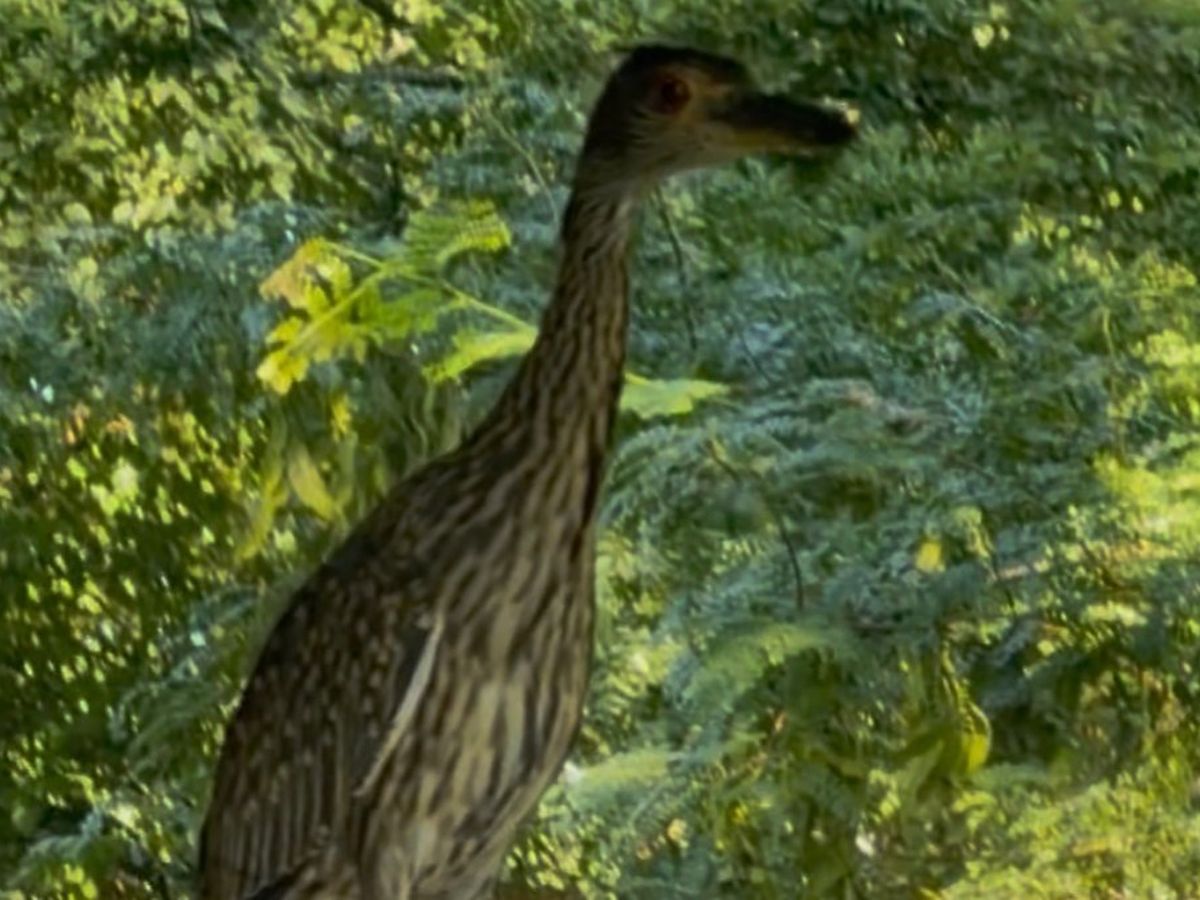
There is at least one juvenile: brown and heavily streaked, pale-spotted across the wings, with a dark bill, a red-orange eye, and the unfinished geometry of a bird that has become large before becoming entirely certain what to do with its body.
It was standing on top of my stepfather’s car.
I drove up calmly.
“Hello, bird.”
The bird remained.
“Look at this bird.”
The bird continued to remain.
I started getting out of the car. The juvenile stretched upward, became extremely vertical, and assumed the deeply unserious posture of an animal confronted with a situation for which no inherited protocol appeared immediately available.
“Yeah,” I told it. “I don’t know what you’re gonna do either.”
We stared at one another for more than thirty seconds.
Neither party appeared to possess a plan.
— excerpted from “The Yellow-Crowned Night Heron,” Field Observation / Entry 002
That was the first record.
The nest corrected the scale.
There were three.
One adult in the middle and two juveniles at either side: three yellow-crowned night herons occupying one structure beneath the canopy. The first bird had seemed solitary because the encounter was solitary. The later photographs show the system around it.
I want to keep watching.
My name is Matthew T. Marx. I am a biologist (B.S.), an independent field researcher, and an aspiring archivist. I am raising $1,100 to build a practical observation kit and turn this local nesting record into a complete public field journal.
Yellow-crowned night herons are locally uncommon and less widely recorded across Kansas than the more familiar Black-crowned Night-Heron. The point is not to manufacture rarity or turn the nest into a spectacle. The point is to document what is here, while it is here, with enough optical reach and stability to leave the birds alone.
WHAT WE ARE FUNDING
$300 — OBSERVE
Binoculars or a monocular, stable support or adapter, storage media, and field power.
$500 — RECORD
Adds stabilized ground video and field audio: a used camera or camcorder, phone gimbal, microphone, or the strongest equivalent the cleared budget can support.
$800 — PREPARE
Protective storage, spare power and media, repeat-observation expenses, and a reserve for longer-reach imaging.
$1,100 — REACH
A used or refurbished DJI Air 3S—or equivalent—acquisition fund. An Air 3S could combine stabilized 4K video, telephoto imaging, and broader habitat-context documentation in one instrument.
Ground optics remain the primary wildlife-observation instrument. Any drone use must be lawful, distant, and non-disruptive. It will never be flown at the nest, used to chase birds, or used to reveal the location. The reach goal is for context and distance—not permission to get closer.
WHAT THE RECORD WILL INCLUDE
The public field journal will include dated observations and effort; field methods and identification evidence; photographs, video, and audio when useful; equipment acquired and actual costs; and uncertainty, failed attempts, and corrections.
Eligible observations and original media will be prepared for contribution through eBird and the Cornell Lab of Ornithology’s Macaulay Library. Cornell/eBird is a contribution pathway, not an affiliation or promise of acceptance.
The complete journal will remain free through FORGOTTEN INDUSTRIES. Exact nesting locations, GPS metadata, donor contact details, receipts, financial details, and equipment serial numbers will remain private.
DONATED GEAR IS WELCOME
Useful equipment or technology can also be donated: binoculars, monoculars, cameras, camcorders, lenses, tripods, gimbals, microphones, recorders, storage media, batteries, power banks, protective cases, or compatible DJI Air 3S equipment.
Please message me before sending anything. Gear must be lawfully owned, safe, unlocked, and cleared of previous personal data. Accepted instruments and their use will be documented publicly. Donor acknowledgment is optional.
FORGOTTEN INDUSTRIES is not a registered charity and cannot issue tax-deductible receipts. A donation does not purchase editorial control, private records, or access to the birds.
Even $300 funds a complete ground-observation phase. Every level closes a real part of the experiment.
READ THE EXISTING RECORD
The Yellow-Crowned Night Heron:
The Heron Family:
Eleven-image photographic record:
ORCID:
Open archive and Git history:
The nesting site is not a destination.
Observe. Do not handle. Do not feed. Do not disturb the nest. Do not convert proximity into permission.
The archive can watch without making itself the center of that process.
A thing documented is a thing not yet lost.
Organizer