A Letter From My Sister:
"Halley Hinton is many things to many people. She is a daughter, a friend, a sibling, a wife, and a mother. Not only do I think of her as those things, I think of her as an artist; a painter, a sculptor, a writer. Growing up, Halley was always elbow deep in something creative. In school she was frequently awarded and acknowledged for her creative pursuits. This love of the arts has continued well into adulthood- not only as hobbies, but in her professional life as well. When I think of Halley and her home, her life- everything is carefully curated for visual excitement. She creates beautiful things. It’s just who she is, and for the first time in my life I am faced with the idea that it may end. If you know and love her already, I know that you understand how devastating that feeling, that realization, must be. For those of you that do not know her- who have stumbled across this go fund me, I am asking you to understand that a world in which my sister goes blind is a world that will have a little less.
Among the people most affected by her vision loss are her husband and daughter. She is unable to work, she is unable to drive, she is unable to read. She can not go to her daughter's school if there is an emergency, she can not help her daughter with homework, or read to her at night. They have gone from a two income household to one- increasing the hours her husband is away at work and leaving her even more dependent on outside help. Their savings and credit limits have been exhausted to pay for the specialists needed to get her diagnosis since losing her health insurance.
Even faced with debt and struggling with day to day finances, she is only asking for help with the money needed for the medical procedures she needs to restore her vision. She has gone from being an extremely independent person- always employed, always on the move, always involved…to someone who has become dependent on other people for almost everything. These procedures would significantly improve the quality of life for not only her but her entire family. We would be so grateful for any amount you could spare.
Chelsea Kaminski,
October 2025"
The Long Story Short:
My name is Halley Hinton, and I am losing my vision to a relatively common and treatable condition, because I can't afford to pay for the treatment. While at the beginning of this journey, I did have health insurance, it wouldn't have covered any of this, as it only covered preventative visits.
I have two eye conditions that require treatment- Cornea Keratoconus, a collagen breakdown of the cornea which can by stabilized through a procedure called Collagen Crosslinking, and Sub-capsular Posterior Cataracts, a non age related type of cataract that affects approximately 3% of patients who present with cataracts. My onset of symptoms was sudden and unusual, and it was a year long saga (which you can read below if you like) to arrive at this diagnosis.
I have exhausted all of my savings and maxed out my credit card paying out of pocket for specialist visits, imaging, tests, and travel. Now that a diagnosis has been found, I am faced with four surgical procedures to restore my vision- two on each eye. I have applied for financial assistance through the surgery clinic for the first portion of these procedures, but the amount of assistance I may or may not receive is unknown, the waiting list for aid is long... and my vision is still declining every day.
This has been an incredibly difficult time in my life. As my sister stated in the letter above, I am an artist. I went to college for fine art with an emphasis on illustration. I paint, sculpt, throw pottery on the wheel, make jewelry, and sew costumes. I began working as a custom picture framer in 2008, an I have been in that trade ever since, most recently working for a local frame shop and gallery from 2019 - 2024. I enjoy baking and gardening. My husband and I build art installments for music festivals and refinish furniture together. Every one of these things that I have been forced to give up over the course of this journey has been a blow... and that is only to me personally, without even beginning to touch on the impacts this struggle has had on my husband and child, my parents and siblings.
At this time, I am profoundly visually impaired, but not blind. I can not drive, I can not see the texture of the ground from standing height, I can not see the faces of my friends and family. Reading and typing are an incredible struggle. I have been fortunate until this point that I can still independently navigate the world to some extent- I am not dependent on a cane or a seeing eye dog, I can walk around familiar locations and accomplish routine tasks- but it's time to put aside my pride and ask for the help of my friends, family, and community, or face the reality that I WILL be blind in the very near future.
The Breakdown:
Keratoconus is a hereditary collagen defect of the cornea which causes the outermost layer of your eye to sag in some places and bulge in others. This is a degenerative condition for which there is no cure, only treatment. The weak cornea is reinforced and stabilized by a procedure called collagen crosslinking, in which a special gel is injected between the layers of the cornea and then treated with UV light, causing the collagen in the layers to melt and fuse back together. Under normal circumstances, my case of keratoconus would still be considered sub-clinical; I wouldn't be looking at surgical correction for another ten or fifteen years. Unfortunately I need cataract surgery, and I can't get it until my corneas have been stabilized. According to my doctor, they will be unable to correctly measure my eyes for cataract surgery until the cornea deformity has been corrected, and my corneas will not heal a effectively from cataract surgery unless they are reinforced first.
The cost of collagen cross linking is $6500-$7000 per eye- and that is only the first part of restoring my vision! As I stated above, I have applied for financial assistance but the wait list could be months, and IF I am approved for financial aid it will most likely (according to the financial advisor at the clinic) not cover the entire cost of the procedure. The purpose of this GoFundMe campaign is ONLY for the collagen crosslinking procedure. I'll cross the cataract surgery bridge when I get there.
If at any point during the course of this fundraiser, my application for financial assistance is approved, all funds raised here will be put toward whatever portion of the procedure is not covered and then toward the cataract surgery that I will have to have after the collagen cross-linking is performed.
If you have read this far, thank you. The year long saga of my vision loss is written out below if you are interested.
Timeline of Vision Loss:
I began to lose my vision in August 2024 at the age of 38. The initial onset of symptoms was nothing more than slightly blurred vision consistent with needing an adjustment to my prescription.
I made an appointment with Dr. Ingram at Greene Optometry Clinic, the optometrist I had been seeing since 2019. He told me my prescription hadn't changed, which was unusual, because my prescription had usually changed yearly. Dr. Ingram suggested lubricating eye drops, and implied heavily that I must not be taking care of my glasses, that the lenses must be scuffed or the frame bent.
I knew this wasn't the case, but I went ahead and ordered a new pair of glasses and two boxes of contact lenses.
A little over a week later I was driving to Alabama to visit my family and attend my High School reunion when I noticed that I was struggling to read street signs and identify the cars on the road. For example, I could tell the car ahead of me was a red pickup, but I couldn't read the license plate, or tell you if it was a ford or a chevy. It was a beautiful day with clear sunny skies... I instantly suspected something was wrong with the new contact lenses I was wearing. I pulled over, removed my contacts and put my glasses on. This did seem to help, so I called the eye clinic and told them about the problem. They suspected a manufacturing or shipping error, and told me to come back in when I got back to town.
The clinic allowed me to return the unopened box and gave me credit back for the other one. Dr. Ingram sent me home with multiple trial pairs of contact lenses- different brands, daily wear types and two week types, and some with slight adjustments to my prescription. Some of them seemed to be slightly better, but no matter what I tried, after a few days I would not be able to see out of them. Dr. Ingram was sure that it was a dry eye problem, but no amount of eye drops ever helped. By the end of September I was struggling to see out of my glasses as well.
At this point I would like to add that up until that September I did have some amount of health insurance. My child and I were covered by a plan through the ACA healthcare marketplace because the public school system requires students to be insured. This plan only covered preventative eye exams/ prescription renewal exams once every two years. Not only had I just used that visit, the policy lapsed at the end of August and we had to drop me from the new policy going forward.
In the following months I saw Dr. Ingram four more times, paying out of pocket each time. While he initially seemed committed to figuring out the problem, as my vision continued to decline with no obvious cause, he became very dismissive. Despite my begging for a referral to an ophthalmologist, he flatly refused to write me one, told me I would be wasting my money, and that I was just "getting older" and that was why my vision was getting worse.
By January 2025, my blurry vision had become pronounced double vision, particularly for items at a distance, like street signs and traffic lights.Naturally by this time I was becoming very concerned. I was calling around all over the area to try and find an ophthalmologist who would accept an uninsured patient with no referral. I also voluntarily stopped driving anywhere except back and forth to work. (A short distance down a pretty empty road)
I finally found an ophthalmologist who would see me. It was going to be expensive, but they didn't have an opening until March, so I knew I would have time to save up. All they wanted was my exam records from the eye clinic.
I called Greene Eye Clinic to see about getting my records and the receptionist told me I would have to pick them up in person, the clinic would not fax or email them to any other office. At this point I am not ashamed to say I had a very small meltdown on the poor receptionist. I told her I was desperate, that I COULDN'T DRIVE, that I was terrified I was going blind. Bless this woman, she was like "Whoa, girl, slow down. Tell me everything from the beginning, because I see from your file that we just saw you in October?"
So I did. She listened patiently, took notes, and said she would call me right back.
An hour or so later I received a call from Dr. Greene, the owner of Greene Eye Clinic. I had never met Dr. Greene and he had never examined my eyes. He apologized for my experience with Dr. Ingram and said that he had looked over my exam notes. He believed that I was experiencing a muscular issue within my orbital socket, and asked my permission to refer me to a doctor he knew in north Georgia who was a specialist in dysfunction of the eyelid and orbital socket. I told him I was trying to get in with an ophthalmologist closer to home, but he was very convinced that because Dr. Ingram had not been able to find anything mechanically wrong with my eyes, that seeing a regular ophthalmologist would be a waste of time. He also told me this doctor could see me in as little as two weeks. I was feeling pretty desperate, so I agreed, and the eye clinic made me an appointment with Dr. Hayek for early February.
I traveled two hours to be seen by Dr. Hayek. He examined my eyes and administered several tests to check the muscle function of my eyelids, orbits, and face. He was extremely apologetic when he told me that while I did have some slight ptosis (drooping) of the eyelid on one side, it was definitely NOT the cause of my vision problems, and that he was also unable to find anything mechanically wrong with my eyes. He did think it was wild that I hadn't been to an ophthalmologist yet and referred me to Dr. Crowder, an ophthalmologist within the same practice, and pulled some strings to make sure I got the earliest available appointment.
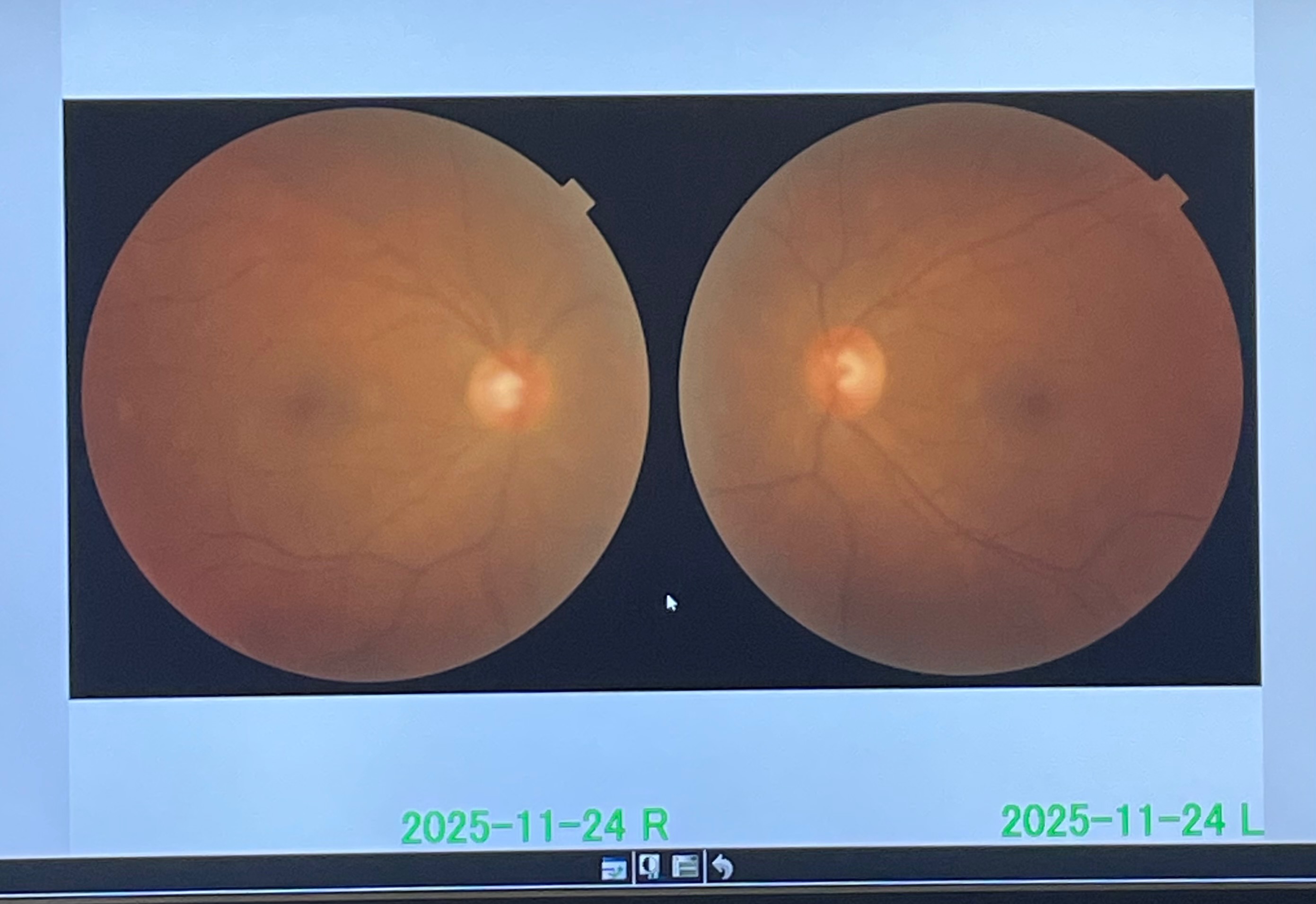
So at the end of February, I saw Dr. Crowder. His office ran several tests for various types of vision dysfunction, and did imaging of my eyeballs, including photographs of my retina, topography of my eye, and an ultrasound of my optic nerve. Dr. Crowder gave me a very thorough eye exam. He told me that he could not see any cataracts, that my vitreous fluid was clear, that I did not have glaucoma, macular degeneration, eye tumors, or retina detachment, and that my optic nerve was not inflamed.
At this point, I asked him if he thought this could be a neurological issue and he said he did not believe so. He diagnosed me with monocular diplopia (double vision in each eye) which he believed was caused by what he called an "irregular astigmatism". This theory was based on the topographical imaging of my eyeballs, which showed that they were distended diagonally and in opposing directions to each other. Dr. Crowder referred me to Dr. Ellison, an optometrist within the same practice who had a lot of experience with strange astigmatisms.
I had to wait about a month to get in with Dr. Ellison. which brings us to mid March, 2025. At this point even close up items were doubled, and reading was becoming an intense struggle. I had to quit working because I could no longer see what I was doing, and trying to force my eyes to cooperate was giving me intense headaches. Dr. Ellison gave me another eye exam, and then she placed a pair of non prescription rigid contact lenses in my eyes. If the "irregular astigmatism" theory had been correct, these lenses would ave corrected my double vision by forcing the shape of my eyeball back into roundness. Unfortunately, they didn't help. not even a little bit. Dr. Ellison did conclude that although the rigid lenses hadn't fixed the whole problem, the prescription in the glasses I was wearing at that time (prescribed by Dr Ingram in August 2024) was definitely, dramatically, incorrect. She wrote me a new prescription an ordered me a set of glasses with "correct" lenses. She thought me double vision might just be caused by the eye strain of wearing an incredibly incorrect prescription for so long, and told me to wear the new glasses for four to six weeks and see if my vision improved.
During this six week period, I took it upon myself to get my doctor to order a full blood workup. Every eye doctor I had seen thus far had asked me if I was diabetic, insulin resistant, or had thyroid disease. I didn't think I was, but it had been several years since I had gotten a panel done, so I thought I'd check. All my blood work came back very, very normal.
Six weeks later, in May, 2025, I could no longer perceive the texture of the ground from a standing height, or read text on a screen, unless the size of the font had been turned up to 200%. My double vision had become triple vision, and I was experiencing intermittent visual snow- a symptom which can be caused by eye fatigue, but can also be a symptom of a neurological issue. At this point, I was quietly starting to panic. I felt like to only options left to be explored were the worst case scenarios- brain tumor, pituitary adeonoma, Multiple sclerosis...
Because the glasses she had prescribed to me did not improve my vision, Dr. Ellison referred me back to Dr. Crowder. He ran all the tests again, with the same results. Finally he wrote me a referral to an MRI clinic to get imaging of my brain and orbits. Fortunately, those MRIs came back completely clean of any irregularities. Now having ruled out a neurological issue like MS or a brain tumor, Dr. Crowder referred me to a cornea specialist.
I'd like to take a moment here to point out that each one of these office visits cost in the neighborhood of $200, plus the additional costs of any extra testing or imaging they needed. All of them required payment up front. The blood panel from my GP was $385. The MRIs were an additional $1300.
It was at this point that I contacted the Social Security Administration here in North Carolina to see if there was some kind of temporary disability or assistance that I could receive. I had been out of work for months, and bills were starting to stack up, with no end in sight. They told me no- without an official diagnosis and a prognosis of disability lasting at least a year I could not even apply for any kind of assistance. The lady I spoke to at the Social Security office was really understanding, but also very realistic. She stressed that applying for disability in North Carolina due to visual impairment was a long and fraught process that usually necessitated a lawyer. She also told me that if I tried to apply for disability because I was unable to drive, that the state of North Carolina would revoke my drivers license and that I would absolutely HAVE to hire a lawyer in order to get it back, if/when my vision issue got resolved. She strongly advised me to leave that as a court of last resort.
I first saw the cornea specialist, Dr. Dholockia, in June 2025. She took additional topography of the surface of my eye and diagnosed me with a condition called cornea keratoconus. This condition is caused when the layers of collagen in your cornea breakdown as time goes by causing the cornea to sag and bulge across the surface. She explained that this is a condition I have likely had since my teens, but my only symptom was the severity of my astigmatism and the rapid rate at which my prescription changed from year to year. Unfortunately, she informed me that Keratoconus was not the cause of my triple vision, but it was something that should be monitored as time went on, and would eventually need to be addressed.
Dr. Dholockia was extremely interested in my case. She was the first doctor I saw who sat down and listened to the entire story from start to finish. She was, in her own words, "baffled" that I hadn't been referred to a retina specialist or a neuro-opthamologist. She immediately wrote both referrals, but she did warn me that it would probably be a long wait for neuro-opthamology and that I might have to travel to Atlanta for it.
At this point I was so desperate and exhausted I would have gone pretty much anywhere if I thought they could fix my eyes. I was trying very hard to put a good face on things for my family, but as the months were dragging on, and my vision continued to get worse and worse, and I kept having to give up more and more things that I loved to do, I was starting to crash out. My anxiety was out of control, and it was starting to affect my relationships in a major way, particularity with my husband.
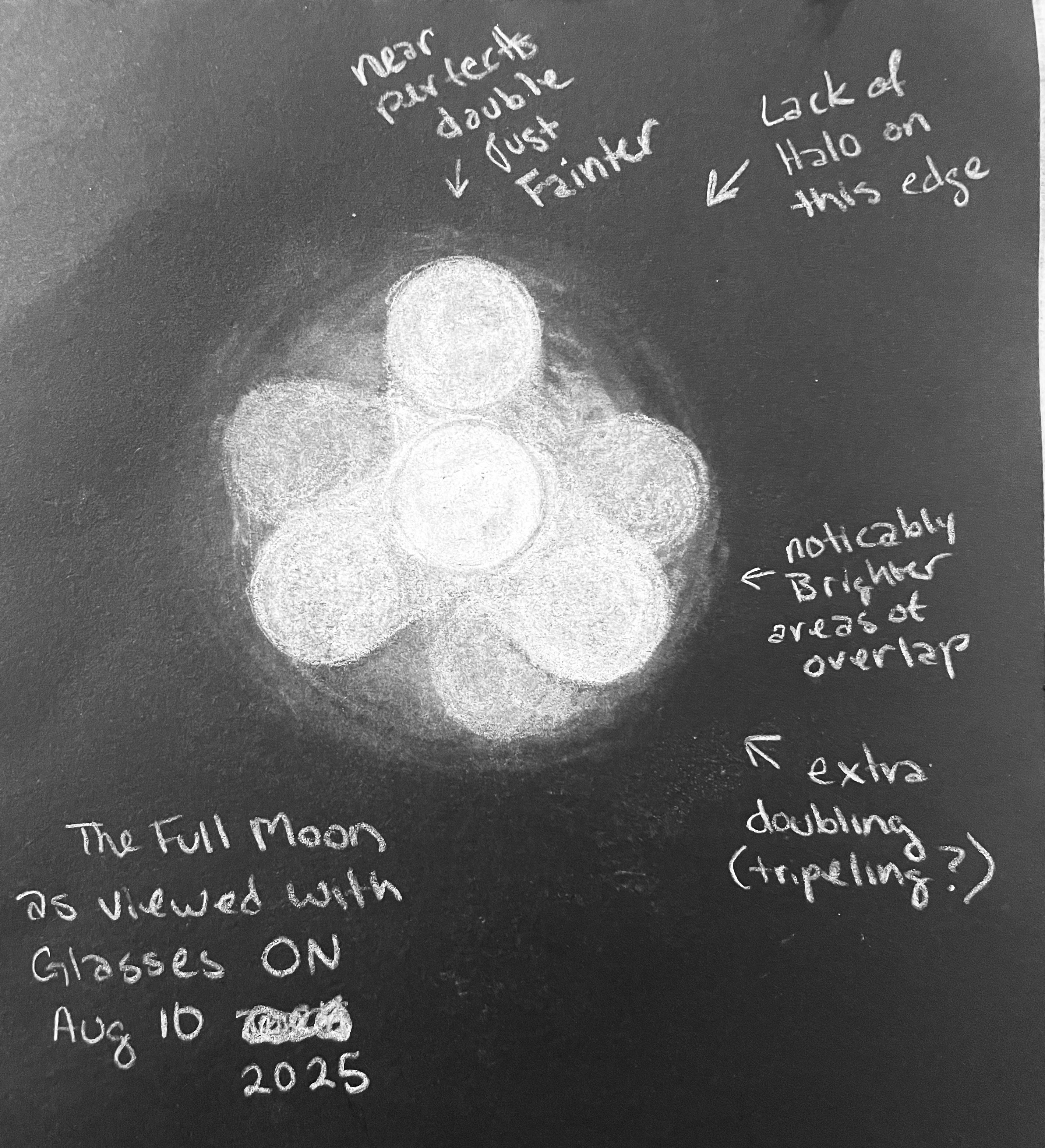
My appointment with the retina specialist, Dr Thomas, was scheduled for mid August, almost exactly a year to the day I had first pulled over on the side of the road to take my contact lenses out. In the days leading up to the appointment, I was trying to talk through what my vision was like with my husband- trying to explain what I was perceiving in a way that was understandable to someone else. Every time I had seen a doctor, I had found myself wondering if I had conveyed what my vision was doing adequately- how solid objects seemed to be tripled in space, how points of light appeared as blown out rings, how text on the screen ran together in shadowy blobs.
It was at this time that my husband reminded me that I was, in fact, a trained artist. "Why don't you just draw something how you are seeing it?" he said. This was easier said than done, because everything there was too look at was so blurred together. Fortunately, the very next night, a beautiful full moon was hanging in the sky. It ended up being an ideal subject. I have included the picture I drew of the moon that night in the pictures above. When I showed my husband and my mother in law, they were both speechless. They couldn't believe I was just walking around with every single item looking that way.
In mid August I saw Dr. Thomas, the retina specialist. As has become routine, I gave him a quick rundown of the entire story. I also pulled out the drawing I had made of the moon. Dr. Thomas looked into my eyes for all of five seconds and said "Ma'am you have cataracts."
To which I replied "Um... No I don't".
And he said "Yes you do, I'm looking at them."
I said "How can this be? I didn't have cataracts three weeks ago?????"
So then Dr. Thomas sat down and told me an incredible story, while holding the picture I had drawn of the moon in his hands.
He explained that the type of cataracts I had were unusual. They weren't associated with age, but were generally caused by illness or injury. They formed fast, usually in seven to ten months, and rather than forming like a cloudy film over the surface of the lens of they eye, they formed like sugar crystals on the back of the lens. Most importantly, this type of cataract is imperceptible to an eye exam until they are almost fully formed, but they affect your vision from the very beginning.
for the record, I do not have, nor have I experienced, any of the usual precursors or comorbidities that would have made this type of cataract a likely diagnosis. I am not diabetic, I do not have thyroid disease, I have never experienced a traumatic injury to my eyes. I have never been exposed to a high dose of radiation or worked in a field that would have caused me to be exposed to radiation for a prolongs period of time.
When I asked him how he knew so much about this (after all he is a retina specialist, not a cataract surgeon) he laughed and held up the picture I had drawn of the moon.
"I had the same type of cataracts." he explained, "and I had no idea what they were, or what was wrong with my vision. I was standing in my yard with my wife looking at the moon, and it looked EXACTLY like this drawing."
A week after I saw Dr. Thomas, I went back to Dr. Dholockia. She confirmed the cataracts, as they were now fully visible. She also double checked and confirmed the keratoconus diagnosis. She told me she was going to speak with her colleague, Dr Seagle, about collagen crosslinking and whether or not we should do it before or after cataract surgery.
A few weeks later Dr. Seagle's office called me and said that he and Dr Dholockia felt that I did need the collagen crosslinking before the cataract surgery and explained the reasoning that I outlined above. It was at that time I was informed of the expected cost, and I applied for financial assistance. That was in mid September, and my application is still "pending review" according to their website. Meanwhile my vision is worsening daily. Its illogical, but some part of me expected it to slow down or stop once I had a diagnosis? Instead, along with the triple vision that has never resolved, I am now experiencing more of the tradition symptoms of cataracts- rainbow aura halos around lights, extreme photo sensitivity, and a dingy yellow color distortion. Its like living with the world's worst instagram filter applied over everything all the time.
If you have read this entire saga, thank you from the bottom of my heart. I know its a lot of information.
It hasn't been easy for me to ask others for help, especially when it seems like everyone is struggling. If you don't have the ability to donate, I understand, but if you would please be so kind as to share this account I would be deeply grateful.