
- D
- C
Halifax Vegan Billboards 2016
Help us put informative and thought-provoking vegan billboards in Halifax, Nova Scotia!
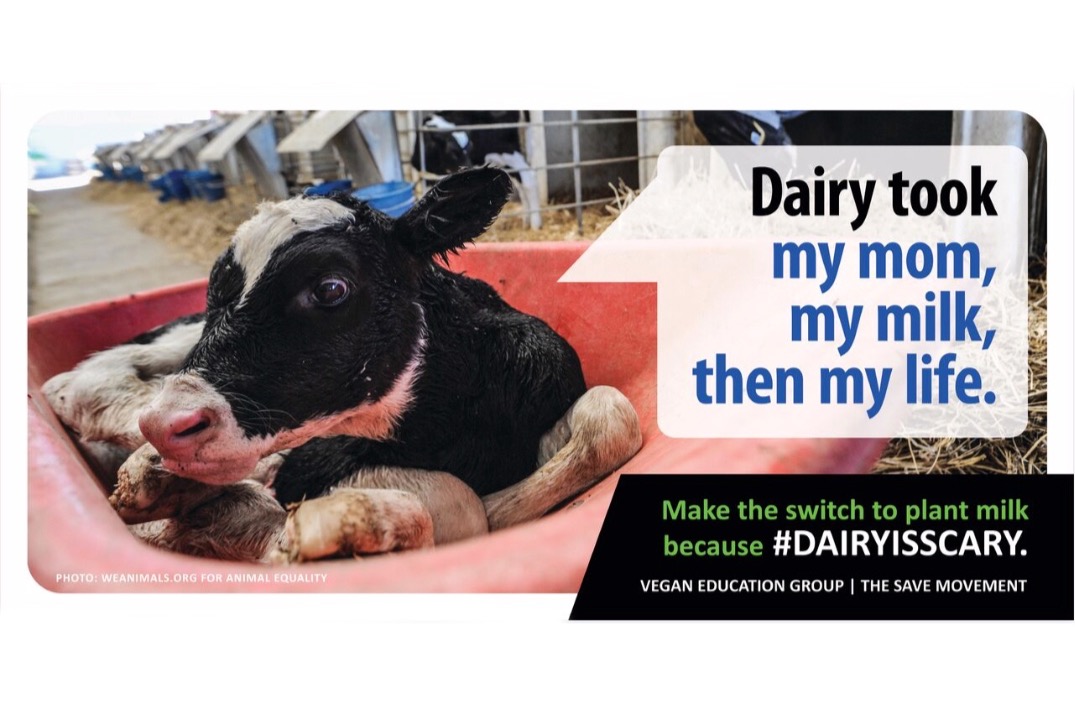
The majority of people are not aware of what happens to dairy cows and calves to produce dairy milk. We want to change that.
We believe that change comes with awareness. We believe that people deserve to know what happens to cows and calves on dairy farms and at slaughterhouses. Millions of mothers and their calves suffer and die so people can consume dairy. We want to get the message out to the people of Nova Scotia that dairy is not the kind choice.
In 2017, Vegan Education Group teamed up with The Save Movement to bring the ‘Why Love One But Eat the Other’ campaign to Nova Scotia. The campaign featured a billboard at a busy location and three posters at the three Halifax ferry terminals. This campaign successfully sparked conversations and media attention while educating the public and raising the awareness.
This time we will raise awareness about dairy cows and their babies and encourage people to consider veganism.
We have a generous supporter who has agreed to match every dollar contributed up to $4300! How amazing is that?! By contributing to this campaign, you will help launch the campaign and bring awareness to ethical food choices, which will lead to a better place for animals. Every dollar that you donate counts. The more money we fundraise, the more billboards we can purchase.
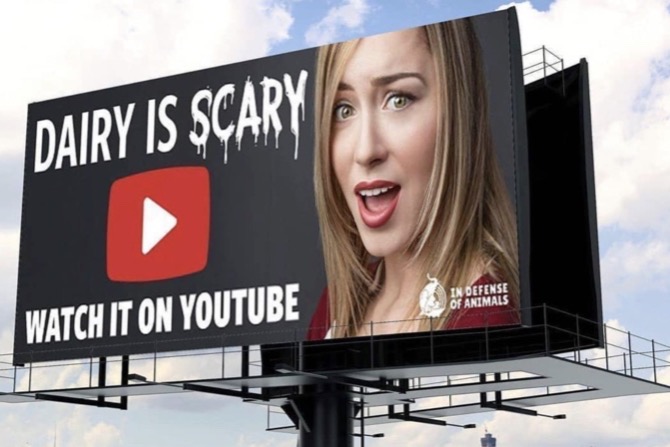
Our plan is to purchase a total of 4 billboards in 2019. The first two billboards, with a message “Dairy is Scary”, which will go up in the Spring 2019. The second set of 2 billboards will be booked for the Fall and they will also raise awareness about animals used for food and to promote veganism.
“Dairy is Scary” video, by Canadian activist and journalist Erin Janus, has reached over 5 million views on YouTube. The video explains the dairy industry in 5 minutes. “Dairy is Scary” billboards have already been launched in Los Angeles CA and Burlington ON in 2018. Let’s make it happen in Halifax!
We will use funds to launch the billboards and to pay for campaign advertising.
We are a volunteer-based organization and all proceeds will go towards the 2019 billboard campaign in Halifax.
INFORMATION
Dairy Cows
Dairy cows are sensitive, social beings who deserve to be treated with kindness and respect. They are gentle, sensitive, peaceful beings who love one another, who love their babies, and who want to live, just like you and I.
I wish I knew earlier about dairy
Just like humans, cows need to be pregnant in order to produce milk. This means that cows on dairy farms are kept in a constant cycle of impregnation and birthing. Their babies are taken away from them the day that they are born either to be raised as future dairy cows or as veal (if they are male). Cows are highly maternal, and have been known to bellow for days after the removal of their calf. Veal calves are immobilized either with the use of crates or chains and are slaughtered at 1-18 weeks of age.
Mother dairy cows are typically kept inside vast manure-filled, concrete-floored sheds with little or no access to the outdoors. They often suffer from foot infections due to this unnatural environment, as well as, other health conditions such as mastitis, a painful inflammation of the udders. Due to these deplorable conditions, these cows, who naturally could live to as old as 25 years are usually “spent” by the age of 4 or 5 when their milk production declines. They are then sent to slaughter, even while pregnant and full term, as cheap hamburger meat. Dairy cows experience such abuse that 40% of them will experience some degree of lameness by the time they reach the slaughterhouse and some.
Toronto Cow Save witnessed young dairy cows with oversized udders being transported to “St. Helen’s” slaughterhouse. Their eyes were wide and some were foaming at the mouth—both signs of stress.
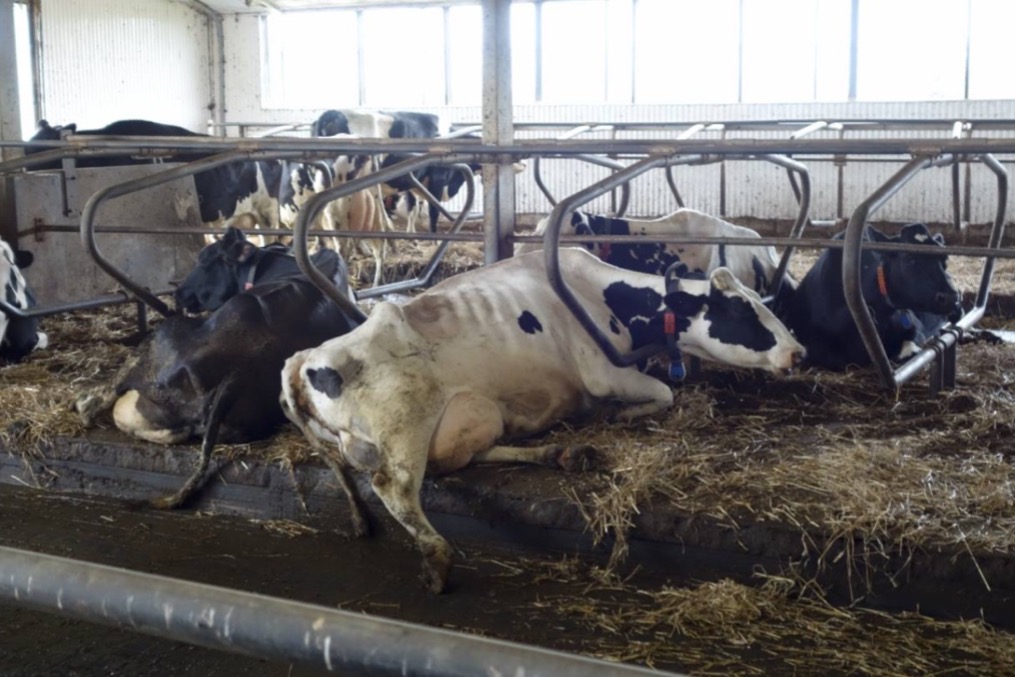
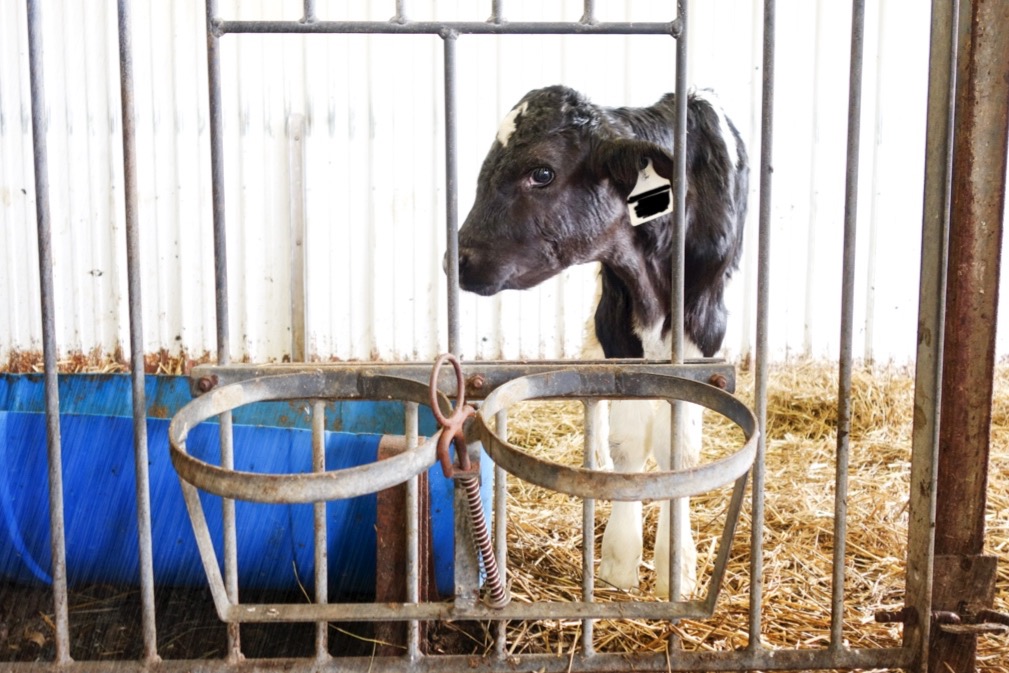 Photos taken on a dairy farm in Nova Scotia. September 2017.
 Routine mutilation
Canadian cows are routinely subjected to agonizing, body mutilating procedures as part of routine farming practice – all of which are undertaken without any pain relief. Males, not selected for breeding, are castrated without painkillers. The scrotum is cut with a scalpel or knife and the testicles removed. This is an excruciatingly painful surgical procedure, which can only be accomplished in a “squeeze chute”, where the animal is trapped and cannot move. In cow breeds with horns, both males and females have their horns burnt or cut off without any pain relief. Finally, in certain provinces, cows are branded using either red hot or freezing metal, with the resulting scar tissue leaving permanent identifying marks on their bodies. No anaesthetic or analgesia is provided.
Transport
Canada’s outdated and inadequate animal transport regulations allow cows and calves to be transported for up to 52 hours continuously with no food, water or rest. There is no requirement for animal transporters to have any training on how to handle animals humanely or to drive safely with them on board.
Cows and calves are terrified when loaded on the trucks. To make them move cows and calves are shocked with electric prods, and often punched and kicked. Electric prods deliver a painful jolt of electricity. Federal slaughterhouse regulations only prohibit using electric prods on the anal, genital, or facial regions of animals. In practice, electric prods are being used to force movement in animals who are too sick or injured to even stand. In some cases, the tool is being provided by government inspectors.
Harsh Canadian climate exposes cows and calves in open-sided transport trucks to freezing, wet winters and intolerably humid summers. In practice, animals are transported every day of the year in all weather extremes with virtually no protection from the elements.
Five hundred cows are found dead on arrival at federally inspected Canadian slaughterhouses each year and 8 thousand are “condemned” due to being too injured or diseased to enter the human food chain (these stats do not include provincially inspected slaughterhouses). Minimal legal requirements not to transport animals with significant illness or injury – such as amputation, uterine or rectal prolapse, hernias so large they drag on the ground or impede walking or animals unable to move at all – continue to be flouted and transgressors are subject to paltry fines when caught.
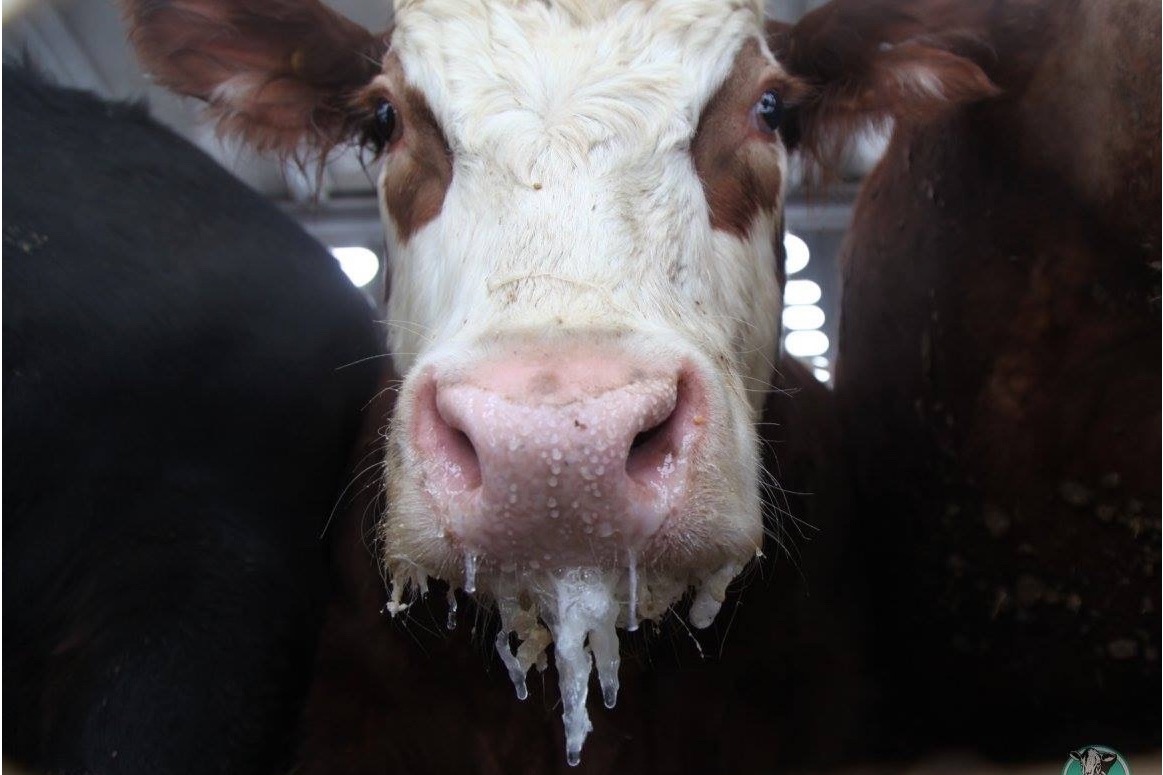 Cow on the transport truck in front of the slaughterhouse. Her saliva is frozen. Photo Credit: Louise Jorgensen, Toronto Cow Save. March 2017.
Slaughter
At the slaughterhouse, dairy cows are forced through a chute that starts out wide and narrows. The terrified animals are forced to move by administering painful shocks with electric prodders.The chute leads to a “knock box”, where a “stun gun” is used to drive a captive-bolt cartridge into the brain, while leaving the brainstem intact so that the heart will continue to pump blood and the cow will bleed out faster. When used properly, this causes the animal to spasm uncontrollably and then collapse into a state where they are believed to be unable to feel pain. However, stunning is frequently unsuccessful due to the terrified animals thrashing around, making it difficult to administer the shot. Slaughterhouses are considered to have an “acceptable” number of captive bolt failures if 95% of cows are not stunned during the first stunning attempt. This would mean that, under ideal conditions, 150,000 of the 3 million cows and calves slaughtered in Canada each year, would not be successfully stunned. Even those that are stunned may regain some degree of consciousness before they are “bled out” by having their throats slit.
In Halal and Kosher slaughter, animals are not stunned before being slaughtered, according to contentious religious tenets. Consider how tough it is to cut through a piece of steak. Now imagine how much strength it takes to slit the throat of a fully conscious steer, with the animal enduring the pain from every determined thrust of the blade. To add to this, the esophagus may be pulled out to prevent blood gushing into their stomachs (though this is illegal). Much of the flesh from animals that are slaughtered according to Halal and Kosher requirements ends up being sold to the general public without being labelled as ritually slaughtered. This is because religious laws stipulate that only certain body parts are allowed to be eaten, so the remainder of the animal is sold to other consumers. The bodies of animals deemed to have not met certain aspects of ritual slaughter requirements are also redirected into general food production.The high speed at which modern slaughterhouses operate means that some cows end up being skinned alive, as they have not yet finished “bleeding out” when they reach the next stage of the meat production process.
Over 27 million adult cows and 263,480 calves were slaughtered in Canada in 2013. Approximately 80% of the calves slaughtered were male.There are over 12-million cows on Canadian farms, including almost 1.5-million dairy cows.
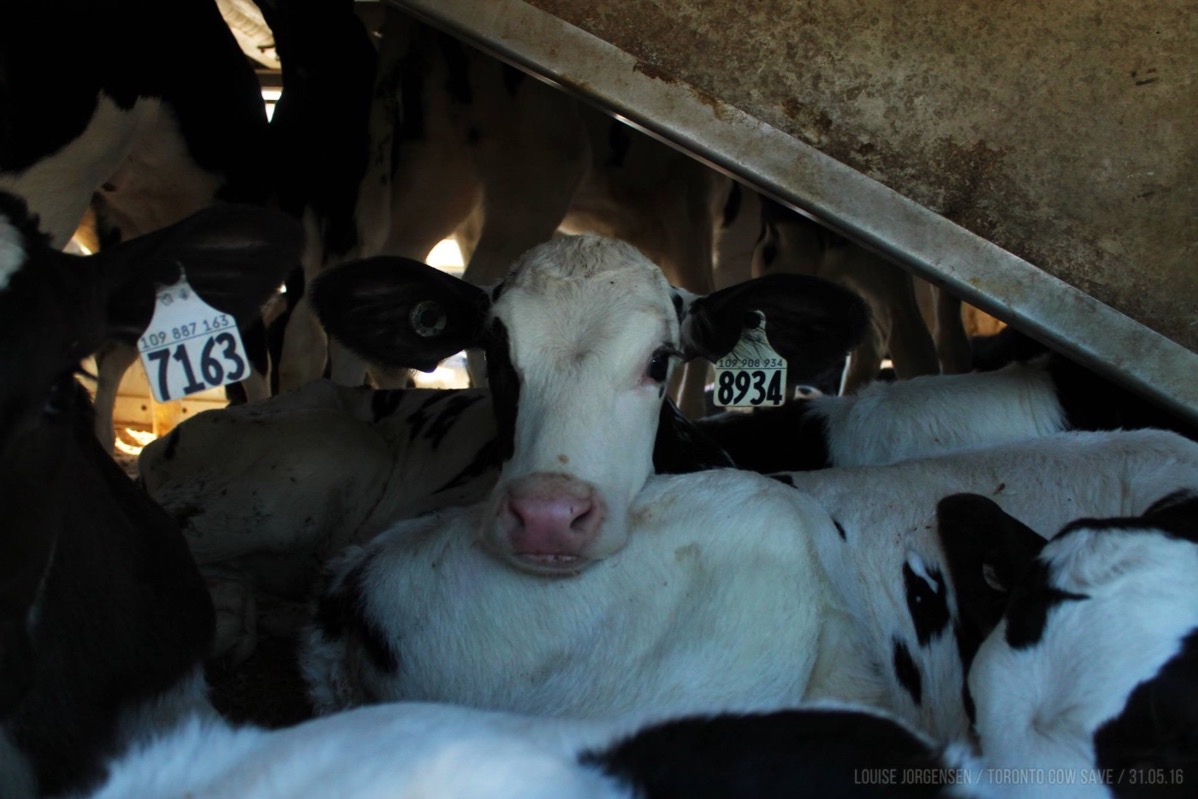 Young calves on the transport track in front of the slaughterhouse.
 Photo Credit: Louise Jorgensen, Toronto Cow Save. May 2016.
ABOUT US
The Save Movement is comprised of groups around the world who bear witness of pigs, cows, chickens and other farmed animals en route to slaughter. Their goals are to raise awareness about the plight of farmed animals, to help people become vegan, and to build a mass-based, grassroots animal justice movement. The Save Movement started in December 2010 with the inception of Toronto Pig Save. Today there are over 560 groups in Canada, the U.S., U.K. & Ireland, Australia, continental Europe, Hong Kong, South Asia, East Asia, South Africa, Mexico and Central/South America.
Vegan Education Group is a volunteer based, registered Non-Profit Society (2016) in Halifax, Nova Scotia. The mission of VEG is to raise awareness about the use of animals for food, clothing, entertainment, or any other purpose; about related health and environmental issues; and provide information to help people become vegan through educational, positive, and peaceful events and campaigns.