- K
- L
- N
Ghana Ventilators Project
0% complete
$2,990 raised of $5K
41 donations
While I was looking at my University of Dayton email, I saw that Ghana only has 67 ventilators. Fred McBagonluri is currently working to get more ventilators for Ghana. I got a chance to speak with him and he needs help to go through the approval process to raise the number of ventilators in Ghana. My hope is to raise $5,000 to help him in his mission. Please give what you can. I will keep you all updated with my youtube channel and through this gofundme. We also will accept donations and art to help spread the word. Thank you for your generosity.
Below is the write up of the low cost ventilator (different from the windshield wiper motor ventilator)...
Background
On the 12th March 2020 the World Health Organisation (WHO) officially declared COVID-19, the infectious disease caused by the new Corona Virus as a global pandemic [1]. This new Corona Virus which was originally discovered in Wuhan in China in December 2019, has now spread to over 170 countries on all continents, infecting approximately 678,000 people and killing over 31,000 [2].
In most people COVID-19 manifests into mild flu-like symptoms with occasional difficulty in breathing. For a minority (mostly aged or with underlining pre-existing medical conditions) this disease can prove to be severe and even fatal. This happens when the infection attacks the respiratory organ system, causing breathing difficulties brought on by pneumonia and eventually leading to organ failure.
As the disease continues to spread into the hundreds of thousands, health facilities all over the world are overwhelmed with providing adequate equipment such as ventilators to assist those that require breathing support. Current ventilators are costly and in high demand. This urgent need for more ventilators has led to innovators and researchers all over the world looking to design low cost ventilators which can be rapidly manufactured and delivered to medical facilities in the shortest possible time. Institutions such as Oxford University and MIT have designed their own versions of low cost ventilators using open source software and available off-the-shelf materials which are currently in testing [3,4].
On the same day WHO declared COVID-19 as a global pandemic, Ghana confirmed its first two cases of the disease. In just about 2 weeks this number has significantly increased to 141 confirmed cases with 5 fatalities [5]. If the trend observed in Ghana follows the trends observed in the West, the need for additional ventilators due to the predicted increase in infections over the next couple of weeks will put the nation on its knees due to the limited capabilities of the national health care infrastructure. All over sub-Saharan Africa a similar trend is being observed with the same potential problem being anticipated.
As a result of this prediction, there needs to be a conscious and concerted effort for Ghana and Africa as a whole to come up with its own version of low cost ventilators which is suited to its particular terrain, using off-the-shelf and locally available materials. The Low Cost Ventilator for Africa Project (LOCOVENT4AFRICA) looks to do just that.
Project Aim
The aim of the LOCOVENT4AFRICA project is to design and rapidly prototype a low cost ventilator using locally available and off-the-shelf materials in developing countries such as Ghana to assist healthcare professionals in treating patients of the COVID-19 pandemic. The working prototype will then be tested in consultation with healthcare practitioners to validate and certify it for mass production.
Design Specification
The low cost ventilator will be required to meet the following minimum design specifications:
Deliver a constant tidal volume to the lungs at 4 second intervals.
Re-inflate collapsed alveoli (lung cavity).
Maintain positive end expiratory pressure in the lungs.
Use local sourced materials.
Other design specifications as required by the Ghana National Health Service will be included.
Design Concept
For the LOCOVENT preliminary design concept, the following components were identified as critical to the first prototype:
Cam and Shaft Assembly,
Bellow Assembly,
Patient Breathing Circuit,
Interconnecting Tubes,
One-way Valves,
Humidifier /Inspiratory PEEP Assembly,
Expiratory PEEP Assembly,
Expiratory Scrubber.
The LOCOVENT preliminary design concept is shown in Figure 1.
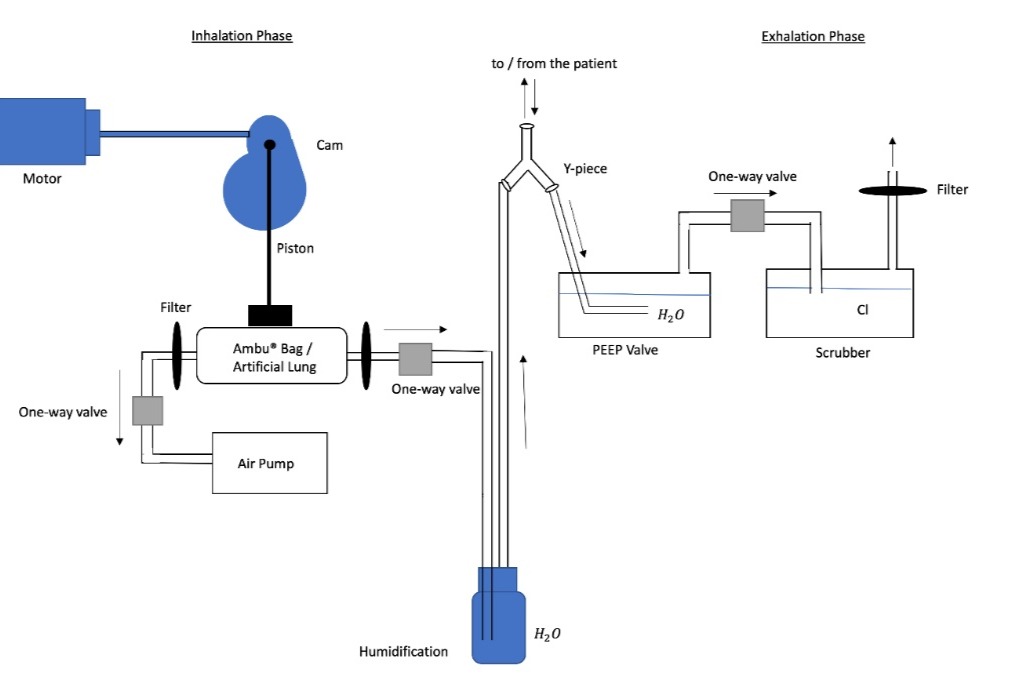
The principle in operation of the LOCOVENT4AFRICA prototype is summarised below:
● The control system performs supervision and actuation of the two mechanical passive valves.
● The cam and shaft controls the timing and delivery of the air tidal volume from the bellows supplied to the patient in the inspiration and expiratory phase of the respiratory cycle.
● The humidifier adds moisture to the supplied air to soften its texture. It also provides 30m Bar pressure to maintain a positive respiratory pressure.
● The one-way valves allow the inspiratory air in only one direction through the “Y” piece towards the patient to end the inspiratory phase of the respiratory cycle.
● At the expiratory phase of the expiratory cycle, the PEEP valve assembly provides 5m Bar to maintain positive respiratory pressure. This prevents the alveoli from collapsing.
● The scrubber assembly disinfects the expired air before being exhausted into the environment.
Estimated Investment Cost to Production
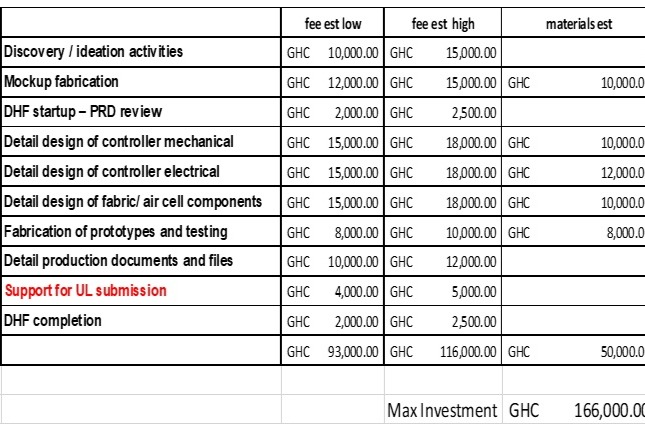
Although the LOCOVENT4AFRICA project is in its infant stages, an estimated investment cost for taking the design through to production has been included for consideration, see Table 1. This estimated cost will be constantly reviewed as the design evolves. It is anticipated that the unit cost of the final manufactured product should be in the range of $600-$900 for a specific production run.
Table 1: Estimated investment cost for taking the LOCOVENT4AFRICA prototype to production.
Reference: 1 GHC = .17 USD
Next Steps
The LOCOVENT4AFRICA team is looking to seek permission from the Ghana Government to exempt them from the current movement restrictions to enable the team complete the design concept and rapidly prototype the solution for testing. This is critical to saving lives and it is anticipated that new materials which have been identified for use in the production may pave way for future patents for the nation.
Below is the write up of the low cost ventilator (different from the windshield wiper motor ventilator)...
Background
On the 12th March 2020 the World Health Organisation (WHO) officially declared COVID-19, the infectious disease caused by the new Corona Virus as a global pandemic [1]. This new Corona Virus which was originally discovered in Wuhan in China in December 2019, has now spread to over 170 countries on all continents, infecting approximately 678,000 people and killing over 31,000 [2].
In most people COVID-19 manifests into mild flu-like symptoms with occasional difficulty in breathing. For a minority (mostly aged or with underlining pre-existing medical conditions) this disease can prove to be severe and even fatal. This happens when the infection attacks the respiratory organ system, causing breathing difficulties brought on by pneumonia and eventually leading to organ failure.
As the disease continues to spread into the hundreds of thousands, health facilities all over the world are overwhelmed with providing adequate equipment such as ventilators to assist those that require breathing support. Current ventilators are costly and in high demand. This urgent need for more ventilators has led to innovators and researchers all over the world looking to design low cost ventilators which can be rapidly manufactured and delivered to medical facilities in the shortest possible time. Institutions such as Oxford University and MIT have designed their own versions of low cost ventilators using open source software and available off-the-shelf materials which are currently in testing [3,4].
On the same day WHO declared COVID-19 as a global pandemic, Ghana confirmed its first two cases of the disease. In just about 2 weeks this number has significantly increased to 141 confirmed cases with 5 fatalities [5]. If the trend observed in Ghana follows the trends observed in the West, the need for additional ventilators due to the predicted increase in infections over the next couple of weeks will put the nation on its knees due to the limited capabilities of the national health care infrastructure. All over sub-Saharan Africa a similar trend is being observed with the same potential problem being anticipated.
As a result of this prediction, there needs to be a conscious and concerted effort for Ghana and Africa as a whole to come up with its own version of low cost ventilators which is suited to its particular terrain, using off-the-shelf and locally available materials. The Low Cost Ventilator for Africa Project (LOCOVENT4AFRICA) looks to do just that.
Project Aim
The aim of the LOCOVENT4AFRICA project is to design and rapidly prototype a low cost ventilator using locally available and off-the-shelf materials in developing countries such as Ghana to assist healthcare professionals in treating patients of the COVID-19 pandemic. The working prototype will then be tested in consultation with healthcare practitioners to validate and certify it for mass production.
Design Specification
The low cost ventilator will be required to meet the following minimum design specifications:
Deliver a constant tidal volume to the lungs at 4 second intervals.
Re-inflate collapsed alveoli (lung cavity).
Maintain positive end expiratory pressure in the lungs.
Use local sourced materials.
Other design specifications as required by the Ghana National Health Service will be included.
Design Concept
For the LOCOVENT preliminary design concept, the following components were identified as critical to the first prototype:
Cam and Shaft Assembly,
Bellow Assembly,
Patient Breathing Circuit,
Interconnecting Tubes,
One-way Valves,
Humidifier /Inspiratory PEEP Assembly,
Expiratory PEEP Assembly,
Expiratory Scrubber.
The LOCOVENT preliminary design concept is shown in Figure 1.
The principle in operation of the LOCOVENT4AFRICA prototype is summarised below:
● The control system performs supervision and actuation of the two mechanical passive valves.
● The cam and shaft controls the timing and delivery of the air tidal volume from the bellows supplied to the patient in the inspiration and expiratory phase of the respiratory cycle.
● The humidifier adds moisture to the supplied air to soften its texture. It also provides 30m Bar pressure to maintain a positive respiratory pressure.
● The one-way valves allow the inspiratory air in only one direction through the “Y” piece towards the patient to end the inspiratory phase of the respiratory cycle.
● At the expiratory phase of the expiratory cycle, the PEEP valve assembly provides 5m Bar to maintain positive respiratory pressure. This prevents the alveoli from collapsing.
● The scrubber assembly disinfects the expired air before being exhausted into the environment.
Estimated Investment Cost to Production
Although the LOCOVENT4AFRICA project is in its infant stages, an estimated investment cost for taking the design through to production has been included for consideration, see Table 1. This estimated cost will be constantly reviewed as the design evolves. It is anticipated that the unit cost of the final manufactured product should be in the range of $600-$900 for a specific production run.
Table 1: Estimated investment cost for taking the LOCOVENT4AFRICA prototype to production.
Reference: 1 GHC = .17 USD
Next Steps
The LOCOVENT4AFRICA team is looking to seek permission from the Ghana Government to exempt them from the current movement restrictions to enable the team complete the design concept and rapidly prototype the solution for testing. This is critical to saving lives and it is anticipated that new materials which have been identified for use in the production may pave way for future patents for the nation.