- K
- C
- L
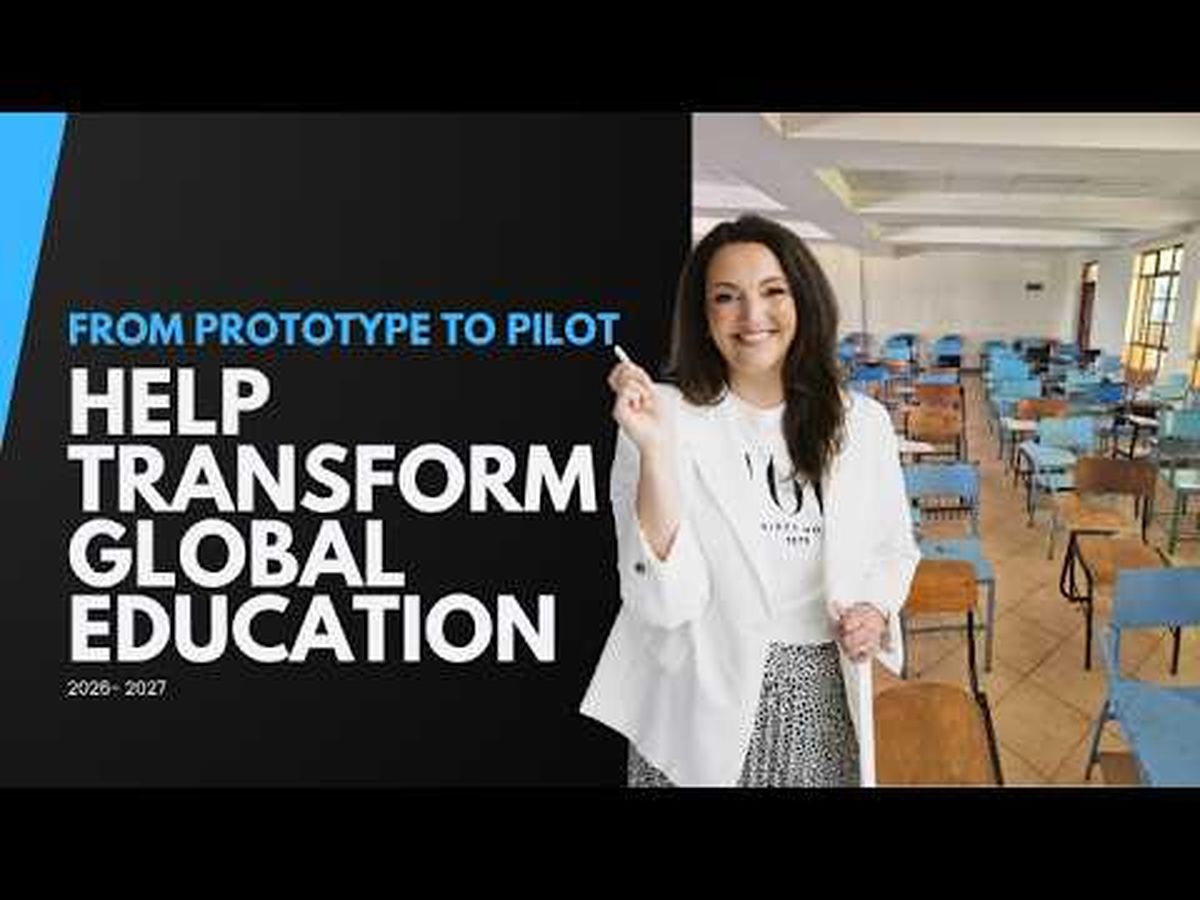
From Protype to Pilot: Help Transform Global Education
0% complete
$3,837 raised of $85K CAD
26 donations
BE PART OF REWRITING THE FUTURE OF EDUCATION, IN REAL TIME
What if education did more than prepare young people to succeed in the world as it exists? What if it helped them discover their ability to shape what the world becomes?
Imagine classrooms where young people don't just learn about creativity, communication, collaboration, critical thinking, and problem-solving. They actually practice them. Every day.
Where teachers are empowered to facilitate discovery rather than simply deliver content. Where artificial intelligence supports educators while protecting and nurturing the creativity of learners.
And where education leaders can finally see whether the competencies promised in policy are being developed through everyday learning.
This is the future we're working toward. And we're inviting you to help build it.
FROM CANADA TO KENYA: LOOK WHAT YOU HELPED MAKE POSSIBLE
For years, The YOU Power Project™ has been developing experiential and entrepreneurial learning opportunities for young people in Canada.
We've worked with approximately 1,000 students, learning what happens when young people are given meaningful opportunities to turn knowledge into action.
That experience inspired us to develop CAP2™: Capacity to Contribute, a technology-enabled ecosystem layer designed to work alongside existing curricula, support teachers with practical social entrepreneurship learning enhancements, and make competency development more visible.
In September 2026, our work took us to Kenya, where educators and education leaders are already advancing an ambitious transition toward competency-based education.
Our first chapter of this fundraiser brought together 26 donations totalling $3,837. Those supporters helped us prepare for an extraordinary opportunity.
In Kenya, we spoke with education stakeholders, demonstrated our technology, visited schools and communities, and met with leaders and organizations exploring the future of learning.
We came home with encouraging feedback, important relationships, and a much clearer understanding of what needs to happen next.
Now, our first school in Mathare has signed on to participate in the pilot, and we're in conversations with other NGO-supported schools, including a potential pilot opportunity connected to Kakuma Refugee Camp in northwestern Kenya.
These are communities of educators and young people with their own ideas, ambitions, expertise, and visions for what education can become.
Our role is to build alongside them.
WHY WE'RE NOT WAITING
We've had extremely encouraging conversations with prospective large-scale foundation and catalytic funding partners. Those relationships represent meaningful possibilities for the future. But major institutional funding processes take time.
There's something we can do in the meantime that makes those conversations stronger: We can generate real evidence, in real classrooms, with the people this work is designed to serve.
We can work with teachers to develop practical training modules that fit their classrooms.
We can continue adapting CAP2 for environments where devices and connectivity may be limited.
We can understand how teachers adopt the approach, what students experience, what needs to change, and what it actually costs to implement well.
Instead of waiting for the larger funding to begin learning, we're inviting our community to help us begin responsibly now.
The evidence we generate can strengthen future funding proposals and inform decisions about whether, where, and how CAP2 should scale.
This is our bridge from prototype to pilot, and from promising conversations to credible evidence.
YOUR SUPPORT UNLOCKS THE NEXT STAGE
We are building this pilot in stages, so that every contribution moves the work forward, and additional funding unlocks deeper implementation.
Our priority is to invest first in the technology, teacher training, and contextual preparation that participating schools need. From there, we can activate virtual delivery, in-person training, and a more comprehensive evidence pilot as resources allow.
Stage 1: Foundational Development
Cumulative funding milestone: $25,000+ CAD
What your support makes possible: Continue enhancing CAP2 for low-to-no-connectivity environments, co-develop practical teacher training modules with participating schools, and strengthen essential data protection and pilot readiness.
Stage 2: Virtual Implementation
$60,000+ CAD
Build on the foundational work to support virtual teacher training, school onboarding, local coordination, classroom implementation, and evidence collection, subject to school readiness.
Stage 3: In-Person Pilot Activation
$85,000+ CAD
Add in-person launch training in Kenya, strengthen coaching and implementation support, and pursue a more comprehensive five-to-six-month evidence pilot.
These are cumulative milestones, not separate fundraising goals. Reaching $60,000 means we have raised $60,000 in total, not $25,000 plus another $60,000.
We are also pursuing in-kind partnerships for devices, cloud services, connectivity, and other infrastructure. Confirmed contributions of these resources may reduce the cash required to activate a stage.
Our goal is a sustained six-month evidence pilot, rather than a brief demonstration that measures initial excitement without showing what happens over time. We want to learn what works, what doesn't, what teachers actually use, and how CAP2 can improve through their experience.
WHAT IF WE DON'T REACH OUR GOAL?
We will continue investing funds raised in the foundational CAP2 development, contextualized teacher training, and pilot-readiness work described above.
If we cannot fund in-person training, we can pursue a virtual implementation pathway. If we cannot responsibly activate classroom implementation, we will continue the development and preparation work and communicate any resulting changes to the pilot timeline.
Contributions are not conditional on reaching a particular milestone, and we will not offer discretionary refunds simply because the fundraising goal is not reached. Applicable GoFundMe refund protections and legal rights remain in effect.
Every contribution helps us move forward. Each funding milestone expands what we can responsibly deliver.
COME WITH US: THE ULTIMATE BEHIND-THE-SCENES EXPERIENCE
One of the most unexpected gifts from our first Kenya journey was the community that formed around it.
We invited supporters into a private WhatsApp group and shared the moments that don't usually make it into polished project reports. Voice notes from the road. Reflections after important meetings. Questions, discoveries, changes of plan, excitement, and uncertainty. And they came along for all of it.
"Wow wow wow!!!! Incredibly amazing first day!!!! I love how you're describing the day! I feel as if I'm THERE with you!"
"OM! What an incredible experience. Amazing pics and videos!"
"Thank you for doing what you do in the world!"
"So excited to see this journey!"
"I see the makings of a documentary coming along"
"Remember that what you are doing will impact Kenya in a very positive way and hopefully make their future less difficult. You are hope. You are changing the future!"
"Thank you for sharing all of this with us, Jess. It is a real education!"
"Every piece of your Kenya trip has added to the context of your pitch; the WHY is so much deeper, your PASSION is so much more lit, your RELATIONSHIPS are stronger, and your support system both here at home and on the ground there have grown. This was meant to happen now, today. YOU. GOT. THIS."
"Thank you for sharing this truly inspiring and eye-opening experience with us all"
"Amazing and wonderful experience. Thank you for sharing it so well!"
For this next chapter, every GoFundMe supporter is invited into our behind-the-scenes community.
You'll receive updates as the work unfolds, along with access to our private WhatsApp journey as we prepare for the pilot and, if in-person training is funded, return to Kenya.
We'll share the work of building something before we know how the story ends, while respecting student privacy, partner confidentiality, and intellectual property.
But the most valuable thing we can offer isn't something that arrives in the mail. It's the opportunity to be part of writing the future of education, in real time.
To see the questions being asked.
To watch educators shape the solution.
To see what happens when a promising idea meets the realities of everyday classrooms.
And, perhaps one day, to say:
“I was there when.”
WHY THIS MATTERS BEYOND KENYA
The children growing up around the world today will help shape the world our own children inherit.
Their ability to think, create, collaborate, solve problems, and contribute matters to all of us.
We're beginning this evidence-building chapter in Kenya because of the bold transformation they started almost a decade ago, paired with our relationships, invitations, and opportunities that have emerged there.
Our first trip to Kenya in September affirmed what we had hoped: education, government, and prospective funding leaders see a genuine need and opportunity for CAP2. Now, rather than waiting for larger funding pathways to unfold, we're making the most of the momentum we've built by moving from prototype to pilot, generating real-world evidence alongside teachers and students, and laying the groundwork for responsible scale.
We believe that helping education systems connect their ambitions to everyday classroom practice is a challenge worth solving. And we believe the time to begin learning is now.
Whether you contribute $50, $100, $250, $500, $1,000, or another amount, you're helping us move this work forward.
If you can't contribute financially, sharing the campaign or introducing us to potential partners is another meaningful way to participate.
Help us put CAP2 into classrooms that are ready for it. Help us earn the evidence. Join us for the next stage of this adventure.
With gratitude,
Jessica Flynn
Founder & CEO, The YOU Power Project™
WANT TO GO DEEPER?
This campaign represents the next chapter of several years of research, implementation, and learning. For those who want to understand the thinking beneath the work, we invite you to explore:
Our larger research, framework, and implementation overview exploring why education systems must move beyond preparing young people to participate toward developing their capacity to actively contribute.
Our white paper explores the relationship between foundational learning, learner agency, competency development, and the conditions young people need to apply what they know.
A deeper exploration of the research and systems thinking informing the technology and implementation model we are building.
These documents are not required reading to support this campaign. They are there for the educators, researchers, funders, policymakers, and fellow systems thinkers who want to dig deeper into the work behind it.
We have built the foundation.
Now we are asking our community to help us make the most of this next step.
Organizer
