- A
- O
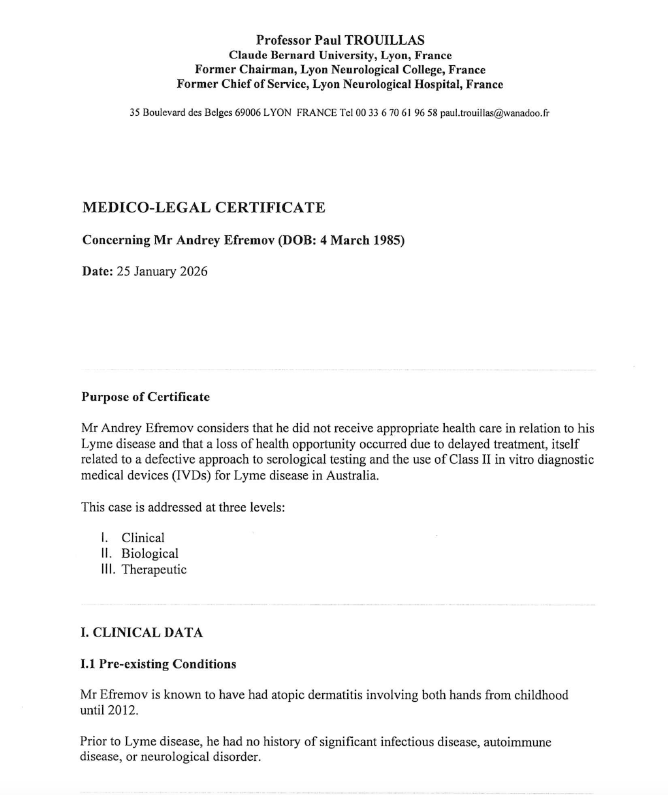
****This is not a medical negligence or compensation claim. It is an administrative law proceeding seeking judicial review of regulatory decision-making, with the aim of ensuring that appropriate safety actions under the Therapeutic Goods Act and PRAC framework are properly considered in relation to Lyme disease IVD medical devices in Australia.****
I strongly believe in the Lyme community in Australia, and this is a critical moment to come together. This legal action is not just about my case — it concerns every patient who has been tested for Lyme disease or Lyme-like illness in Australia. It is a rare opportunity to have these issues examined through proper legal process.
Summary
My name is Andrey Efremov. I am directly affected by the diagnostic pathway and regulatory decisions relating to Lyme disease testing in Australia, and I have legal standing to bring this matter before the Federal Court.
I am seeking support to initiate a judicial review against the Department of Health in relation to decisions concerning Lyme disease diagnostic tests used in Australia.
While this case arises from my individual experience, it raises broader questions of public importance — particularly for the many patients who have undergone Lyme disease testing within the Australian healthcare system.
The proceeding will examine how diagnostic devices are validated, interpreted, and relied upon in clinical practice, and whether existing regulatory processes adequately address limitations that may affect patient outcomes.
Background
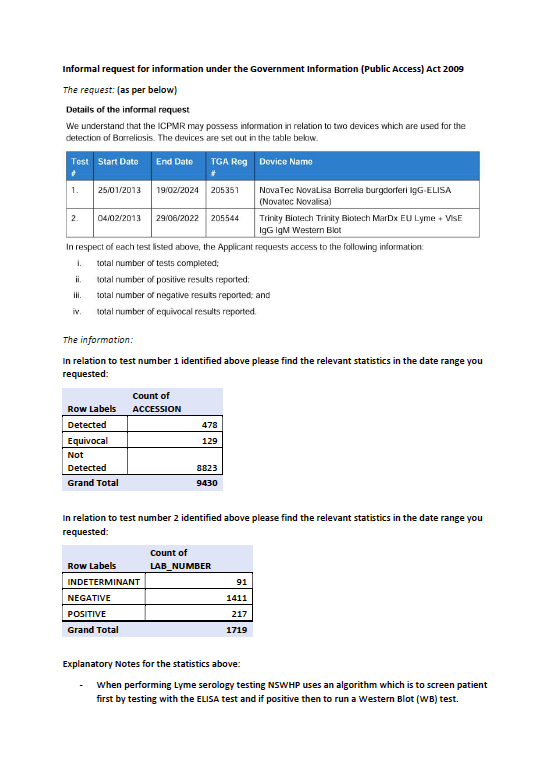
Between 2013 and 2024, a single high-volume public pathology laboratory in Sydney processed over 11,000 Lyme disease serology tests.
These tests were performed using a two-tier algorithm involving ELISA screening followed by Western Blot confirmation.
During this period:
• 9,430 ELISA tests were performed
• 1,719 Western Blot tests were performed
In my own case, initial testing returned negative results through this system.
Subsequent independent testing in Australia identified evidence consistent with neurological Lyme disease (Borrelia Garinii strain).
This discrepancy led to a detailed review of the diagnostic pathway.
Through formal freedom of information requests and scientific analysis, I became aware that different diagnostic platforms use different antigen compositions, and that certain strain-specific markers — particularly those associated with Borrelia garinii, a strain linked to neurological involvement — may not have been fully represented across all testing configurations.
The following medical devices were involved in the diagnostic pathway and affected me:
• NovaTec NovaLisa Borrelia burgdorferi IgG ELISA – ARTG 205351
• Trinity Biotech MarDx EU Lyme + VlsE Western Blot – ARTG 205544
• ViraStripe Borrelia IgG – ARTG 279792
Why This Case Matters
This proceeding seeks to test these issues through lawful process, not to assert conclusions outside that process.
This case concerns broader systemic questions:
• Whether diagnostic devices adequately calibrated and validated capture strain diversity
• How antigen coverage impacts real-world test sensitivity
• Whether limitations are clearly communicated to clinicians
• How regulatory decisions respond to emerging concerns
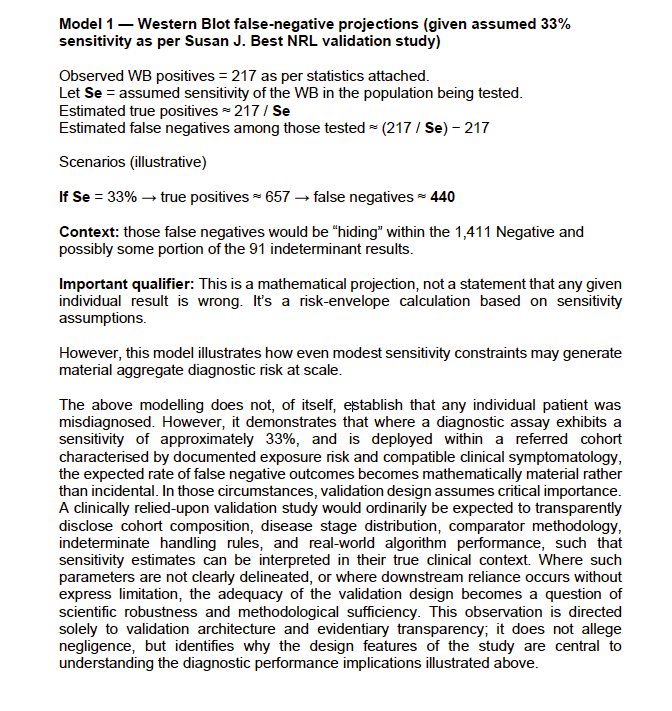
In large referral cohorts — particularly where patients present with travel exposure and clinical symptoms — even modest sensitivity constraints can have significant aggregate implications.
The purpose of this case is not to assert conclusions, but to ensure that these issues are properly examined under administrative law.
Legal Action
With legal representation from Peter Fam ( Maat’s Method Pty Ltd), I intend to seek judicial review in the Federal Court of Australia with community help.
The proceeding will examine whether administrative decisions made by the Department of Health in relation to these diagnostic devices were legally sound and procedurally fair.
This is a public law challenge.
It seeks legal scrutiny — not assumptions.
Intended Outcome
The intended outcome of this proceeding is to achieve:
• Greater transparency in how diagnostic devices are evaluated and approved
• Clarification of how assay limitations are communicated in clinical settings
• Consideration of whether safety alerts are required where antigen coverage may be incomplete
• Review of whether regulatory action, including reassessment or recall processes, should be considered where performance limitations are identified
It is noted that one of the devices used in the diagnostic pathway has since been cancelled from the Australian Register of Therapeutic Goods.
Any further regulatory outcomes will be determined through proper legal and expert processes.
Why Funding Is Needed
Federal Court proceedings are complex and resource-intensive.
Funds will support:
• Legal representation and counsel
• Court filing and procedural costs
• Expert scientific and technical analysis
• Preparation of evidence and submissions
This is not a small case.
It involves technical, regulatory, and legal complexity at a national level.
Transparency, Integrity and Costs
All issues raised in this matter will be examined through proper legal process.
This fundraiser does not assert wrongdoing as a matter of fact. It seeks to enable lawful and independent examination of issues relating to diagnostic reliability and patient safety.
Based on current legal advice and cost estimates, it is anticipated that Federal Court proceedings, including solicitor, counsel, and expert involvement, may require funding in the range of approximately AUD $80,000.
Initial legal work has already been undertaken, including formal advice and preparation of a letter of demand. This has been completed at a cost of approximately AUD $8948, as evidenced by issued invoices and the executed costs agreement.
Legal advice received to date indicates that the issues raised warrant further consideration through formal proceedings. Any conclusions will ultimately be determined by the Court.
All funds raised will be held and administered through the trust account of Maat’s Method Pty Ltd, in accordance with legal cost arrangements. Funds will be allocated progressively in stages (for example, in increments of AUD $10,000) as the matter advances.
Regular updates will be provided to ensure transparency in how funds are used and how the proceedings progress.
Closing
This case is about ensuring that diagnostic systems are robust, transparent, and fit for purpose.
Where thousands of patients rely on medical testing, even small limitations can matter.
Your support helps bring these questions before the Court.
Modelling based on available data suggests that false negative outcomes may have occurred at a non-trivial scale; however, the extent and implications of this can only be determined through proper regulatory and legal examination.
I am directly affected by the diagnostic pathway and subsequent clinical findings, which form the basis of this legal action.
Relevant Matters – FOI Requests and Tribunal Proceedings
This matter has been developed over a sustained period through formal legal and administrative processes, including Freedom of Information (FOI) requests and proceedings before the NSW Civil and Administrative Tribunal (NCAT).
Multiple applications have been made under the Government Information (Public Access) Act 2009 (NSW) to obtain documents relating to Lyme disease diagnostic testing, validation, and regulatory oversight.
These processes have resulted in:
• the release of internal regulatory and clinical materials;
• identification of gaps in documentation and decision-making pathways;
• ongoing disputes regarding access to information and procedural handling.
The matter has also been the subject of several NCAT proceedings and appeal decisions, including:
Efremov v Health Administration Corporation [2024] NSWCATAD 250
Efremov v Health Administration Corporation [2025] NSWCATAD 122
Efremov v Health Administration Corporation [2025] NSWCATAP 8
Efremov v NSW Health Administration Corporation [2026] NSWCATAD 11
Efremov v NSW Health Administration Corporation [2026] NSWCATAD 37
Efremov v NSW Health Administration Corporation [2026] NSWCATAP 34
In addition, related applications and procedural steps have been undertaken in matters involving other institutions, including the University of Sydney, with Tribunal correspondence confirming ongoing administrative review processes and filing requirements.
These proceedings demonstrate that the issues raised are not speculative, but have been examined within formal legal and administrative frameworks over multiple years.
The present Federal Court judicial review builds upon this existing record and seeks to address broader questions concerning regulatory decision-making, transparency, and patient safety.
Active FOI proceedings 2026 Sydney NSW Australia
Efremov v The University of Sydney [2026] NSWCAT (Administrative Review – GIPA matter) case 2026/00005122 Listed for Hearing at NCAT Sydney (John Maddison Tower, Level 10) on 29th of June 2026 at 10:00 a.m. - you are welcome to come and support.
Efremov v University of Sydney [2026] NSWCAT (Administrative Review – GIPA application) case 2026/00123288 in progress, case conference due
Efremov v NSW Health Administration Corporation [2026] Appeal Panel listed for hearing on 03 July 2026 at 10:15 a.m. at NCAT Sydney (John Maddison Tower, Level 10) - welcome to come and oversee
Core Scientific Foundations (Brief)
This legal action is supported by peer-reviewed research examining the performance of Lyme disease serological assays used in Australia.
The ICPMR / University of Sydney study Dickeson et al. (2016), Pathology 48(3): 251–256 “Concordance of four commercial enzyme immunoassay and three immunoblot formats for the detection of Lyme borreliosis antibodies in human serum: the two-tier approach remains” demonstrated significant variability between diagnostic assays, with some tests showing low agreement (~56%) and performance dependent on antigen composition.
“A total of 222 clinical specimens were selected to evaluate positive agreement (sensitivity) and negative agreement (specificity). The samples were collected, initially tested and archived between 2002 and 2013 and then selected from −25 C storage on the basis of previously having a MarDx and western immunoblot result”.
“Antigens derived from both North American and European species of Borrelia were not used in the MarDx EIA kit, even though the inclusion of both is now considered necessary for any testing strategy” - This highlights a recognised limitation in antigen composition within certain assay configurations.
The Australian Government–funded study (Susan Best et al., 2019) "Investigation of the performance of serological assays used for Lyme disease testing in Australia" further confirmed that assay sensitivity varies widely, with some immunoblots demonstrating very poor sensitivity as low as 33% (Trinity Biotech MarDx EU Lyme + VlsE Western Blot – ARTG 205544) . It also found that differences in results arise primarily from assay design and antigen selection, including reliance on strains not representative of all clinically relevant Borrelia species.
Together, these studies establish that Lyme serology is inherently dependent on antigen coverage. Where key antigens are absent or limited, false negative results may occur despite underlying infection.
This scientific limitation is central to the present legal action, which concerns whether such limitations were adequately validated, disclosed, and relied upon in clinical practice.
Organiser