- T

Help Keep DeafVIDEO.TV Online — A Smarter, Faster, and More Resilient Future
For years, DeafVIDEO.TV has served as a vital resource for the Deaf and hard-of-hearing community — a place where signed language content lives, breathes, and keeps people connected. What many visitors don't see is the infrastructure quietly humming behind every video stream. Today, that infrastructure stands at a crossroads, and with your help, we can make it stronger, faster, and far more affordable than it's ever been.
The Drive Problem We Can't Ignore
The hard drives that store DeafVIDEO.TV's video library are old. Not just aging in the way we politely say when we mean "getting up there" — they are genuinely, measurably past the end of their expected service life. Every day they keep running is borrowed time. When a hard drive fails without a ready replacement, it doesn't just slow things down. It takes the site down. For the Deaf community, that's not a minor inconvenience — it's a loss of access to content that may not exist anywhere else.
This is the most pressing reason we're raising funds right now. The drives need to go. The question is what replaces them, and the answer is where things get genuinely exciting.
The Plan: Bring the Server Home
Something significant has already happened behind the scenes. DeafVIDEO.TV recently moved to a CDN — a Content Delivery Network — to handle the actual serving of videos to viewers. That change eliminated the bandwidth constraints that once made hosting from a home network unthinkable. Videos are now delivered from the CDN's global infrastructure. The server itself is now responsible only for encoding and storage, not for shouldering every viewer's stream directly.
That shift made something possible that wasn't before: moving the server hardware home, out of a commercial data center in Tampa, Florida, and into a carefully prepared home setup in Maryland. The monthly cost savings alone make this worthwhile. But the performance story is what's really compelling.
Why the Mac Mini Leaves the Tampa Server in the Dust
You might picture a Mac Mini — small, quiet, sitting on a desk — and assume it can't hold a candle to proper server hardware in a Florida data center. You'd be wrong, and here's why.
The current Tampa server relies on its CPU for everything, including video encoding. It has no GPU. That means every time a video needs to be processed, the processor grinds through it inefficiently, the way a chef is forced to chop vegetables by hand when a food processor is sitting right there, unused.
The Mac Mini has Apple's Media Engine — dedicated silicon built specifically for video encoding. Encoding that takes minutes on the Tampa server takes seconds on the Mac Mini. It's not a small difference. It's the difference between a workflow that strains and one that flies.
And the network? The home connection is 1 gigabit fiber — the exact same speed class as the Tampa data center. There's no compromise there. On top of that, the home location in Maryland sits just milliseconds from Ashburn, Virginia, one of the most significant internet exchange points on earth, where a staggering share of global internet traffic flows. In terms of connectivity to the internet backbone, this Maryland home setup is exceptionally well-positioned.
What About the Power Going Out?
This is always the first question when someone hears "home server," and it's a fair one. The home is equipped with a Tesla Powerwall 2, which stores 13.5 kWh of energy and automatically takes over the moment grid power drops. The server keeps running. Viewers keep watching. No one notices a thing.
The Right Drives for the Job
Not all hard drives are created equal, and this is one area where cutting corners would be a mistake.
Consumer-grade desktop hard drives are built for light, intermittent use — the kind of workload you'd expect from someone saving documents, loading photos, and shutting the computer down at night. A server that runs continuously, processing and serving video around the clock, would push a desktop drive well beyond its design limits. Failure would come fast.
At the other end of the spectrum, enterprise drives are engineered for data centers running hundreds of drives in massive arrays — overkill in both capability and cost for what DeafVIDEO.TV needs.
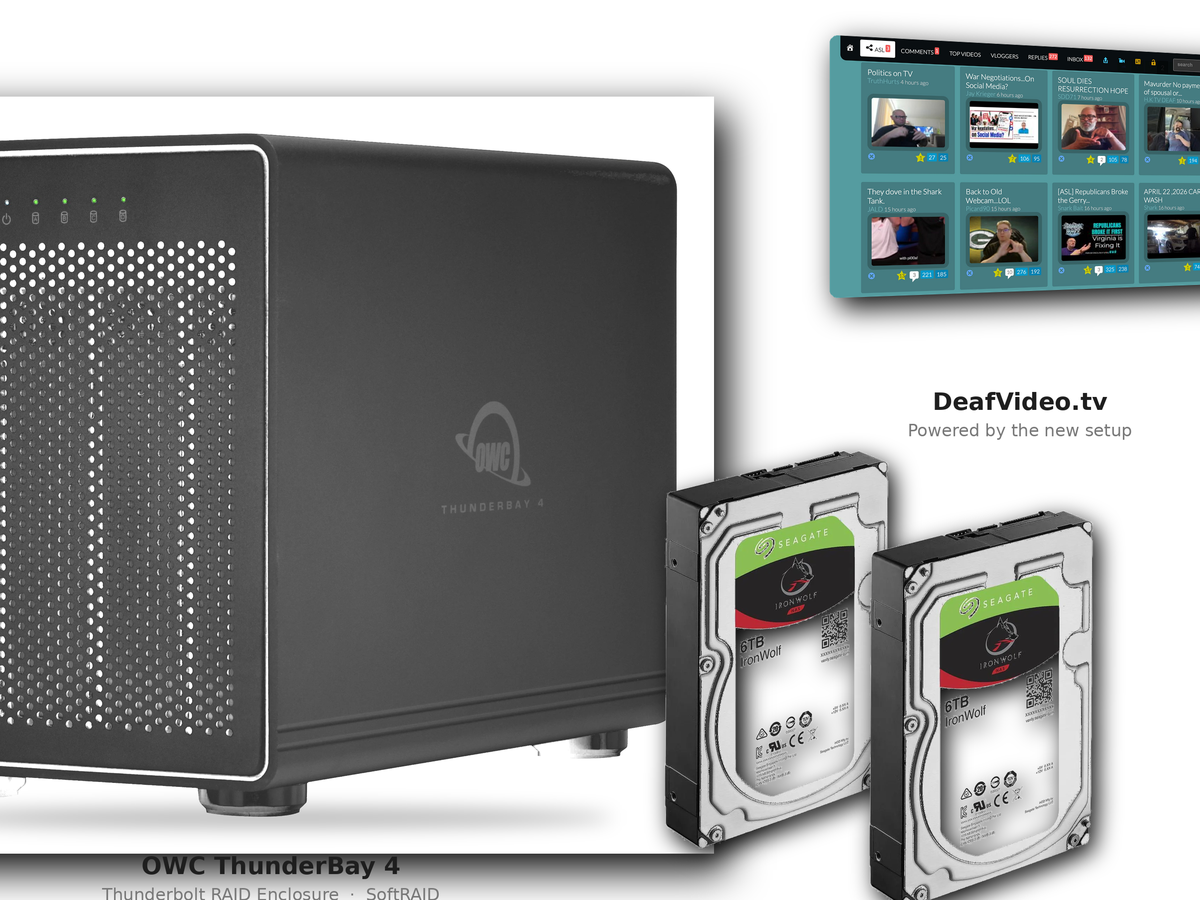
The right choice sits squarely in the middle: NAS drives. Specifically, the Seagate IronWolf, a 7,200 RPM NAS-class drive purpose-built for exactly this kind of always-on environment. At $229 each, they cost more than a typical desktop drive — and for good reason. IronWolf drives are rated for 24/7 continuous operation, carry a workload rating of 180 TB per year (far beyond what a desktop drive can handle), and are engineered to tolerate the heat, vibration, and relentless read/write cycles of a server that never sleeps.
This is not a place to save $40 per drive and regret it six months later. The IronWolf is the sensible, cost-effective choice for a server that needs to keep running year after year.
The Enclosure: Built for This Exact Job
Two great drives need a great home. The OWC ThunderBay 4 — priced at $530 in the configuration needed — is that home.
It's worth being specific about why that number is what it is. OWC sells a lower-cost version of the ThunderBay 4 that is a bare JBOD enclosure: four bays, no intelligence, no RAID management. You plug in drives and the Mac sees them as individual, disconnected volumes. That's fine for simple storage, but it doesn't give DeafVIDEO.TV the mirroring protection the server needs.
The $530 configuration includes OWC SoftRAID — professional RAID management software that enables true RAID 1 mirroring and, critically, monitors the health of both drives continuously. SoftRAID can detect when a drive is beginning to show warning signs and alert you before it fails outright. For a server that's supposed to stay up, that kind of early warning is invaluable. The enclosure itself connects via Thunderbolt for maximum speed and features serious thermal management for drives running day and night. This is professional-grade equipment chosen deliberately, not casually.
How the RAID Mirror Works
In a RAID 1 configuration, the two IronWolf drives don't share work — they share responsibility. Every piece of data written to one drive is written simultaneously and identically to the other. They are perfect mirrors of each other at all times.
If one drive fails — and eventually, all drives fail — DeafVIDEO.TV keeps running without a single dropped video, without a single error message to visitors, without any interruption whatsoever. The surviving drive carries on alone while the failed drive is replaced and the mirror is rebuilt. This is how professional operations maintain near-100% uptime, and it's exactly the standard DeafVIDEO.TV is built to meet.
What We're Raising and Why
Here is the full one-time hardware cost:
- OWC ThunderBay 4 with SoftRAID: $530
- Two Seagate IronWolf NAS drives (7,200 RPM): $458 ($229 × 2)
- Hardware subtotal: $988
The fundraising goal is set at $1,000 — rounding up slightly to account for shipping, sales tax, and any platform fees taken from contributions. Every dollar raised goes directly toward getting this hardware purchased and DeafVIDEO.TV moved onto the new setup. Nothing is pocketed, nothing is diverted.
This is a one-time ask for a one-time purchase. No monthly overhead, no recurring costs being passed to the community. The goal is simply to get the right hardware in place so that DeafVIDEO.TV can move off aging, at-risk drives and onto a faster, more reliable, more economical setup — one that will serve the community for years to come.
The Tampa data center served DeafVIDEO.TV faithfully. But the future is smarter than renting rack space for a slow server when a fast one sits at home on a gigabit connection, backed by a battery, milliseconds from one of the world's fastest internet backbones.
Help us make the move. Every contribution gets us closer to drives that won't fail, a server that encodes video faster than ever, and a monthly cost that drops instead of climbs.
DeafVIDEO.TV has always been for the community. This upgrade is powered by you.
Organizer