This new technology was almost lost. In 2024, researchers were unable to get a patent for their process (Examination Report No 1- a PDF download). They were turned down due to a lack of novelty. When their carbon punching patent was denied, the spin off start up business, LM Plus, which was created to develop and market the concept, closed down. (To the best of my knowledge, this technology was abandoned because it was not patentable.)
LM Plus focused on developing a device the size of a semi-truck trailer, with an emphasis on making profits from the pure carbon that is produced. (Their planned customers were corporations or cities?) The device I'm working on is is about 12"x12"x16" (30.5cm x 30.5cm x 40.5cm) and marketing emphasizes the oxygen that is produced. (The pure carbon that is produced could be collected and resold by recycling centers or private, local businesses. Apparently, pure carbon is valuable, and it would be monetarily worth while to develop a collection system for the pure carbon produced. Some thoughts on a distribution system are shared near the end of this story.)
A problem has been discovered. The solvent used, dimethylforma-mide, is toxic, flammable, and releases fumes. I now need to research with "green" solvents, (which may or may not work) or find a way to make the dimethylformamide safe. --- As it turns out, the "green" solvents are also toxic, so devising a nonspillable system, and dealing with the fumes, seems the route to go. (Check valves and timing seem probable solutions.)
Friends have told me they don't understand the technology involved in this project, which is understandable since it's a new technology. This new technology didn't even have a name (except for the one I gave it -- carbon punching). A reasonably good explanation of the technology is available here.
At this point, I've designed a plunger/syringe system that holds a carbon dioxide absorbing powder. (There is also a new CO2 filter I need to explore.) The CO2 absorbing powder releases the CO2 after being heated to above 80°. The plunger lowers to cool and to absorb CO2 from the "air", and lifts to a contained space to release the absorbed CO2, which is then pressured into the gallium mixture. (The next goal is to buy materials so I can build and refine a prototype.)
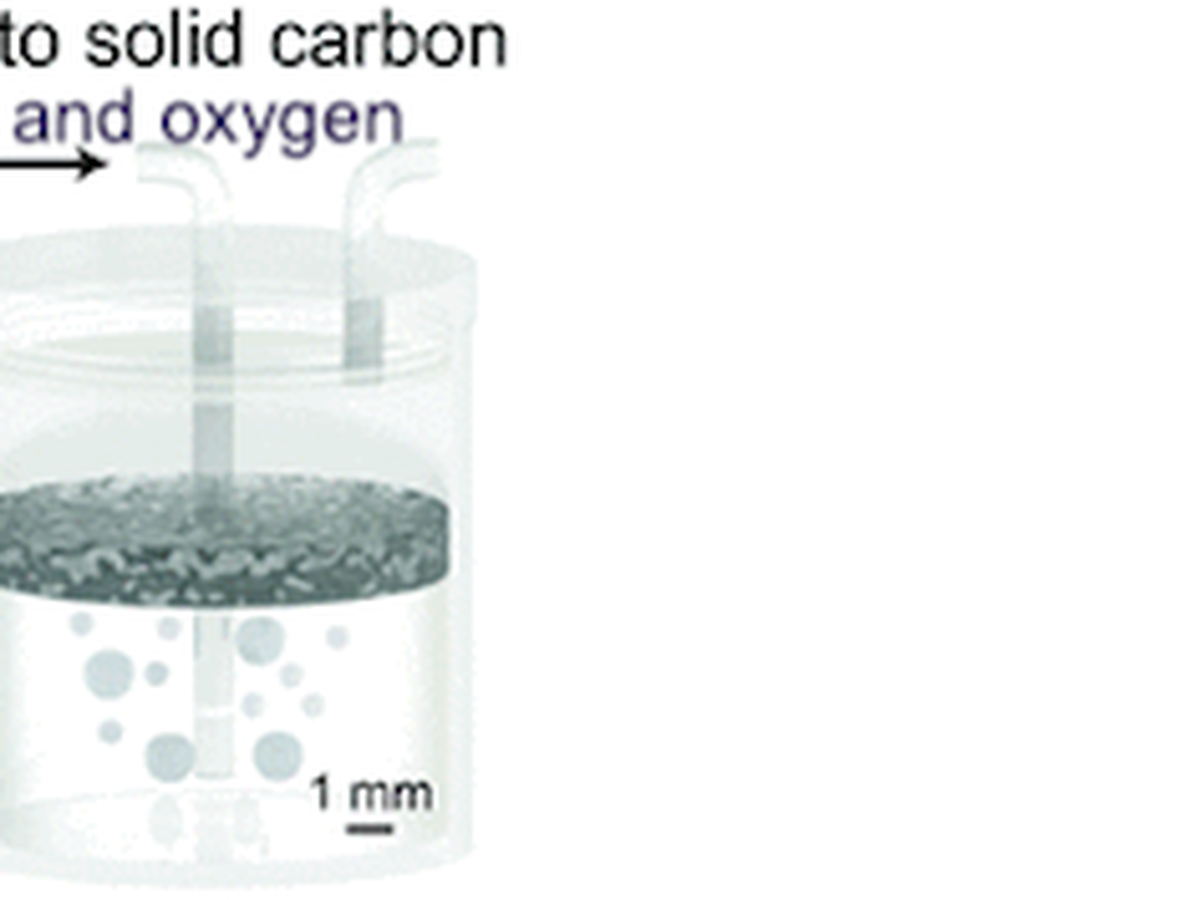
Historically, the carbon punching process, by way of several experiments, has evolved since the 1940s, to the point where liquid gallium, a metal you may never have heard of (and that melts into a liquid at the low, and inexpensive temperature of 86° F) can break carbon dioxide down to solid carbon and oxygen. Gallium can, when combined with a solvent, silver nano particles ,and some vibrations, break carbon dioxide down into solid carbon and oxygen. Unlike mercury, gallium is not at all poisonous or damaging to the touch, and can be handled safely, without unusual precautions . (You can hold gallium in the palm of your hand without concern.)
This project is about making carbon punching devices that are inexpensive to build and and can easily be made available to the public. The device isn't actually all that complicated. Most of the device is made of plastic and the "electrical parts" include an aquarium heater for the gallium, another for the CO2 absorption material, some sort of vibratory device, and a small motor for lifting and pressuring the carbon dioxide into the gallium mixture.
About me: My name is Keith D. Foote. I'm a 68 year old science geek, and physics is a hobby. In high school, I was trained in mechanical drafting. In the Air Force, I was trained and worked as an electrician. After that, I supported myself with home and appliance repair. As time went on, I researched and wrote the Ultra-Space Field Theory (a 269 page nonfiction book describing physics using a field theory paradigm). In 2016, I accepted a freelance position with Dataversity, where I researched and wrote science data articles for 8 years. I'm now semi-retired. I'm also very concerned about global warming and its impact on the planet and the human race. I take this carbon punching project very seriously.
Supporting evidence that carbon punching technology is real: On October 6, 2021, Junma and Jianbo Tang, et al, of the University of Melbourne, published the results of their experiments in the paper 'Liquid-Metals-Enabled Mechanical-Energy-Induced CO2 Conversion' (https://findanexpert.unimelb.edu.au/scholarlywork/1600085-liquid-metal-enabled-mechanical-energy-induced-co2-conversion).
It is estimated the process costs about $100 to "convert a ton of CO2!" That is a remarkably inexpensive price for saving the planet... if we can just get people on board to develop low cost carbon punchers. (Roughly 900 million tons need to be removed to return us to the levels that existed in 1950.)
It is my goal to develop small inexpensive carbon punchers, that imitate Junma and Jianbo Tang, et al's experiments, producing oxygen and solid carbon. The devices would be placed in peoples homes and offices. This would result in two positive effects: 1) Small amounts of oxygen would be released, benefiting the occupants, and 2) Reducing the amount of carbon dioxide in our atmosphere and "aggressively" counteracting global warming. The design issues are described here.
These carbon punching devices would be sold at cost, with the goal of keeping their price under $350. Additionally, the design would be open sourced.
Some really rough predictions: If each device removes 5 lbs of pure carbon per year from the atmosphere (and we crudely equate 5 lbs of carbon with 5 lbs of carbon dioxide), it would take 400 small, home-based carbon punchers to produce 1 ton of carbon per year. 40,000 would eliminate 100 tons per year, etcetera. (There are roughly 134 million households in the United States vs the 900 million tons that needs to be removed.)
Sadly, the president of the U.S. government has made it clear he does not believe in global warming, and we cannot trust corporations, who are focused primarily on their own short term profits. So... if we want our children to have any kind of civilized lives, we, the people, will have lower the carbon dioxide levels in our atmosphere .
Thoughts on collection system:
-The pure carbon should be formed in squares or rectangles for efficient packaging (tho, this may not happen until later in the manufacturing process.
-Cities with recycling programs might be good targets. The recycling center could make a profit from selling the carbon.
Organizer