Post-WC26 Update!! Fan-owned football coming to the USA!!
0% complete
$1,370 raised of $5M
10 donations
POST WC26 UPDATE!!!
This GoFundMe campaign is a response to Belgium 4 - USA 1.
The 4 semifinalists for WC26 (France, England, Spain and Argentina) are all previous FIFA Men's World Cup winners. Brazil, Uruguay, Germany and Italy, the other World Cup winners, either fell earlier in the WC26 competition or simply did not qualify.
Only 8 countries out of FIFA's 211 members have ever won the men's World Cup.
Every FIFA Men's World Cup winner has a world-class professional football league or competition structure.
The USMNT fell short again in the Round of 16 for a simple reason -- the USA does not have a world-class professional football league for men.
Neither U.S. Soccer nor MLS represent that global standard of excellence in football.
This GoFundMe campaign is the remedy for that.
We must acknowledge, however, that the USWNT is the only global standard of excellence that the USA has:
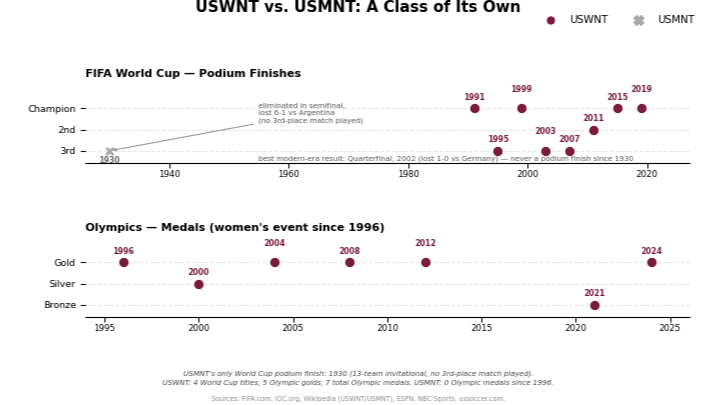
In short, what you are about to read is as important for the USWNT as it is for the USMNT, and for youth footballers and professional players.
As argued below, neither U.S. Soccer nor MLS represent the global standard of excellence for 1st Division football leagues when measured against our global benchmarks from England, Germany and Brazil:
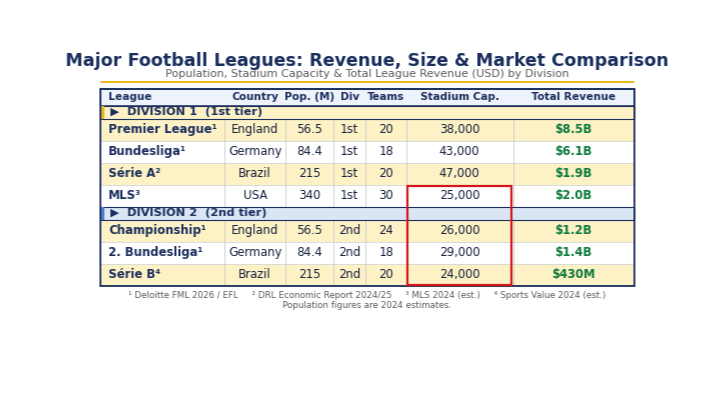
In addition, it is important to consider the global standard of excellence for football clubs.
Today, neither the USA nor Canada can point to one world-class football club based on the five (5) drivers of revenue (i.e., venues, commercial, TV/digital, competitions (both domestic and international) and player transfers), where fan support and stadium size drive the revenue variables as established by Deloitte's Football Money League Report:
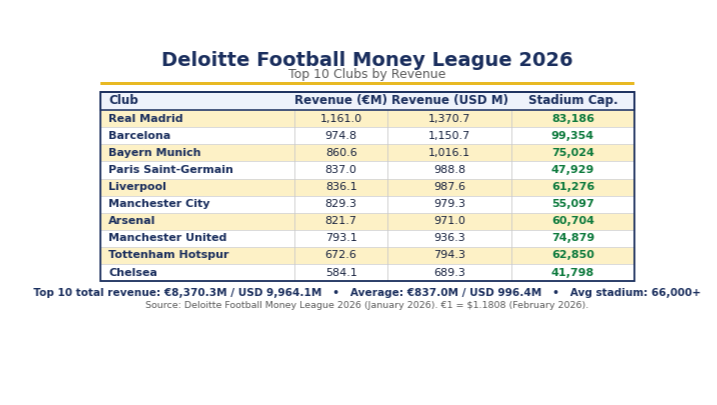
In summary, this is the global standard of excellence the USA and Canada are missing:
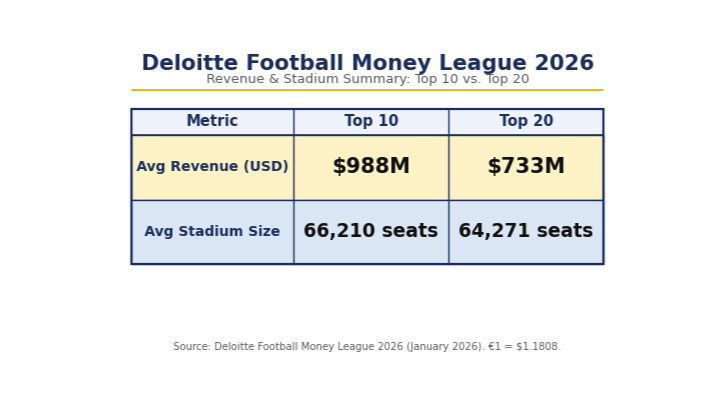
With that in mind, this GoFundMe campaign is targeting four (4) groups of football (soccer) supporters in the USA and Canada:
Group #1: The roughly 5 million youth football (soccer) families in the USA who are paying $5000 to $20,000 dollars per child per year via the “pay-to-play” model, but who are mere “consumers,” and who are in essence “renting a service” that over-promises and under-delivers,
Group #2: The roughly 10 million urban (inner-city) youth footballers (boys and girls) who have been excluded from the sport for the past 30 years because they could not afford the “pay-to-play” model (a population that is largely black, brown and/or low-income),
Group #3: The women and girls, who despite the incredible accomplishments of the USWNT are positioned in the USA as “second-class citizens” in non-Olympic and non-World Cup years, and who will never garner the respect or the wages of MLS (whose wages are considerably below the benchmark wages for men playing professionally in the Top 5 football leagues of Europe), and
Group #4: The 90 million hard core football fans in the USA and Canada, of all races, creeds, gender persuasions and cultures who do not spend their hard earned cash on the NFL, the NBA, Major League Baseball, the NHL or MLS, but who continue to follow the Beautiful Game on TV, cable and streaming services and who are waiting for a world-class professional football league and clubs in the USA and Canada that they can support, and that represents the global standard of excellence for football leagues and clubs.
This is a GoFundMe campaign for you!!!
FIFA (IFAB), UEFA and the Big 5 European football leagues (the EPL, the Bundesliga, La Liga, Serie A and Ligue 1), have the biggest and richest football clubs, the best and most lucrative domestic and international leagues and competitions, the best players from around the world, the highest salaries in the world, the best infrastructure for games, training and monetization, and the best foundation for women and youth to grow their game and maximize revenue.
Europe is the center of the footballing world.
Only the USA is in a position to challenge Europe’s global football hegemony.
This GoFundMe campaign is for these four (4) loyal footballing groups in the USA and Canada.
It is the chance to transform yourselves from being mere consumers (of the "pay-to-play" model and MLS) and become member-owners of a new professional football league and new world-class football clubs that are on par with the great global football leagues and clubs in the world.
Those world-class leagues are: the English Premier League, the German Bundesliga, La Liga and Brazil's Serie A.
And the great fan-owned football clubs are: Real Madrid, Barcelona, Bayern Munich, Flamengo, Palmeiras, Boca Juniors, River Plate, etc.
In the German Bundesliga, 33 of the 36 clubs are fan-owned and controlled. The vast majority of the football clubs in South America are fan-owned and controlled.
This GoFundMe campaign is bringing that fan-owned football league and club model to the USA and Canada.
The new league, The Football Supporters Trust League (STL), will follow the Bundesliga's 50% + 1 Share Rule (50+1) with adaptations for the USA and Canada (see below).
The STL business strategy is that within 5-7 years, STL will be:
(1) the #1 football league on the planet for both men and women (who will play under the same club brand a lá Europe and Latin America), with the highest annual global revenue,
(2) fully integrated with youth football using an "everyone-can-play" approach that is directly connected to and integrated with STL and its new professional fan-owned multi-sport football clubs, and
(3) by 2032, 4 of these new fan-owned football clubs will rank within the Top 20 football clubs in the world, according to Deloitte's Football Money League Annual Report. See the details below.
Importantly, no raffle, contest, goods, service, prize, or promotion is offered in exchange for donations made to this GoFundMe.
PART I -- Introduction
From FIFA’s President Gianni Infantino:
“As FIFA President, I have to care . . . about having . . . challengers to the European associations and leagues.”
-- Gianni Infantino, in an ESPN interview shortly after the U.S. Soccer Presidential elections in February 2018.
“You are the United States of America . . . the greatest country in the world, you are number one in everything you do. You cannot be satisfied to be number 20 in the number one sport in the world. You want to be number one in the number one sport. So let's go for it! The Super Bowl . . . is fantastic, right? It has 120, 130 million viewers, right? The World Cup has 6 billion viewers. So a World Cup is 104 Super Bowls in one month. It's three Super Bowls a day. And this . . . can happen every week, if the USA has the best league in the world.”
-- Gianni Infantino, in an interview with Colin Cowherd @Foxsoccer, April 1, 2025
“This American culture . . . where you don’t have the concept of promotion and relegation . . . that I think has to be explored.”
“For children, it must be free to play football . . . you go to Europe or Africa, you can play football for free, you can play soccer for free. We need to bring this to the U.S. as well, and then you will see the talent will go to play soccer.”
“This is what we’re changing now with the FIFA Club World Cup and the World Cup (2026) – to show to young Americans that if you’re good and if you are talented, you don’t need to go to another sport, because through soccer there is a path for glory and a path for money as well”
-- Gianni Infantino, in an interview with Sports Illustrated, June 23, 2025
This GoFundMe campaign is about realizing Gianni Infantino's vision of creating the #1 football league in the world in the USA and Canada.
But first, I need to tell you a story.
The Origins of the J.League (the Japanese professional football league)
In 1990, some Japanese businessmen, C-suite types, high up in the corporate hierarchy, took a joint trip to Italy for the 1990 FIFA World Cup. That trip and the World Cup itself profoundly impressed them. It wasn't a particularly exciting World Cup by World Cup standards, but Maradona was in the final against Germany, and all-in-all it captured their imaginations.
Upon returning to Japan, they wrote a letter to João Havelange, then the president of FIFA, and asked “What do we need to do to bring the World Cup to Japan?”
Havelange wrote back and said, “We'd love to bring the World Cup to Asia, but you don't have a professional football league, so until you have a professional league, we really can't consider it.”
This was in the fall of 1990. One of the gentlemen that went to Italy was from SONY. The group decided to hire SONY's design department, and those designers were tasked with inventing from whole cloth, the entire corporate image of a football league comprised of 10 teams. They came up with the team names and assigned those teams to ten cities. They chose the team colors and designed the logos, the uniforms and the mascots. With the artwork completed, they went to a Japanese sports apparel company to produce football kits and merchandise. They began selling kits and merchandise for this imaginary league in 1991, throughout SONY’s retail store network in Japan – with the publicly disseminated promise that the professional league would eventually exist.
It took them over two years to get the league, now known as the J.League, off the ground.
From 1991 to 1993, they sold USD 200 million worth of merchandise via SONY’s retail store network.
The best part of the story is that all of the sales were walk-in sales.
There was no Internet!
Today, technology (i.e., the Internet, e-commerce, mobile apps, data management, streaming, AI, etc.) can not only launch a new world-class professional football league, to rival the best leagues in Europe and Latin America, for a fraction of the cost; but technology will allow for that league and its clubs to scale to nationwide proportions and revenue maximization in record time using a proven business model from Europe and Latin America, that has delivered literally decades of financial success off the field and trophies on the field -- namely, fan-owned multi-sport football clubs, following the model of the German Bundesliga’s 50% + 1 Share Rule (50+1).
Introducing: The Football Supporters Trust League (STL):
STL is a new fan-owned world-class professional football league and clubs for the USA and Canada, that is modeled after Germany's Bundesliga, with a 50% + 1 Share Rule (50+1).
For STL, 50+1 means the fans have club membership in and voting control of the league and clubs and hire professionals for their respective administrative and operating decision-making duties.
Professional athletes, both men and women, will play under the same football club brand a lá Europe and Latin America.
STL is also a strategy to restructure, realign and fully integrate youth football nationwide into and with STL via Promotion and Relegation (Pro/Rel).
STL is supported by three (3) strategically structured sister organizations:
The Football Supporters Trust of the United States of America (TUSA)
TUSA is a first of its kind organization in the USA, modeled after the football supporter’s trust movement in the U.K. and Europe, where the voice of the fans with respect to club ownership, voting, decision-making, ticket pricing, fan support groups, etc. is taken into account. In short, TUSA is a mechanism to bring participatory democracy (in the true sense) to the sport of football – registration is reserved for individual football fans only:
The Federation of Clubs of the United States (FOCUS)
FOCUS is the A-to-Z support organization for new and existing football clubs at all levels -- to assist in all aspects of establishing a new club, and to help existing clubs and/or leagues rebrand, restructure, survive and thrive, and to license football clubs and leagues entering or who want to enter STL's professional ranks – registration is reserved for legally incorporated football leagues and clubs only or for leagues and clubs wishing to become more professionally organized and managed:
and
Urban Refugee (UR)

Urban Refugee is the branding, digital, e-commerce, apparel, real estate, culture and streaming arm of STL, TUSA and FOCUS.
Part of STL's branding strategy is to tap into the full cultural, ethnic, racial, gender mosaic of both the USA and Canada in the search for new football club brands. That means the deep examination and exploration of history, events, cultures and psyches that have been erased or marginalized.
STL's branding strategy is based on delving into our collective unconscious and making connections at deep emotional levels that have heretofore remained untapped.
In essence, STL is working with a phenomenon that was identified by senior marketing executive Steve Stoute over a decade ago. It is the notion of "tanning." Everyone can be tanned. It is a process of linking our interior and collective inner landscapes.
Urban Refugee, therefore is named for the branding process itself. We are all urban refugees being woven together like a beautiful quilt.
Urban Refugee will also be responsible for marketing the STL image and that of the STL fan-owned football clubs nationwide, with each club embodying a unique brand that links all the clubs together in a rhizomatic-like structure.
This branding approach will be applied to other leagues and/or clubs that agree to become members of the STL family.
Urban Refugee's real estate strategy includes master planning, land acquisition, valuation, stadia finance and construction, club HQ, training facilities, etc.
STL's highlights are:
• Professional men, women and youth under the same club brand
• Professional men and women will be paid the same base salaries
• A full integration of non-professional independent and affiliated youth football leagues and clubs with STL's professional ranks nationwide
• A league-wide Financial Fair Play algorithm
• A Bozeman Rule for the Americas (North and South)
• New football club brands that rival the best brands from Europe and Latin America
• A new crop of top-tier larger state-of-the-art stadiums that rival Europe’s and Latin America’s top-tier infrastructure in terms of fan capacity, amenities and true "football" culture.
• A top-to-bottom restructuring of the football pyramid in the USA
• Promotion & Relegation (Pro/Rel)
• An “open” model for other leagues and clubs to join the STL family of clubs
• An “open” door for billionaires, millionaires, corporations and wealth management firms (i.e., hedge funds, private equity, venture capital, etc.) that adhere to the STL framework regarding “fan ownership” of football clubs (think of Bayern Munich which is owned by 400,000+ fans who have 75% control of the club, with the other 25% being held equally (8.3%) by Adidas, Audi and Alliance Insurance)
• Football clubs that are multi-sport venues (i.e., football, futsal, basketball, swimming, gymnastics, tennis, table tennis, track & field, lacrosse, etc.) as well as community education (i.e., STEM + the humanities + the arts + spiritual uplifting + consciousness raising), community organizing and community development (think Mondragon), and startup company assistance (think Y-Combinator-like assistance) platforms from youth to adults
• Digital technology (including AI) as the principal tool for maximizing revenue and grassroots football fan empowerment
STL will use 4 football club business models as foundational and complementary to its 50+1 Rule:
(A) THE REAL MADRID MODEL (fans have 100% voting, operational and managerial control of the club),
(B) THE BAYERN MUNICH MODEL (fans have at least 50+1 control with the remainder held by third-party investors),
(C) THE SWANSEA CITY MODEL (fans maintain less than 50% control but no less than 20% participation in all board, operational and managerial decision-making), and
(D) THE CHELSEA MODEL (an STL adaptation, where fans will have less than 20% but no less than 10% participation in all aspects of the club’s board, operational and managerial decision-making).
All 4 models will be utilized by STL.
A+B will be focused on STL's 32 member-owned multi-sport football clubs.
C+D will be primarily focused on taking existing leagues and clubs and migrating them to and under the STL umbrella of clubs.
All fans who intend to be voting members of their football club must be registered members of TUSA and all clubs must be approved members of and licensed by FOCUS, adhering to STL's Financial Fair Play Algorithm.
STL's vision involves:
(i) A Bottom-Up Strategy (BUS), and
(ii) A Top-Down Strategy (TDS).
The BUS is focused on youth football. That means looking upwards towards the professional ranks.
This GOFUNDME campaign is part of STL's BUS.
STL's proposal is that the 4 groups cited above, which includes 5 million youth footballing families across the USA, should own and control the world-class professional football clubs they support, which should include parallel and complete youth football programs under each professional club brand.
The alphabet soup of "pay-to-play" youth football (soccer) leagues and clubs, is a service that these 5 million youth footballing families are renting.
That "rent" can range from 5,000 to 20,000 dollars per child per year. Using 5,000 dollars as a benchmark, means conservatively that roughly 25 billion dollars a year is being paid into youth football every year.
In return, the boys and girls and adolescents are suppose to receive entry into a pipeline that will take them to (i) an NCAA program for football or (ii) into professional football.
Youth football in the USA is like paying rent in an apartment that you do not own. Someone else is getting rich off of your money.
That 25 billion dollars annually needs to be redirected -- namely, towards STL, a fan-owned professional world-class football league and clubs, that our four groups and in particular the 5 million youth footballing families, can become members-owners of, instead of consumers.
STL has a better way:
The idea is to arrange the USA and Canada into Four (4) Regions:
REGION I (NORTHEAST),
REGION II (MIDWEST),
REGION III (SOUTH), AND
REGION IV (WEST).
The USA has a population of 340 million. With Canada that population rises to 380 million.
Think of the USA and Canada as four (4) Germany's (whose population is roughly 85MM).
In short, with STL , the USA and Canada will have Four (4) Regional Bundesligas.
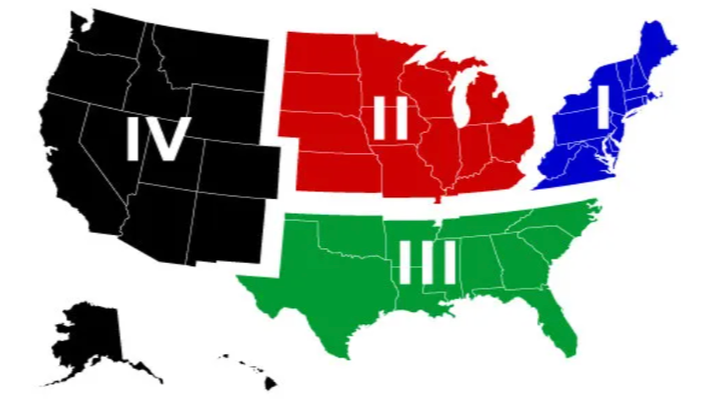
Those regions will be populated fully with STL's new fan-owned world-class football clubs, following Germany's Bundesliga, and more particularly, the Bundesliga's 50+1 Rule.
STL envisions 32 1st Division professional clubs, with 8 world-class football clubs per region.
And STL 2, will have 32 2nd Division professional football clubs, with 8 world-class clubs per region.
STL + STL2 = 64 world-class professional clubs nationally.
In short, 16 world-class football clubs per region.
The 64 professional football clubs in these top two divisions (STL and STL 2) in each of the four regions (with Pro/Rel) will be the “inspirational targets” for all youth football clubs at all of the levels below STL and STL2 in that given region.
STL's philosophy is not “pay-to-play” but an “everyone-can-play” model.
That means that the literal tens of millions of youth who have been excluded for 3 decades because they couldn't afford it, are able to play for free.
And those youth footballing families who can afford it, will stop paying rent and become member-owners of a world-class professional football league and clubs that has a fully integrated co-ed youth program below it, in a professional league with promotion and relegation (Pro/Rel).
In short, both adults (professional women and men footballers) will be under the same professional club brand as youth, following the model from Europe and Latin America. And those clubs will be fan-owned and controlled like Real Madrid, Barcelona, Bayern Munich, Flamengo, Palmeiras, Boca Juniors, River Plate, etc.
In short, the STL strategy is to open the game to the entire foundation of talent that this country has to offer.
Remember, STL is creating 32 1st Division clubs across 4 regions to rival the best clubs from Europe and Latin America, with the intention of placing 4 of those clubs in Deloitte's Football Money League Report Top 20 in ten years or less.
We will be working to encourage, incentivize, restructure and rebrand MLS to become STL2.
Here are the First Four (4) of those 32 STL fan-owned clubs:
The Black Rose of Eire F.C.:
CLUB PROFILE DATA:
Region: I
City / Metro Area: Boston
City / Metro Area Population: 4.9 million
Projected Number of Club Members (1): 100,000
Projected Stadium Size (2): 62,500
Colors: Green, Orange & Gold
Brand Tier Ranking: 1
Cultural Mix Index (CMI): 8
Mass Transit Ranking: 9
THE CLUB STORY:
The most obvious connection about Boston and its surrounds centers on the American Revolution. We felt that that theme had been largely exhausted from a social fabric perspective, and frustratingly for months, despite deep research into the many themes that comprise Boston and its history and people, no brand emerged. We turned to other cities and other challenges.
Months later, we stumbled across an article about the Irish Potato Famine. That led into the history of tensions between Ireland and England, and between the Protestants and Catholics, and then a story emerged from 17th Century London. We read of laws being passed in England that forbade the use of the word Ireland in day-to-day conversation. Representatives of the Crown were charged with ferreting out Irish sympathizers in pubs, and other social settings. The mere mention of the word Ireland was sufficient cause for arrest and imprisonment. In response, Irish sympathizers developed a “code name” for Ireland that allowed for conversations and broader communication to take place. That code name for Ireland was The Black Rose.
Given Boston’s deep historical connection with Ireland, we felt that The Black Rose of Eire F.C. was a fitting brand and symbol for a football club – that also interestingly, connects with the spirit of resistance and revolution at the heart of Boston’s tradition.
All are welcomed to joint this club, regardless of your race, creed, color , gender persuasion or cultural roots.
(1) Projected monthly dues paying members
(2) Not inclusive of club training facilities (men, women and youth), club HQ, recreational, educational and leisure facilities and other holdings
Kings & Queens F.C.:
CLUB PROFILE DATA:
Region: I
City / Metro Area: New York City
City / Metro Area Population: 19.9 million
Projected Number of Club Members (1): 500,000
Projected Stadium Size (2): 100,000
Colors: Purple, Gold & Black
Brand Tier Ranking: 1
Cultural Mix Index (CMI): 10
Mass Transit Ranking: 10
THE CLUB STORY:
Globally speaking and following football tradition, mega-cities like New York City (and for example London, Buenos Aires, Rio de Janeiro, etc.) are usually home to several world-class football clubs. As the largest, most cosmopolitan, ethnically and culturally diverse city in the United States, New York City has a deep sports tradition. Within that context, football has largely been sustained at the youth and amateur level, since the late 19th and early 20th Century, in the so-called outer boroughs of Brooklyn and Queens, which are also the two largest boroughs in the city and the two most ethnically diverse. Together they represent 5 million New Yorkers.
Brooklyn and Queens initially presented themselves as possible rivals, with a major football club in each borough. But in thinking through the branding process and in our quest to create global brands, we felt that Brooklyn and Queens together presented a far greater opportunity than apart.
Queens is in Queens County, and Brooklyn is in Kings County. Hence, Kings & Queens F.C.
Imagine a Greek couple from Astoria, or a Jewish couple from Williamsburg, or some Rastafarians from the Flatbush section of Brooklyn, or the Italians from Bensonhurst, all wearing “crowns” and becoming royalty (after years of subservience to Manhattan), and you have the spirit of Kings & Queens F.C.
All are welcomed to become part of the Kings & Queens family, regardless of race, creed, color or sexual persuasion.
Omnes Quin Huc Intrant Regalles Exeunt -- All Who Enter Exit as Royalty
(1) Projected monthly dues paying members
(2) Not inclusive of club training facilities (men, women and youth), club HQ, recreational, educational and leisure facilities and other holdings
Southside Maroons F.C.:
CLUB PROFILE DATA:
Region: II
City / Metro Area: Chicago (South Side)
City / Metro Area Population: 9.5 million
Projected Number of Club Members (1): 75,000
Projected Stadium Size (2): 55,000
Colors: Red, Burgundy & Tan
Brand Tier Ranking: 2
Cultural Mix Index (CMI): 8
Mass Transit Ranking: 6
THE CLUB STORY:
Before speaking about Hyde Park as a community and the concept of the Maroons, it is important to situate the South Side of Chicago in its proper historical setting.
Chicago itself was founded by Jean Baptiste Point du Sable, a man of African descent with possible roots connected to Haiti, who was a fur trader in and around the Great Lakes Region. Most historians consider his settlement, the first non-indigenous settlement, as having been made at the mouth of the Chicago River in 1779. Du Sable was educated, multi-lingual and married a native American woman of the Potawatomi nation. Chicago in this sense symbolizes deep ties to indigenous networks and communities.
Chicago was officially incorporated as a city in 1837. Post the Civil War and the Emancipation of the slaves, it became arguably the destination for the millions who migrated out of the South to the North and West.
The South Side of Chicago became a magnet for the newly emerging black intelligencia, many of whom were educated at historically black colleges and universities (HBCUs). Far more than Harlem, which is well known by reputation, the South Side of Chicago was the largest concentration of black professionals, intellectuals and scholars in the United States, well into the 20th Century. It is not a coincidence that Barack Obama used Chicago as his base.
In 1890, the current version of the University of Chicago was founded in the Hyde Park neighborhood on Chicago’s South Side, bordering Lake Michigan. John D. Rockefeller was foundational benefactor. In keeping with its ambition of becoming one of the world’s great universities, it has produced the “Chicago School,” in economics, over 100 Nobel Prizes have been awarded to university scholars, and it played a central role in the Manhattan Project during WWII. The first nuclear reaction took place under Stagg Field in 1942.
Stagg Field was home to the university’s American football team known as the Maroons. In 1939, American football was abolished by Robert Maynard Hutchins, the university’s President, as being "incompatible with the university’s academic standards and mission."
Today, the name Maroons harkens back to rebellious escaped slave communities who fought for their freedom, from South America (i.e., Brazil’s Quilombos) to the Caribbean slave communities in the mountains of Jamaica, to similar communities in the swamps of South Carolina to Florida. We believe we have captured the vastness and complexity of this history.
In the spirit of the founding of Chicago, all races, creeds, colors and sexual/gender persuasions are embraced with open arms as members of the Southside Maroons.
(1) Projected monthly dues paying members
(2) Not inclusive of club training facilities (men, women and youth), club HQ, recreational, educational and leisure facilities and other holdings
Zapata-Villa F.C.:
CLUB PROFILE DATA:
Region: IV
City / Metro Area: Los Angeles
City / Metro Area Population: 13 million
Projected Number of Club Members (1): 500,000
Projected Stadium Size (2): 100,000
Colors: Red, Green & Gold
Brand Tier Ranking: 1
Cultural Mix Index (CMI): 9
Mass Transit Ranking: 3
THE CLUB STORY:
Los Angeles is the second largest Spanish-speaking city in the world. In Los Angeles County alone there are nearly 5 million Mexican-Americans. Considering adjacent Orange County, Riverside County and the greater LA metropolitan area – the presence of knowledgeable football fans with a deep tradition in the sport is unprecedented.
Given this strong Mexican and Central American presence, MLS welcomed Chivas USA, into the league in 2004. Chivas USA was intended to be seen as a "little brother" to its parent club C.D. Guadalajara, one of the most widely supported and successful teams in Mexico. In Spanish, chivas means “goats” which is the nickname of C.D. Guadalajara.
Lamentably, Chivas USA never truly connected with the Mexican community or any population in the Los Angeles area. The Hispanic population of Los Angeles simply could not be fooled into supporting C.D. Guadalajara’s “B” team.
In this context, and after much cultural and historical research into Southern California and Mexico, we felt that two Mexican patriots and revolutionaries, Emiliano Zapata and Pancho Villa, symbolized something special in Mexican hearts and minds.
Zapata-Villa also symbolizes the “return” of Mexicans to California, and in particular, to what was in the past a part of their country. Finally, this population and others who choose to join and vibrate with this world-class football club, have a club they deserve and that reflects the 21st Century reality of bi- and/or multi-cultural origins.
Zapata-Villa F.C. is the quintessential multi-cultural club that is open to everyone regardless of race, color, ethnic or gender background.
(1) Projected monthly dues paying members
(2) Not inclusive of club training facilities (men, women and youth), club HQ, recreational, educational and leisure facilities and other holdings
PART II -- Some Questions:
Question #1: Who are you?
Answer #1: My name is Robert Wilson. I grew up in St. Louis and attended Stanford as an undergraduate, and subsequently, I graduated from Harvard Law School. My entire professional career has been spent in law and finance.
To make a very long story short, after graduation from law school, I took some time off to travel. That involved hitch-hiking from Los Angeles to South America. Eventually, I wound up in Brazil. There, I taught high school mathematics for three years to make ends meet. I met my wife in Rio, and we have been married for over 40 years. We have two children, both now adults.
After teaching in Brazil, we moved to New York City. I began practicing law, but my career took a detour into real estate, banking and then into NYC government for four years.
In government I began as a lawyer at the NYC Office of Management and Budget (OMB), largely focused on municipal finance. My next position was Chief of Staff to the Deputy Mayor for Finance & Economic Development, where I was principally responsible for the revitalization of 42nd Street and the establishment of a new third financial district in downtown Brooklyn.
The last position I held in NYC government was as head of the Division of Real Property (DRP), which was formerly the NYC Department of Real Estate. In that position, I was tasked, amongst other things, with finding a site somewhere in the 5 Boroughs for a new stadium that would be the venue for the 1994 FIFA World Cup, and thereafter, the home of an NFL franchise. When I began in NYC government we had no children. After four years, we had two sons. The private sector called.
I was recruited by Citi to head the bank's debt-to-equity swap program. At that point in time, Citi held the largest portfolio of so-called Brady Bonds. In essence, Brady Bonds, which were named after U.S. Secretary of the Treasury Nicholas Brady, were foreign loans to sovereign states on Citi's books backed by the full faith and credit of the U.S. Treasury via a zero coupon bond attached to a given country's debt instrument. I managed on behalf of Citi, a portfolio over USD 15 billion in face value bonds from a variety of so-called developing countries from around the world. My mandate, where possible and financially advisable, was to convert those bonds into equity, usually at country-sponsored privatizations of state-controlled assets.
After a number of years of doing these "swaps," I proposed to Citi's senior management, the creation of a dedicated private equity investment fund, capitalized with Brady Bonds, to participate in Brazil's privatizations. Citi then sent me and my family back to Brazil, to become a co-founding partner of that fund. With co-investors we managed roughly USD 2 billion, with 750MM of that amount from Citi. At the time, that fund was the largest single-country fund in the history of Latin America.
The fund as a whole did spectacularly well in terms of returns on investment (ROI). Except for one investment. We allocated USD 15MM to take a controlling stake in a then 1st Division Brazilian football club.
I was already a fan of The Beautiful Game, but that experience opened my eyes to the business of football. After 4 years, we wrote-off the investment and took a loss (the only loss in the portfolio).
Today, that same club EC Bahia, is controlled by the City Football Group, the owners of Manchester City and NYCFC (MLS), which they bought for USD 200MM some years later. The timing of our investment was off but the instinct was correct.
That experience of managing a top-tier football club in Brazil, showed me the inner workings of that asset class. It also prompted me to do deep research into the industry sector in Brazil, in the USA and globally and to start a blog about The Beautiful Game.
That research and the blog led me to write a book entitled, The Football Manifesto and Club Handbook: Bringing the Beautiful Game to the People and Making the US #1 in the World (TFM I), which is available on Amazon.
The Football Manifesto II: Blueprint for a Football Revolution in the USA -- An A-to-Z Toolkit for the Creation of Football Clubs (TFM II), is almost finished and ready for publication as I write these words.
TFM II represents the formal launch of The Football Supporters Trust League (STL).
TFM II also has an entire chapter devoted to the origin of the Beautiful Game, tracing its roots back to the British Empire, and just as importantly to Brazil.
This genealogy also reveals the crucial distinction between football (the Beautiful Game) and the game that the NFL plays, which henceforward and based on history, should rightfully be referred to as American rugby.
Today, I am the Founder and Managing Partner of Gaia Labs, a new approach to venture capital, private equity and company building projects (CBPs).
STL is a Gaia Labs' CBP. You can read more about Gaia Labs and its larger vision beyond football here: https://gaialabs.vc/
Question #2: The USA and Canada already have a 1st Division league in MLS. In addition, you will need FIFA and U.S. Soccer approvals. How do you intend to deal with these challenges, some of which may be financial but are certainly political as well?
Answer #2: First, no one in the USA needs permission to start a new 1st Division professional league.
Second, U.S. Soccer's Professional League Standards (PLSs), will be exceeded by STL. We believe that FIFA will fully support this initiative to finally bring a legitimate 1st Division professional football league to the USA and Canada.
Third, and most importantly, in TFM I, after over four years of research, we concluded several things based on the evidence compiled:
(i) That MLS (by 2018, when TFM I was published) had lost money every year for the past 22 straight years, and that the MLS business model and legal structure was primarily geared to generate tax loss carry-forwards for the billionaire investors in the league, which means that the so-called “single-entity” LLC in Delaware is not structured to maximize revenue, but on the contrary, is structured to generate losses annually that are then funneled upstream according to the IRS Tax Code on a pro rata basis to each of the billionaire investors above MLS’s LLC.
Based on our research to date (2026), we feel that this MLS business model remains intact.
This upstreaming of losses above the "single-entity" LLC, allows for those losses to be “offset” against revenue from other non-MLS investments in the respective investment portfolios of the 30 billionaires (including CAPEX for stadium and training center development), thereby reducing respectively the taxable income burden of each investor.
In short, and from an investment perspective, MLS is a wash – there is no incentive to maximize revenue because there is an overriding incentive to generate tax loss carry-forwards,
(ii) That there were and still are three (3) overlapping and self-reinforcing monopolies that serve as a virtual lid on the pressure cooker of demand for football in the USA and Canada – the FIFA/UEFA monopoly, the U.S. Soccer/MLS/SUM monopoly and the NFL monopoly.
Practically, and as explained in detail in TFM I, these 3 monopolies are working together to guarantee that the USA does not create a world-class football league and world-class football clubs, because if such a league and clubs did in fact exist in the USA, it would:
- challenge FIFA/UEFA’s global hegemony in football,
- undermine the power of the MLS/U.S. Soccer monopoly, and
- threaten the NFL’s monopoly as the dominant professional sports league in the USA,
(iii) The threat to the NFL (American rugby) of a world-class football league in the USA, goes to the origins of MLS – namely that over the past 30 years and practically speaking, MLS has structurally guaranteed that the pipeline of black inner-city athletes that flows into the NFL (American rugby) every year, a pipeline worth tens of billions of dollars annually, would not be interfered with by football.
Estimates are that black athletes in the NFL make up conservatively over 60% of the NFL’s players – and some estimates are over 70%. If a world-class football league in the USA existed, that paid world-class wages to compete with the EPL, the Bundesliga, La Liga, etc., black inner-city athletes would begin to migrate away from American rugby (the NFL) and into football.
(iv) TFM I, did not attempt to establish intent, but the evidence accumulated over 30 years, coupled with the fact that MLS was founded principally by NFL owners, and then coupled with the fact that MLS was structured as a “single entity” and that both U.S. Soccer and MLS were then (and are) administered by hand-picked former NFL employees, set the stage for the product that MLS currently is, as well as setting the stage for a more robust “pay-to-play” model at the youth level – a model guaranteed to exclude primarily but not exclusively black inner-city athletes (“pay-to-play” also excludes Hispanics and anyone who is financially below the middle class) – that process of exclusion based on family income has had sociological and racial impacts on literally tens of millions of youth (boys and girls) for three straight decades,
(v) Again, there is no attempt here or in TFM I to establish intent, but 30 years of accumulated evidence provides a clear indication of what happened.
In TFM II, the core theses (stated above) in TFM I about the 3 overlapping monopolies, FIFA/UEFA, MLS/U.S. Soccer and the NFL, and their cabal and collusion to suppress football in the USA have been reinforced with additional evidence.
Simply put, it is no coincidence that every stadium for World Cup 2026 in the USA is an NFL stadium.
TFM II argues that it is also no coincidence that no MLS stadium qualified according to FIFA’s criteria to stage a World Cup game (i.e., a minimum of 40,000 seats). This is simply one example amongst others.
In TFM II, an entire chapter is dedicated to the NASL v U.S. Soccer and MLS lawsuit in Brooklyn federal court. We firmly believe that the failure of that lawsuit to name the NFL as a party defendant was a fatal litigation error. Evidence accumulated over 30 years, regarding the 3 overlapping monopolies goes directly to the issue of properly defining the "market," which was crucial to the judge's instructions to the jury and the jury's deliberations, which resulted in a rejection of NASL's claims.
Now 30 years after MLS’s founding, across the USA and Canada, there are 181 professional sports teams. Those teams are scattered across the Big 4: the NFL, the NBA, Major League Baseball (MLB), and the NHL, and the Little 3: MLS, NWSL, and the WNBA.
The Big 4 generate USD 50+ billion every year. The Little 3, generate roughly USD 2-3 billion annually.
All 181 of these professional sports teams are owned by billionaires or by double- and triple-digit millionaires who maintain minority ownership positions.
This billionaire sports team ownership model (BSTOM) dominates the professional sports landscape in the USA and Canada.
In Europe and Latin America, however, another sports club ownership model prevails – namely, fan-owned multi-sport football clubs.
This model has proven itself to be financially viable for decades off the field and has repeatedly proven its worth on the field with consistent winning and major trophies.
Real Madrid, Barcelona, and Bayern Munich are all fan-owned and controlled multi-sport football clubs that rank, according to Deloitte, in the Top 10 of the richest and most successful football clubs globally.
Real Madrid for instance, generated more annual revenue during the 2024-25 season at Euro 1.2 billion (USD 1.4 billion) than any other football club in history. It has 90,000+ dues-paying members who control the club, has won more European Champions League titles than any other club, and plays in the famous Santiago Bernabéu stadium (81,044 seats).
Bayern Munich, with approximately 435,000 dues-paying fans, is the largest fan-owned club in the world. Bayern generated Euro 978.3 million (USD 1.15 billion) in revenue during the 2024-25 season, plays in Allianz Arena (75,024 seats), and has posted nearly three straight decades of profits (even during COVID), along with both German and European championships.
MLS, by way of comparison, comprises 30 teams that are all contained in a single LLC in Delaware. When MLS was formed in 1996, the salary cap for the league was USD 1.96 million per team. This year (30 years later), according to the CBA with its permissible adjustments, the average per team payroll is roughly USD 20 million. The average stadium size at MLS is 24,000 seats.
The first-division leagues in England, Germany and Brazil respectively, have an average stadium size of 38,000 for the English Premier League, 43,000 for the German Bundesliga, and 47,000 seats for the top-flight Brazilian league.
This past year (2024-25), Manchester City’s payroll (USD 304 million) was roughly half the entire MLS payroll (including Messi) for roughly 900 players across 30 teams (USD 580-600 million). Real Madrid’s revenue last year (USD 1.4 billion) was well over half of the total annual revenue for MLS (Forbes estimates USD 2 billion). In short, the payroll of one team in England (population: 57 million) is half the payroll of MLS, and one club in Spain (population: 48 million) that is fan-owned and controlled is generating more than half the revenue of MLS, which has had a 30-year monopoly in the largest and richest market in the world - the United States and Canada (combined population: 380 million).
In other words, MLS, by traditional notions of finance, and by any stretch of the imagination and in any context of global excellence (i.e., revenue from venues, TV/Digital, commercial, player wages, international and domestic competitions, attendance and player transfers), is a second-division league, at best.
STL's strategy is to “fill the gap” created by the 3 overlapping monopolies for a true world-class football league and world-class football clubs in the USA.
STL, as the new fan-owned and controlled football league and football clubs will "fill the gap" in the United States and Canada for a legitimate 1st Division professional world-class league that competes on a par with the English, German, Spanish, and Brazilian professional football leagues and clubs, and meets or exceeds that global standard of excellence that these football leagues and clubs represent both on the field and off.
Question #3: What do you intend to do with USD 5 million? You can't possibly launch a new world-class football league for both women and men with so little money?
Answer #3: First, think of what the J-League did over 30 years ago. And second, remember that this GoFundMe is STL's BUS (not STL's TDS).
Today, we know that AirBNB and Uber are billion dollar companies built on mobile app platforms. AirBNB generated roughly 12.2 billion dollars in 2025, and as of July 2026 has a market capitalization of 86 billion dollars. Uber generated 52 billion dollars in revenue in 2025, and has a market capitalization of roughly 150 billion dollars.
STL will not be involved with a public listing of shares like these companies because it is a not-for-profit corporation.
But STL will fully leverage social media and mobile apps to maximize its revenue and monetization potential for the fan-owned football clubs and any other football clubs and leagues that are under the STL umbrella.
My more than 30-years in finance tells me that STL will be the most successful tech-driven mobile app launch of a professional sports league in history.
In keeping with Gianni Infantino's plea, STL will be the #1 football league on the planet by 2032.
Again, STL's strategy is to offer the 90 million dedicated football fans in the USA and Canada a product they can not only embrace, but that they can be member-owners of. This includes at least 5 million families in the USA who support The Beautiful Game via the "pay-to-play" model, and the millions of families who have been excluded by that same model, plus the millions of women and girls who are looking for and demanding economic and professional parity in sports.
STL's strategy is to rally those four (4) targeted groups together at the professional football league and club level, and to empower youth football as an "open system" for total talent development nationwide -- urban, suburban and rural -- all under the same league and club brand.
Again, STL is filling a gap in the marketplace. A marketplace of 90 million fans, who do not have a professional football league and/or club product to be passionate member-owners of or to monetize against.
To repeat the refrain, the USA and Canada today do not have a legitimate 1st Division world-class league that competes on par with football's global league benchmarks: the EPL, the Bundesliga, La Liga and Brazil's Serie A.
STL will be a direct pipeline from youth to the professional ranks.
Instead of paying on average USD 5,000 a year or more per child for youth football -- in essence paying rent for a service as a consumer -- fans, youth footballing families and their communities will be the proud member-owners of a world-class football club in their region, that competes on par with the best football clubs in Europe and Latin America.
PART III -- The Ask:
Think of USD 5MM in the following way:
50,000 fans and/or youth footballing families x USD 100.00 each = USD 5MM, or
10,000 fans and/or youth footballing families x USD 500.00 each = USD 5MM, or
5,000 fans and/or youth football families x USD 1000.00 each = USD 5MM
There are "n" number of permutations.
50,000 fans and/or youth football families is roughly 1% of the youth football families in the USA.
1% of the youth footballing families in the USA can literally change the world.
Clearly, STL's goal is to fully tap into the 90 million hardcore footballing fans in the USA and Canada.
We have to place this fundraising exercise in context.
First, this is the year of the 2026 FIFA Men's World Cup.
Second, because of WC26, this is a unique once-in-a-lifetime window of opportunity.
Third, this is the first time in the history of professional sports leagues in the USA that a league (STL) and its clubs, are being purposefully structured to be owned and controlled by its fans.
Dedicated Football Fans and Youth Footballing Families are the Key to the Future
Roughly 5 million children are formally registered in organized youth football systems in the USA (i.e., US Youth Soccer, AYSO, US Club Soccer, ECNL, MLS Next, etc.). And another roughly 2 million children are estimated to play football in some form.
Assuming one child equals one participating family, we have 5 million families in organized play and 2 million families in a broader array of participation formats.
If 5 million families spend annually USD 5,000 per child for registered players that equals USD 25 billion is being spent on youth football annually.
In short, we can conclude that somewhere between USD 20-30 billion is being spent annually on youth football programs.
Is USD 5,000 per year per child a plausible figure?
At the competitive "pay-to-play" level, we believe that it is, once you include:
- Club dues
- Travel
- Hotels
- Tournament fees
- Private coaching
- Camps
- Equipment
- Uniforms
- Gas and meals
For many traveling youth football club families, costs are well above USD 5,000 per child annually, with elite pathways sometimes exceeding USD 10,000-20,000 per child annually.
According to Forbes, MLS's annual revenues are USD 2.2-2.4 billion.
Youth football, therefore, is 5x to possibly 10x higher in revenues generated annually than MLS.
The USA is the only country in the world where youth football generates more revenue than the top professional league (MLS). That should tell you something.
By all objective measures, "pay-to-play" for the men's game over the past 30 years, has been disappointing -- even an abject failure, given the amount of money invested.
Conservatively, USD 10 billion spent annually on youth football over 30 years is a substantial amount of money (and it could easily be a higher amount).
The question is what does the USA have to show for this 30-year investment in the multiples of billions of dollars by literally millions of youth footballing families?
The answer is not much:
- Not one world-class male player has been produced in the USA in the past 30 years -- if we define "world-class player" as a talent capable of starting on any national team squad in the world, or any professional club squad in the world. World-class talent would be Messi, Neymar, Cristiano Ronaldo, Platini, Modric, Vini Jr., Dembélé, Mbappe, Zidane, Canavaro, Ronaldinho, Ronaldo Nazario (R9), Maradona, Pelé, etc., or more recently Lamine Yamal.
- Not one world-class football club exists in the USA, if we use as our benchmark Deloitte's Football Money League Report, which lists the Top 20 football clubs in the world. Even in Deloitte's auxiliary list of the Top 30, only one non-European club appears, Brazil's Flamengo
- The USMNT, in terms of on-field performance at both the Olympics and the more prestigious FIFA Men's World Cup, has produced mediocre results, despite the multiples of billions of dollars of investment below MLS at the youth level.
- Olympics = 0 medals
- World Cup = 0 trophies
- And this does not include the literal tens of millions of youth (girls and boys) in the USA that over the past 30 years have been excluded from the sport of football because they could not afford it
Again, STL believes that those 5 million youth footballing families in the USA are in essence paying rent to receive a service. In short, it is money out the window.
The youth football industry sector promises access to training and a pipeline into the NCAA and/or the professional ranks. The promise, however, is a long way from the actual product delivered.
There was no alternative until now.
Those 90 million hard core football supporters, and in particular those 5 million youth footballing families deserve to be "member-owners" of world-class football clubs -- not "renters" of the product that they are spending money for.
That is exactly STL's and this GoFundMe's proposition:
- fan, family and community ownership of football clubs
- world-class football clubs, with world-class brands, world-class stadium and training infrastructure, the best global talent on the field (women & men), and world-class revenue
- a football club member-owned pipeline of youth talent into STL's professional ranks
Question #4: What Exactly is the STL Strategy for Youth Football?
Answer #4: First, and to repeat, everyone involved in the USA’s youth football industry must recognize one key fact based on 30-years of research – namely, that MLS is not a 1st Division professional league by the global standard of excellence when compared to the world's best football leagues (i.e., the EPL, the Bundesliga, La Liga and Brazil’s Serie A) and the world's best fan-owned football clubs (e.g., Real Madrid, Barcelona, Bayern Munich, Flamengo, Palmeiras, Boca Juniors, River Plate, etc.).
Youth football today, particularly in the USA, is spending billions annually with the ultimate target being a 2nd Division professional league in MLS.
For the first time in the history of the USA and Canada, STL, a legitimate world-class fan-owned and operated 1st Division football league and football clubs competing on par with the best leagues and clubs from Europe and Latin America, will be the ultimate objective of the youth football pipeline.
Second, the existing infrastructure of the “pay-to-play” model must be leveraged where possible. More importantly, the STL's “everyone-can-play” model will focus on and leverage wherever possible, existing private and publicly available infrastructure, as well as public school infrastructure.
Third, is the importance of futsal:
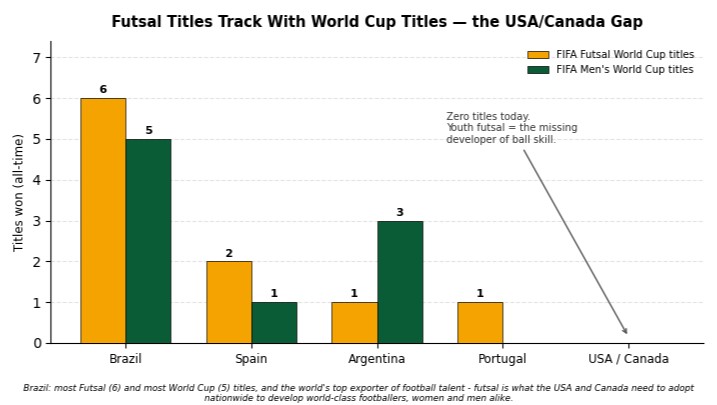
At STL, we realize that futsal is a youth training platform that should be embraced as early as possible in a player's career (boys and girls). With that in mind, here is how STL sees the approach to youth in the USA and Canada.
For age groups 1-5 – STL will promote Tom Byers’ Soccer Starts at Home Model – recognizing that a smaller sized football at the feet of toddlers and pre-K children is the best introduction to the intimacy needed to master the ball skills at the more senior age levels. It is also in this age group that the love of the ball and the game is developed. At this level parental involvement should be minimal or not at all. Simply leave balls around and make them available in as many varied settings as possible (both inside and outside the home).
For age groups 6-12 – STL will promote futsal across the USA and Canada in all secondary schools, both private and public, using existing infrastructure and FIFA official futsal parameters for the ball itself and the courts (which can be readily adapted to existing basketball court infrastructure). Futsal is the most popular sport in Brazil for a reason. The skills developed in futsal translate as the principle reason Brazil continues to be the largest exporter of footballing talent on earth.
All STL clubs will promote futsal across all age groups.
For age groups 13-18 – STL will again leverage existing private and public school infrastructure for year-round football for the first time with an emphasis on outdoor (grass) and indoor (futsal) playing surfaces. The philosophy of outdoor grass football fields will be the STL standard. Futsal at this level will continue to be a priority, along with beach football (both indoors and outdoors) for stamina and training.
This age group will solidify the already existing proposal, following Japan’s example, for a National High School Football Championship (NHSFC).
In short, STL is and will be working with local public high schools and public high school infrastructure and importantly, public high school culture (where the rivalries are quite naturally local and regional) to create a new "free" platform for the revelation of urban based footballing talent for both boys and girls and adolescents.
Where possible both private and public high schools (and fully integrated K through 12 schools) will compete for the annual NHSFC.
For age groups 18 and up – STL will work with two channels – (i) the NCAA and colleges and universities at the D1, D2, D3 and D4 levels, and via (ii) its own STL professional infrastructure which will be fully integrated with STL-sponsored and non-STL sponsored youth football and futsal leagues and clubs, for a smooth transition into collegiate sports and/or the STL professional ranks into STL and/or STL2 (with Pro/Rel in the given STL relevant region).
An Overview of Fan and Community-Owned Football Clubs
FC Bayern Munich
By way of example, and as stated earlier, Bayern Munich is the largest fan-owned football club in the world. At more than 430,000 dues paying members, this multi-sport football club is structured as a not-for-profit (NFP), while its professional football operations (what we see on TV) are structured like an LLC. Of that LLC, the fans own 75% and the remaining 25% is split equally between Audi, Allianz Insurance and Adidas (8.3% each) .
Bayern plays in Allianz Arena, which seats 75,000, and generated almost USD 1 billion in revenue for the 2025-26 season. Incredibly, the majority of the fan-owned clubs in the Bundesliga are operating in the black and generating profits.
While most people focus their attention on the EPL, statistically the Bundesliga is the financially healthiest football league in the world. It has the highest average attendance in the world at 42,000+. It has the least debt of any football league in Europe and out of the 36 clubs in the 1st and 2nd Divisions, only 3 are not fan-owned and controlled.
The Bundesliga as a whole (Bundesliga + Bundesliga 2) generated USD 6.68 billion in revenue last season (2024-25 season). If the trend holds, the 2025-26 combined Bundesliga revenues will be USD 7.16 billion.
STL believes that each of the 4 regions in the USA and Canada referred to above, can match the Bundesliga's revenue generating potential by 2032.
Club Atlético River Plate
River Plate is completely fan-owned and operated. By Argentinian law, most football clubs operate as non-profit civil associations (asociaciones civiles sin fines de lucro), meaning no private investors or corporations can own a majority stake or take profits out of the club.
The club is community-owned and run by its members (socios) who pay monthly fees, elect the president and board of directors, and vote on major club decisions.
Today, River Plate has one of the largest active paid memberships in the world, totaling approximately 352,000 members. By most accounts this ranks River Plate in the Top 5 global football clubs by membership:
#1: Bayern Munich (432,000+)
#2: Benfica (392,000+)
#3: River Plate (352,000+)
#4: Boca Juniors (315,000+)
#5: Borussia Dortmund (220,000+)
River Plate (known locally as Los Millionarios) plays in Estadio Monumental Antonio Vespucio Liberti (a/k/a Mâs Monumental), which holds roughly 85,000. River Plate is the highest attended football club in the world, having sold out for the past 4 straight years.
Mâs Monumental is receiving an upgrade and its new capacity will be 101,000. Only FC Barcelona's Camp Nou will be larger at 105,000.
River Plate's youth academy has produced the following players:
- Alfredo Di Stéfano
- Daniel Passarella
- Ariel Ortega
- Javier Mascherano
- Gonzalo Higuaín
- Pablo Aimar
- Erik Lamela
- Julián Álvarez
- Enzo Fernández
Education is an integral part of the academy and STL will adopt that model for all STL clubs.
Clube de Regatas do Flamengo
Flamengo is one of the largest fan-owned clubs in the world at 118,000+ club member-owners, and it is definitively the richest in Latin America. It is the only club outside of Europe to qualify for the Deloitte Football Money League Report (2026) Top 30 in the world.
This past year, Flamengo recorded annual revenues exceeding R$2 billion for the first time in its history (roughly USD 350 million). It plays in the legendary Maracanã, which seats 78,000+.
Importantly, Flamengo embodies the best example of a multi-sport football club. It has an array of Olympic sports available for all ages, boy and girls, with both amateur and professional growth lines. The key sports are: football, basketball, futsal, swimming & diving, volleyball, tennis, rowing, gymnastics, judo and table tennis.
The club operates as an urban country club for monthly dues paying members, with programs for children of all ages, with restaurants, poolside leisure areas, and the courts and fields for the amateur and professional sports listed above for both women and men.
Flamengo has sent multiple representatives to the Olympics from most of these sports. In the most recent Paris Olympics (2024), Flamengo won six medals: a Gold medal in gymnastics, and Silvers and Bronzes in rowing and judo.
Flamengo represents the best example globally of a multi-sport football club that is administered by its club member-owners.
Flamengo's youth academy (Ninho do Urubu -- "The Vulture's Nest") has produced the following players:
- Zico
- Júnior
- Adriano
- Júlio César
- Adílio
- Andrade
- Tita
- Leandro
- Vinícius Júnior
- Lucas Paquetá
- Reinier
- Sávio
- Aldair
- Djalminha
To round out the picture of the multi-sport football club model, it is worth remembering that Luka Doncic, the star of the NBA's Los Angeles Lakers, played professionally in Europe for Real Madrid.
This is the 50+1 multi-sport football club model that STL is bringing to the USA and Canada.
Football supporters everywhere and particularly the families of youth footballers must lead the way!!!
First, and again, let's remind ourselves again of the fact that the USWNT is the only global standard of excellence that we have in the USA. There are strong arguments, however, to support the idea that Title IX has more to do with the USWNT's success than "pay-to-play."
In TFM II, we will deal with the split between NWSL and MLS as two arguably competing business models, and how in juxtaposition to Europe and Latin America, this is not the best route from the women's game in the USA and Canada.
Second, and just as importantly, the "pay-to-play" model as has been stated, has contributed very little if anything to the men's game. By any global measure of excellence, the USMNT is underperforming.
When that is coupled with the damage done by "pay-to-play," over the decades, which has excluded literally tens of millions of youth because they simply couldn't afford it, we have a serious situation on our hands.
The good thing about raising USD 5MM is that we will be able to leverage and maximize cutting edge social media and mobile technology (including where we can AI) and that means that what would have taken 10 times the amount of money and time a decade ago, can be done relatively cheaply and in a much shorter time-frame.
We believe that the process of change in the USA for The Beautiful Game, has to begin NOW. Time is an enemy.
The USD 5MM will be allocated to cover all the BUS and TDS costs associated with:
(a) legal, finance, tax, accounting and marketing (social media) for STL, TUSA, FOCUS and Urban Refugee,
(b) design of STL's "football kits" and related merchandise for the planned 32 fan-owned football clubs,
(c) technology build-out of the Urban Refugee digital platform for STL (and its clubs), TUSA and FOCUS for fan and club registrations and voting (possibly via blockchain), and for the build-out of the mobile app that will launch STL and its fan-owned clubs, and
(d) the hiring of the first lean staff for the implementation of the STL vision.
What Will I Get By Donating USD 100.00 or More to this GoFundMe?
Importantly, U.S. law requires that this kind of donation not be "in exchange" for a good or service. You are donating to a "cause," namely, STL's new 50+1 business model, STL's new branding strategy for professional multi-sport football clubs, and in particular STL's strategy to create a viable, well-structured nationally-based alternative to the "pay-to-play" model, that is fully integrated with Pro/Rel and youth development in each region below.
It means you are setting the stage to be a member-owner of a world-class football club in the USA and Canada, just like club members who support Real Madrid (95,000+ club members), Barcelona (140,000+ club members), Bayern Munich (340,000+ club members), Flamengo (118,000+ club members, Boca Juniors (280,000+ club members), and River Plate (350,000+ club members).
These six (6) clubs collectively have 1.323 million dues paying members.
All of these clubs are fan-owned democratic institutions. STL intends to replicate this model by 10x in the USA.
Again, STL is being structured to create a 50+1 model (like the clubs above) via a new set of fan-owned clubs and brands to rival these European and Latin American club benchmarks.
What has been described in this GoFundMe campaign is the crucial Bottom-Up Strategy (BUS).
The BUS is rightfully focused on the 90 million football fans in the USA and Canada, and in particular, the 5 million youth footballing families in the USA that have supported the pay-to-play youth football model with their time, money and passion for the past 3 decades.
STL is the opportunity to transform those 90 million fans and especially those 5 million youth footballing families in the USA into football club member-owners. Not consumers!!! Member-owners!!!
We only need 50,000 fans and/or youth footballing families (1% of the total youth footballing families in the USA) to contribute USD 100,00 each and STL will have reached its goal -- the triggering of a new fan and community-owned paradigm for football in the USA and Canada.
The STL model means that cash flows and revenues will be maximized for the sport of professional football in the USA and Canada for the first time.
It also means that those cash flows and revenues and profits, will be returned to the fans, youth footballing families and their community-owned clubs and to the communities themselves, instead of being upstreamed and treated as dividends and/or franchise value enhancements for billionaires.
PART IV -- The Top-Down Strategy
In order to restructure football from youth to the pros in the USA and Canada, we also need a Top-Down Strategy (TDS).
The TDS:
The TDS necessitates the creation of a dedicated STL investment fund for a roll-up and consolidation of football in the USA and Canada.
Such a fund (the STL Football Fund (STLFF)) will also include a strategy for the construction of a new family of larger state-of-the-art multi-use and importantly (where applicable) multi-sport football stadium facilities to be allocated across the already mentioned 4 STL regions.
The STLFF will be a greenfield fund for all of STL's infrastructure needs.
STL via the STLFF will establish wholly-owned and controlled sub-funds in each region where it deems appropriate to meet the league's needs.
STL's first wave of stadium infrastructure is targeting a minimum of 4 new stadiums in each region for a total of 16, where those new stadiums would average 45-50,000 seats. Because of the scale of the infrastructure challenge and following U.S. Securities & Exchange Rules (SEC), the STLFF will not be a retail product, and therefore, will only be available to SEC "qualified investors."
This GoFundMe campaign, however, is not focused on stadium infrastructure.
This GoFundMe campaign is about grassroots football fan empowerment and creating STL's legal and institutional framework for the fan-owned club membership alternative to the overwhelmingly dominant strictly consumer-based model currently associated with professional sports and football in particular in the USA and Canada.
The new proposed stadium infrastructure, coupled with STL business model (50+1) and STL's football club branding strategy will be the key to unlocking the full monetization potential and value of football in the USA and Canada.
STL's Amazon Value Creation Approach
Think of what STL is doing along the lines of Amazon's business model. For years, Amazon lost money until it completed the build-out of its warehouses, supply chains and delivery mechanisms. All of that was necessary CAPEX. Once that CAPEX exercise was completed and fully functional Amazon broke even financially. Then it recouped all prior years' losses. Then it became operationally profitable. Today, Amazon has a market capitalization of USD 2.65 trillion.
For STL, the difference that makes all of the difference, is that those cash flows and revenues will be recycled back into the league, the clubs and the communities that support these fan-owned clubs.
STL's research indicates that there are 90+ million hard core football supporters across the USA and Canada. This group is not spending their hard-earned cash on the NFL, the NBA, MLB, the NHL or MLS.
They watch The Beautiful Game on TV by following the EPL , the Bundesliga, La Liga, Serie A or Ligue 1 or one or several of the great clubs from Europe. In the alternative and increasingly a substantial subset of this group follows Mexico's Liga MX.
There is simply no product in the USA and Canada for them to support and monetize against. That 90+ million fan number is based on today's demographics. We believe that when STL is fully in-gear, that number will rise.
Once STL structures itself (with grassroots support from the four groups being targeted by this GoFundMe campaign, which includes the 5 million youth footballing families in the USA), we will be repeating what the J-League did over 30 years ago, but with a twist.
The twist is that STL's fans, families, players and supporting staff are the conceptual pivot of value creation. Corporations, billionaires and millionaires will play structured supportive roles.
Some Closing Remarks About the J.League
The launch of the J.League over 30 years ago is part of STL's inspiration.
When the J.League officially launched in 1993, it began with 10 founding clubs. One of the defining features of the league was that each club had emerged from the company teams of major Japanese corporations (mostly composed of factory workers). Although the clubs adopted city identities rather than corporate names, the corporations remained their principal owners and financial backers.
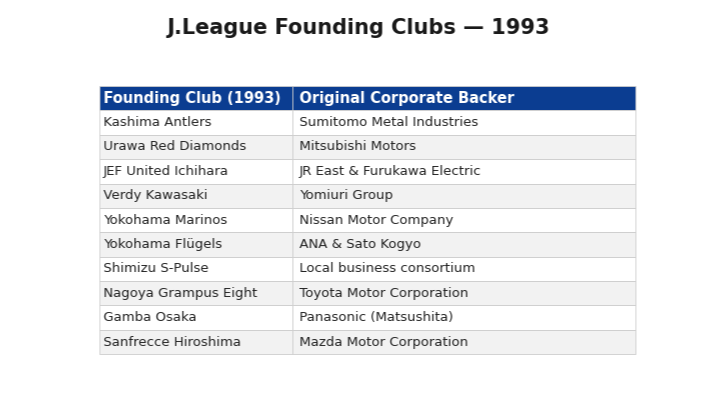
There are two important exceptions. The table reveals two interesting departures from the “one company, one club” model:
- Shimizu S-Pulse was created from scratch as a community club rather than evolving from a corporate works team. It was financed by hundreds of local companies and civic leaders in Shimizu, making it arguably Japan’s first truly community-based professional football club
- JEF United Ichihara and Yokohama Flügels each had two principal corporate sponsors, reflecting partnerships rather than single-company ownership
Why this matters
The J.League deliberately transformed Japan’s traditional corporate sports model into a city-based football culture:
- Clubs dropped corporate names in favor of geographic identities
- Companies remained owners or principal financial supporters
- Clubs were expected to build local fan bases rather than serve primarily as employee teams
- Municipal governments, supporters, and local businesses gradually became more involved over time
This hybrid football club creation approach proved highly successful and has become one of the most influential models in Asian football.
It is also worth noting that the J.League’s founders viewed these corporations primarily as anchor investors. Their long-term objective was not to create permanent corporate clubs, but to use corporate capital to establish financially stable clubs with deep local identities and community connection. That transition from company teams to community institutions is one of the central lessons of the J.League model.
STL's four business models mentioned above (particularly models "C" and "D") are adaptable to exactly this kind of (local) corporate, fan and community modeling.
At bottom, STL is creating a football culture in the USA and Canada. STL is flexibly adaptive to the variety of cultures and financial models that make up the football mosaic of both countries.
By creating a flexible approach and an "open door," by 2032, STL will be generating more revenue and more profit than any other football league in the world.
Lastly, please remember to buy The Football Manifesto and Club Handbook: Bringing the Beautiful Game to the People and Making the USA #1 in the World (TFM). TFM is available in paperback, on Kindle or on Audible. TFM is available from independent booksellers. If you buy it on Amazon, please give it a 5-Star rating.
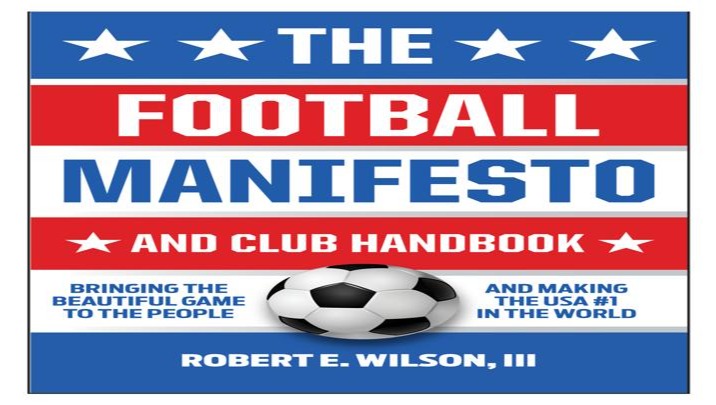
The Football Manifesto II: Blueprint for a Football Revolution in the USA -- An A-to-Z Toolkit for Creating Football Clubs (TFM II) will be out shortly.
It is time to shed the role of being a mere consumer of football.
STL is the opportunity to become an member-owner and stakeholder in your club and in The Beautiful Game in the USA and Canada.
STL is that avenue and product.
Put football in the hands of its fans and their communities where is belongs!!!
To the army of football supporters in the USA and Canada, who have long been dormant -- this is your Wake-up Call!!!
"Here’s to the crazy ones. The misfits. The rebels. The troublemakers. The round pegs in the square holes. The ones who see things differently. They’re not fond of rules. And they have no respect for the status quo. You can quote them, disagree with them, glorify or vilify them. About the only thing you can’t do is ignore them. Because they change things. They push the human race forward. And while some may see them as the crazy ones, we see genius. Because the people who are crazy enough to think they can change the world, are the ones who do."
-- Steve Jobs
Please spread the GoFundMe link to your networks!!!
Remember: Real Footballs Are Round!!!!
(*) Statistics from Deloitte's Football Money League Report (2026).
For a quick overview of the vision please listen to this interview on Dave Zirin's Edge of Sports Podcast: https://podcasts.apple.com/us/podcast/edge-of-sports/id280938935?i=1000698783372
Organizer