- S
- A
It has always been my passion to work with wildlife. Since graduating in 2017 from the University of Vermont with a Bachelor of Science in Wildlife & Fisheries Biology, I have had the opportunity to live and work in 8 states as a wildlife technician on different projects. I learned early on in my career that I wanted to work with lesser-known species of conservation concern.
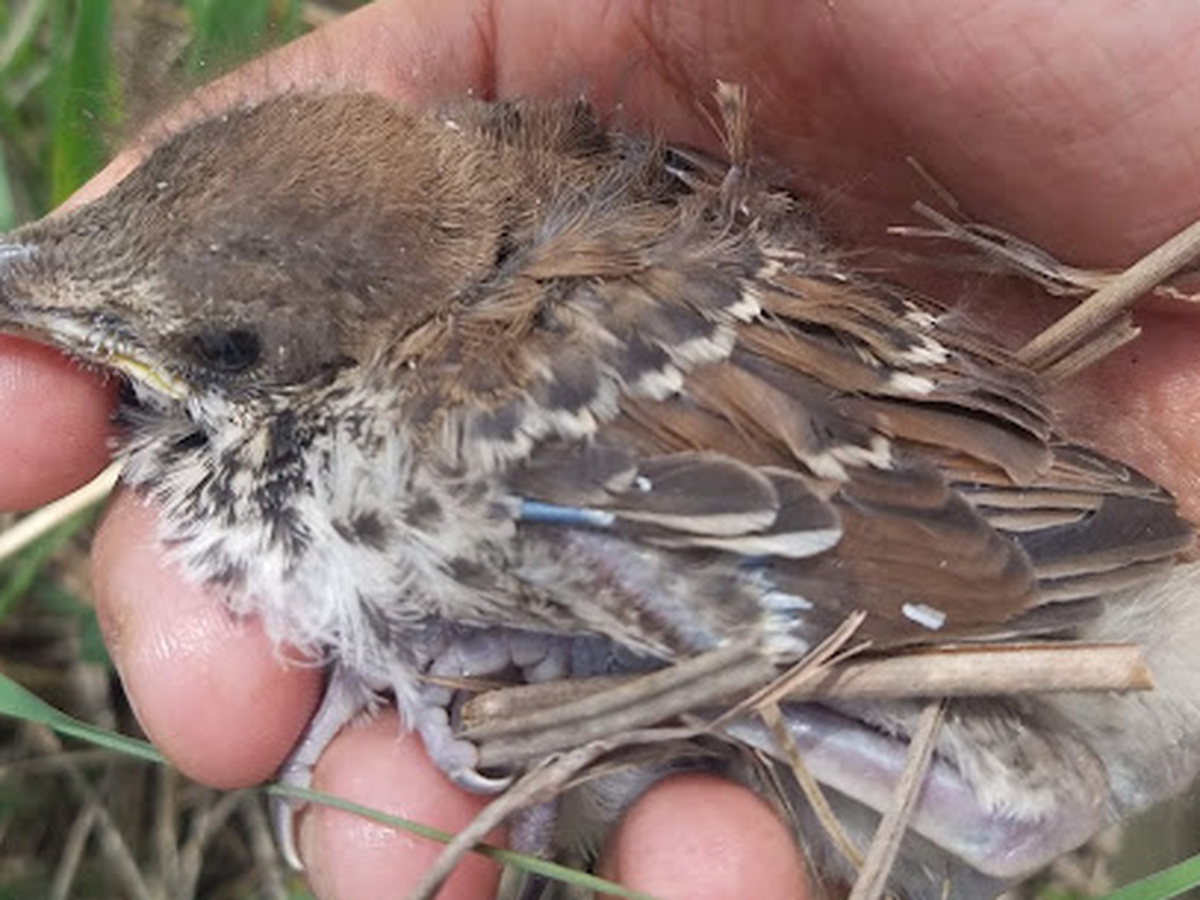
It was with great excitement that I started graduate school at Antioch University New England in 2020, pursuing a Master of Science in Environmental Studies with a Conservation Biology concentration. While pursuing my degree, I began my thesis study on a bird in my home state of Massachusetts, the Brown Thrasher! While not as well studied as other birds in the region, the Brown Thrasher is just as important! My study aims to determine if the Brown Thrasher has a preferred habitat in Massachusetts. I have had great success researching this bird the past two summers! Once completed, my thesis will be published through Antioch University New England and sent to Massachusetts Fish & Wildlife to help implement conservation and management practices for the Brown Thrasher.
The summer of 2023 will be my final field season studying the Brown Thrasher before I begin my data analysis. The data collection takes place in shrubland adjacent to different habitats (farmland, pine barren forests, and deciduous forests) and the shrubby edges of farmland. During early spring, I conduct point counts from sunrise to 9 am and record all birds I see and hear. While the emphasis is on the Brown Thrasher, it is important to document all birds detected in these areas for further analysis. Later in the summer, I return to each field site to collect vegetation data for habitat analysis; this consists of but is not limited to measuring vegetation height, identifying plant species, and measuring downed woody debris.
I have applied to a few small grants, but funding has been limited! This summer, my field sites are in Western Massachusetts. I am looking for funding for housing ($700), partial tuition payment for thesis credits during the summer ($1,300), and gas reimbursement ($500). Any additional funding would go towards the remaining tuition costs for my final year in grad school! Please see below for more information regarding the Brown Thrasher.
Thank you so much!
Alec Woolf
In the Northeastern United States, birds residing in shrubland and early-successional habitats are a guild that is declining due to habitat loss in the region (King and Schlossberg 2014). Since 1950, New England has lost 66 percent of its shrubland habitat (King and Schlossberg 2014). Currently, powerline corridors provide roughly 10 percent of shrubland habitat for species in Massachusetts (King et al. 2014).
One shrubland avian species that is declining in the northeast is the Brown Thrasher (Toxostoma rufum). The Brown Thrasher can be found from the Northeastern United States to just east of the Rocky Mountains and parts of Texas. In the Northeast, the Brown Thrasher’s decline tends to vary from state to state. Based on breeding bird surveys, the Brown Thrasher has declined from 25-45 %. It is considered a species of conservation concern in several states, such as New Hampshire, Rhode Island, Connecticut, New York, Vermont, and New Jersey. In Massachusetts specifically, the Brown Thrasher has declined by 32 %. The Brown Thrasher has mainly disappeared from the Southeastern and Western parts of Massachusetts (Mass Audubon 2022).
In the Northeast, the Brown Thrasher is found in shrubby fields with young trees, powerline areas, and pine barrens (Cavitt, J. F. and C. A. Haa 2020; NH Fish & Game, n.d). Due to its cryptic nature, the Brown Thrasher's migration patterns are not well known, especially its fall migration. Thrashers are known to arrive in Massachusetts in mid to late April. Based on spring 2017-2022 findings, birders have detected Brown Thrashers along the coast, on farmland, within pine barren conservation areas, and near hardwood forests (E-Bird 2022).
References
King D. I. and S. Schlossberg 2014.Synthesis of the Conservation value of the early-successional stage in forests of eastern North America. Forest Ecology and Management 324:186-195.
King, D.I., Schlossberg, S. Brooks, R.T., Akresh, and M.E. 2011. Effects of fuel reduction on birds in pitch pine scrub-oak barrens of the United States. Forest Ecology and Management 26(1): 10-18.
Smetzer, J.R., King, D.I., and S. Schlossberg. 2014. Management regime influences shrubland birds and habitat conditions in the Northern Appalachians, USA. The Journal of Wildlife Management 78(2): 314-324
Mass Audubon.2022. Breeding Bird Atlas Species Accounts. Retrieved from: https://www.massaudubon.org/our-conservation-work/wildlife-research-conservation/bird-conservation-monitoring/breeding-bird-atlases/bba2/find-a-bird/(id)/4908. Accessed October 2022.
Cavitt, J.F and C.A. Haas. 2020. Brown Thrasher (Toxostoma rufum). Birds of the World. Cornell Lab of Ornithology. Accessed February 2021. Retrieved from: https://birdsoftheworld.org/bow/species/brnthr/cur/introduction
New Hampshire Wildlife Action Plan Appendix A Birds-355, N.D. Retrieved from: https://www.wildlife.state.nh.us/wildlife/profiles/wap/birds-brownthrasher.pdf. Accessed October 2022.
eBird. 2022. eBird: An online database of bird distribution and abundance [web application]. eBird, Cornell Lab of Ornithology, Ithaca, New York. Available: http://www.ebird.org. Accessed October 2022.