- S
- P
- P
I have had primary progressive multiple sclerosis for over 25 years. I am now 53 which means I have been sick for half my life and for almost all of my adult life. Primary progressive is the worst type of multiple sclerosis, if there is such a thing as a hierarchy of misery in the world of MS. Primary progressive multiple sclerosis is progressive from the beginning. Here's a little story: some years ago I went to a play. I sat in the disability designated section. The lady sitting next to me and I struck up a conversation. She shared she had multiple sclerosis and I told her I had multiple sclerosis too. She asked me what type and I told her. And then she said: “I'm so sorry”. Perhaps this helps you understand that primary progressive multiple sclerosis is one hair away from being a rare disease. People with my form of MS rarely, and I mean rarely, qualify for clinical trials. There's only one type of medication for and it has been described by some very respectable specialists as less than promising. But check this out: it wouldn't matter if it were a very effective medication because I don't qualify for it since I don't have the form of primary progressive multiple sclerosis that this medication can mildly, slightly, vaguely, somewhat help. There are categories within categories within categories, and apparently I belong to the extra shitty category. And yet, I have never asked myself “why me?” I find this to be a pointless and rather selfish question. Why not me? And if not me, then who? Why somebody else?
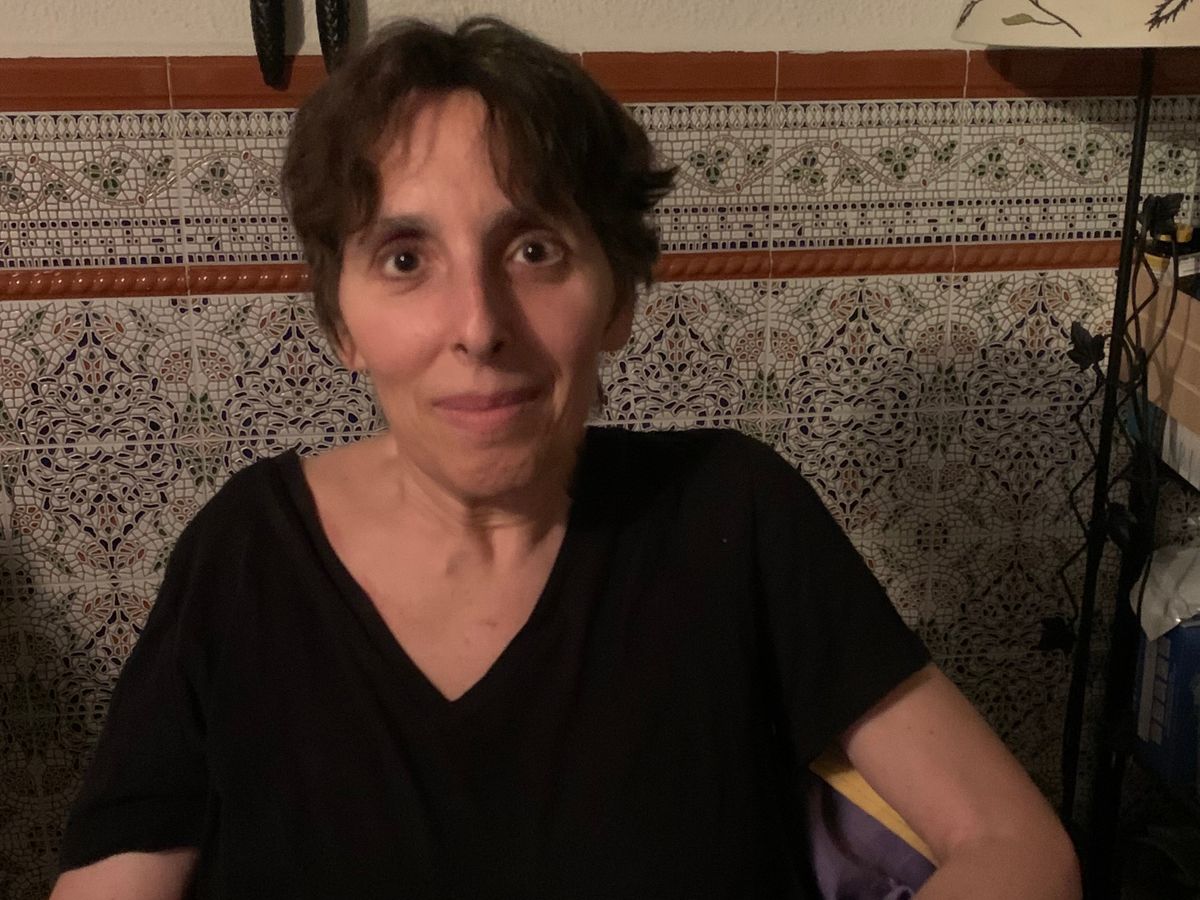
The Expanded Disability Status Scale measures progression of disability in people with multiple sclerosis. It goes from 0 to 10, 0 being healthy, and 10 being dead due to multiple sclerosis. I currently measure 8.5, which translates to being "essentially restricted to a bed or a chair or being pushed in a wheelchair, has some effective use of one arm, retains very few self-care functions". I occupy a 97 ft.² space and I need assistance with almost everything. Allow me to be a little bit extra graphic to describe my daily routine. At 9:30 AM the first caretaker comes. She gets my meals ready, gets me out of bed with the help of a lift and sits me on a shower commode on wheels. She takes me out to a patio where she bathes me with a hose, come rain or shine. She takes me back inside, she gets me dressed and "parks” me at my desk before leaving, and there I stay until 2:30 PM, when the next caretaker comes and moves me from the shower commode to a regular wheelchair. She leaves and I stay there until 8:30 PM which is when the last caretaker comes. She gets me ready for bed and then leaves. I stay in bed until 9:30 AM the next day when the routine starts again, 4 meticulously planned caregiving hours a day which is what I can afford. Day in and day out I’m moved from my bed to the desk where I am now typing these words, the desk where I eat, the desk with the iPad with which I read, I watch movies and documentaries, I listen to interesting talks, I listen to podcasts, I get the news, I tutor English and Spanish, I video call my friends, I interact with the world... For years I've been working hard on normalizing and making sense of this rosary of crap but it is not easy. And yet, I can find ways to grow and to find enjoyment in the very physically and emotionally limited and isolating space I occupy. I can find resilience and patience. One thing difficult to find though is financial security.
I recently read an article in The Atlantic on Canada's euthanasia law. I found it telling although, at times, a bit misleading. There were a few cases mentioned that particularly hit really close to home such as the case of a 44-year-old woman who had ALS, who needed more care hours than she was provided, who could not afford private caretaking and who didn't want to end her days in a long-term care facility. She wrote her own obituary and she ended it up by writing that she could've lived longer if she had had more help. The author of the article described her case as an example of when applying for MAID (Canada's euthanasia law) can hardly be viewed as a “triumphant act of autonomy”. The way I read it, her heartbreaking protest was not against her country’s euthanasia law. It was against systems that are not equipped to deal with the needs of people with dependent physical disability. Society’s view is that all the serious financial difficulties that come with chronic diseases that result in disability and require caretaking are just part of the disease package. The message seems to be: your lives are not worthy of saving and those of you who have lost the physical ability to take care of yourselves and don't have the means to pay for caretaking, move to a long-term care facility, so that we can segregate and institutionalize you. You're not just sick: you are sick, impoverished, irrelevant… Just vanish away, the sooner the better. Talk about complete loss of autonomy. But I am not here to discuss Canada's or any other country’s death with dignity laws. I am here because I find myself in a very similar situation. For the over 25 years I have seen pieces of me and my life evaporate, one after the other: my health, my desire to have a family, emotional and physical connection with a partner, my job as a public school teacher, my home, financial security, and finally, most of my participation with and in the world. And as perplexing as this may sound to some people, just like the lady mentioned in the article, I want to live longer. We greatly admire the journey and courage of famous people who find themselves in this type of situations. We listen to the interviews, we buy the book with their live story, we watch the movie based on the book… Are the requirements to be considered worthy of continuing living in the face of this medical circumstance wealth and fame? It appears so. Well, I am not irrelevant. I am worthy of saving and my life is worthy of being fully lived to the limits imposed by my physical disability, not the ones imposed by my financial means. So I am here looking for help in the form of a GoFundMe account which I opened myself. I'm doing this because, as I heard a famous comedian say in an interview, nihilism is pretty useless. I still have intentions and I want to put them toward achieving my fundraising goal. Since 2015, when I stopped working and went on disability, I have spent around $250,000 to cover my caretaking, equipment and adaptation needs.
I worked for as long as I could, for as long as my body allowed me. I was a public school teacher in Oregon and I taught, in Woodburn and Salem, using a cane, then using a walker, then using a wheelchair. When I called Social Security to apply for disability, the gentleman on the other end of the line asked why I had waited so long to start the application process. The answer is easy: I loved my job and, in any case, I waited and waited until my body could not wait any longer so my Social Security contribution and, therefore, my disability pay would be as high as possible. Regardless, I lost my home. I was forced to sell it, since having to pay for care and mortgage made it impossible to make ends meet. Affording caretakers and keeping my house was out of the question but having to sell my house pushed me to make yet another heartbreaking and life-changing decision. After making the United States my home for 30 years, I realized that the best and only dignified course of action was to move back to my birth country, Spain, where the cost of living is lower and where I could afford having a home again, maybe? You could say I was lucky? in one regard though. Before I left the US, I went to see my neurologist one last time and he mentioned a private clinic in Puebla, Mexico, that offers an experimental treatment for multiple sclerosis. This treatment is available as clinical trials in a number of hospitals around the United States and other parts of the world, but only for people with the most common form of multiple sclerosis. Given my type of MS and its advanced stage, I was never going to qualify for any of those clinical trials. So I had to try the private clinic (I have to say that I humbly think it worked to slow the progression of my illness) but… I had to pay for it myself, of course. There went a large portion of the money I made from the sale of my house and there went the idea of starting anew, as ridiculous as that might sound to many people given my condition.
I've been wondering lately how I ended up here. I have worked hard all my life, I gave the United States my most "productive" years and I've always paid my taxes. But it's rather a rhetorical question because, as I also read recently in The Atlantic, most of us are one shock away from poverty. I know how I ended up here: caretaking is very expensive, disability is very expensive and the United States does not have a system set up to help people in my circumstances: dependent disability. Most countries don't. They expect families to pick up the burden. Sometimes families are not able, sometimes families are not willing. Multiple sclerosis has a tendency to show up in your mid/late 20s, right about the time you're trying to shape your adult life. When my MS started to show up I was 26 years old. I almost drowned in a wave of confusion and fear. When you don't even know if you'll be able to carry that fear, you need to accept that it will be highly unlikely finding a partner who will help you to carry the weight of the illness, the weight of the fear and the weight of the financial burden. So a single life it is. I am a severely disabled single woman in her early 50s who was forced to retire early. Early retirement plus singleness make my financial struggles that much more complicated. To top it all off, the financial model of those of us who need caretakers is a bit wacky. When you need to pay for care it is as if you were forced to be the owner of a shoe shop where you are the only customer; as if you paid your employees for helping you to try on the shoes, boxing them, bagging them, so you can take them home with you…, and the thing is you never wanted to open the shoe shop to begin with. As I am writing this, I'm actually amazed and, may I say, proud that I've made it this far. My disability is inversely proportional to my financial resources but directly proportional to my determination. So I decided to open a GoFundMe page. When I had the treatment, there were other patients from the US, and other parts of the world, with me in the clinic, and many of them had gathered the money for the treatment through fundraising. I am fundraising now, post treatment, to recover what I spent. More than 65% of people who declare bankruptcy in the US do it because of medical bills. I did not declare bankruptcy but I lost my home and now I exist in a 3 m x 3 m room and, predictively, the place where I live is not adapted to my needs, which makes my physical limits even more limiting. Indeed, selling my house in the United States was personally devastating but it allowed me to have an important and expensive medical treatment as well as a dignified, although limiting and isolating, next chapter of my life. The other option was moving to a low income care facility for severely disabled people. I am acquainted with the unacceptable and depressing conditions of those places, which put profit over service, and I refuse to make that my final destination in life. To move to a care facility is to consciously choose to accelerate the process of withering away. And I want to live.
Lately I have also been thinking that I could have started my fundraising when I was in the United States and I would have been able to keep my house and pay for the treatment, perhaps... I might have saved myself a lot of heartbreak and trouble. The US was my home and the country that shaped me profoundly to become the person I am today and having to leave it and to leave my friends and my younger sister and her family behind was not easy. But believe it or not, it did not occur to me. Perhaps there is a logic as to why I did not quite grasp how difficult my situation was, is. You see, since I was able to sell my house, as personally heartbreaking as that was, I walked away from a financially difficult situation debt free, bankruptcy free and with a profit that I thought at the time would be enough for a down payment for a house in my hometown to start all over again. Then came the treatment and since, despite the cost, I was able to pay for it with part of the profits from the sale of the house, I counted myself lucky for having the money for it. But there went the possibility of having a home again. In any case, I always thought of GoFundMe.org as a resource people use to ask for help to cover one-time costly medical surgeries or treatments. Turns out a chronic disease that results in disability is vastly more expensive. By the time I became fully aware of all that, I was already in Spain. And then again, I have lost so much, I have had to abandon so many dreams and I have had to learn to accept so much hardship and indignities that perhaps I became numb to the reality of more losses. Or perhaps I didn't and I am here now because here is where I need to be. I don't believe in the idea that things happen for a reason. I believe shit happens, to me, to you, to all of us, and sometimes, if we're lucky, we learn something because of it.
It's been three years since I left the States and a year since I started my GoFundMe page. When I first moved here, I had to stop using my motorized wheelchair and replace it with a terrible manual wheelchair whose only virtue was being small enough to fit into the elevator in the building where I live. Thanks to donations from friends and family, I have been able to find a chair that is wide enough to finally fit a good cushion and that still fits into the elevator. I have also been able to buy a very good airflow mattress to prevent pressure sores or ulcers. I can say now that, for the first time in a long time, my days are mostly pain-free and my nights are restful, which is no small accomplishment. The donations I have received so far were also essential to help me cover around 45% of my yearly MS related expenses. I am forever grateful.
I hardly ever leave my room. I see very few people over the weeks and months, except for my caregivers and my friends via video call. Parked in a 3m x 3m room all day, my sanity hangs by a very thin thread, gripped firmly by the fist of my resilience and curiosity, which is what drives me to sit in front of my iPad and use it to learn things and not go completely bananas. Showering on the terrace with a hose, in the cold of fall and winter, is a very unpleasant experience but, since the place where I live is not mine, I cannot make the necessary adaptations. I read my books on Libby and I watch my movies on Kanopy, so they're free. I haven't bought new clothes in a while. I have three weekly "uniforms" for the cold weather and three weekly uniforms for the warm weather that I rotate through every three weeks. And for the last four years, my only footwear has been a pair of slippers. When I needed to go to the dentist, having not been for six years, I went on a French website I learned about in the rabbit hole that is Internet. This website presents information on a large number of auctions held daily in France. I bid on four 18th-century tapestries, won, and sold them to raise the money for the dentist and cover other health-related expenses. It took me two and a half years to sell them, but I did it all without leaving my desk, simply by pressing buttons. I have no shortage of effort and imagination. However I've reached a point in my sclerosis where it wants to force me to live in the here and now. What my illness wants now is for me to exist, to simply survive, and I rebel against it. I believe what truly sets human beings apart from other animals is our ability to dream and to make projects. People dream of having a partner, having a family, becoming a parent, opening a business, having a job they like, traveling, creating things with their hands; people also have short term projects, daily projects such as going for a walk or going for a swim or going for a bike ride, or going out to eat. None of that is available to me. I need a project because living in the here and now is what mayflies do and I am not a mayfly. But most of all, I want to continue learning, I want to enjoy more time and conversations with my friends and my family, I want to see my nephews grow and I want to be there to try to help them become good, principled, and loving people. I want to continue to be in awe of the experience of being alive. And truly, that is the heart of it: the right to experience life should arise from the will to live it, not from the weight or the limits of one's pocket. Would you help me meet my fundraising target to recoup the money I spent on the treatment ($75,000) and use it to cover my ongoing medical expenses. I humbly ask you to contribute and share. Thank you from the bottom of my heart, Rebeca
Organizer