Applied Scholastics
African Literacy Campaign - 2026
Building the Capacity to Learn
The Challenge
Despite Ebola, COVID and endemic poverty and corruption, there is one constant over our 20 years of work in West Africa: the children, striving to learn in off-again, on-again school systems turning out generations of functional illiterates.
In Liberia, education is still recovering from years of genocidal civil war, tripped up by two pandemics. Only about half of children complete primary school. For those that stay the course to adulthood, real learning gained is closer to two years in school by developed world standards. Students move from grade to grade without a strong foundation, while teachers do their best without the practical tools to support real understanding.
In Ghana, the situation is hopeful, on the surface. Institutions are stable. A national competency-based curriculum is already in place. Yet, national test results still show many students struggle, especially in math and English. Teachers are being asked to teach in new ways without enough hands-on training to make a meaningful difference.
In both countries, access to school is not the problem. It is whether actual learning is occurring. And so, we work.
Progress to Date:
2006
Our work began through the African Human Rights Leadership Campaign, engaging young people in Liberia, Sierra Leone and Ghana around civic education and leadership.
2006–2014
While we were able to activate thousands of youth as peer human rights educators across West Africa, it became clear that literacy and learning capacity were the roots of many larger challenges.
2014–2015
The Ebola shut down of Liberia’s schools redoubled our determination to focus directly on learning.
2016
We formally partnered with Applied Scholastics International an organization uniquely qualified to offer the solution to illiteracy through the proven effective learning methods of American author and innovator L. Ron Hubbard, widely known as “Study Technology ” or “Study Tech.” We started in Liberia, delivering structured, competency-based student and teacher Study Tech workshops focused on how learning works.
2016–2019
Multiple workshop trainings in Liberia, Ghana and Sierra Leone, working with teachers, universities, and education leaders.
2020–2021
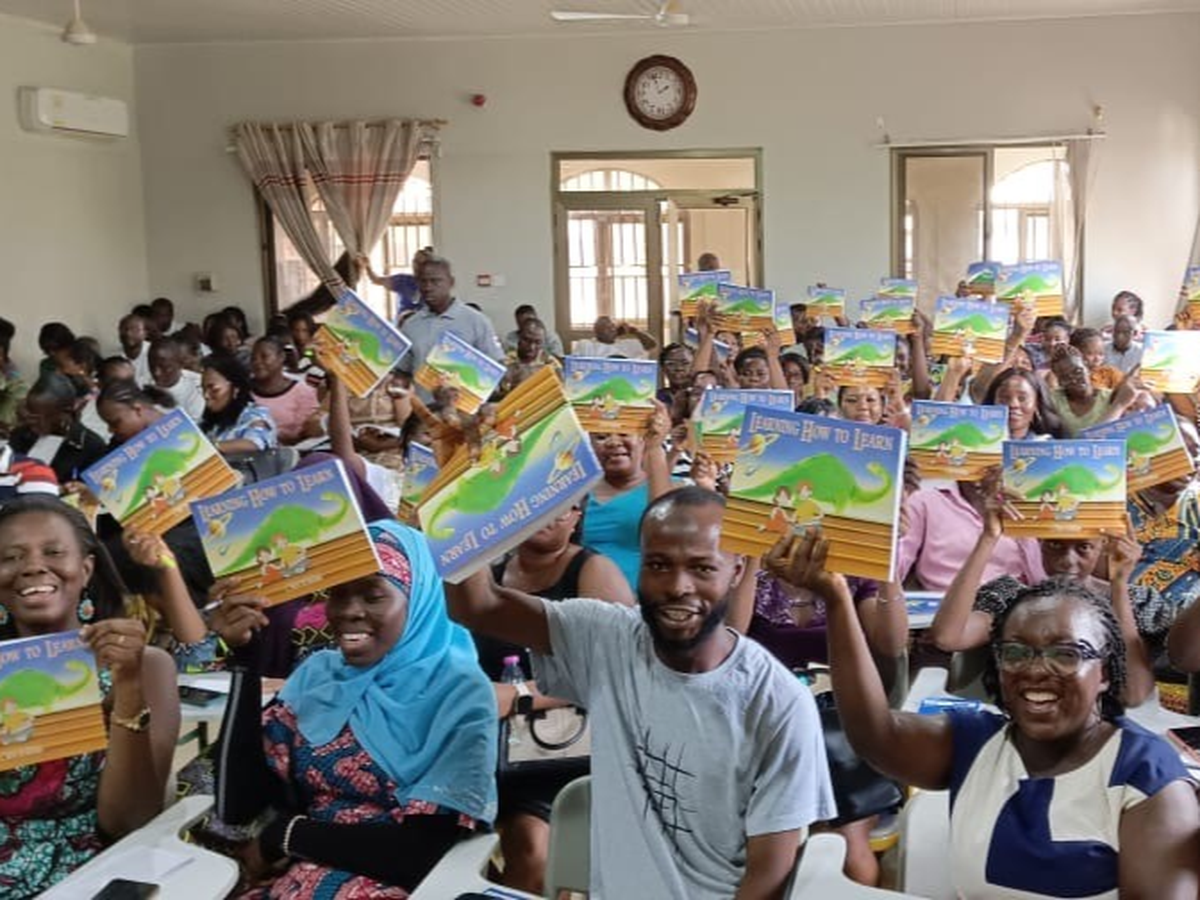
While COVID halted travel, training continued online. Teachers completed APS courses such as Learning How to Learn and Dictionary Skills, helping maintain momentum.
2022
We returned to Liberia and Ghana, training some 80 professors and instructors at Cuttington University’s main campus in Liberia as well as educators and policymakers in Ghana’s Central Region.
2023
Training expanded, including the faculty at Cuttington’s School of Graduate and Professional Studies in Monrovia, Liberia and 90 teachers across three Ghanaian regions, moving the Ghana Education Service to request broader scale-up.
2024
Fully shifting our focus to a trainer-of-trainers model led by local educators, the demand accelerated sharply. In Ghana, local APS trainers introduced Study Tech to more than 500 educators in just a few weeks, with many more showing up than we could accommodate. We also trained teachers affiliated with the Federation of Liberian Youth, the oldest youth service organization in that country.
2025
We now have 20 certified trainers in Ghana and 12 more in Liberia. We have trained more than 1,000 teachers over the life of the campaign, with more than 700 since 2024. The GES has formally requested expansion toward 22,000 teachers in the Central Region, with a long-term vision of nationwide rollout.
Meanwhile, Campaign Director Joseph Yarsiah trained at APS Spanish Lake to certification as a course room supervisor, in December successfully apprenticing by training the another African country’s education minister and his delegation.
The Road Ahead in 2026
We are no longer in the pilot stage. Local trainers are leading delivery.
Government is asking for expansion. Costs per teacher are lower than ever, and demand is higher than what we can currently meet. Each trained teacher reaches 30 to 50 students every year, multiplying impact far beyond a single classroom.
We must build our progress by orders-of-magnitude in 2026 and beyond.
Ghana: Kicking off in February, we will train another 12 master trainers and further equip APS Ghana’s lead volunteer, Richmond Atta Williams, to strengthen national leadership and coordination.
Liberia: Work in Liberia also starts next month, training the faculty at the Timothy Bowles Global Cares Academy and formally re-engaging our partnership with the Federation of Liberian Youth. All trainings will focus on practical APS courses teachers can use immediately: Learning How to Learn, Teaching with a New Approach, and Fundamentals of Learning.
Conclusion
To our supporters, past and to come: thank you. None of this was or will be possible without your generosity.
Together, we are not just bringing hope where too often there has been none; we are bringing the effective learning tools for competency to make those hopes and dreams the reality.
Together, let this be our legacy.
Tim Bowles
Pasadena, California
January 18, 2026
Organizer

Applied Scholastics Spanish Lake
Beneficiary