- M
- P
- F
Who is Bernie and Why he Needs you Support
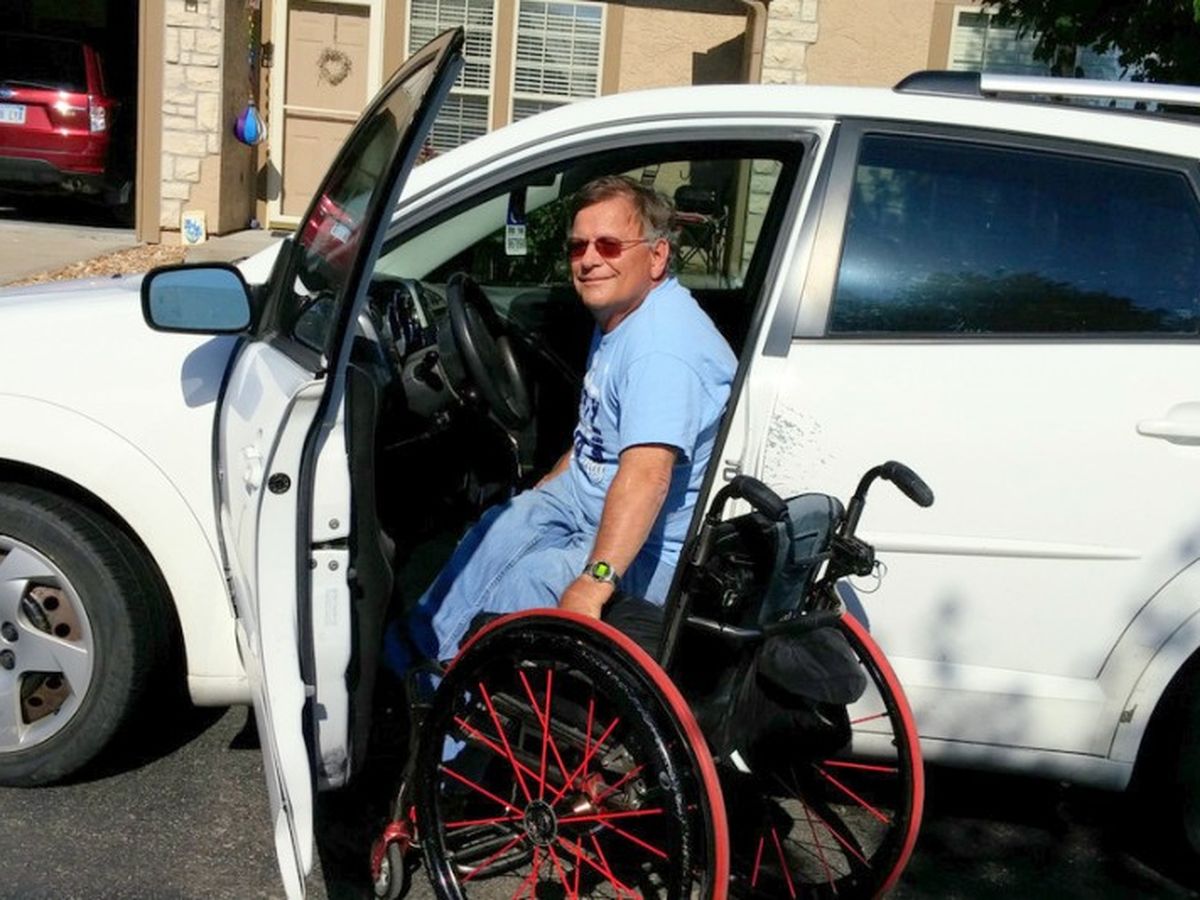
Bernie and I became co-workers and friends three years ago and I’ve known for a couple of years that Bernie’s shoulders are a mess. He has very recently learned that he is about to lose use of his hands, too, if he doesn’t make a drastic change, soon. Bernie needs to move out of his push wheelchair and into an electric wheelchair before he completely blows up the joints in his hands, elbows and shoulders. We have decent health insurance at work that will pay for the new chair, so why hasn’t he made the switch? The answer to that question is as simple as it is profound. The day Bernie moves into an electric wheelchair he loses his independence. He will no longer be able to make the transfer from his chair to his car by himself because he does not have and cannot afford a wheelchair accessible van.
It’s been 38 years since Bernie survived a 3,000 foot fall from the skies above Ecuador. This was after his speeding hang glider popped out of a thermal (an updraft, which gliders use to gain altitude) and went over the falls (hit a downdraft and tumbled); which broke the support structure of his glider. People don’t survive 3,000 foot falls. In spite of the fact that he knew he was going to die, Bernie did everything he could to get his broken glider under control. The glider came out of the down draft in a spin and his goal was to turn that spin into a much more controlled ellipse, making it possible to direct the fall into a nearby lake. He was on top of the glider, jumping up and down on the frame, trying to steer the glider out of the spin, fighting to survive a fall he knew he could not survive. But Bernie not only survived the fall, he barely got hurt. He had one serious injury from his fall from the skies, an exploding fracture of his T-12 vertebra.
Now I am not down-playing the severity of an exploded vertebra, not even a little. But Bernie fell out of the sky and didn’t die. The next part of his story is just as harrowing. Imagine being in a third world country, in the middle of nowhere, with a broken back. What happens next? Well, if you’re extremely lucky, have a habit of defying death, have incredible friends (one of which happens to be a skilled ER nurse) and end up in the care of the right doctor who says, “Don’t worry, I have the only white Lincoln Continental in all of Ecuador, so you can trust me,” you eventually make it onto a flight to LA, strapped to a makeshift gurney that straddles several seats in the first class section of a Braniff Airlines flight with very little additional damage to the shattered vertebra along the way. This was nothing short of a miracle. If you’re unlucky, when you get back to civilization (Los Angeles, CA) the ambulance medics getting you off the plane try to use a two man carry instead of using a clam-shell stretcher, and one of the medics places a hand directly under the shattered vertebra when he tries to pick you up. This was nothing short of a disaster.
I’m not going to bore you with the details of the 38 years between then and now (actually, the story is not boring at all, but I need to get to the point), but I want you to understand something. That same drive that kept Bernie alive when he was facing certain death is the same drive that has kept him independent for 38 years. Saying Bernie has maintained his independence in spite of his injury is an understatement. No, it’s a misstatement. And it is the whole point. Bernie has not let this injury and the resulting disability define him. He has refused to accept life on anything but his own terms. (I’m tempted to say “in spite of being a paraplegic” but that’s just wrong. Bernie would refuse to accept life on anything but his own terms no matter the circumstances.) He is creative and resourceful and always on the move. He’s incredibly talented and has done amazing things.
Bernie revamped a vocational rehab program called TAPS, The Training and Placement Service of the Epilepsy Foundation of America. The program was housed at the downtown offices of the Oregon Epilepsy Foundation and was allied with Good Samaritan Hospital's Neurological Programs. Before Bernie, the program focused on helping disabled people find work as therapy. Bernie transformed the program into one that focused on helping disabled people find real, productive work. Bernie is right, “Employers aren’t hiring people because they want to be therapists; employers are hiring people because they want a job done.”
While TAPS focused on working with persons with epilepsy, Bernie also did a lot of work in the broader field of disability and employment. He worked with several other disability related employment programs, he was appointed to the Governor's Committee on Employment of the Handicapped (whose name he quickly got changed from handicapped to disability), he truly enjoyed working with employers, and he worked directly with the primary funding source of these programs, the Federal Department of Labor.
Bernie’s work with the above organizations and later at Cedar Sinai Hospital in Baltimore, Maryland, didn’t just leave a lasting legacy within these organizations. His work inspired others, such as Helen N. Barba, who acknowledges Bernie in her book: Follow Your Bliss, Soul Centered Job Hunting. (http://www.amazon.com/Follow-Your-Bliss-Soul-Centered-Job-Hunting/dp/1581127464 )
Bernie, along with his friend, Bob Jones, co-founded RiversWest Small Craft Center (http://www.riverswest.org/history.html ). Bernie became interested in building boats after building an ultralight Airplane and crashing it into a barbed wire fence. He may be a little slow on the uptake, but after that aerial accident, he realized it would hurt less to drown than to crash. Bernie needed a place to build his boat and knew others did as well, so in 1991, he and Bob started RiversWest. Bernie then built a 31 foot boat designed to allow free movement of his wheelchair from stem to stern. RiversWest is still operating today as a club (membership fee is $50 annually) that promotes the use of sustainable, beautiful boats built to operate on the human scale.
Bernie published Common Sense Design Book (a copy of this catalog is for sale at http://www.oldsaratogabooks.com/?page=shop/browse&fsb=1&searchby=author&keyword=Wolfard%2C+Bernie ), after starting a company that sold boat plans (original designs by Phil Bolger). Bernie’s company, his book and RiversWest Small Craft Center made practical, sustainable boat building attainable to anyone that wanted to build their own boat.
Here are a couple of links that reference boats that Bernie either built or inspired:
http://forum.woodenboat.com/showthread.php?120510-100nm-in-a-Bolger-Idaho-in-Argentina
http://www.boats.backwater.org/Sneakeasy/
And a link to the company that continues to sell Bolger’s (and other’s) boat designs:
http://www.common-sense-boats.com/
Bernie’s work with non-profits and his adventurous spirit led him to another gig; this one as President of SOAR (Shared Outdoor Adventure Recreation). SOAR’s goal was to make outdoor adventure activities accessible to the disabled. Prior to SOAR, programs geared towards making the outdoors accessible to the disabled were designed to protect disabled adventurers from hurting themselves. The idea of protecting someone from getting hurt when they are engaging in inherently risky activities is an oxymoron. People don’t climb mountains, navigate rapids, and ski downhill because it’s safe, they do it to prove that they can and for the adrenaline rush. Being disabled doesn’t remove the desire to prove you are capable of accomplishing amazing things, nor the fun of the rush. If anything, being disabled magnifies the importance of both. SOAR’s goal was to develop programs that allowed people with disabilities to have full access to outdoor adventure activities, and then transfer those programs to normal training programs. Today, you can find many outfits and organizations that are equipped to work with people with disabilities. Bernie’s work at SOAR was instrumental in changing the landscape of this industry.
You get the picture; Bernie is a serial start-up specialist. His creative talent, his unique perspective on living with a disability and his unwillingness to see adversity as anything but an incentive to get something done has driven him throughout his life to create lasting legacies that many people continue to benefit from today.
Bernie is not done creating. But for the first time in his life he is truly afraid. He is afraid because his deteriorating hands, elbows, and shoulders are forcing him to move to an electric wheelchair and he cannot afford the van that he needs to remain independent when that happens. Now, for the first time, Bernie is asking for help.
Bernie has fought off help for decades. In fact, if you’ve offered to help him in the past, he may have responded to you rather brusquely. He acknowledges that he hurt some people along the way, people that were only trying to help him. He told me that he feels sad about “some of the stuff” that he’s done. He struggles with his past behavior. He said that there were times that people tried to help him and he’d just “go off.” For this, he is truly sorry.
There is a reason Bernie is so emotional about accepting help. Bernie is scared to death to accept help because he is afraid that by accepting help he will become truly disabled. He is afraid of becoming “an incapable and needy blob.” He describes his fear this way, “I don’t want to become a warm ectoplasm worthy of a person’s sympathy but not their respect.” He can’t stand it when he hears someone say, “That is quite an accomplishment, considering his disability.” In Bernie’s mind, that phrase, “considering his disability,” completely denigrates the accomplishment, particularly for things that would be an accomplishment for anyone. He has told me repeatedly that when he accepts help he feels like he is selling a part of his soul. I volunteered to help Bernie write this appeal not to help him sell his soul, but to help him get his soul back.
Bernie needs this van. Therefore he needs to raise approximately $73,000 ($38,000 for the van, including sales tax; $29,000 for modifications, and $6,000 for access to the Go Fund Me platform). Bernie is close to retiring from his almost 11 year tenure at Castle Creations. While he appreciates Castle and its owners for many things (and he loves working with me!), being at Castle for over ten years has slowly worn him out because it hasn’t allowed him the opportunity to create. Bernie is a creator. He will create again. When I ask him what he will create, he starts to ramble on (if you know Bernie you know what I mean) about all of the ideas that are percolating to the surface. Bernie is at the starting block, once again. He is ready to go. But this time, he needs our help.
Please, give what you can. If we help Bernie obtain this van, he will be able to remain true to himself. When Bernie is true to himself, he creates amazing things that other people have never imagined. Let’s gets Bernie off of the starting blocks and headed towards whatever his amazing life has in store for him (and us) next.
With my utmost respect,
Roberta Beier
Director of Finance and Administration
Castle Creations, Inc.
Bernie and I became co-workers and friends three years ago and I’ve known for a couple of years that Bernie’s shoulders are a mess. He has very recently learned that he is about to lose use of his hands, too, if he doesn’t make a drastic change, soon. Bernie needs to move out of his push wheelchair and into an electric wheelchair before he completely blows up the joints in his hands, elbows and shoulders. We have decent health insurance at work that will pay for the new chair, so why hasn’t he made the switch? The answer to that question is as simple as it is profound. The day Bernie moves into an electric wheelchair he loses his independence. He will no longer be able to make the transfer from his chair to his car by himself because he does not have and cannot afford a wheelchair accessible van.
It’s been 38 years since Bernie survived a 3,000 foot fall from the skies above Ecuador. This was after his speeding hang glider popped out of a thermal (an updraft, which gliders use to gain altitude) and went over the falls (hit a downdraft and tumbled); which broke the support structure of his glider. People don’t survive 3,000 foot falls. In spite of the fact that he knew he was going to die, Bernie did everything he could to get his broken glider under control. The glider came out of the down draft in a spin and his goal was to turn that spin into a much more controlled ellipse, making it possible to direct the fall into a nearby lake. He was on top of the glider, jumping up and down on the frame, trying to steer the glider out of the spin, fighting to survive a fall he knew he could not survive. But Bernie not only survived the fall, he barely got hurt. He had one serious injury from his fall from the skies, an exploding fracture of his T-12 vertebra.
Now I am not down-playing the severity of an exploded vertebra, not even a little. But Bernie fell out of the sky and didn’t die. The next part of his story is just as harrowing. Imagine being in a third world country, in the middle of nowhere, with a broken back. What happens next? Well, if you’re extremely lucky, have a habit of defying death, have incredible friends (one of which happens to be a skilled ER nurse) and end up in the care of the right doctor who says, “Don’t worry, I have the only white Lincoln Continental in all of Ecuador, so you can trust me,” you eventually make it onto a flight to LA, strapped to a makeshift gurney that straddles several seats in the first class section of a Braniff Airlines flight with very little additional damage to the shattered vertebra along the way. This was nothing short of a miracle. If you’re unlucky, when you get back to civilization (Los Angeles, CA) the ambulance medics getting you off the plane try to use a two man carry instead of using a clam-shell stretcher, and one of the medics places a hand directly under the shattered vertebra when he tries to pick you up. This was nothing short of a disaster.
I’m not going to bore you with the details of the 38 years between then and now (actually, the story is not boring at all, but I need to get to the point), but I want you to understand something. That same drive that kept Bernie alive when he was facing certain death is the same drive that has kept him independent for 38 years. Saying Bernie has maintained his independence in spite of his injury is an understatement. No, it’s a misstatement. And it is the whole point. Bernie has not let this injury and the resulting disability define him. He has refused to accept life on anything but his own terms. (I’m tempted to say “in spite of being a paraplegic” but that’s just wrong. Bernie would refuse to accept life on anything but his own terms no matter the circumstances.) He is creative and resourceful and always on the move. He’s incredibly talented and has done amazing things.
Bernie revamped a vocational rehab program called TAPS, The Training and Placement Service of the Epilepsy Foundation of America. The program was housed at the downtown offices of the Oregon Epilepsy Foundation and was allied with Good Samaritan Hospital's Neurological Programs. Before Bernie, the program focused on helping disabled people find work as therapy. Bernie transformed the program into one that focused on helping disabled people find real, productive work. Bernie is right, “Employers aren’t hiring people because they want to be therapists; employers are hiring people because they want a job done.”
While TAPS focused on working with persons with epilepsy, Bernie also did a lot of work in the broader field of disability and employment. He worked with several other disability related employment programs, he was appointed to the Governor's Committee on Employment of the Handicapped (whose name he quickly got changed from handicapped to disability), he truly enjoyed working with employers, and he worked directly with the primary funding source of these programs, the Federal Department of Labor.
Bernie’s work with the above organizations and later at Cedar Sinai Hospital in Baltimore, Maryland, didn’t just leave a lasting legacy within these organizations. His work inspired others, such as Helen N. Barba, who acknowledges Bernie in her book: Follow Your Bliss, Soul Centered Job Hunting. (http://www.amazon.com/Follow-Your-Bliss-Soul-Centered-Job-Hunting/dp/1581127464 )
Bernie, along with his friend, Bob Jones, co-founded RiversWest Small Craft Center (http://www.riverswest.org/history.html ). Bernie became interested in building boats after building an ultralight Airplane and crashing it into a barbed wire fence. He may be a little slow on the uptake, but after that aerial accident, he realized it would hurt less to drown than to crash. Bernie needed a place to build his boat and knew others did as well, so in 1991, he and Bob started RiversWest. Bernie then built a 31 foot boat designed to allow free movement of his wheelchair from stem to stern. RiversWest is still operating today as a club (membership fee is $50 annually) that promotes the use of sustainable, beautiful boats built to operate on the human scale.
Bernie published Common Sense Design Book (a copy of this catalog is for sale at http://www.oldsaratogabooks.com/?page=shop/browse&fsb=1&searchby=author&keyword=Wolfard%2C+Bernie ), after starting a company that sold boat plans (original designs by Phil Bolger). Bernie’s company, his book and RiversWest Small Craft Center made practical, sustainable boat building attainable to anyone that wanted to build their own boat.
Here are a couple of links that reference boats that Bernie either built or inspired:
http://forum.woodenboat.com/showthread.php?120510-100nm-in-a-Bolger-Idaho-in-Argentina
http://www.boats.backwater.org/Sneakeasy/
And a link to the company that continues to sell Bolger’s (and other’s) boat designs:
http://www.common-sense-boats.com/
Bernie’s work with non-profits and his adventurous spirit led him to another gig; this one as President of SOAR (Shared Outdoor Adventure Recreation). SOAR’s goal was to make outdoor adventure activities accessible to the disabled. Prior to SOAR, programs geared towards making the outdoors accessible to the disabled were designed to protect disabled adventurers from hurting themselves. The idea of protecting someone from getting hurt when they are engaging in inherently risky activities is an oxymoron. People don’t climb mountains, navigate rapids, and ski downhill because it’s safe, they do it to prove that they can and for the adrenaline rush. Being disabled doesn’t remove the desire to prove you are capable of accomplishing amazing things, nor the fun of the rush. If anything, being disabled magnifies the importance of both. SOAR’s goal was to develop programs that allowed people with disabilities to have full access to outdoor adventure activities, and then transfer those programs to normal training programs. Today, you can find many outfits and organizations that are equipped to work with people with disabilities. Bernie’s work at SOAR was instrumental in changing the landscape of this industry.
You get the picture; Bernie is a serial start-up specialist. His creative talent, his unique perspective on living with a disability and his unwillingness to see adversity as anything but an incentive to get something done has driven him throughout his life to create lasting legacies that many people continue to benefit from today.
Bernie is not done creating. But for the first time in his life he is truly afraid. He is afraid because his deteriorating hands, elbows, and shoulders are forcing him to move to an electric wheelchair and he cannot afford the van that he needs to remain independent when that happens. Now, for the first time, Bernie is asking for help.
Bernie has fought off help for decades. In fact, if you’ve offered to help him in the past, he may have responded to you rather brusquely. He acknowledges that he hurt some people along the way, people that were only trying to help him. He told me that he feels sad about “some of the stuff” that he’s done. He struggles with his past behavior. He said that there were times that people tried to help him and he’d just “go off.” For this, he is truly sorry.
There is a reason Bernie is so emotional about accepting help. Bernie is scared to death to accept help because he is afraid that by accepting help he will become truly disabled. He is afraid of becoming “an incapable and needy blob.” He describes his fear this way, “I don’t want to become a warm ectoplasm worthy of a person’s sympathy but not their respect.” He can’t stand it when he hears someone say, “That is quite an accomplishment, considering his disability.” In Bernie’s mind, that phrase, “considering his disability,” completely denigrates the accomplishment, particularly for things that would be an accomplishment for anyone. He has told me repeatedly that when he accepts help he feels like he is selling a part of his soul. I volunteered to help Bernie write this appeal not to help him sell his soul, but to help him get his soul back.
Bernie needs this van. Therefore he needs to raise approximately $73,000 ($38,000 for the van, including sales tax; $29,000 for modifications, and $6,000 for access to the Go Fund Me platform). Bernie is close to retiring from his almost 11 year tenure at Castle Creations. While he appreciates Castle and its owners for many things (and he loves working with me!), being at Castle for over ten years has slowly worn him out because it hasn’t allowed him the opportunity to create. Bernie is a creator. He will create again. When I ask him what he will create, he starts to ramble on (if you know Bernie you know what I mean) about all of the ideas that are percolating to the surface. Bernie is at the starting block, once again. He is ready to go. But this time, he needs our help.
Please, give what you can. If we help Bernie obtain this van, he will be able to remain true to himself. When Bernie is true to himself, he creates amazing things that other people have never imagined. Let’s gets Bernie off of the starting blocks and headed towards whatever his amazing life has in store for him (and us) next.
With my utmost respect,
Roberta Beier
Director of Finance and Administration
Castle Creations, Inc.