
Designed for Active Dysregulation, Not Ideal Calm States
I designed and provisionally patented a nervous system regulation device for the moments people often need help most; the moments when thinking clearly is hardest.
Not when someone is already calm.
Not when they can easily remember what to do.
Not when their mind is organized and their body is steady.
I designed this for moments of active dysregulation: overwhelm, panic, PTSD activation, emotional flooding, overload and distress.
Because I know what it is like to need nervous system regulation tools and, in the exact moment I needed them most, fail to remember them.
That part is personal for me.
I have experienced what it is like to be in a dysregulated moment and struggle, ultimately failing to recall the steps, methods and techniques for nervous system regulation that I had intentionally taken the time to learn and ingrain in memory for future use. Things I knew like second nature when calm suddenly felt unreachable in the exact moment I needed them most.
I know I am not alone in that experience.
And I wanted to be the change I wished to see in the world within the realm of nervous system regulation support currently available.
I also knew from personal experience that some of the supports that existed, including EMDR-related care and other nervous system regulation tools, had at times felt financially out of reach for me. I wanted to create something more affordable and more accessible, something people could use at home or on the go, without having to wait for office hours, wait for a therapist or psychiatrist appointment, or depend on support that may not be available quickly enough or affordably enough in the exact moment it is needed most.
I wanted to do better than what previously existed, or what currently exists.
This is not a greed-driven or profit-first mission. I did not protect this idea simply to own it. I patented it, because if this product enters existence, I want its mission protected alongside it. My mission is to help make nervous system regulation accessible to the greatest number of people possible, at an affordable price, for use at home or on the go, in the moments it is needed most: moments of dysregulation, not ideal calm states.
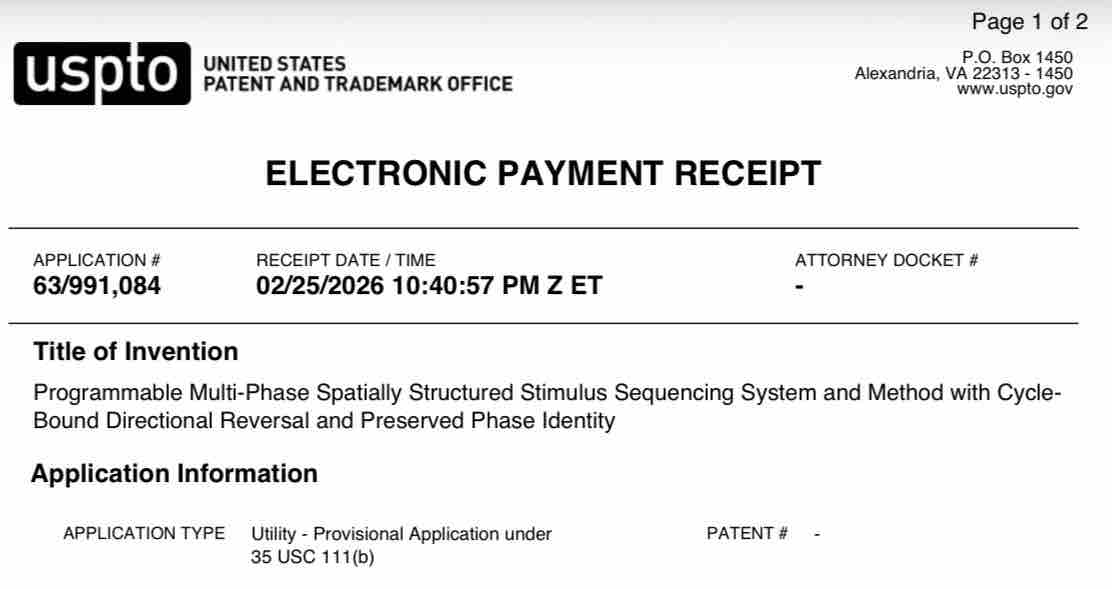
On February 25, 2026 at 10:40 PM ET, I filed a federal provisional patent with the United States Patent and Trademark Office.
Application #: 63/991,084
Priority date secured.
Legally time-stamped.
Architecture protected.
Now I need help building the first working prototype.
I am a wife, mother and licensed Funeral Director and Embalmer in New York. For over a decade, I have served families on the worst days of their lives. I have stood beside parents burying children, spouses saying goodbye to the love of their life, veterans, mothers, teenagers, grandparents and entire families shaken by grief.
Professionally, I am trained to remain calm, steady and competent.
But I am also human.
For years, I lived in a body that felt chronically braced. On the outside, I was high functioning. On the inside, my nervous system was stuck in survival mode. My jaw was tense, my shoulders were tight, my breathing was shallow, my sleep was never fully restorative and my body rarely felt at ease.
I did not realize I was living in chronic autonomic dysregulation. I thought it was anxiety, stress, personality or simply the price of responsibility.
Later, I learned something life-changing: the nervous system can learn stress patterns, but it can also learn safety.
Tools like slow breath pacing, bilateral stimulation and predictable rhythmic sequencing helped me. They changed my life. But I also discovered something major: in the moments people need those tools most, they may be the least able to use them efficiently.
When someone is dysregulated, overwhelmed or panicked, they may not be able to clearly think through what to do, remember breathing counts, organize steps or guide themselves effectively in real time. The prefrontal cortex does not function as efficiently under stress as it does in a regulated state. That is where so many existing supports fall short.
That is why I designed this device.
It is meant to be preset ahead of time, ideally when the user first gets it and is calm enough to choose the settings they want ready for future moments of distress. The goal is simple: when overwhelm hits, the user does not have to think through a method, remember timing or mentally organize the process. They can simply turn the device on and follow it.
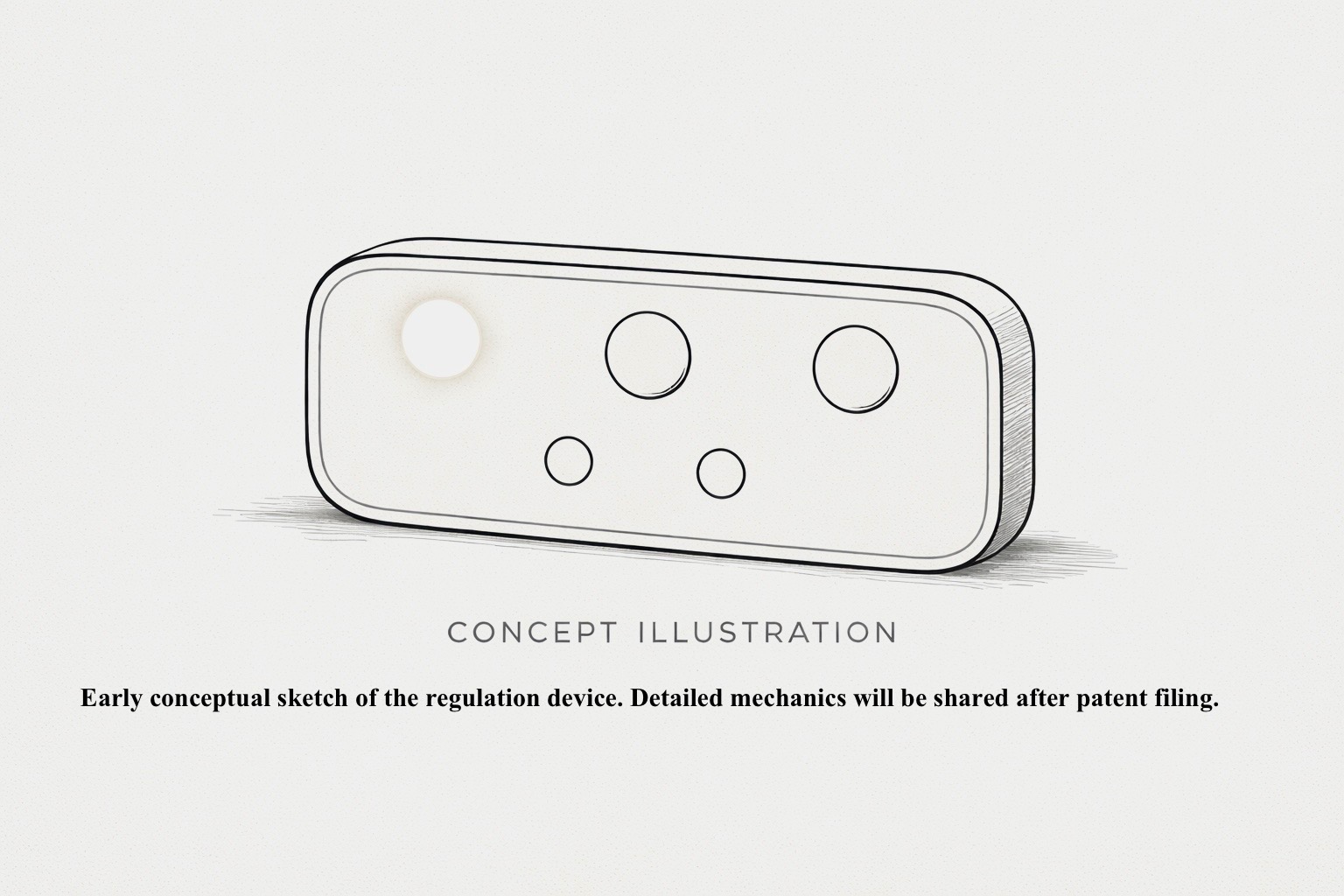
The prototype I plan to build would consist of 3 lights arranged linearly from left to right:
- left light = inhale
- middle light = hold
- right light = exhale
Using a 4-2-6 breathing pattern as an example:
- inhale for 4 seconds
- hold for 2 seconds
- exhale for 6 seconds
When the device is turned on in a moment of overwhelm:
- the left light turns green for 4 seconds to signal inhale
- the middle light turns yellow for 2 seconds to signal hold
- the right light turns red for 6 seconds to signal exhale
Then the sequence reverses direction.
After that first left-to-right cycle:
- the light that was just on the right turns green for 4 seconds for inhale
- the middle light turns yellow for 2 seconds for hold
- the left light turns red for 6 seconds for exhale
It would continue cycling back and forth until the user felt calm enough to turn it off.
That back-and-forth design matters because this device is not only guiding breath pacing, it is also introducing bilateral stimulation through alternating left-right visual sequencing.
That means it combines two regulation-supporting elements in one structured experience.
Breath pacing helps guide respiration into a slower, more deliberate rhythm. Patterns with a longer exhale can help support nervous system settling and help the body shift away from a more activated state.
Bilateral stimulation gives the brain and body something external, rhythmic and predictable to follow. The alternating left-right sequence helps create structured sensory engagement without requiring the user to mentally direct each step themselves.
By combining both, this device is designed to:
- reduce cognitive load during distress
- remove the need to count or remember steps
- provide something simple and external to follow
- support real-time nervous system regulation
- make regulation more practical in everyday life
- help people in the exact moments self-guidance becomes hardest
This is what makes the concept different: it is designed for real moments of dysregulation, not ideal calm conditions.
It is simple in design, but meaningful in the benefits it stands to offer.
This is not about replacing therapy.
This is about accessibility.
This is about usability.
This is about helping real people in real moments.
Because this invention is provisionally protected, I cannot publicly share the full schematics or complete sequencing architecture. What I can share is this:
- it is grounded in nervous system physiology
- it integrates breath pacing and bilateral stimulation
- it is designed to reduce cognitive demand during dysregulation
- it is intended for real-life use, not just ideal calm settings
- it is being created with affordability and accessibility as core parts of the mission
I designed this for real people in real moments:
- parents overstimulated by late afternoon
- teens with racing thoughts
- children learning emotional regulation
- veterans with PTSD
- people living with trauma
- healthcare workers and caregivers
- grief-stricken families
- first responders and last responders
- anyone who has ever felt trapped in fight-or-flight
My mission is simple: to help make nervous system regulation more tangible, practical, affordable and accessible to the greatest number of people possible.
To move from protected concept to working prototype, I need funding for:
- PCB development
- electrical engineering refinement
- component sourcing
- microcontroller integration
- professional prototyping
- housing design
- manufacturing consultation
- safety compliance review
- utility patent drafting
- iterative improvements toward scalable manufacturing
This fundraiser supports the bridge between a protected concept and a real, testable tool that can be built, refined and eventually placed into people’s hands.
If you have ever felt wired but exhausted, panicked and unable to think clearly, overstimulated past your limit, unable to remember the very techniques you know when you are calm or watched your child melt down and wished help could be more immediate and usable, then you understand why this matters.
I am building what I wish existed years ago.
Filed. Protected. Mission-led. Now we build.
If this mission speaks to you, please consider donating or sharing.
Even a donation of $5, $10 or $25 helps move this prototype forward.
Thank you for helping me build something that could one day help people in the moments they need that help the most, during dysregulation, not ideal calm states.
Organizer