Help Mobilize the Middle Majority to Fix Congress
0% complete
$450 raised of $100K
2 donations

Congress Is Not Broken. It Is Working Perfectly — Just Not for You.
Let's start with three plain sentences.
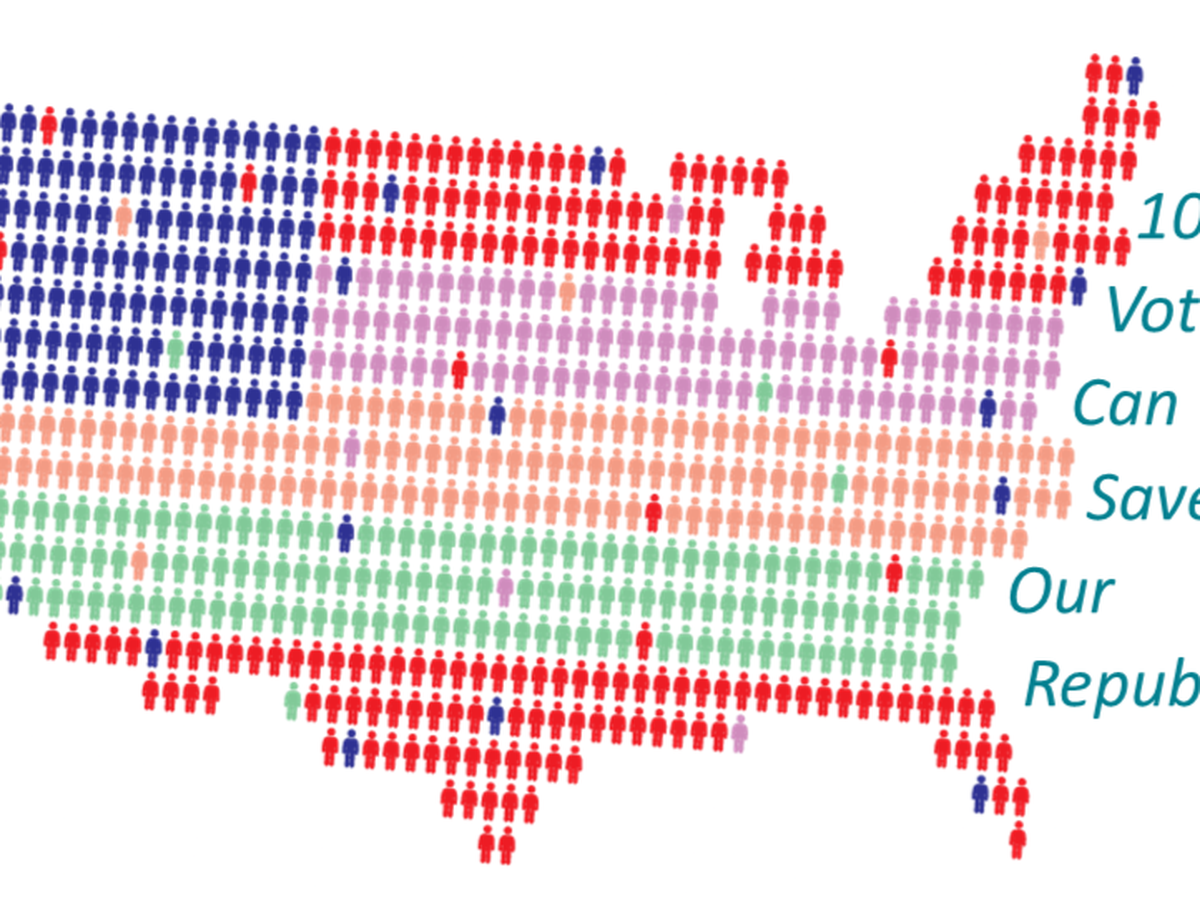
- Seven percent of American voters effectively choose eighty-seven percent of Congress.
- Congress is incapable of addressing America's practical challenges — affordable healthcare, safe schools, good jobs, housing, climate — because it serves that seven percent minority, not the ninety-three percent majority.
- Congress is not broken. It is working perfectly — just not for us.
How is this possible? And what can we do about it?
The brief answer to the first question is gerrymandering and low-turnout primaries. The answer to the second is the Middle Majority Movement that I am asking you to help launch.
But before we explain the solution, consider just a few examples of what congressional dysfunction actually costs us.
- Eighty-five percent of American voters — including 77% of Republicans, 89% of independents, and 92% of Democrats — support allowing Medicare to negotiate prescription drug prices. The policy would save seniors billions of dollars a year. For years, Congress did nothing. When Congress finally passed a limited version of the reform, every Republican in Congress voted against it — despite the overwhelming support of their own constituents. Now there are active efforts to repeal even that.
- After every mass school shooting, polls show 80 to 90 percent of Americans support expanded background checks and other common-sense measures. Congress responds with moments of silence, expressions of grief, and the familiar argument that now, during this time of mourning, is not the moment to talk about policy. The moment passes. The next shooting begins the cycle again.
- Nearly three-quarters of Americans — including 59% of Republicans — support requiring Supreme Court justices to retire after a certain number of years. Congress will not act. Overwhelming majorities of Americans across party lines have supported rebuilding the country's roads, bridges, and broadband for decades. Congress spent years failing to pass even a basic infrastructure bill.
It is tempting to look at this record and conclude that Congress is broken. But that conclusion misses something important.
On every one of these issues, Congress was not failing. It was succeeding — for the voters and donors who actually determine its members' political survival: a small, activated, ideologically intense minority that shows up reliably in primaries, and pharmaceutical donors whose campaign contributions and primary threats make the drug pricing vote easy. Primary voters who treat any gun regulation as an existential threat to the Second Amendment. Interest groups who can advance a career - or end it.
For those constituents, Congress has been remarkably effective. The majority — the Americans who just want their government to function — has simply not been an important concern of these politicians.
This is not a partisan observation. It describes a structural failure that affects every American regardless of party.
Congress is not failing the majority because it is incompetent and polarized. It is failing the majority because the majority is not who Congress works for.
This has got to change.
The Middle Majority Movement Has Found the Way to Change It.
Before describing how we accomplish this change, it is worth understanding how we got here — because the problem did not arise overnight, and its origins explain why it has been so hard to solve.
Gerrymandering — the practice of drawing congressional district boundaries to favor the party in power — dates to the earliest years of the republic. But it was manageable for most of American history because the tools available to mapmakers were crude. That changed dramatically in the computer age, when sophisticated computer mapping software made it possible to design districts with surgical precision — packing opposing voters into a handful of districts while spreading your own voters efficiently across as many seats as possible. The result was a Congress increasingly insulated from the preferences of the actual electorate.
At the same time, Americans were sorting themselves geographically — liberals, mostly Democrats, concentrating in cities and inner suburbs, conservatives, mostly Republicans, spreading across exurbs and rural areas. This sorting was not engineered by anyone; it happened organically, driven by economic opportunity, cultural affinity, and housing costs. But it interacted with gerrymandering to produce something neither force would have created alone: Congressional districts so lopsided that the only election that matters is the primary, where a tiny fraction of the most ideologically extreme voters in each party decides who represents everyone else.
The result is the Congress we have today. Not incompetent. Not simply polarized. Structurally designed — partly by deliberate manipulation, partly by demographic accident — to be unresponsive to the majority.
This was not always the way Congress worked. The constitutional design that the founders put in place, imperfect as it was — and it was deeply imperfect, tolerating slavery and excluding most Americans from political life — nonetheless solved a genuine problem of democratic governance: How do representatives from communities with competing interests find workable solutions that enough of them can live with?
For most of American history, that is what Congress did. Members arrived in Washington representing genuinely different constituencies; they negotiated, traded, and compromised; and they eventually produced legislation that reflected something close to the actual preferences of the country. It was messy and slow and often frustrating. But it worked.
Congress began losing this capacity in the 1960s, as the parties sorted ideologically and the political center thinned. The decay accelerated sharply in the 1990s, when nationalized politics, the rise of partisan media, and the early effects of computer-aided gerrymandering began to reward confrontation over compromise. By the 2000s and 2010s, the combination of gerrymandering, geographic sorting, low primary turnout, and the flood of big money into politics had fundamentally changed the incentive structure for members of Congress. Compromise no longer helped you keep your seat. Performative conflict did.
The result is a Congress that has largely stopped performing its core constitutional function. But the problems it was designed to solve have not gone away. Healthcare costs, crumbling infrastructure, school safety, climate — these are collective challenges that individuals and communities cannot solve on their own, and that only coordinated government action can address at scale.
The Middle Majority Movement will restore the conditions under which Congress can perform that function again — by mobilizing the middle majority produce enough electoral leverage to make effective governance the smart move for members of Congress, rather than the risky one. Here's how.
Subverting Gerrymandering
Geographic sorting is not something we can fix in the short or medium term. But gerrymandering is susceptible to attack, because its Achilles' heel is its inability to protect incumbents in their own primaries.
A congressional primary in a safe district can be decided by five thousand votes or fewer. Alexandria Ocasio-Cortez won her first primary by 4,136 votes. An Iowa Republican primary was once decided by six. These are not anomalies — they are the normal arithmetic of low-turnout primaries.
The churches, unions, civic associations, business groups, and neighborhood organizations already present in most districts have members who collectively outnumber those margins many times over. They just don't know it. And they have never been organized to act on it together.
That is the leverage point the Middle Majority Movement is designed to exploit.
We the people are powerful. We have simply not realized how much power and agency we have, and have not had the tools to make it easy to exercise it.
Here Is How the MMM Will Work
Congressional districts are not monolithic. A single district might contain farming communities and factory towns, small business owners and union members, veterans posts and faith congregations, service clubs and neighborhood associations, chambers of commerce and environmental groups. Rural counties sit alongside suburban precincts. A Baptist church and a Catholic parish may share a zip code with a mosque and a synagogue.
Looking more closely at the civic life inside any one of these districts, we can see a pattern.
- A Rotary Club and a labor council are both trying to keep good jobs in their county — one through business development, the other through collective bargaining — without recognizing that they are working on the same problem from opposite perspectives.
- A farmers' association and an environmental club are both worried about water quality and soil health — one because their members' livelihoods depend on them, the other because the ecosystem does — and neither has thought of the other as an ally.
- A veterans post and a teachers' union both want a community where young people have a future worth staying for — one because they served to protect it, the other because they spend their days trying to educate future citizens of the community.
- A fire department auxiliary and a tiny municipality are both one bad budget cycle away from losing the ability to serve their communities.
- A faith congregation and a small business alliance both know that when families can't make ends meet, the whole community suffers — and both have been trying to address that reality with bake sales and charity drives when what is actually needed is a government that works.
All of these groups experience the same practical problems. All of them would benefit from effective government action on the challenges none of them can solve apart and alone. And none of them are currently organized to act on that fact together.
The Middle Majority Movement works with that diversity rather than against it.
Within a district, MMM organizes multiple local chapters — each one rooted in a particular community or civic tradition. A chapter might be anchored by a faith coalition in one community, a farm bureau in a rural county, a veterans post in a small town, or a chamber of commerce in a suburban business district.
Each chapter brings together the leaders of the organizations its community already trusts — the groups whose members show up for pancake breakfasts and school board meetings and county fairs, who already know each other, and who already have the confidence of the people they represent.
When a primary election approaches, all the chapters in a district form a Civic Working Unit — a temporary, focused coordination structure with a single purpose - to answer one question, together: Which candidate, if elected, would best represent the majority of people in this district — not just the party base?
The CWU process has three stages. First, each chapter polls its members and identifies their shared priorities. Second, the chapters come together to compare those priorities, evaluate the candidates, and reach a shared recommendation — not a mandate, but a signal to their members. Third, each organization does what it already knows how to do: It urges its members to vote in the primary, and recommends which candidate(s) to vote for.
No new organization is required. No door-knocking army is needed. No one is being asked to become a political activist. The people are already there. The organizations are already trusted.
The diversity that has historically made coordination impossible becomes, through this process, a source of strength — because a candidate who can satisfy the agreed common priorities of a farm bureau, a veterans post, a small business alliance, a church group, and a teacher's association, is by definition a candidate who represents the district's actual majority.
Once a coordinated majority successfully nominates a candidate in a gerrymandered districts, the candidate's victory in the general election is almost guaranteed. That candidate will be of the same party as before — but he or she will owe their seat to the majority, not to the party base.
This works without changing a single law. It works in red districts and blue districts. It does not require building a new movement from scratch — it requires unifying the civic energy that already exists.
And it flips the incentive structure that has produced the Congress we have.
Right now, the smart move for a politician in a safe district is to keep the base activated and everyone else tuned out. We change that calculation: Earn the majority, keep your promises, and you keep your seat. Break your promises, and the same coalition that put you there will replace you.
In this new reality, performative politics is a liability. Effective governance is what gets you renominated.
This is not for the left or for the right. It is not for the Democratic establishment or the Republican establishment. It is for regular people — Democrat, Republican, Independent — who just want their government to function, and to serve them for a change.
Who I Am and Why I Am Doing This
I'm Daniel Wolf. I have spent most of my life at the intersection of civic infrastructure and technology. I founded Democracy Counts in 2015 to give Americans the tools to conduct honest election audits, to engender confidence when the local election administration deserves it, and to generate data that can lead to challenges and reform when the administration makes mistakes or engages in fraud. We built a great product. Our Actual Vote app is in both app stores and has been used in elections across the country since 2020, by hundreds of dedicated volunteers.
But use by hundreds of people is a failure, not a success, because we need hundreds of thousands.
The lesson this taught is that a good tool is not enough — people need to believe that political engagement is worth their time. For most people, especially for working- and middle-class people, politics takes a distant back seat to their important and urgent life concerns. If you are working overtime to survive while trying to raise children, the chances are slim that you'll have enough time, energy, or interest to sort through the competing claims of politicians, much less to engage in the kind of work required to keep elections honest or defeat an incumbent who doesn't represent your interests.
I am a registered Democrat, but before I'm a Democrat I'm an American, who cares deeply about maintaining the Constitutional order and rule of law that has seen America through so many crises. My fundamental commitment is not to my particular policy preferences – which are fun to debate but ultimately are just my own preferences – but to restoring our republic, to regenerating a genuinely majority-representative democracy. Once that foundation is re-laid, then we can have the fun policy debates, and our once-again responsible representatives can find reasonable compromises that move the needle.
An Invitation to Be Part of Something Powerful and Urgent
I have to be honest with you about where we are.
This is not a proven model. It is an experiment at this stage — a well-grounded, carefully reasoned experiment, backed by real data and a team with the credentials to execute it — but it has not yet been tested in a primary election. That test is what Phase I is for, and what your donation will fund the beginnings of.
This means that you and other people who support this work right now — before the experimental evidence emerges — are doing something genuinely rare. You are not joining a movement that has already succeeded. You are making it possible for the movement to achieve its Kitty Hawk moment.
If the Middle Majority Movement is successful, historians will mark 2026 as the year it began. Not because of anything dramatic that happened in Washington, but because a handful of early backers enabled the infant movement to empower civic organizations in a few districts to coordinate and mobilize in a primary election, and the effect was to change who represented them. And then it happened again. And then it became unstoppable.
If the Movement is successful, you and those who made the first experiment possible — who looked at the logic and the data and the team and decided that this was worth backing — will have done something that no amount of money can buy later: You will have been early, you will have been prescient, and you will have demonstrated that your belief in America’s possibility was stronger than any cynicism about America’s dysfunctions.
Whatever you believe about the current moment in American politics, this much has always been true:
- "Never doubt that a small group of thoughtful, committed citizens can change the world; indeed, it's the only thing that ever has." — Margaret Mead
Whatever form your support takes, it matters. And I am grateful for it.
The Strategic Timeline of the Middle Majority Movement
The growth of the movement will go through three phases:
I. Startup
This GoFundMe campaign is raising the initial seed funding that gets us to the starting line — early legal structure, the first organizing visits, and the foundation for the activation tour. If you give $25 or $100, you are not a small donor to a large machine. You are one of the first people to publicly say yes — and in doing so, you make it easier for others, especially professionals, to say yes too.
II. Proof of Concept
A $1.5 million raise — sought simultaneously from private investors and foundations — will fund the complete proof-of-concept through the 2026 primary cycle. It will pay for two things.
First, a months-long activation tour through up to ten Congressional districts — meeting with civic leaders, learning what their organizations need, making the case that their members hold potentially transformative political power, and assessing which districts are best for our proof-of-concept experiment.
Our goal is to organize MMM chapters in four to six districts in the 2026 primary cycle. If we succeed, at least one congressional primary in 2026 will be decided by a coordinated middle majority — and we will have the data to prove it.
Second, a digital platform that makes it much easier for MMM members to carry out the activities required for success — coming together, building consensus, coordinating, mobilizing, and winning.
After the election, the platform will track whether candidates keep their commitments and report that record back to the chapters.
This GoFundMe campaign is also an important public signal of traction. Every dollar donated here tells potential investors and foundations that real people believe this is worth doing — reducing the fear that it will fail for lack of public support, and making it easier to raise the $million-plus needed for this phase.
III. National Expansion
If Phase II is successful — and we believe it will be — we will grow nationwide. Our goal is active chapters in 100 Congressional and Senate districts before the 2028 primary season, with a fully built-out digital platform to match. This phase will cost $3–5 million. By late 2026, having demonstrated the value of the model, funding this expansion should not be difficult.
IV. Vertical Expansion
Municipal and county-level politics is where almost all politicians get their start — where they learn who matters, what works, and who they need to keep happy to move up. The state level — Assembly and Senate offices, Secretary of State and Governor races — is where the most consequential decisions about gerrymandering are made. By the time local politicians have risen to state office, they are strategic actors, and most care more about staying in power and shaping the rules to favor their party than about being the change we all want to see.
The final phase, through 2030 and into 2032, will therefore expand both horizontally — into every Congressional district — and vertically into state, county, and municipal races. The digital platform will make it easy for Civic Working Units to set up structures suited to any geographic boundary, and the accountability features will have matured to the point where politicians face real, ongoing consequences for breaking their commitments to the majority.
By this time, the cost of sustaining the Movement and maintaining the software will have settled to approximately $2–3 million per year — an achievable amount to raise once the value to local populations has become clear.
The Middle Majority Movement Founding Team
- Daniel Wolf, Founder: J.D., Harvard Law School; Ph.D. (abd), Political Science, UC San Diego; Fulbright Fellow; Fellow, Thomas J. Watson, Jr. Foundation; author of the world's first country-specific election observer's manual. More info: www.linkedin.com/in/danielhwolf
- Jason Flatley, CTO: Director of Data Science at AIG; evolved Democracy Counts' Actual Vote app into a mature, scalable platform. He brings the analytical firepower the Movement will require.
- Pete Hauge, Lead Software Architect: Microsoft Principal Engineer, responsible for enterprise-scale software development; robust infrastructure expertise. He brings the engineering background to build this pathbreaking civic platform.
My Ask of You and Your Friends
I have given many years of my life and most of my income to election integrity and related work. I believe in the value of what our team is doing. But I have also learned that my team and I cannot sustain what we have built, much less build something even more ambitious, without the support of people who believe in our mission.
So I am putting my embarrassment aside and asking for your support. Financial support is our most urgent need. But support comes in many forms — introductions to potential donors, investors, or civic leaders; skills and services; and honest feedback. All of it matters.
Your donation to the Middle Majority Movement through Democracy Counts — the nonprofit parent organization of the Movement — is fully tax-deductible and goes directly to funding the first phase of this work.
Your contribution is not a leap of faith into the void. It is a bet on an experiment to prove that middle-majority Americans can and will exercise their power to reclaim their government.
Every Contribution Matters
Every contribution, at whatever level feels right to you, brings us closer to the proof of concept that eventually transforms American politics and government.
If you would like to get involved, at any level, in almost any way, or introduce us to anyone else who can help, here is a contact form and questionnaire on which you can share your thinking and describe what you can offer the movement.
If this story speaks to you, please share this page with those you think might feel the same way. Not as a favor to me, but because the more people who know this is possible, the more possible it becomes.
The middle majority is, by definition, most of us. We just haven't acted like it yet. When we do — when we succeed in electing politicians who concentrate on the issues that most concern us — the result will transform American politics and government. And it will start to be felt immediately.
There is one more, longer-term consequence worth naming, though it is hard to quantify.
When people experience civic engagement that actually works — when they show up, coordinate, and see the result in who represents them — something changes. The learned helplessness that has kept the middle majority on the sidelines begins to lift. People who re-engage in their community, even if primarily thinking about their self-interest, tend to deepen their selfless engagement in their community.
The civic relationships rebuilt in the process of organizing a chapter, finding consensus, and holding a representative accountable do not dissolve after the election. They become the substrate of community life — the trust, the connection, the sense of shared purpose that Alexis de Tocqueville identified as America's deepest source of democratic strength, and that we have been losing for decades.
If the Middle Majority Movement succeeds in its electoral mission, it may also — without setting out to — help rebuild something that cannot be legislated or funded back into existence. That would be its most enduring legacy.
Thank you.
Dan
*Additional Information For Those Who Want to Go Deeper*
Note 1: The Primary Election Turnout Arithmetic
The central claim of the Middle Majority Movement — that a few thousand coordinated votes will change a congressional nomination — is grounded in verifiable data, not wishful thinking.
In 2024, of an estimated 149 million registered voters eligible to vote in state primary contests held through April, only approximately 34 million cast a ballot — an aggregate turnout of roughly 23% of active registered voters. In non-presidential midterm primaries the numbers are lower still. In many safe congressional districts, primary turnout will fall below 10% of registered voters, meaning the winning candidate will be chosen by a tiny fraction of the district's population.
The average margin of victory in U.S. House general elections in 2024 was 27.3 percentage points. In the most gerrymandered safe seats, that margin will exceed 40 or 50 points. These races will be decided in the primary, not the general. A typical safe-seat primary may draw 15,000 to 30,000 total votes — and the winning margin will often be as few as a few hundred to a few thousand. In some cases no one will challenge the incumbent because it feels like a fool’s errand to do so.
In many other cases, there may be multiple challengers who, collectively, might win a majority of votes but, because the majority is splitting its votes or is simply not showing up, the candidate who is supported by an activated minority will win with a plurality.
The civic organizations present in most congressional districts — churches, unions, business associations, neighborhood groups — will have combined memberships that routinely exceed the vote totals that keep minority-indebted incumbents in office.
The math is not complicated. What has been missing is the coordination. The Middle Majority Movement will provide it.
Note 2: Phase I Budget Transparency
The $1.5 million Phase One raise will be allocated across four areas:
People — approximately 60%
- The core budget will cover the founder's time as a full-time organizer, the CTO's analytical and software work, the software architect's platform development through the proof-of-concept phase, and other staffers making all the machinery work.
Listening tour and district organizing — approximately 15%
- This will cover travel, convening, and the direct costs of identifying and organizing civic leaders in four to six target districts. This is the field work that will prove the model.
Platform development — approximately 15%
- This will cover the lightweight digital tools needed for Phase I coordination — not the full civic operating system, which will be a Phase II build, but the basic shared infrastructure that will let chapters communicate, build consensus, and track commitments.
Legal, compliance, and operations — approximately 10%
- This will cover entity maintenance, the Democracy Counts / MMM / MMG structural relationships, and general operations.
- Phase II funding ($3–5M) will be conditional on demonstrated Phase I success and will not be raised until that proof exists.
- Investors and donors are not being asked to fund a completed vision — they are being asked to fund an experiment, a test of a specific, falsifiable hypothesis: that Americans will step up to the plate and swing the bat that they already have in their hands.
Note 3: What the Chapters and Civic Working Units Will Do
The Chapters and Civic Working Units (CWU) will be the operational units of the Middle Majority Movement. The Chapters will be composed of like-minded civic organization representatives; the CWUs will be temporary, ad hoc coordination entities formed by the chapters within a congressional district with a specific electoral mission.
A typical CWU in Phase One might include representatives from multiple chapters across a district. They will simply agree, for the duration of an election cycle, to coordinate on a single question: Which candidate, if elected, will best serve the interests of the majority of people in this district?
The CWU process will have three stages. First, consensus-building: member organizations will poll their members, identify shared priorities, and evaluate candidates against those priorities. Second, endorsement: the CWU will arrive at a shared candidate recommendation — not a mandate, but a recommendation to members. Third, mobilization: each organization will use its own trusted relationships to encourage its members to vote in the primary. No new voter registration infrastructure will be required. No door-knocking army will be needed. The existing trust relationships will do the work.
After the election, the CWU's role will shift to accountability: tracking whether the elected representative keeps their commitments, and making that record available to member organizations on a continuing basis. The digital platform will collect the data, the CWU and chapters will interpret it and communicate with their representative proactively.
Note 4: How the Hybrid Model Will Work — and Why It Is Structured This Way
The Middle Majority Movement will operate through three legally distinct but closely coordinated entities.
Democracy Counts (DC)
Democracy Counts Inc is a 501(c)(3) nonprofit founded in 2016 (EIN 81-2822233). It is the organizational founder and the legal home for tax-deductible charitable contributions to the MMM. DC's mission — empowering Americans to verify and improve the integrity of their elections and to improve the functioning of American democracy — encompasses the civic organizing and accountability work of the Middle Majority Movement. Donations to DC are fully tax-deductible, and DC will hold governance rights to ensure that MMM remains nonpartisan.
Middle Majority Movement (MMM)
- MMM will be a civic association — the people-powered movement itself. MMM will be the entity within which chapters and Civic Working Units in districts organize, coordinate, and hold their representatives accountable. MMM will receive philanthropic support from donors and foundations, and will direct a significant portion of its resources back into platform development and national expansion through service contracts with MMG.
Middle Majority Group, Inc. (MMG)
- MMG will be a Delaware Public Benefit Corporation — a for-profit entity with a legally embedded public mission. MMG will build and operate the digital platform, the civic operating system that will make coordination possible at scale. It will employ the technical team, own the intellectual property, and generate revenue through platform subscriptions, service contracts, institutional relationships, and eventually redirected political donor revenue. MMM and DC will be part owners of MMG.
Philanthropic capital will flow into DC and MMM, which will fund civic organizing and platform development through arm's-length commercial service contracts with MMG. MMG, in turn, will generate operating revenue that flows through a waterfall structure back to early investors — capped at 10x for Phase I investors and 5x for Phase II — with all surplus beyond those caps returned to MMM's civic mission.
This structure was chosen for an important reason: Philanthropic funders generally will not fund unproven ideas at the scale this initiative will require. The early-stage capital needed to build and prove the platform must come from people who are willing to take on that risk - and they demand a return on their investment. The waterfall structure repays them for taking the risk, while ensuring that the mission — not profit extraction — will be the long-term beneficiary of success. Private risk capital will create the public good; the public, who receive the ultimate benefits, will provide the returns that reward the risk. After investors are compensated, further profits will go to advancing the mission.
Note 5: For Investors and Institutional Partners
Full materials are available on request, including:
- Business Plans for MMM and MMG
- Market study
- Customer/donor acquisition White Paper
- District Selection Methodology White Paper
- Technical Architecture and Platform Design Documents
- Five-Year Financial Projections — base, conservative, and upside scenarios
- Legal Structure Summary (Delaware PBC / 501(c)(3) / civic association
- Investor FAQs
- Etc.
Equity investment in Middle Majority Group, Inc. (Delaware Public Benefit Corporation) will be available to accredited investors.
Philanthropic contributions to Democracy Counts are tax-deductible under Section 501(c)(3).
For further information, contact Daniel Wolf through the GoFundMe portal (GFM suppresses email addresses to prevent phishing attacks).
The middle majority is, by definition, most of us. We just haven't acted like it yet.
Organizer
Democracy Counts Inc (DEMOCRACY COUNTS)
Beneficiary