- J

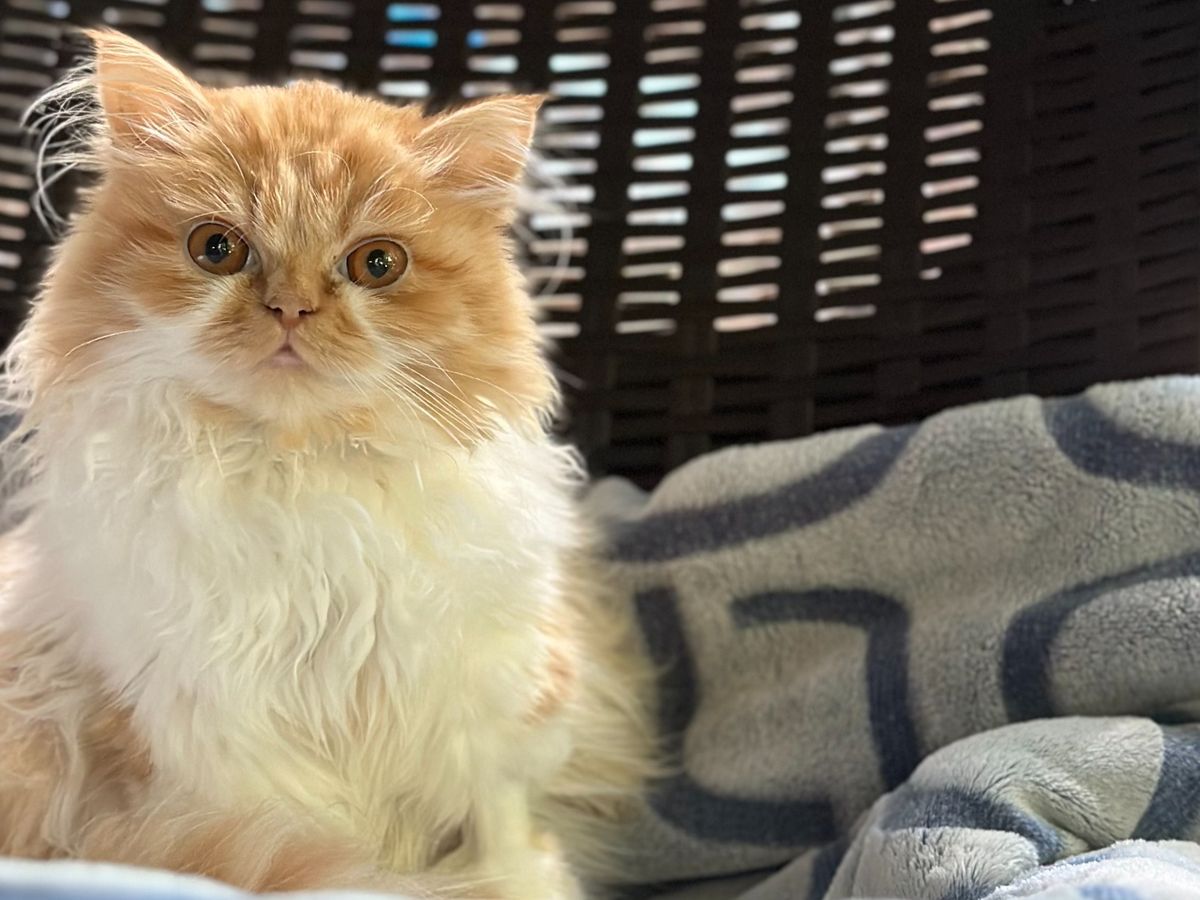
I'm reaching out to you on behalf of my little Persian Hank.
Little Hank Moody is only 5 months old, but in that time she's lived more than most of us. My tiny, existential pussycat. At the beginning of August she started exhibiting symptoms that worried us. Very lethargic, no playing or climbing her favorite posts, no attacks on the pesky red laser. Soft stool, morning vomiting. A bloated abdomen, despite being treated for worms. And a newly developed heart murmur.
She underwent several tests immediately: blood test, stool test, and testing of the abdominal fluid. All test came back as mysterious as her symptoms appeared. Extremely anemic. No sign of a serious infection. No kitty Leukemia. First thoughts by my vet, maybe she has FIP (a feline coronavirus that mutates into a cat killer with all her symptoms). She went to see a specialist in Marin where she was further tested for FIP and given a blood transfusion to help her anemia. While all tests came back negative, nothing else was rising to the forefront as an answer. Her body was still making everything she needed to fight, but we couldn't tell where her red blood cells were going, because it wasn't back into her blood stream.
As a safe way to diagnose FIP, we began the very painful process of treatment, where we administered injections everyday at home. If she got better, we had our answer. Rolling into week three of treatment she showed some signs of improvement, but not where she needed to be. Her distended belly was still hanging around and so was her unwillingness to play. We went to another specialist. Finally, we got the ultrasound we were hoping for. Results showed us that the underlying issue was even more rare than we could have expected.
After almost two months of fighting, Hank has been diagnosed with Intrahepatic Arteriovenous (AV) Fistula. It is an extremely rare congenital condition in cats where passages develop between liver arteries and veins. Symptoms were spot on: lethargy, vomiting, weight loss, abdominal swelling. It was a miracle she was still alive; she is a miracle everyday.
The specialist informed me of the two options, only one felt realistic to him at the time, which would be to put her down. The specialist said there are surgical ways to treat her condition, but only a handful of people on the planet knew how to do it. One of that handful currently practices at UC Davis Animal Hospital. What are the odds of that? Perhaps he could help? But who knew how quickly we could get in contact, what the cost would be, and if it could even be done. I asked him to reach out anyway.
The doctor at UC Davis contacted me immediately, he had recently done the surgery successfully last week! While every path we have gone down led us somewhere worse, it was like a door was always open to find our way out.
For those that are interested in the specifics, I'll add them at the bottom.. But needless to say I have no intention to give up on Hank, and we're setting up a plan with UC Davis to get her the care she needs ASAP. My only hurdle is the cost (doctor estimated between $10,000-$14,500), of which I'm willing to bare, but I know how many of you have been following Hank's health closely and are excited to help. Call me crazy, but there is nothing in the world I would rather devote my time and money to rather than helping Hank.
She's no longer a kitten to me, more like a tiny little buddha teaching me resilience in her own way. Anyone lucky enough to spend time with her falls in love quickly.
All we are hoping for is the beauty of science and some extra love from the universe to push this sweet fur baby back onto the right track. She is the light of my life without a doubt.
Please help us save little Hank, and share with anyone you think would be willing in their own way. The power of numbers is what I'm hoping for here.
Still fighting,
Hannah & Hank
Further description from the doctor of her conditions and approach for treatment: "Hank likely has a complex blood vessel (vascular) abnormality in the abdomen. It is likely a connection between an artery and a vein, which is something that generally should not happen, but we can see this occur congenitally (most common version in cats). The usual term for this abnormality is an arteriovenous malformation or AVM. The way that we often treat these AVMs is with an arterial approach (ie. go into the artery with catheters and wires) and place a substance within the artery to cause blockage and/or a venous approach (usually involves tying off a vein or veins after a surgical approach to the veins).
In order to determine the next direction to go, we do a specialized CT scan that has particular vascular stages to allow us to characterize the abnormalities as well as we can. Usually from that scan, we can get an idea of whether we should move forward with a direct angiogram. An angiogram is a dye study that is performed by going into the arteries that may be supplying this AVM and use that to map the flow of blood. From there, we can decide if we should do just an arterial approach or both an arterial and venous approach.
Outcome is really tough to predict in these cases. I would estimate that about 75% of the cases that I have treated are able to be improved dramatically; it is dependent on whether the blood supply is able to be “re-routed” and no other abnormal blood vessels develop. Sometimes it can take multiple procedures, but usually we try to aim to treat it as aggressively as possible during the first procedure."