
If you know me, you probably know that asking for help publicly is not something that comes naturally to me.
I’ve always been someone who tries to figure things out on my own, push through difficult situations, and show up for others when they need support. Being the person who listens, helps problem-solve, or sits beside someone when life gets hard has always felt natural to me.
Which is probably why writing something like this feels uncomfortable. Sharing personal struggles publicly isn’t something I usually do; I tend to keep moving forward quietly and try to figure things out as I go.
But right now my health situation has become too complex and unpredictable to carry alone.
If you feel comfortable sharing this, it truly helps more people understand what I’m navigating right now.
TLDR / Quick Summary
I’m currently in the middle of a complicated medical diagnostic process involving possible connective tissue and autonomic disorders.
Over the next several months (and for the past eight months), I’ve been traveling frequently between South Carolina, Mississippi, and North Carolina for specialists, imaging, and testing while waiting for genetic results.
Because my symptoms are unpredictable and often limit how much I can work, the biggest challenge right now has become the travel and logistical costs of continuing care.
This fundraiser is intended to help cover 4–5 months of medical travel, testing copays, insurance payments, and basic living expenses while I focus on getting answers and stabilizing my health.
The Long Version
Over the past several years, doctors have been trying to piece together a complicated medical picture involving multiple systems in my body. As this process has unfolded, I’ve started realizing that many things I’ve dealt with throughout my life were probably connected all along.
Looking back, I’ve had multi-system medical issues going all the way back to childhood, many of which were never fully explained at the time. For years they were treated as isolated problems rather than pieces of a larger pattern.
Unfortunately, many of those symptoms were misdiagnosed, minimized, or brushed aside, which allowed the underlying problems to progress before anyone began looking at the bigger picture.
Right now I’m working with several specialists to try to piece together what exactly is going on.
My bloodwork has shown persistent thrombocytosis and leukocytosis for years, even when metabolic, vitamin, inflammation, and autoimmune panels come back normal. A bone marrow biopsy raised more questions than answers, and specialists are still working to determine what may be causing those abnormalities.
At the same time, my genetic counselor strongly suspect a connective tissue disorder, and I am currently waiting on genetic testing (WES) results to determine whether I have classical Ehlers-Danlos syndrome. That diagnosis could potentially explain many of the joint instability, chronic pain, and systemic issues I’ve been experiencing.
I’m also scheduled to see a cardiologist to evaluate possible autonomic nervous system dysfunction, including whether conditions like POTS may be contributing to symptoms such as dizziness, heart-rate spikes, and fatigue.
Because of the abnormal blood counts, part of my diagnostic process has also involved hematology specialists. My hematologist in Mississippi has been involved in monitoring these issues and coordinating testing.
In addition, I traveled to Atrium Health in North Carolina, where I was initially evaluated by an MDS specialist and then referred to a myeloproliferative neoplasm (MPN) specialist for further evaluation. I am currently on the waitlist to be seen by that specialist.
Another medical issue that has come up alongside everything else is an abdominal hernia.
In January I met with a general surgeon for a consultation regarding one large abdominal hernia and two smaller abdominal hernias. Because the main hernia has grown fairly large, the repair will need to be done as an open incisional surgery rather than laparoscopically.
Before scheduling surgery, my surgeon wants clearance from my hematologist in Mississippi due to the ongoing investigation into my blood counts. They want to rule out any bleeding or clotting risks before moving forward.
I have an appointment with my hematologist on March 18, 2026 to screen for bleeding and clotting risks. If everything looks safe from a hematology standpoint, the plan will be to move forward with scheduling surgery.
The hernia itself has become large enough that it now impacts daily movement and comfort, so repairing it is something I would like to address once it’s safe to do so.
Recovery from that surgery is expected to be around eight weeks.
What daily life looks like right now
One of the hardest parts of this situation is that my disability is dynamic and unpredictable.
Many of these conditions are also largely invisible, which can make it difficult for others to understand how much they affect daily life. From the outside I may look fine on some days, but internally my body is constantly managing pain, fatigue, and instability & more.
Some days I can function relatively close to normal. But even on my better days, my baseline still isn’t what most people would consider typical.
I live with chronic pain throughout my body that moves, flares, and changes intensity.
Along with the pain, I also deal with symptoms like:
• chronic physical fatigue
• brain fatigue and brain fog
• memory lapses
• dizziness
• heart-rate spikes (tachycardia)
• migraines and head pressure
• light sensitivity
• gastrointestinal issues
My joints are unstable and prone to sprains, and wounds tend to heal more slowly than they should. Certain joints, especially my feet, ankles, knees, fingers, and neck/shoulders, are frequently affected.
On flare days, even basic daily tasks can become difficult, and managing symptoms becomes its own kind of full-time effort.
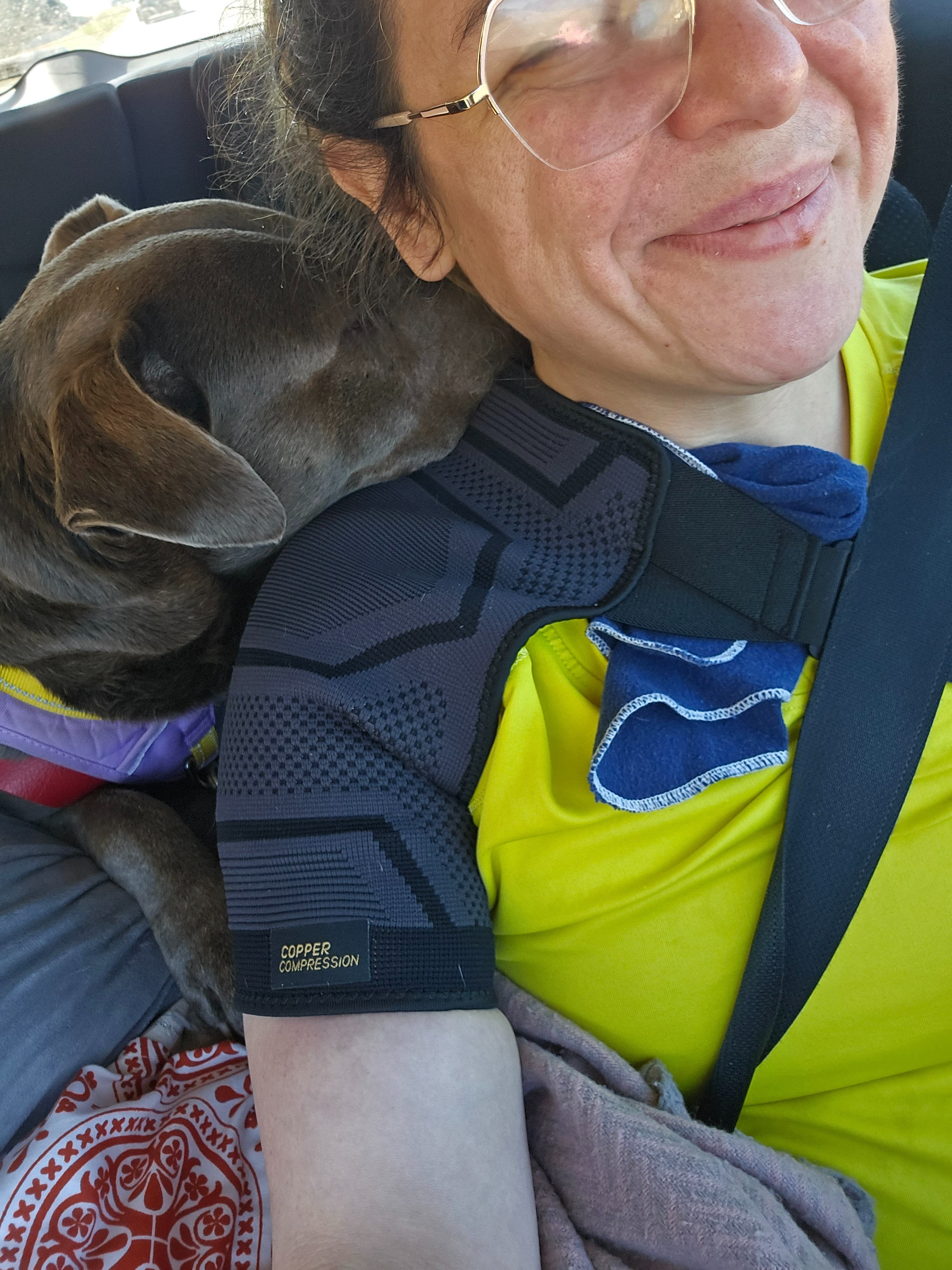
Recently, one issue in particular has become significantly worse. Over the last three and a half months, my cervical spine and shoulders have become a major source of pain and functional limitation.
I’m currently seeing a neurosurgeon for this issue and have a follow-up appointment this Tuesday, March 17, 2026
Because of this, even basic work has become difficult.
Right now I do Spark (Walmart delivery) when my body allows it, but lately that has been extremely limited—sometimes only a few orders per week.
Work, school, and what changed
Before my health became this medically complex, I spent about two and a half years working in community outreach on the Mississippi Gulf Coast, helping connect residents with resources and support.
When that contract ended in January 2025, what initially felt uncertain ended up being somewhat of a blessing given how complicated my health situation has become.
During 2025 I focused on school full-time and completed my Associate’s degree with a focus in Social Work, with the goal of continuing on toward a bachelor’s degree in Social Work.
For now, I’ve decided to take a two-semester break from school so I can focus on stabilizing my health and navigating this diagnostic process.
I’m fortunate to have decent health insurance, so the medical care itself isn’t the biggest expense.
Why the financial strain has gotten so heavy
The biggest challenge right now isn’t the medical care itself; it’s the logistics required to access it.
Many of my appointments require travel to Mississippi, where the doctor who has been most attentive to my case practices.
Because different parts of my medical workup involve different specialists, my care currently spans multiple states.
I also travel to North Carolina for hematology appointments with specialists at Atrium Health.
Because my appointments are spread across multiple states, I move between my sister’s home in Vancleave, Mississippi and my mom’s home in Graniteville, South Carolina, depending on where my next appointments are scheduled.
Altogether, these appointments require roughly between 1,600 and 2,400 miles of travel each month.
Between fuel, vehicle wear, and basic living expenses during weeks when symptoms limit work, the financial pressure has become significant.
I’m still doing everything I can to keep moving forward through this process, but the reality is that getting the care I need right now requires more travel, time, and energy than I can realistically sustain on my own.
Right now the biggest financial pressures include:
• travel costs for medical appointments across multiple states
• fuel and vehicle wear from thousands of miles each month
• health insurance premiums and diagnostic testing copays
• basic living expenses during weeks when symptoms limit work
• my car payment, since reliable transportation is essential for reaching these specialists
Another piece of life right now
My husband, Tyler, is also recovering from a major medical issue.
He had a hip replacement on March 10, 2026 due to avascular necrosis, and after he heals from this surgery he will eventually need the other hip replaced as well.
During his recovery he is staying with family in North Alabama, where he has additional support while he heals.
So both of us are navigating significant medical limitations at the same time.
What support over the next few months will help cover
Starting this fundraiser was not an easy decision for me. But right now my health has essentially become a full-time job, and I realized I can’t realistically manage everything on my own while also pursuing answers and treatment.
This fundraiser is intended to help support me over the next four to five months while I continue the diagnostic process and begin treatment once clearer answers are in place.
The goal reflects the estimated cost of travel and vehicle costs, testing and insurance costs, and basic living expenses during this period.
My hope during this time is to stabilize my health, learn how to manage whatever chronic conditions are ultimately confirmed, and put myself in the best position possible to move forward.
Contributions will help support:
• travel to specialist appointments
• diagnostic imaging and testing copays
• fuel and vehicle costs required for medical travel
• medications and treatments related to connective tissue disorders, POTS, or MCAS if confirmed
• health insurance payments
• basic living expenses during periods when symptoms limit my ability to work
Thank you for taking the time to read my story and for caring about what I’m navigating right now.
If you feel moved to help, whether by donating or simply sharing this, it truly means more than I can express.
I’m hopeful that with the right answers and treatment plan, this difficult chapter will eventually become something I can look back on rather than be living inside of.
Until then, I’m taking things one appointment, one mile, and one step at a time.
Organizer