
Organized by OurBrainBank, Inc.
Beyond the Tumor: Fund Patient-Powered GBM Research
A determination that continues
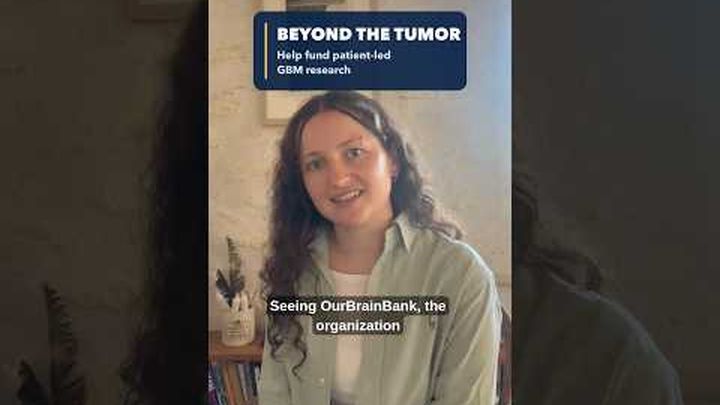
OurBrainBank began with Jessica Morris, a person living with glioblastoma who refused to accept that patients should remain on the margins of research and decisions about their own care.
Her daughter, Tess Pilkington, sees that determination living on in every patient and care partner who shares an experience, asks the next question, and helps make the glioblastoma community impossible to ignore.
As Tess explains in the video above, Jessica “would not settle for the GBM statistics, nor would she ever stop trying to turn this horrible disease from terminal to treatable.”
Today, OurBrainBank carries that work forward—powered by patients.
Why Beyond the Tumor matters
We are not waiting for the cure—not because we have stopped hoping for it, but because people living with glioblastoma need better information, support, access, and evidence now.
The backbone of standard GBM care has changed little in roughly two decades. Meanwhile, every diagnosis creates urgent questions that a scan cannot answer:
Was molecular testing completed, and what do the results mean? Should we seek a second opinion? Are clinical trials or other treatment options available? What are the likely benefits, burdens, and alternatives? How will this plan affect daily function and quality of life? When should the plan be revisited with the care team? Can supportive or palliative care begin alongside treatment?
Families should not need insider knowledge, money, time, or extraordinary emotional stamina simply to learn which questions to ask.
Beyond the Tumor is about closing the space between medicine and the person living through it.
What patients and care partners told us
OurDataBank was built from a nationwide survey of 525 people affected by glioblastoma. Their responses revealed significant gaps in communication, information, and access:
- 54% said a second opinion was never discussed.
- 34% were not informed about tumor testing, and 36% did not receive mutational testing.
- 66% were never offered a clinical trial.
- 69% were not informed about tissue storage.
- 40% reported no discussion of tumor treating fields. Among those offered this treatment, 29% experienced access barriers.
Education and financial hardship were also associated with differences in access and satisfaction.
These are not isolated stories. They are evidence of communication, navigation, and equity gaps that patient-powered research can make visible.
Our goal is to help give the next family the map too many families never received: better questions, clearer information, stronger support, and a meaningful voice in decisions about their care.
What comes next: DANO-GBM
OurDataBank showed us where people are being missed. DANO-GBM will help us understand more of what happens between appointments.
Through DANO-GBM , OurBrainBank and its research collaborators plan to study social isolation, social support, mobility, and quality of life over time.
Participants answer brief questions and may securely contribute smartphone-derived patterns related to mobility and social connection. DANO does not collect the content of calls or text messages and does not record audio.
DANO is observational research, not a treatment. Its purpose is to build evidence about experiences and needs that have too often gone unmeasured—evidence that can help inform better support and future interventions.
Why we are asking the community to help
OurBrainBank prepared an application for an NBTS funding opportunity, but the application was withdrawn before scientific review because our team could not satisfy the Principal Investigator eligibility requirements: an MD or PhD and qualifying prior grant history.
This was an administrative eligibility barrier. It was not a scientific rejection of DANO, and it was not the loss of an awarded grant. But it left a real funding gap.
The need did not disappear because one funding route closed.
Beyond the Tumor is our community’s route forward: a $200,000 campaign to help advance the approved DANO work and sustain the patient-powered research, practical resources, and advocacy surrounding it.
What your donation helps make possible
Your gift supports OurBrainBank’s patient-powered research and programs, including DANO-GBM. It helps us:
- Bring patient and care partner priorities into research.
- Collect and analyze evidence about life with GBM between appointments.
- Translate findings into practical information, resources, and advocacy.
- Share evidence with researchers, clinicians, advocates, and the wider community.
- Keep quality of life, access, communication, and equity visible alongside the search for better treatments.
Please donate to Beyond the Tumor and share this fundraiser with someone who may want to take part.
A donation of any size—and every person who passes this campaign on—helps strengthen the community behind patient-powered glioblastoma research.
Together, we can keep working to move glioblastoma from terminal to treatable while improving the experience of people living with it today.
- J
1 supporter
 guidestar.org/profile/82-2307232