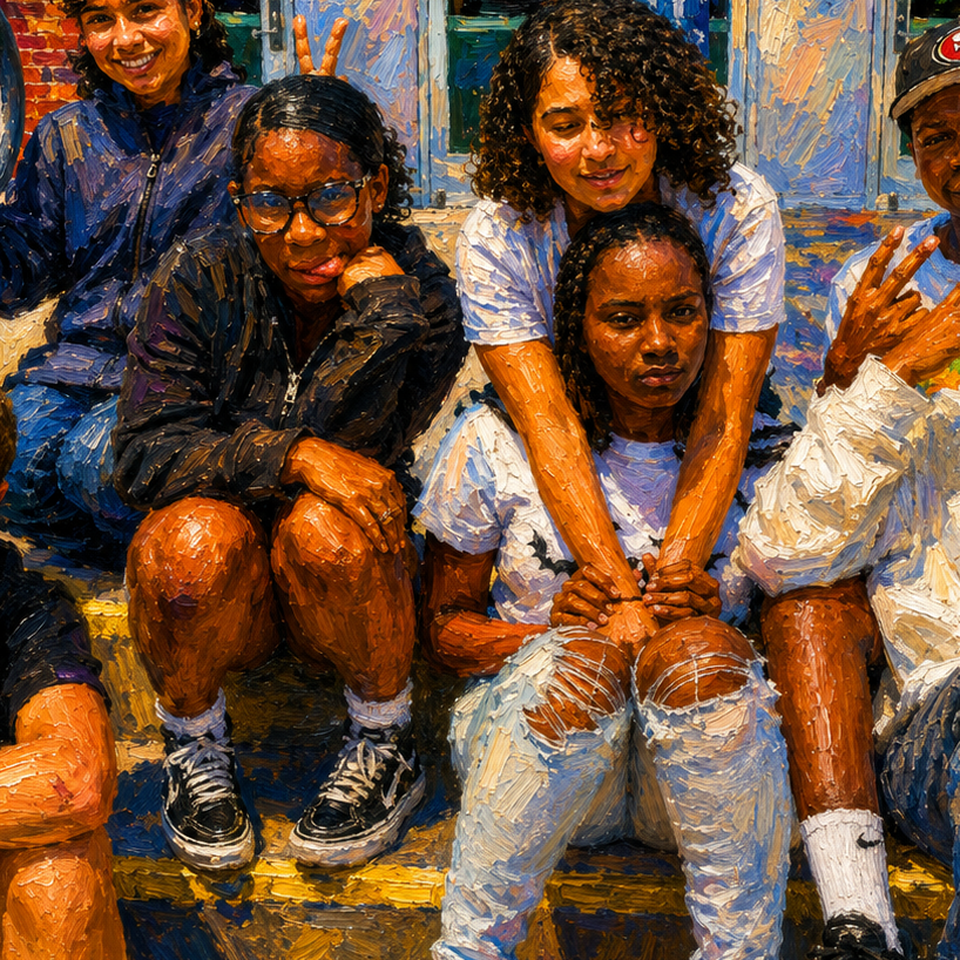
The Garden Project is an interdisciplinary student-led initiative that uses literacy, art, culture, environmental learning, and community engagement to transform both a school environment and the way children understand their own capacity to create change. Our students live and learn within a community where they may encounter poverty, housing instability, violence, substance abuse, environmental neglect, and other realities that children should never be asked to carry alone. Yet those realities are not the whole story of their community, and they are certainly not the whole story of our children.
We began with a simple challenge: look again.
Students walked through their community to a local park, a place some had associated with fear, and were asked to search deliberately for beauty. They discovered flowers, trees, color, light, texture, nature, architecture, laughter, one another, and signs of life they had previously passed without noticing. The assignment was not to pretend hardship did not exist. It was to discover that hardship does not have the right to become the only narrative of a place or a people. We began calling this “finding beauty in the cracks”
The flower emerging through concrete, life appearing where one might have expected only deterioration, possibility existing beside struggle.
That experience became the foundation for something tangible. Students are designing, building, painting, and planting gardens at their school. Their planters and artwork will reflect their cultures, identities, histories, families, school, and community. Through English Language Arts, students develop descriptive language, metaphor, symbolism, perspective, point of view, vocabulary, observation, evidence-based reasoning, reflection, and narrative writing. Through Social Studies, they examine culture, community, place, identity, history, citizenship, and responsibility. Through art and design, abstract ideas become physical objects. Through gardening and environmental study, students experience stewardship, patience, interdependence, growth, and the extraordinary reality that something cared for can become something different.
Why Investment Matters
An investment in this project is not simply an investment in soil, lumber, paint, plants, tools, or garden beds. It is an investment in authorship.
Children spend much of their lives inhabiting environments designed by adults. This project gives them an opportunity to become designers of an environment themselves. Instead of being told what their community is, they investigate it. Instead of merely describing what is missing, they imagine what could exist. Instead of seeing a neglected space and learning that neglect is permanent, they participate in creating evidence that transformation is possible.
The project also refuses the false choice between emotional well-being and academic rigor. Students are expected to observe carefully, acquire and apply sophisticated language, support interpretations with evidence, analyze perspective, communicate ideas orally and in writing, collaborate, revise, design, create, and reflect. Different students may require different pathways into that work, but the intellectual destination remains rigorous.
For children whose educational journeys have not always provided consistent academic foundations, experiences like these can reconnect learning to something immediate and consequential. A word such as symbolism becomes more than a definition on a worksheet when a student must decide what a flower growing through concrete symbolizes. Perspective becomes tangible when students realize that the park did not necessarily change; the way they looked at it did. Evidence becomes meaningful when they must point to the specific thing they observed that changed their thinking. Literacy becomes a way of interpreting their own world.
What Investors Help Us Build
Funding allows us to provide durable planters and construction materials; soil, plants, seeds, and gardening equipment; paint and visual-art supplies; culturally representative design materials; books and literacy resources; documentation and student portfolios; environmental and community-learning experiences; and the resources necessary to preserve and expand the project year after year.
But the return on that investment cannot be measured only by the number of garden beds constructed.
We can measure student vocabulary and writing. We can assess comprehension, observation, evidence-based reasoning, and reflection. We can document student artwork and oral presentations. We can examine changes in students’ perceptions of their school and community. We can measure participation, collaboration, ownership, and the ability to articulate the meaning behind what they created.
And there will be another kind of evidence growing outside the classroom.
There will be a garden.
There will be children’s artwork where there was once an empty surface. There will be color where students saw gray. There will be something alive that requires their stewardship. And every child who participated will be able to stand before it and say:
I helped imagine this.
I helped build this.
I helped make something beautiful here.
We are not asking investors merely to help us beautify a school.
We are asking them to help children experience themselves as people capable of creating beauty, meaning, culture, knowledge, and change.
A garden begins with a seed. So does literacy. So does confidence. So does community transformation.
Sometimes the most important lesson a child can learn from watching something grow is this:
The conditions in which something begins do not have to determine what it can become.