- J
- S
I hate swimming.
I hate getting wet.
I hate being cold.
But I also hate losing.
I joined a swimming club at 11, because I was so terrible at swimming that I couldn’t finish my swim lessons. I had a tantrum every weekend. Even at an early age, my ears gave me grief. Surgeries, albeit routine, were always around the corner. I distinctly remember not being able to collect the big black brick off the swimming pool floor because of the pain in my ears. I failed my badges – gutting for a kid. Swimming wasn’t the best sport to choose.
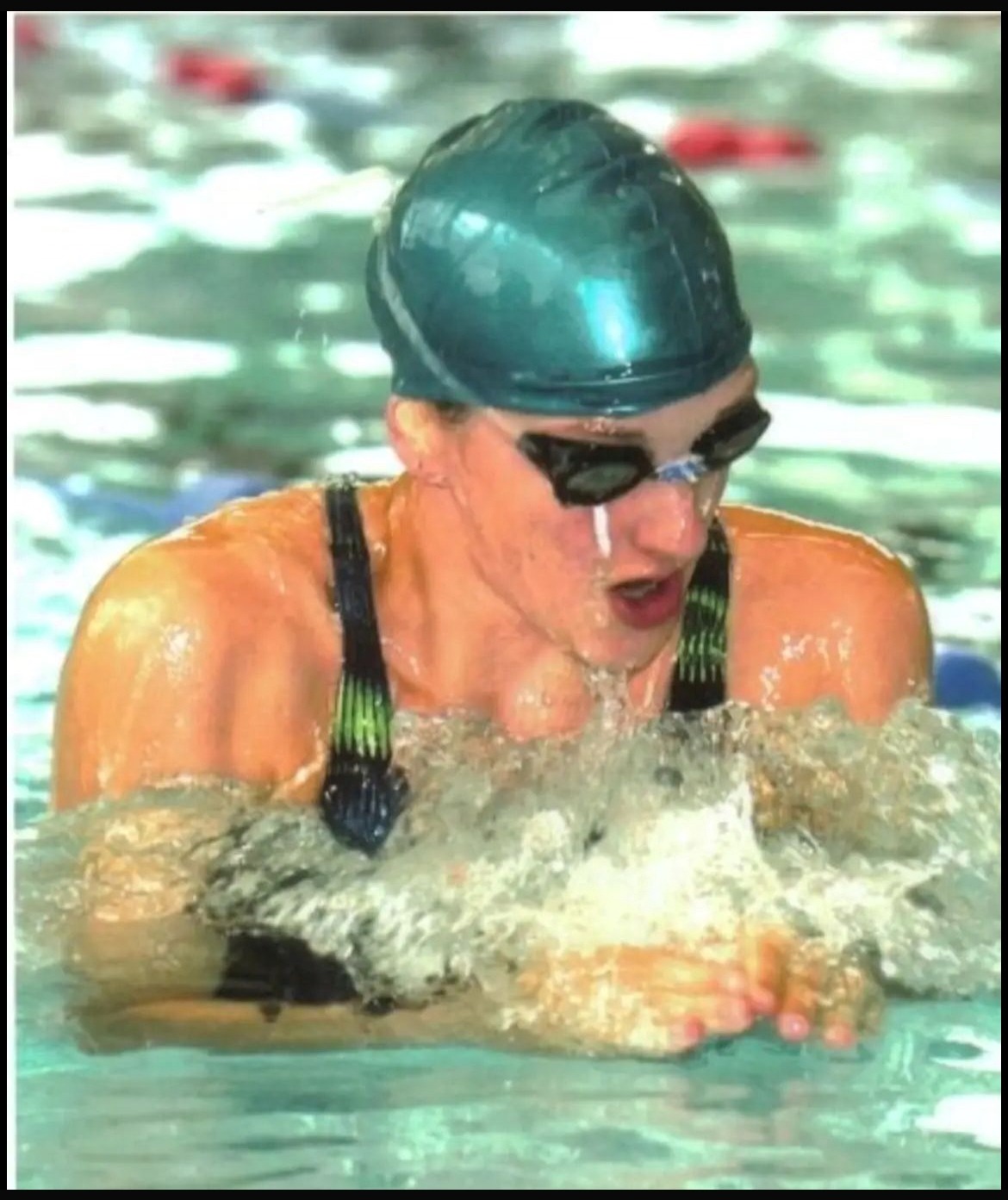
At the club, my swimming got better. I started to win - small things - one length when nobody else was trying. Catching up to the person in front. Leading the lane. Every small win led to wanting more. I became addicted. I qualified for my first British Age Group Nationals aged 14 just as a new coach moved to the Hampshire Club I trained at. I came last. I hated that. In 1998, aged 15, I won the Hampshire County Championship 200m Breaststroke in a record time that still stands 27 years later – the oldest record still standing. I went on to become British Age Group champion that same year. My coach took a job in Cambridge and, having finished my GCSE’s, he suggested I go with him. A week after my 16th birthday, I left home - I was dreaming of big things and he convinced me that there was nowhere local for me to move to.
I got selected for several international events and was the only female to bring home a gold medal at the 6-Nations event in Lake Como. But I was stressed out with a new swim team, new school, new friends, no family, no transport, and nobody to talk to. On arrival to the World School Games in China in 1998, I pulled my hamstring. With no team physio, I was forced to swim my 200m breaststroke; it wasn’t the done thing to travel that far and not race for your country, despite an injury. I came a respectable 4th considering the pain. But I should have won. This was the start of an ongoing struggle with injury, and ongoing surgeries for my ears which were now more complicated. I had ear surgery in the winter of 1998, a ‘big’ surgery to remove the rotting bones from my left ear, and an attempt to skin graft my ear drum. I was told I would be out of the pool for two weeks. It kept me out of the pool for six months. The continual infections were so severe that the perforations were re-introduced. On it went. My hearing deteriorated in my left ear due to the removal of the bones. Despite being told countless times that swimming wasn’t helping, I desperately wanted a tattoo of the Olympic rings. I wouldn’t, couldn’t, stop. When I was unable to swim, I was still showing up, and doing land training on poolside instead, even at 5am. When I did get wet, I had no choice but to train with a snorkel – I couldn’t, and still can’t, get my ears wet. The holes in my ear drums are so large that water goes straight through and gets trapped in the inner ear. It is painful to tumble, painful to dive, painful to push off underwater due to sensitivity to pressure changes, and most days, painful to turn my head to breathe. My snorkel was, and still is, my best friend. I am renowned for having a ‘bad’ start because I cannot go deep underwater. And I struggle with perception of depth due to my issues with pressure.
Cambridge was difficult. I swam for six years and never swam a personal best time. It was mentally tough. But I went there to train, and I continued to do that, believing in my dreams. In 2002 I won all 18 events in the Cambridgeshire County Championships. They introduced a skins event to ‘give others a chance’ so the following year I made sure I won every event again, including the skins. I hate being told I cannot do something. In 2003 I missed the European Championships in the 200IM by 0.03seconds. Whilst this was incredibly frustrating, it made me focus even more on the 2004 Olympic Trials. And finally, after seven years, my luck felt like it was changing. Having just finished my degree, I convinced my parents to fund me for one more year whilst I did a master’s degree and could continue training; I had been a ‘lottery funded’ athlete being ranked in the top 25 in the world, but £100 a month didn’t even cover my petrol. Two weeks before these trials however, I was knocked over by a bus. I was devastated. In my mind, I had failed. I got a job and couldn’t train full time anymore due to pressures of working in a hospital. So, I walked away from the sport and barely set foot in a pool for 17 years.
In the time since finishing swimming, my hearing got so bad that I had a BAHA implanted. Things settled down. My ears, like me, like being dry. I never talk about swimming. I hate swimming.
I found a job that I love. I have had a great career in Cardiac Physiology. But despite the BAHA, my hearing continued to deteriorate, and it became an increasing struggle to hear my colleagues due to face masks and working in a theatre environment where I can’t lip read or see people’s faces to understand that they are talking. Infections were fewer but lasted longer and required multiple antibiotics to resolve. I didn’t ever disclose my hearing issues at interviews, too scared for judgement and failure. And nobody ever asked. I hate losing. On New Years Day in 2023, I woke up and I could hear nothing. I had lost the hearing, suddenly, in my better ear. And it coincided with my first episode of vertigo. I was falling over and feeling like the room was spinning but had assumed I was just ill. I hadn’t heard of vertigo. I had no idea that sudden hearing loss was a medical emergency. One Consultant I worked with helped me find a private specialist due to the waiting list in the public sector. Despite steroids, the hearing in my better ear never fully recovered. Out of nowhere, what once was a struggle, became a living nightmare. Work felt impossible. But this Consultant proved to me that I could find a way to get by – that hearing loss doesn’t have to mean job loss. I started to use the small microphone of my BAHA to enable me to hear him directly through my implant into my skull via Bluetooth. Only at this point did I feel I could disclose the hearing issue to my employers. But whilst work was tolerable, I didn’t recognise myself anymore. Socialising became embarrassing; just a blur of noise that sounded like my head was in a washing machine. I had lost myself, lost my self-esteem, and was devastated that without my implant, I could now no longer hear my small children’s voices, or hear them crying at night.
Bumping into an old swim coach from the neighbouring town of my childhood club, he convinced me to use swimming to help myself. To deal with ‘life’. Hours and hours watching that black line of the pool provides me with solace, as it had done during my childhood at times of difficulty. Some peace when life gets tough. I promise you though, I really do still hate swimming. This ‘new’ coach helped me get back in the pool – to find myself, to have a release, and to perhaps, maybe, dream about rectifying my failings in other ways. He helps me believe, and see, that I can still achieve.
I have a six-hour round trip to work most days. I work long days in a hospital with no set finish time. I work in a different country to the one I reside in. I have two small children. I therefore cannot join a club and train normally. So, I must train alongside members of the public with the sessions my UK coach sends me. I do what I can, without his feedback, when work commitments allow. It’s not the 70km a week in a pool I once did. He reminds me that quality is better than quantity.
When he encouraged me to compete again, I couldn’t quite believe the time on the scoreboard. But, each time I race, it mostly continues to be this way. 17 years of no training at all, and I am setting some lifetime bests. In 2024 I was shocked to realise that I had qualified for the Irish Olympic Trials. A realisation that it was exactly 20 years prior that I swam in my last Olympic Trials, and failed, was difficult to deal with; I had convinced myself that 20 years later, I was a granny by age, and a granny in the pool. I couldn’t get past the wonder of what might have been and the envy for those who had a chance of that tattoo. I am racing people half my age. Young enough to be my children. I feel like I don’t belong. I am training in the public – they get angry at me, and I get angry at them. I feel like I don’t belong. When I race, I rely on a flashing light strobe to know when the starting gun has gone. Sometimes there is no strobe. Sometimes the strobe does not stretch the distance to the lane that I’ve been allocated. I cannot hear the stewards checking the entries for the race. I cannot hear the whistle to get on the block, and I cannot hear the whistle to stand down off the block when there are technical issues. I remain in the starting position like a fool. It is a distraction. An embarrassment. I don’t belong.
I had surgery for a second BAHA in December 2024. Complications of that surgery left me with hearing loss so bad that I now qualify as a deaf swimmer. And the ongoing episodes of vertigo mean that I often train or race through dizziness or nausea, and struggle to walk or swim in a straight line. Sometimes I fear I may fall off the starting block. I obviously cannot hear – conversations between anything more than one person I simply cannot follow. I don’t like loud places. I don’t like open spaces where sound lingers, and clarity is lost. I don’t like conferences. I don’t like social interactions. I don’t like ordering a coffee or food – I cannot predict the questions I may get asked and the noise and location of coffee machines mean I cannot lip read. And I struggle to lip read people with accents who move their lips differently when they speak. I feel like I don’t belong. I cannot be coached normally because I cannot hear without my implants. I get angry that I can’t hear instruction and my coach, on a rare 1:1, is normally too far away in a public balcony for me to lip read. For this reason, I absolutely hate telephone calls; I can’t see any lips.
I didn’t know deaf sport existed. A coach in NI whose club I race out of, sent me a link to the Deaflympics and nominated me. My initial response was negative – it isn’t the real Olympics. It’s not the one I wanted. The testing requirements for eligibility are difficult to receive. A sadness runs through me. There it is on paper – eligible for deaf sport. Six months after the surgery that rendered me ‘deaf’, I have yet to come to terms with it. I would rather hear my children’s voices than swim in an Olympic Games.
A rightful virtual slap from the NI coach reminded me that I need to see things as an opportunity, not a door closing. It has caused me to become quite passionate about deaf sport. I am an adult, and relatively comfortable in my own skin. Isolated but happy enough. Imagine you have a child or teenager that is hard of hearing, or deaf, attempting to enjoy and participate in sport at any level with their peers, or even trying to exist socially with their peers. They cannot hear the whistle of a referee and instead continue to run towards scoring a goal. They can’t hear the starting gun and are left standing. Imagine watching the humiliation, the embarrassment, the confusion of being unable to follow what’s happened, and feeling their isolation. Life as a ‘deaf’ person is isolating enough. Few people ‘speak’ the language and only those close to you, or another hard of hearing person, truly understand the difficulties. They shout at you, they get annoyed that you have a habit of shouting, they assume you are rude because you ignore them or misunderstand what they have said, or they move their lips in a way that is so unnatural that you can’t help but want to tell them that you are deaf, not stupid.
The Deaflympics, and deaf athletes, receive no funding from the UK government. Ironically, we are not part of the Paralympics. The Deaflympics is celebrating its centenary this year. It is older than the Paralympics and the second largest multi-sport event after the Olympics. With the games in Tokyo, all athletes are being asked to raise close to £5000 to fund themselves. We, and the supporting coaches and team, must purchase our own team kit for the privilege of representing our country at a Major Games. Imagine being asked to compete, only to find that you must pay for everything. There is no celebration for the medal winners on their return. No thank you. No well done. No publicity. Again, as a working adult, this is one thing. But imagine being a parent who is unable to provide their child with such a life changing opportunity or seeing that they continue to be treated differently to the ‘real’ Paralympians.
Going to Tokyo, for me, was never in my game plan. The same way that reaching the 2024 Olympic Trials ever was. For me it was, and continues to be, about trying to face my demons. Trying to find peace, acceptance, and realise just how good I was, and how good I may still be. When I returned to the sport, I set out to attempt to achieve a Masters World Record. I am on the way. I hold 14 Irish Masters Records. I broke a British Masters Record in October before my surgery and missed the European Record by 0.6second. I’ve only been back in the pool two years and am not a full-time athlete. I want more. Tokyo, I hope, will give me the opportunity to feel that I belong. Somewhere. That I am understood, and that being different does not mean being less.
I want to show my children that you can still dream. That I may be on average, 20 years older than the other participants, but am on a par with them. That I’m likely the only Mum competing. That I am not out of place, and even if I feel it, that it shouldn’t stop me dreaming. I hope to teach them that life is full of setbacks, that your road to success will rarely be straight, but that success is not a result of a dream but a result of hard work. That you can dare to dream, whatever your age. And that your path may lead to other opportunities to the one you had originally set out.
The risk remains – if I don’t achieve this goal, or don’t medal at the Deaflympics as my times suggest I may, will I once again render myself a failure? Possibly. Probably. But it’s a process. Another step on my winding road to what I hope to achieve. If it gives another parent inspiration to participate in competitive sport despite their age, if it gives my children inspiration to never give up, or if it raises the profile of Deaf Sports, then that’s still an achievement. I’ll take that.
Organizer
Nicola Hutchison
Organizer