Dear Friends, Family, and Kind Supporters,
I am moving to Greece in August, and I need your help.
My situation has changed dramatically, and I am preparing for my future with limited resources. Many of you are aware that I contracted Long Covid in 2020. This spiraled into five continuous years of diagnostics without leading to a cure. As a result, I have multiple painful disabling conditions, including ME/CFS (Myalgic Encephalomyelitis/Chronic Fatigue Syndrome), Secondary Mitochondrial Dysfunction, and Langerhans Cell Histiocytosis (LCH) - a rare multisystem disease.
Despite working with some of the best hospitals in the US, I remain permanently disabled with no treatment in sight and no ability to earn a living. The debilitation is enormous. Even brief standing, short conversation, or taking a shower can lead to collapse or days of recovery. Working within a limited energy envelope, every outing or visit must be carefully timed and planned. Life is a constant balancing act: a negotiation of limits that, most frustratingly, cannot include exertion or exercise. I know I’m not alone in the world of chronic illness.
This is a crushing situation, and recently my partner of 11 years has decided to move on from our relationship. I have lost my home, stability, and the homestead animals, gardens, and mountainslice I cherished. I’ve worked with the State of VT investigating my living options; the lack of options or ability to fund even the most basic lifestyle is shocking. My health needs and routines remain primary, and it is clear that my disability income will not sustain me here in Vermont.
The bottom line: I can adapt. I’m making a deliberate shift toward an area where the cost of living is significantly lower, and healthcare is available and affordable. I am relocating to Eretria, Greece, where I can afford to live modestly on my small fixed income. It has taken time, research, and a great deal of courage to arrive at this decision and share it openly.
I have an incredible immigration lawyer, a trustworthy landlord, and a kind and knowledgeable Langerhans specialist in Athens who understands the complexity of my case and will be part of my long-term care team.
This is the part of my journey where I need to ask for your help covering the costs of this transition, including essential transition expenses, flights, visa and Immigration fees, home basics just to get started, and other relocation logistics. My goal is self-sufficiency once resettled. I have limited savings held in a Certificate of Deposit to meet visa requirements and to preserve the ability to renew my residency.
Though I continue to grieve the life I lost, I am building something affordable and sustainable. Every bit of support, in any amount, truly makes a difference. And if you’re not in a place to give financially, sharing this letter, or simply offering encouraging words also means the world to me.
If you’d like to stay updated, please let me know- I’d be happy to add you to my email list. If you’d like to read more about this huge transition in my life and why I chose Greece, there is a more detailed letter below.
With love and gratitude,
Emma
Why I Choose Greece
In May/June of this year, I took a month-long exploratory trip: I visited Attica/southeast of Athens, Aegina, Kalamata, Kefalonia, and spent time in Thessaloniki. Some of these places were not handicap accessible or too far from amenities or medical care. Others, though beautiful and healing, had too many stairs, or too little parking to be practical. Eventually, I found Eretria, a small historic town on Evia (Euboea), Greece’s second-largest island.
Eretria offers a quieter, more local atmosphere; yes, it’s an island—but one that’s connected to the mainland by bridge, making it a practical and welcoming choice for my needs. Eretria boasts 300 days of healing sunshine a year, yet still has seasons - think Carolinas meets dry Mediterranean climate. This is not a luxury destination nor a major tourist area, but a working, local town that is safe and welcoming, kind to English speakers (though I’m slowly learning Greek), and grounded in thousands of years of community values that deeply resonate with me.
I qualify for a Financially Independent Persons (FIP) Permit—a visa commonly accessed by retired persons—which allows me to live there legally and within my means.
I’ve signed a year lease in a quiet area of town, close to the calm Euboean gulf, on a small, accessible, ground-floor home with a large fenced yard full of fruit trees and chickens—ideal for my health needs and the well-being of my two companions, Sage and her best cat friend and sister, The Cheat. The barbeque space and a second bedroom are ready for visitors (!)
All of my doctors—local, Dartmouth, and Boston alike—have agreed and endorsed this move. After years of testing, consultation, and diagnostics, they gave me the extra confidence I needed to make this bold choice for myself. Though the decline and progression is clear, they agree I am stable enough to relocate and fully support my effort to seek a better quality of life. I’ll continue managing symptoms through pacing, supplements, acupuncture, and integrative naturopathic medicine, while keeping in touch with providers back home.
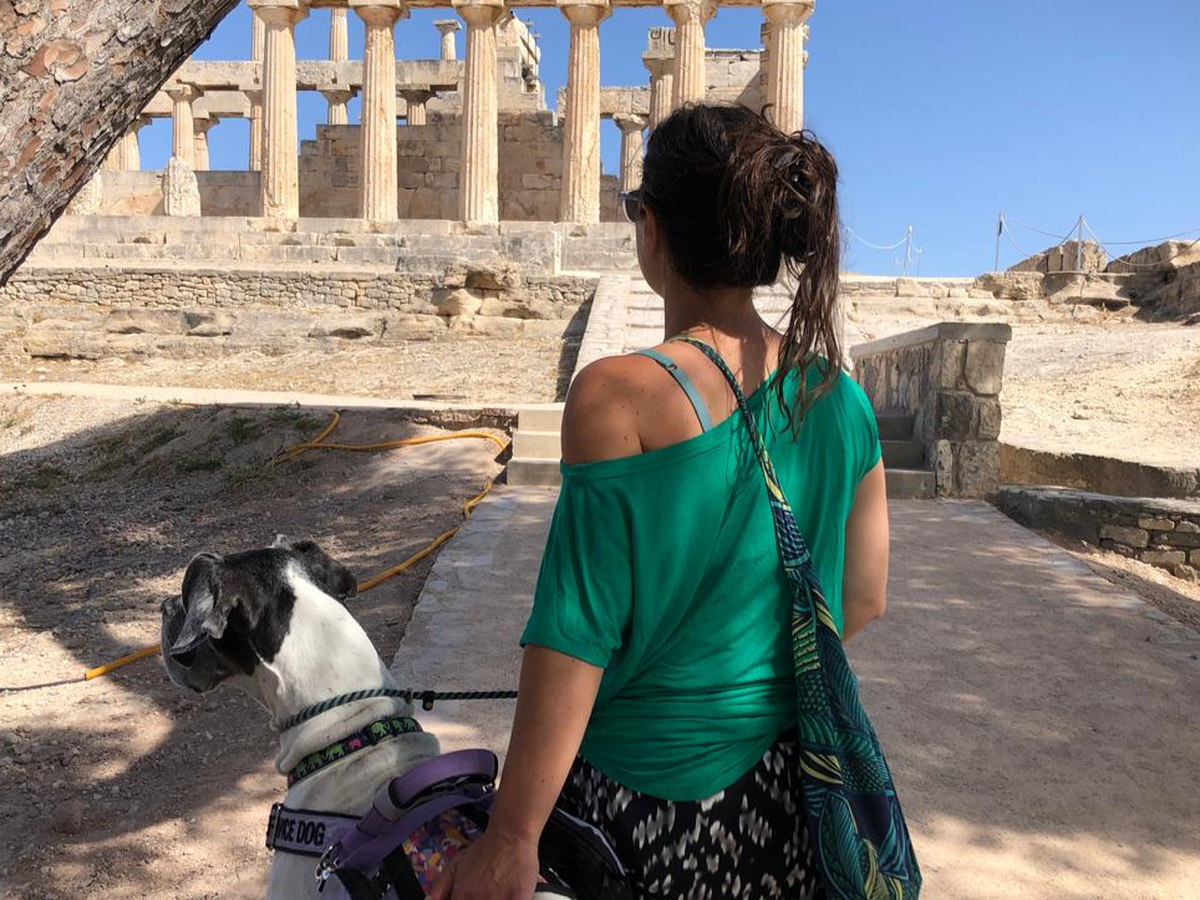
Sage (dog), The Cheat (cat) and Me
Sage has been by my side through it all. She provides safety and comfort daily. My cat, The Cheat, is a calming, joyful presence, and best of friends with Sage. They are my family, routine, and emotional anchor —and they are coming with me.
I’ve adapted the best I know how through years of unrelenting health struggles, the deaths of loved ones, and the slow unraveling of what once felt steady. Even Sage, my constant companion, has adapted remarkably. She now provides essential support with mobility, stability, and wheelchair pulling when needed, helping me navigate daily life with chronic illness more safely and with empowering independence. She began intuitively assisting on stairs, and picked up the wheelchair support beautifully. We worked extensively with a trainer to develop her new responsibilities as a service animal. The recent trip to Greece with her was incredibly successful; Sage performed diligently and reliably, and she even received a special invitation from the captain to visit the cockpit on our long-haul flight.
The three of us are resilient-together
How I Got Here
Before COVID, I was a person in constant motion- working, building a career, nurturing relationships, dancing, planning for a future that felt possible. In March of 2020, I was one of the unlucky many who got sick in the first wave. What began as "just a virus" evolved into a disabling, relentless series of symptoms, rare chronic illnesses, and years of struggle. For nearly 5 years I’ve traveled regularly to Boston and Dartmouth for extensive testing and specialist evaluations to confirm my diagnoses.
The Virus that Changed Everything
Invasive cardiopulmonary exercise tests revealed a musculoskeletal limitation at the cellular level— Secondary Mitochondrial Dysfunction is a direct result of endothelial damage from the virus, which has impaired my body’s ability to extract oxygen and produce cellular energy (ATP), creating a toxic, exhaustion-inducing state. The active, capable life I once knew has given way to one of strict limitations—where even basic tasks require advanced planning and recovery.
The viral infection also triggered the very rare Langerhans Cell Histiocytosis, confirmed via lung biopsies, which later moved into my bone—making it even rarer. Thankfully, it is currently non-active. Muscle biopsies, typically used to evaluate mitochondrial function in research, revealed small fiber neuropathy (now common in long COVID), as well as a benign but rare form of non-Langerhans histiocytosis, called reticulohistiocytoma. This further underscores the complexity and rarity of my case.
A Complex Medical Journey
In 2021, I connected with leading clinicians at Brigham and Women’s Hospital through the NIH-funded RECOVER program. Since then, I’ve contributed to ongoing research at Mass General Brigham and remained under the close care of Dana-Farber Cancer Institute, who described my case as an “extremely rare phenomenon.” These institutions have collaborated closely to coordinate my care, and I also brought on a geneticist to oversee the full diagnostic picture.
The years-long diagnostic process has involved a broad range of fields—neurology, immunology, oncology, hematology, mitochondrial medicine, and many more—with over 20 experts across three major hospital systems, leaving no stone unturned in building a comprehensive care plan.
The virus that has affected millions set my body on a slow, relentless path of decline. My cells are aging rapidly, starved of oxygen: This manifests in profound physical and mental exhaustion, making even gentle exercise or activity impossible without severe setbacks. Clusters of stroke-like symptoms—a distressingly common complication of long COVID— highlight the extensive vascular damage the virus has caused. These symptoms serve as a stark reminder of the serious, systemic impact on circulatory and neurological health. Even an underlying hypermobility connective tissue disorder (hEDS)—once manageable and undiagnosed in a previously strong body—was worsened by the viral assault, further complicating my condition.
Experimental Therapies
In 2022, I traveled to Cyprus to explore experimental Heparin-Induced Extracorporeal LDL Precipitation (HELP) Apheresis Therapy. While we didn’t find a “magic bullet,” I gained access to supportive therapies, potential future options, and confirmation of the vascular support my body requires. That experience could have also suggested that a different climate might positively influence my health—though at the time, a move wasn’t feasible.
What Daily Life Looks Like Now
These illnesses have devastated nearly every aspect of my life: my mobility, income, independence, and capacity to function day-to-day. Life is a constant balancing act: a negotiation of limits that, most frustratingly, cannot include exertion or exercise.
The pain becomes intolerable if I do too much, especially the day after. It’s important to understand that these are not “invisible” to those who live them daily—they are relentless, concrete, and incredibly difficult to manage without accessible care, adequate support, and ongoing research. If I seem okay when you see me, it’s because you’re not seeing the aftermath. I don’t show myself on my bad days.
Emotionally, it’s a daily battle. Wading through uncertainty, never knowing what kind of day I’ll wake up to. I know I’m not alone in the world of chronic illness. It is profoundly difficult to articulate what this feels like unless you’re living it—or happen to be a molecular biologist - shout-out to the scientists doing the work we so desperately need. Sending gratitude to researchers, caregivers, doctors, and those of us in the battle.
Forward Motion
Whether you're here because of wonder, kindness, or because you relate: thank you for walking alongside me.
Your support restores not only my pride and dignity, but also my hope in building a life rooted in meaning, resilience, and self-sufficiency.
With love and gratitude,
Emma